Samudra Manthan Scheme: India's Offshore Energy Push and Net-Zero Goal - UPSC Notes
Balancing an ₹84,084 crore deepwater hydrocarbon push with India's long-term net-zero climate goals.
Aug, 2026
•10 min read
Overview
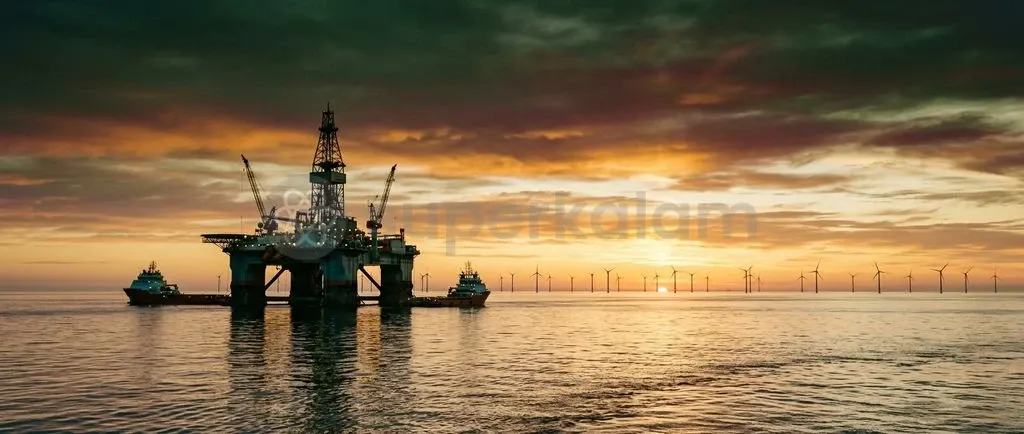
Fig: India's offshore strategy balances deepwater hydrocarbon exploration under Samudra Manthan with ambitious offshore wind expansion in its Exclusive Economic Zone.
The Union Cabinet's approval of the ₹84,084 crore 'Samudra Manthan' National Offshore Exploration Scheme is a strategic macroeconomic hedge to mitigate India's 88.7% crude oil import dependency. It balances immediate fossil-fuel supply security against the long-term transition toward a net-zero emission economy by 2070.
According to PIB releases on the Cabinet decision, the central sector scheme aims to catalyse hydrocarbon reserve accretion exceeding 600 MMTOE across India's marine basins up to FY 2030–31. Achieving sustainable energy security requires coordinating deepwater exploration with the Ministry of New and Renewable Energy's 30 GW offshore wind targets within India's 2.3 million square kilometer Exclusive Economic Zone.
Why in the News: India's Push for Offshore Energy Frontiers
The Ministry of Petroleum and Natural Gas launched the Samudra Manthan initiative to address India's mounting national crude oil import bill.
Key macroeconomic factors driving this offshore push include:
- High import dependency: India's crude oil import reliance reached 88.7% in FY 2025–26, while domestic crude output dropped to 28 million metric tonnes.
- Severe fiscal drain: The nation incurs an annual import outlay of approximately ₹13 lakh crore (around USD 144 billion), leaving the domestic economy vulnerable to international market volatility.
- Opening of restricted zones: Inter-ministerial coordination has cleared previously restricted 'No-Go' offshore zones, making over 99% of restricted EEZ waters—exceeding one million square kilometres—accessible for Exploration and Production (E&P) bidding per PIB reports.
Discuss with SuperKalam
What target amount of hydrocarbon reserve accretion does the Samudra Manthan scheme aim to catalyse by FY 2030–31?
Ask NowUnderstanding Samudra Manthan and India's Deepwater Potential
The Union Cabinet approved the Samudra Manthan National Offshore Exploration Scheme as a Central Sector Scheme with an outlay of ₹84,084 crore up to FY 2030–31.
According to PIB releases, the scheme's primary objective is catalysing reserve accretion of over 600 MMTOE in deepwater and ultra-deepwater maritime blocks.
Key features and frontier discoveries under the initiative include:
- Direct financial support: Provides up to ₹650 crore for every exploratory well drilled in deepwater frontiers, per reports by The Indian Express on 31 July 2026.
- Andaman Basin potential: Directorate General of Hydrocarbons reports published in April 2026 indicate a resource potential of approximately 371 MMTOE in the Andaman offshore region.
- Sri Vijaya Puram-2 discovery: Oil India Limited's exploratory drilling revealed a natural gas discovery with 87% methane content, noted in media interviews with the Andaman and Nicobar Lieutenant Governor on 26 May 2026.
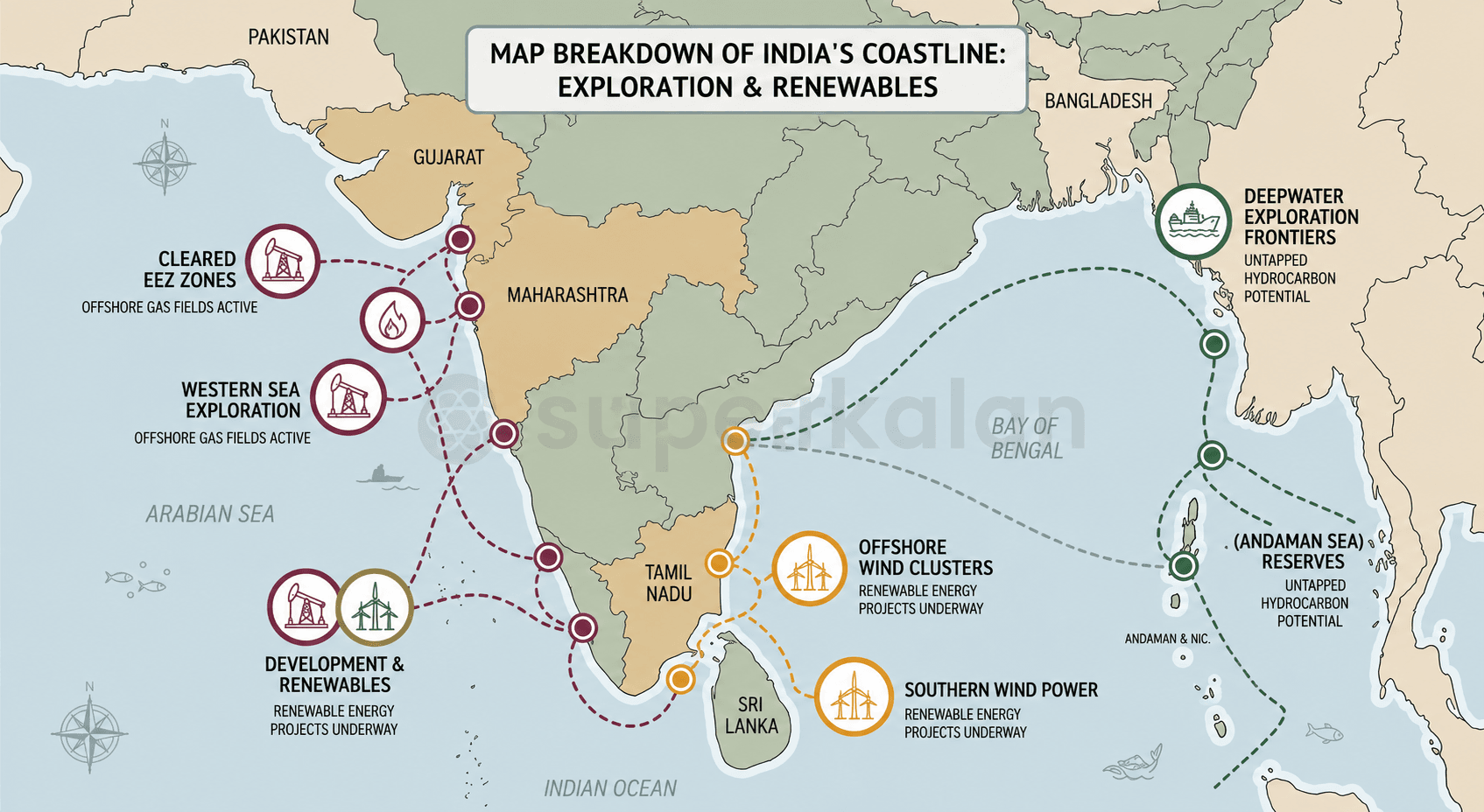
Fig: India's maritime basins contain strategic hydrocarbon potential in deepwater zones like Andaman alongside 70 GW of techno-commercial offshore wind capacity.
Deepwater Hydrocarbons vs. Renewable Energy: A Comparative Framework
India's maritime energy strategy balances deepwater hydrocarbon extraction alongside the Ministry of New and Renewable Energy target of installing 30 GW of offshore wind by 2030.
Deepwater oil and gas drilling provides firm base-load energy to reduce import bills. Meanwhile, marine renewable infrastructure offers zero-carbon power aligned with India's Glasgow climate commitments. Data from the Ministry of New and Renewable Energy estimates India's techno-commercial offshore wind potential at 70 GW, evenly split between Gujarat (36 GW) and Tamil Nadu (35 GW).
A structural comparison reveals how these two maritime tracks differ across regulatory, economic, and environmental metrics:
| Dimension | Deepwater Hydrocarbons (Samudra Manthan) | Offshore Wind Energy (MNRE Strategy) |
Primary Objective | Macroeconomic import substitution & reserve accretion | Grid decarbonisation & zero-emission power generation |
Resource Target | >600 MMTOE reserve accretion by FY 2030–31 | 30 GW installed capacity targeted by 2030 |
Techno-Commercial Potential | Unallocated EEZ basins (>1 million sq km cleared) | 70 GW total (36 GW Gujarat, 35 GW Tamil Nadu) |
Fiscal Support Mechanism | HELP revenue-sharing & reduced royalty slabs | ₹7,453 crore VGF scheme for 1 GW commissioning |
Statutory & Environmental Siting | Category 'A' EIA 2006 & CRZ-I/IV clearance | CRZ clearance & maritime spatial planning |
Primary Ecological Risk | Deepwater blowouts & hydrocarbon oil spills | Avian collision & benthic ecosystem disruption |
Discuss with Superkalam
How does HELP's Revenue Sharing Model improve offshore administrative efficiency?
Ask NowFiscal Incentives and Regulatory Regimes: HELP, OALP, and Beyond
The Hydrocarbon Exploration and Licensing Policy, introduced by the Ministry of Petroleum and Natural Gas, replaced the old profit-sharing mechanism with a Revenue Sharing Model.
Official guidelines state that HELP eliminated tedious cost-auditing delays inherent in the legacy New Exploration Licensing Policy (NELP).
Key regulatory features and fiscal mechanisms across both sectors include:
- Open Acreage Licensing Policy (OALP): Allows operators to submit Expressions of Interest (EoI) for unallocated offshore blocks continuously throughout the year.
- Uniform single licence: Permits exploration of crude oil alongside coal bed methane, shale gas, and gas hydrates under one contract.
- Tiered royalty rates: Deepwater blocks face a 5% royalty rate after a 7-year holiday, while ultra-deepwater blocks enjoy 0% royalty for 7 years followed by 5% thereafter.
- Offshore wind VGF: The Union Cabinet approved a Viability Gap Funding outlay of ₹7,453 crore to support 1 GW of offshore wind projects in Gujarat and Tamil Nadu.
While hydrocarbons rely on revenue-sharing and tax concessions, offshore renewables require direct capital subsidies to lower levelised costs.
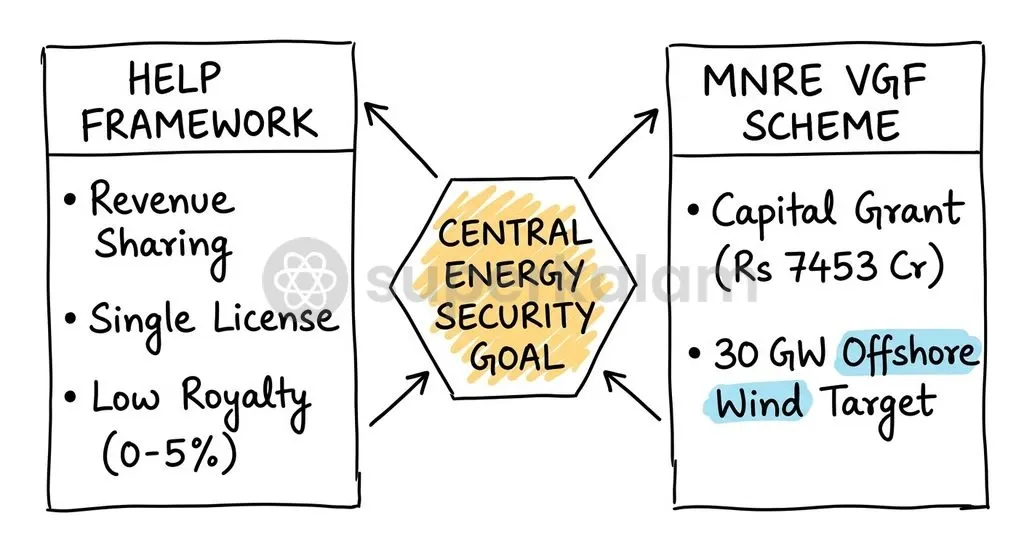
Fig: Regulatory regimes contrast HELP's revenue-sharing and royalty concessions with VGF capital support for offshore renewables.
Environmental and Geopolitical Challenges in the Exclusive Economic Zone
Under the 1982 United Nations Convention on the Law of the Sea, India exercises sovereign rights over the world's 18th largest Exclusive Economic Zone, spanning 2.3 million square kilometers.
Expanding offshore infrastructure across this vast maritime domain introduces severe ecological responsibilities.
Key compliance and disaster response frameworks include:
- Environmental clearances: Mandatory Category 'A' Environmental Clearance under EIA Notification 2006 and Coastal Regulation Zone (CRZ-I/IV) approvals.
- Oil spill response: The Indian Coast Guard coordinates operations under the National Oil Spill Disaster Contingency Plan (NOS-DCP).
- Real-time tracking: INCOIS operates the indigenous Online Oil Spill Advisory (OOSA) system to project marine oil trajectories.
Geopolitically, deepwater activities near frontier regions like the Andaman Sea carry strategic weight. Opening maritime blocks near the Malacca Strait reinforces India's presence in vital Indo-Pacific sea lanes. However, an expanding industrial footprint requires continuous coordination under UNCLOS provisions to safeguard marine biodiversity while asserting sovereign rights.
Discuss with Superkalam
Is investing ₹84,084 crore in deepwater fossil fuel infrastructure justified despite India's Net-Zero 2070 target?
Ask NowThe Road Ahead for India's Offshore Energy Mix
A sustainable maritime energy roadmap requires joint Marine Spatial Planning between the Ministry of Petroleum and Natural Gas and the Ministry of New and Renewable Energy.
Key priorities for integrated offshore development include:
- Spatial coordination: Mapping hydrocarbon blocks alongside wind corridors to optimise ocean space and protect ecological sanctuaries.
- Shared infrastructure: Utilising common supply vessels, bathymetric survey datasets, and port facilities to reduce capital expenditure.
- Fiscal recycling: Reinvesting hydrocarbon royalties into expanding renewable energy grid connectivity to support the 30 GW offshore wind goal while lowering the ₹13 lakh crore import bill.
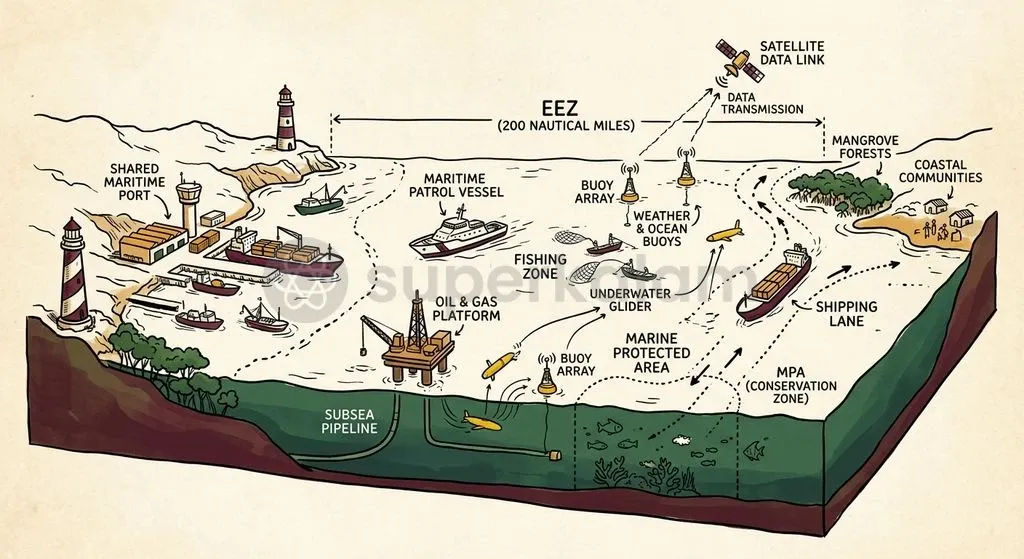
Fig: Integrated Marine Spatial Planning enables co-existence of offshore energy infrastructure while maintaining ecological governance under UNCLOS.
Key Takeaways
- Samudra Manthan Outlay: The Cabinet approved a ₹84,084 crore Central Sector Scheme up to FY 2030–31 to catalyse 600 MMTOE in hydrocarbon reserve accretion.
- Macroeconomic Pressure: India faces an 88.7% crude import reliance (FY 2025–26) and a USD 144 billion annual import bill, driving the opening of 99% of restricted EEZ waters.
- HELP vs VGF Incentives: HELP offers a Revenue Sharing Model, uniform single licensing, and 0% to 5% royalty rates, whereas offshore wind receives ₹7,453 crore in VGF funding.
- Offshore Wind Potential: MNRE targets 30 GW by 2030, supported by an estimated 70 GW potential across Gujarat and Tamil Nadu.
- EEZ & Governance: India manages 2.3 million sq km of EEZ under UNCLOS, enforcing mandatory Category 'A' EIA 2006 clearances, NOS-DCP spill protocols via the Coast Guard, and INCOIS OOSA trajectory modeling.
Mains Question
'The ₹84,084 crore Samudra Manthan scheme represents a strategic macroeconomic hedge against an 88.7% crude oil import reliance, yet it highlights the policy friction between long-term fossil fuel infrastructure expansion and India's Net-Zero 2070 commitment.' Critically examine.
Evaluate NowMultiple Choice Questions
QUESTION 1
Q1. With reference to the 'Samudra Manthan' National Offshore Exploration Scheme, consider the following statements:
- It is a Central Sector Scheme implemented with an outlay of ₹84,084 crore up to FY 2030–31.
- It provides direct financial support of up to ₹650 crore for every exploratory well drilled in deepwater frontiers. 3. It aims to catalyse hydrocarbon reserve accretion exceeding 600 MMTOE across India's marine basins.
Which of the statements given above are correct?
QUESTION 2
Q2. Which exploratory discovery made by Oil India Limited in the Andaman offshore region revealed natural gas with an 87% methane content?
QUESTION 3
Q3. Consider the following statements regarding India's offshore renewable energy targets:
- The Ministry of New and Renewable Energy has estimated India's total techno-commercial offshore wind potential at 70 GW, split between Gujarat and Tamil Nadu.
- The Union Cabinet approved a Viability Gap Funding (VGF) outlay of ₹7,453 crore to support 1 GW of offshore wind projects.
- The Ministry of New and Renewable Energy has set a target of installing 100 GW of offshore wind capacity by 2030.
Which of the statements given above is/are correct?