RTE Section 12(1)(c): Mandate, Legal Battles, and True Inclusion
As states dilute the 25 per cent RTE quota and courts revisit minority exemptions, entry-level access alone fails to ensure genuine classroom equity.
Oct, 2026
•9 min read
Overview
Section 12(1)(c) of the Right of Children to Free and Compulsory Education Act, 2009 mandates non-minority private unaided schools to reserve at least 25 per cent of entry-level seats for children from economically weaker sections and disadvantaged groups. Enacted to enforce the fundamental right to education under Article 21A, the provision attempts to dismantle classroom socio-economic stratification by integrating marginalised students into private educational spaces at state expense.
As of March 2026, entry-level enrolment alone fails to deliver genuine educational equity. Persistent friction over delayed state reimbursements, structural exemptions, and classroom segregation shows that school access without social inclusion reduces a radical constitutional mandate to mere procedural compliance.
Why RTE Section 12(1)(c) Stays in the News
A 27 October 2026 editorial makes the point that matters for UPSC: admission under Section 12(1)(c) of the RTE Act, which seeks to bring over 50 lakh students from weaker sections into private schools, does not by itself ensure social inclusion. Section 12(1)(c) of the Right of Children to Free and Compulsory Education Act, 2009 remains an active flashpoint among state governments, private school managements, and civil society advocates across India. Legal challenges regularly surface in constitutional courts over two primary controversies:
- State-Level Neighbourhood Exemptions: The wider controversy persists after states such as Maharashtra, Karnataka, and Kerala sought to introduce neighbourhood rules exempting private unaided schools from admission allocations if a functional government or aided school exists within a one-kilometre radius, prompting High Court interventions.
- Re-examination of Minority Exemptions: In Anjuman Ishaat-E-Taleem Trust v. State of Maharashtra (2025 INSC 1063), a two-judge Bench of the Supreme Court of India questioned the correctness of a blanket exemption granted earlier to minority institutions and referred the matter to a larger Constitution Bench.
This referral has revived high-stakes debates balancing institutional autonomy under Article 30 against the universal guarantee of fundamental educational rights under Article 21A.
Understanding Section 12(1)(c): Mandate and Eligibility Rules
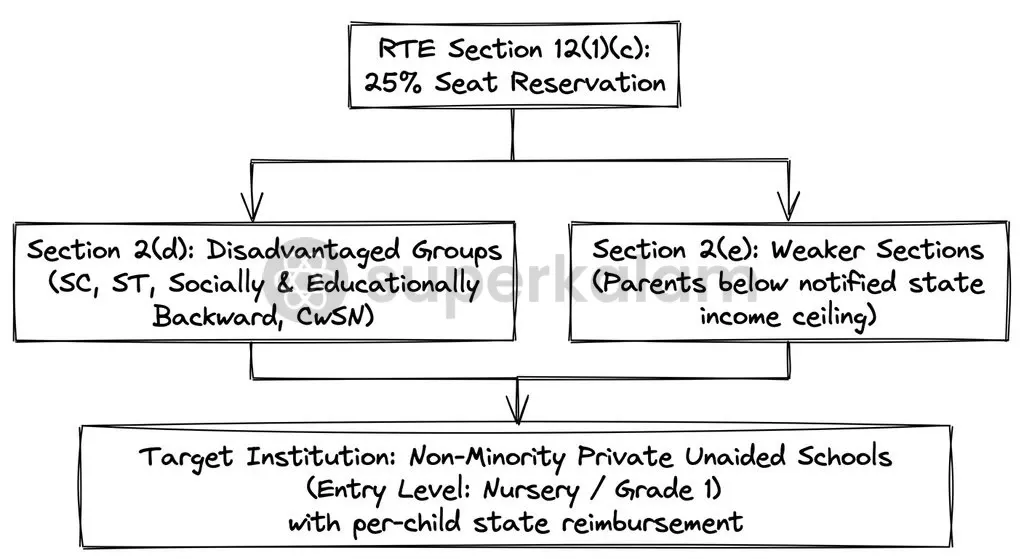
The Right of Children to Free and Compulsory Education Act, 2009 structures its primary inclusion mechanism through Section 12(1)(c) to bridge the divide between public and private education. The statute requires private unaided schools to admit at least 25 per cent of children belonging to weaker sections and disadvantaged groups at the entry level—defined as pre-school nursery or Class 1—and provide free education until the completion of elementary schooling.
Eligibility under the statute is bifurcated into two distinct statutory categories to address historical marginalisation and financial deprivation:
- Disadvantaged Groups (DG): Defined under Section 2(d) of the Act, this category covers children belonging to Scheduled Castes, Scheduled Tribes, and socially and educationally backward classes (SEBC), alongside specific categories notified by state governments.
- Weaker Sections (EWS): Defined under Section 2(e), this category applies to children whose parents or guardians fall below specific annual income ceilings notified by respective state governments.
Despite clear legislative architecture, national implementation remains heavily bottlenecked. Studies by the Central Square Foundation and Indus Action indicated that nationwide seat utilisation under the 25 per cent quota historically hovered between 20 per cent and 30 per cent of total capacity, constrained by complex document verification, rigid online portals, and school-level non-compliance.
Discuss with Superkalam
Recall the two statutory categories eligible for the 25 per cent quota under Sections 2(d) and 2(e) of the RTE Act.
Ask NowConstitutional Foundation and Judicial Validity
Article 21A of the Constitution of India provides the fundamental rights anchor for the legislative architecture of the RTE Act. Inserted via the Constitution (Eighty-sixth Amendment) Act, 2002, Article 21A directs the State to provide free and compulsory education to all children between the ages of 6 and 14 years in such manner as the State may, by law, determine.
Private unaided schools initially resisted the quota, arguing that compulsory non-fee admissions violated their freedom to practise an occupation under Article 19(1)(g). The Supreme Court resolved this challenge in Society for Unaided Private Schools of Rajasthan v. Union of India (2012) 6 SCC 1. The Court upheld the provision, ruling that the State can impose reasonable restrictions under Article 19(6) to advance the egalitarian goals of Article 21A.
The legal framework shifted two years later regarding minority educational institutions. In Pramati Educational and Cultural Trust v. Union of India (2014) 8 SCC 1, a five-judge Constitution Bench held that the RTE Act is ultra vires the Constitution insofar as it applies to minority institutions protected under Article 30(1). This ruling granted a blanket exemption to both aided and unaided minority schools from the 25 per cent quota.
| Legal Dimension | Society for Unaided Private Schools (2012) | Pramati Educational Trust (2014) | Anjuman Ishaat-E-Taleem Trust (2025) |
|---|---|---|---|
| Bench Strength | 3-Judge Bench | 5-Judge Constitution Bench | 2-Judge Division Bench |
| Primary Issue | Validity of Section 12(1)(c) quota | RTE application to minority schools | Re-examination of blanket exemption |
| Core Ruling | Upheld 25% quota under Article 19(6) | Exempted all minority schools via Article 30(1) | Doubted Pramati and referred to larger Bench |
| Current Status | Binding law for non-minority schools | Under formal reconsideration | Pending before a larger Supreme Court Bench |
Discuss with Superkalam
Explain why physical admission under Section 12(1)(c) does not automatically guarantee pedagogical or social integration in private classrooms.
Ask NowThe Financial Bottleneck: State Reimbursements and Private School Friction
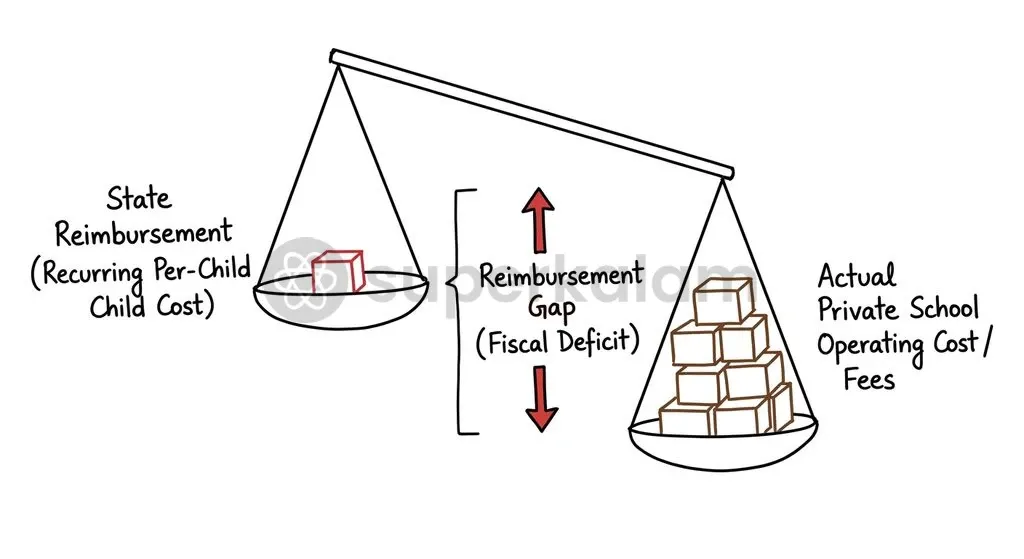
Section 12(2) of the Right of Children to Free and Compulsory Education Act, 2009 establishes the statutory reimbursement mechanism designed to compensate private unaided institutions. Under this section, the State must reimburse schools either to the extent of the per-child expenditure incurred by the State in government schools or the actual tuition fee charged by the private school, whichever is lower.
This framework generates structural friction between private school managements and state education departments across two main pressure points:
- Flawed Cost Calculations: According to an evaluation by the Accountability Initiative and the Vidhi Centre for Legal Policy, state governments frequently exclude administrative overheads, teacher pensions, and capital outlays when computing public per-child expenditure.
- Multi-Year Payment Backlogs: State administrations regularly delay reimbursement disbursements by several years, leaving schools with uncompensated operating shortfalls.
Because state-notified per-child reimbursements sit substantially below real operating costs in urban private schools, managements claim financial deficits. This friction encourages institutions to erect informal barriers, deny admissions, or create artificial procedural hurdles during annual lottery rounds.
Why Physical Admission Does Not Equal Classroom Inclusion
Section 3(2) of the RTE Act explicitly specifies that no child shall be liable to pay any fee or expense that prevents them from pursuing and completing elementary education. Despite this statutory guarantee, physical entry does not automatically translate into social or pedagogical integration inside elite classrooms.
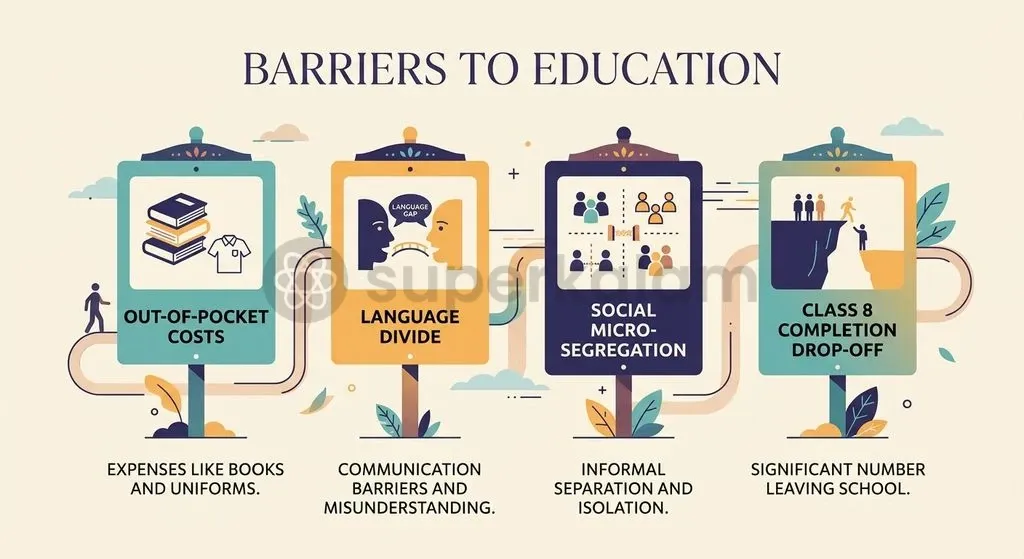
First-generation learners admitted under Section 12(1)(c) encounter significant structural and cultural barriers that perpetuate informal marginalisation:
- Hidden Out-of-Pocket Expenses: While basic tuition is waived, parents face recurring charges for private transport, uniforms, textbooks, co-curricular materials, and school-mandated digital devices, documented as severe deterrents by the National Commission for Protection of Child Rights.
- Micro-Segregation in Classrooms: Field assessments conducted by the IIM Ahmedabad RTE Resource Centre reveal that quota students frequently face separate seating arrangements, exclusion from sports leagues, and public identification during fee collections.
- Pedagogical and Language Divides: Children from vernacular-speaking backgrounds transition into English-medium classrooms without dedicated bridge courses or bilingual teaching assistance, leading to early academic stagnation.
- The Post-Elementary Drop-Out Cliff: Because the statutory protections under Section 2(f) and Section 12(1)(c) end when a student turns 14 or completes Class 8, disadvantaged students face immediate fee liabilities in Class 9, triggering severe transition drop-outs.
Discuss with Superkalam
Suppose an urban private unaided school faces recurring multi-year delays in Section 12(2) reimbursements from the state. How might this financial strain affect its admission process for EWS candidates?
Ask NowEthical Dimension: Dignity, Segregation, and Equal Opportunity
Classroom integration under Section 12(1)(c) engages fundamental ethical questions regarding human dignity, collective welfare, and systemic justice in education. When a child enters an elite private institution only to face institutional condescension, the statutory safeguard fails its purpose. Tokenistic admission without social empathy risks reinforcing feelings of inadequacy and second-class status among young learners.
True educational justice requires transforming school ecosystems across two ethical dimensions:
- Breaking Inter-Generational Bias: Desegregation cannot remain a mere numerical quota imposed by executive decree. Bringing affluent students and disadvantaged peers together in an inclusive environment dismantles social prejudice and humanises diversity.
- Upholding Equal Human Worth: Denying adequate learning support or tolerating subtle social barriers inside the school violates the foundational premise of equal dignity.
Reforming Section 12(1)(c): Practical Steps Toward Real Integration
The National Commission for Protection of Child Rights and State Commissions are statutorily empowered under Section 31 of the RTE Act to monitor safeguards and redress grievances, but their oversight must be backed by institutional reforms. Achieving meaningful inclusion requires systemic interventions that extend beyond admission lotteries.
To convert Section 12(1)(c) from an entry portal into a sustainable model of educational empowerment, policy execution should focus on four actionable priorities:
- Targeted Direct Benefit Transfers (DBT): State departments should provide supplementary DBT allowances directly to eligible families to cover non-tuition costs, including uniforms, books, and daily commuting expenses.
- Transparent Reimbursement Audits: State governments must adopt transparent formulas for calculating per-child public expenditure that account for real institutional overheads, paired with automated public finance portals to eliminate disbursement delays.
- Mandatory Pedagogical Bridge Programmes: Schools must institute bilingual remedial classes, teacher sensitisation workshops, and culturally responsive learning materials to eliminate classroom micro-segregation.
- Extending Statutory RTE Cover to Grade 12: Aligning the RTE Act with the National Education Policy (NEP) 2020—which recommends universalising education from pre-school through Grade 12 (ages 3 to 18)—would dismantle the Class 8 drop-out cliff and guarantee complete secondary education.
Discuss with Superkalam
Compare the judicial reasoning in Society for Unaided Private Schools (2012) with Pramati Educational Trust (2014) regarding fundamental rights under Article 19(1)(g) and Article 30.
Ask NowKey Takeaways
- Statutory Mandate: Section 12(1)(c) of the RTE Act, 2009 requires non-minority private unaided schools to reserve at least 25 per cent of entry seats for children from weaker sections and disadvantaged groups.
- Constitutional Validity: The Supreme Court upheld Section 12(1)(c) in Society for Unaided Private Schools (2012) as a valid restriction under Article 19(6) to advance Article 21A, while Pramati (2014) granted a blanket exemption to minority schools under Article 30(1).
- Judicial Referral: In Anjuman Ishaat-E-Taleem Trust (2025 INSC 1063), the Supreme Court doubted the correctness of Pramati and referred the minority exemption question to a larger Bench.
- Financial Strains: Section 12(2) reimbursements face continuous delays and calculation disputes, leading private managements to resist admissions and erect informal entry barriers.
- Inclusion Deficits: High auxiliary expenses, classroom micro-segregation, absence of bridge education, and the Class 8 drop-out cliff undermine the transformative intent of the law.
Mains Question
"Physical entry does not automatically translate into social or pedagogical integration inside elite classrooms." In the light of this statement, critically analyse the micro-structural and institutional impediments that hinder genuine inclusion under Section 12(1)(c) of the RTE Act, 2009. (10 Marks)
Evaluate NowMains Question
The constitutional balancing between fundamental rights under Article 21A and minority institutional autonomy under Article 30 has witnessed evolving judicial interpretations from Society for Unaided Private Schools to Anjuman Ishaat-E-Taleem Trust. Elucidate the judicial trajectory and evaluate the operational challenges plaguing the reimbursement framework under Section 12(2) of the RTE Act. (15 Marks)
Evaluate NowPractice MCQs
QUESTION 1
With reference to the Right of Children to Free and Compulsory Education (RTE) Act, 2009, consider the following statements:
- Section 12(1)(c) mandates private unaided schools to reserve at least 25 per cent of seats at the entry level for weaker sections and disadvantaged groups.
- In Pramati Educational and Cultural Trust v. Union of India (2014), a Constitution Bench upheld that minority institutions are strictly bound by the Section 12(1)(c) quota under Article 21A.
- The statutory reimbursement to private unaided schools under Section 12(2) is calculated as the per-child expenditure incurred by the State in government schools or the actual tuition fee of the private school, whichever is lower. Which of the statements given above are correct?
QUESTION 2
Consider the following statements regarding the categories eligible under the Right to Education Act, 2009:
- 'Disadvantaged Groups' (DG) under Section 2(d) include Scheduled Castes, Scheduled Tribes, and socially and educationally backward classes.
- 'Weaker Sections' (EWS) under Section 2(e) are defined exclusively through central uniform income cut-offs notified by the Union Ministry of Education.
- Section 3(2) prohibits charging any fee or expense that would prevent a child from pursuing and completing elementary education. Which of the statements given above is/are correct?
QUESTION 3
Consider the following statements regarding judicial determinations surrounding Section 12(1)(c) of the RTE Act:
- In Society for Unaided Private Schools of Rajasthan v. Union of India (2012), the Supreme Court ruled that the 25 per cent quota acts as a reasonable restriction under Article 19(6).
- In Anjuman Ishaat-E-Taleem Trust v. State of Maharashtra (2025), a Division Bench of the Supreme Court doubted the correctness of the blanket exemption for minority schools and referred it to a larger Bench.
- Several High Courts intervened when states sought to introduce rules exempting private schools if a functional public school existed within a one-kilometre radius. Which of the statements given above are correct?
QUESTION 4
According to research findings cited by the Accountability Initiative and the Vidhi Centre for Legal Policy, which of the following is a key deficiency in state reimbursement mechanisms under Section 12(2) of the RTE Act?
QUESTION 5
Consider the following statements regarding the implementation and scope of RTE Section 12(1)(c):
- Studies by the Central Square Foundation and Indus Action indicated that nationwide seat utilisation under the quota historically remained between 20 per cent and 30 per cent.
- Statutory protections under Section 12(1)(c) mandate free education in private unaided schools through the completion of higher secondary education (Class 12). Which of the statements given above is/are correct?
Discuss with Superkalam
Weigh the constitutional balance between protecting minority institutional autonomy under Article 30(1) and guaranteeing universal access to elementary education under Article 21A.
Ask Now