RoDTEP and RELIEF Schemes: India's WTO-Compliant Export Strategy
RoDTEP refunds embedded taxes on exports till 31 Dec 2026, while RELIEF cushions freight and insurance shocks from West Asia.
Oct, 2026
•7 min read
Overview
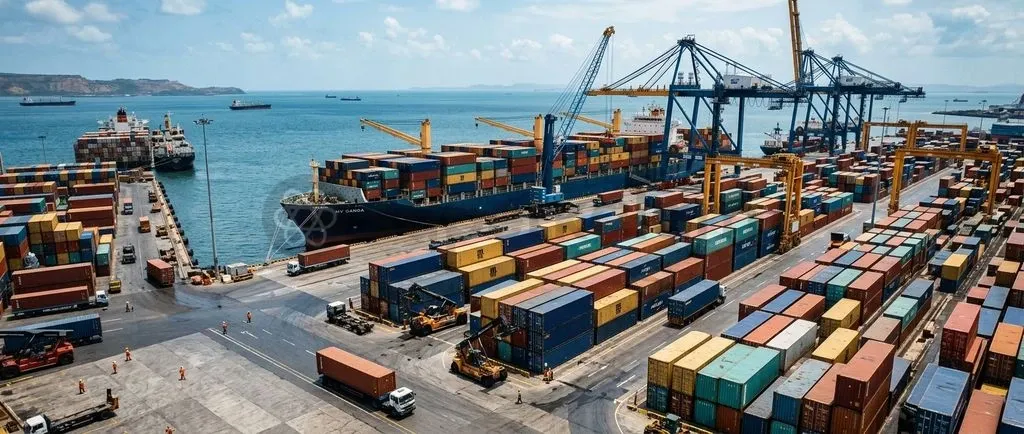
India has rebuilt its export architecture around compliance and liquidity. The new framework pairs the RoDTEP scheme for tax remissions with the RELIEF initiative for credit risk management. Together, they align Indian exports with World Trade Organization rules while neutralising un-rebated domestic taxes.
The Directorate General of Foreign Trade (DGFT) and the Ministry of Commerce and Industry steered this shift under the Foreign Trade Policy 2023. By replacing direct cash incentives with indirect tax remission and export credit guarantees, India protects price competitiveness without triggering international trade disputes.
Why in the News?
The DGFT notified the extension of the RoDTEP Scheme up to 31 December 2026 under Notification No. 41/2026-27. As of October 2026, the Department of Commerce also expanded Component II of the RELIEF initiative to protect exporters from maritime disruptions in West Asia.
According to the DGFT, the RoDTEP extension covers Domestic Tariff Area (DTA) units, Advance Authorisation holders, Special Economic Zone (SEZ) units, and Export Oriented Units (EOUs). The Commerce Ministry structured RELIEF to cap insurance premia at baseline rates, maintaining cargo flow through volatile shipping lanes.
Why India's Export Strategy Needed a Fresh Approach
Indian exporters long depended on direct financial grants to offset heavy freight and compliance costs. The Foreign Trade Policy 2023 broke with this past, establishing an ecosystem-based strategy anchored in district export hubs and trade facilitation.
Two structural pressures forced this change:
- Multilateral invalidation: Legacy export subsidies repeatedly lost legal challenges at the WTO.
- Supply-chain exposure: Geopolitical shocks demanded institutionalised risk mitigation rather than emergency cash grants.
Modern trade competitiveness turns on domestic cost neutralisation rather than state subsidies. When embedded local levies go un-refunded, Indian exporters essentially export domestic taxes. That un-rebated tax burden drives up final prices in contested global markets.
Discuss with Superkalam
Identify the specific WTO ASCM articles that India's legacy export incentive schemes were found to have violated in the DS541 dispute panel ruling.
Ask NowMoving Away from Direct Subsidies: The Core WTO Problem
A WTO dispute panel dismantled India's legacy incentives in dispute DS541 (India – Export Related Measures). On 31 October 2019, the panel held that several Indian export programmes violated Articles 3.1(a) and 3.2 of the Agreement on Subsidies and Countervailing Measures (ASCM).
According to the WTO Dispute Settlement Panel Report (WT/DS541/R), India had crossed the per-capita income threshold under Annex VII(b) of the ASCM. Consequently, schemes conditioning payouts on export performance became prohibited subsidies under international trade law.
| ASCM Classification | Legal Scope | Relevant ASCM Provision |
|---|---|---|
| Legally Prohibited | Subsidies contingent upon export performance | Article 3.1(a) |
| Legally Permissible | Remission of prior-stage cumulative indirect taxes on inputs consumed | Annex II & III |
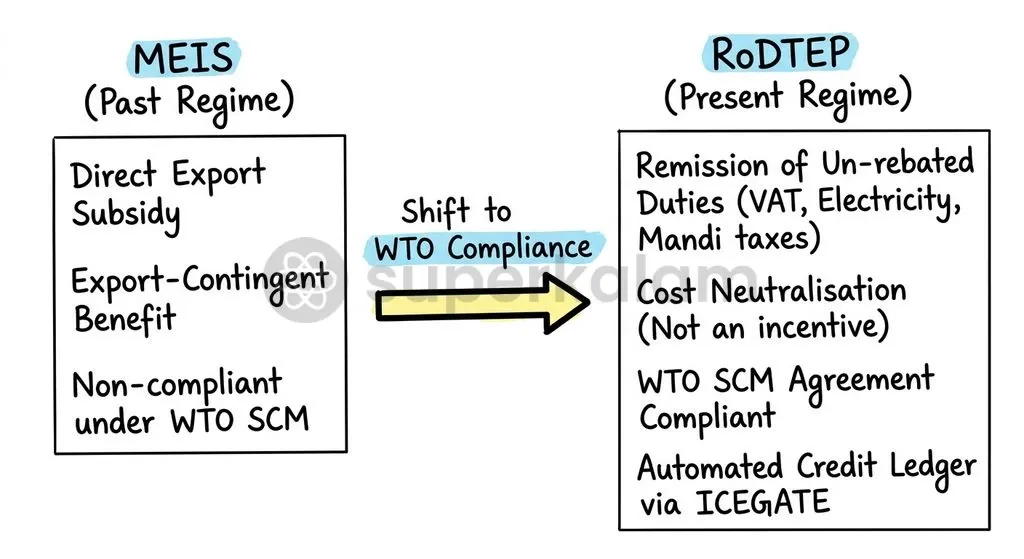
The panel found that duty credit scrips under the Merchandise Exports from India Scheme (MEIS) constituted direct government revenue foregone. Because MEIS granted a flat percentage on free-on-board (FOB) value without calculating actual taxes paid on inputs, it breached WTO rules.
Discuss with Superkalam
Explain in your own words the difference between a prohibited export subsidy and a permissible tax remission under the ASCM.
Ask NowPillar 1: RoDTEP and the Logic of Tax Remission
The RoDTEP scheme follows the standard trade principle that goods should be exported, not taxes. Administered by the DGFT, RoDTEP refunds un-creditable central and state duties that bypass the Goods and Services Tax (GST) net.
The mechanism uses a documented audit trail to verify that remissions do not exceed taxes paid:
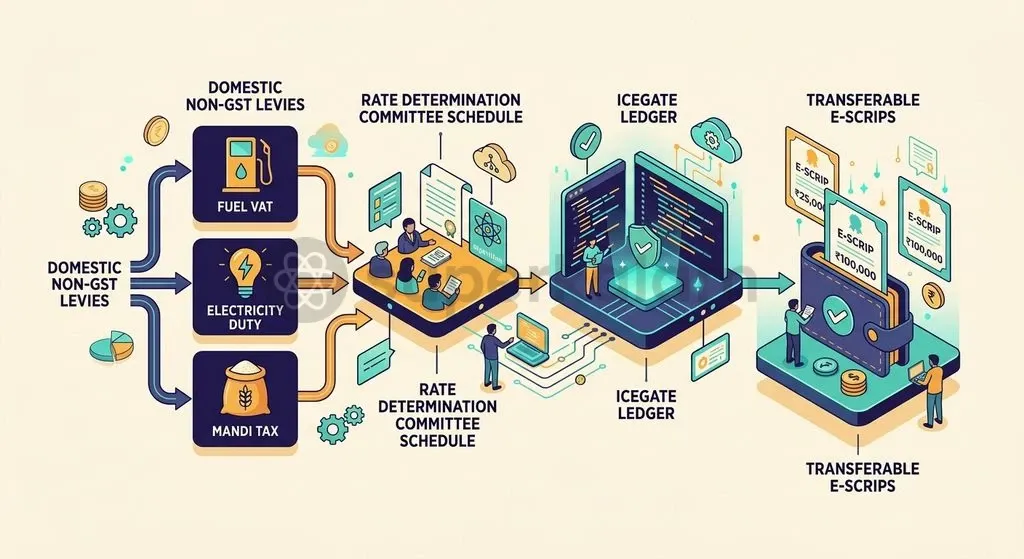
- The RoDTEP Rate Determination Committee sets input-output tax incidence schedules across tariff lines.
- The system calculates cumulative indirect levies, including electricity duties, fuel VAT, and local mandi cesses.
- Exporters receive benefits as transferable electronic duty credit scrips on the ICEGATE ledger managed by the Central Board of Indirect Taxes and Customs (CBIC).
Under DGFT Notification No. 41/2026-27, RoDTEP maintains unchanged rates and value caps under Appendix 4R and 4RE through 31 December 2026. This certainty allows manufacturers in both domestic tariff areas and export zones to plan long-term supply contracts.
Discuss with Superkalam
How can an Indian export manufacturing firm utilise ICEGATE digital ledgers to defend against foreign countervailing duty investigations?
Ask NowPillar 2: The RELIEF Scheme and Export Credit Risk Mitigation
The Government of India introduced the RELIEF initiative on 19 March 2026 to shield trade flows from maritime chokepoint crises. Backed by an outlay of ₹497 crore under the Export Promotion Mission, the scheme protects liquidity during Red Sea and West Asian trade disruptions.
The framework operates across three distinct intervention tiers alongside Export Credit Guarantee Corporation (ECGC) Limited:
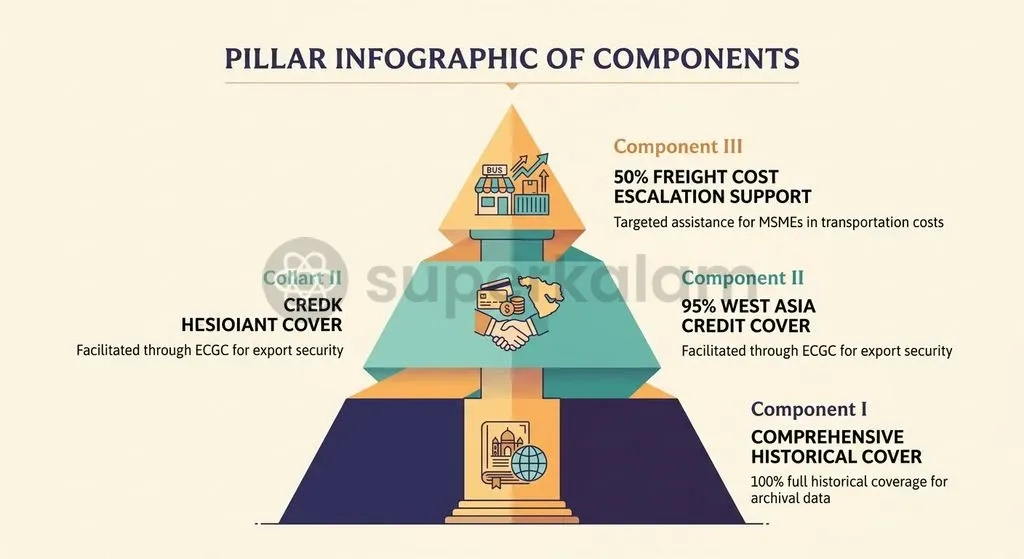
- Component I: Provided up to 100% risk coverage for existing ECGC-insured exporters with Bill of Lading dates between 14 February 2026 and 15 March 2026, absorbing excess claim liabilities.
- Component II: Offers 95% risk coverage for Indian exporters taking out fresh Stand Alone or Whole Turnover ECGC policies for designated West Asian ports.
- Component III: Reimburses up to 50% of freight and insurance escalation (capped at ₹50 lakh per exporter) for non-ECGC insured MSMEs.
Per DGFT Notification No. 37/2026-27, the Department of Commerce extended Component II while capping insurance premia at baseline rates. This credit protection prevents geopolitical transit shocks from draining working capital across vulnerable export sectors.
Discuss with Superkalam
Analyse the structural trade-off between operating RoDTEP under strict annual budgetary caps versus offering uncapped, demand-driven tax remissions.
Ask NowDirect Subsidies vs Tax Remission: A Structural Comparison
The shift from direct subsidisation to audited tax remission defines India's new trade compliance model.
| Dimension | Merchandise Exports from India Scheme (MEIS) | Remission of Duties and Taxes on Exported Products (RoDTEP) |
|---|---|---|
| Primary Objective | Direct export subsidisation and incentive payout | Neutralisation of un-rebated embedded domestic taxes |
| WTO ASCM Status | Prohibited subsidy under Article 3.1(a) | Permissible tax remission under ASCM Annex II and III rules |
| Calculation Method | Flat 2% to 5% of FOB export value | Verified input-output tax incidence schedules per tariff line |
| Disbursement Medium | Physical/electronic transferable scrips | Freely transferable e-scrips on the CBIC ICEGATE ledger |
| Tax Coverage | Arbitrary grant unrelated to actual tax burden | Specific non-GST taxes (fuel VAT, electricity duty, stamp duties) |
| Beneficiary Coverage | Excluded several export-processing categories | Covers DTA, Advance Authorisation, SEZ, and EOU units |
Key Hurdles: Budget Caps, Verification Audits, and Tariff Friction
Fiscal ceilings and foreign countervailing duties create operational friction for Indian exporters under RoDTEP. Because the scheme runs on strict annual budgetary allocations, rates face periodic uncertainty.
Budget pressure triggered a sharp rate cut when DGFT Notification No. 60/2025-26 halved remissions across all HS lines on 23 February 2026. The government restored full rates on 23 March 2026 under Notification No. 66/2025-26. Such mid-year adjustments complicate pricing and narrow operating margins for small manufacturers.
| Date | Regulatory Event | Impact on Exporters |
|---|---|---|
| 23 February 2026 | DGFT Notification No. 60/2025-26 | Remission rates halved across all HS lines |
| 23 March 2026 | DGFT Notification No. 66/2025-26 | Full baseline remission rates restored |
Exporters also face external friction in overseas destination markets:
- Foreign Countervailing Duties: The US Department of Commerce and the European Union have targeted Indian exports with countervailing duties.
- Audit Vulnerabilities: Foreign authorities argue that India lacks plant-level audit data proving RoDTEP scrip values do not exceed actual input taxes paid.
- Sectoral Carve-Outs: Bringing SEZs and EOUs—which generate over 20% of merchandise exports—into RoDTEP required separate notifications (Appendix 4RE) after initial exclusions disrupted input sourcing.
Discuss with Superkalam
Propose two policy measures to integrate Special Economic Zones (SEZs) seamlessly with Domestic Tariff Area (DTA) customs networks while maintaining WTO compliance.
Ask NowThe Way Forward: Building a Resilient Trade Architecture
India needs broader structural reforms alongside tax remission to build export competitiveness. The National Logistics Policy targets a reduction in logistics costs from 13–14% of GDP toward the global benchmark of approximately 8%.
Four priorities stand out for long-term export growth:
- Enterprise-Level Digital Verification: Build automated auditing tools on ICEGATE so firms can generate transaction-level tax ledgers during foreign countervailing duty probes.
- Permanent Fiscal Ring-Fencing: Insulate RoDTEP allocations from mid-year budget clawbacks to give exporters pricing certainty across multi-year supply contracts.
- Enhanced Export Credit Access: Turn RELIEF into a standing, contingent credit buffer under ECGC Limited to absorb regional shipping and insurance spikes.
- Seamless SEZ-DTA Integration: Align Special Economic Zones with domestic customs networks to eliminate inverted duty anomalies.
Key Takeaways
- The WTO Dispute Settlement Panel ruled in DS541 on 31 October 2019 that India's legacy MEIS export subsidies violated Articles 3.1(a) and 3.2 of the ASCM.
- RoDTEP meets multilateral trade rules by reimbursing embedded, non-GST domestic levies through verified tax incidence schedules.
- DGFT Notification No. 41/2026-27 extended RoDTEP remissions through 31 December 2026 for DTA, SEZ, EOU, and Advance Authorisation shipments.
- The RELIEF scheme committed ₹497 crore through ECGC Limited to counter shipping disruptions and freight risk along West Asian trade lanes.
- Countervailing duty actions by the US and EU highlight the need for firm-level digital tax verification to defend RoDTEP remissions internationally.
Mains Question
"The transition from the Merchandise Exports from India Scheme (MEIS) to the RoDTEP framework marks a paradigm shift from direct subsidisation to audited domestic tax neutralisation." Examine how this transition aligns India's foreign trade architecture with multilateral trade obligations while addressing domestic cost disabilities. (10 Marks)
Evaluate NowMains Question
Geopolitical transit chokepoints and multilateral trade disciplines require India to move beyond emergency fiscal grants toward institutionalised risk mitigation and tax compliance. In light of the RELIEF initiative and the RoDTEP scheme, critically analyse the effectiveness of India's current export support framework. (15 Marks)
Evaluate NowPractice MCQs
QUESTION 1
Regarding the World Trade Organization's (WTO) Agreement on Subsidies and Countervailing Measures (ASCM) and India's export incentive programmes, consider the following statements:
- In dispute DS541, the WTO dispute panel held that duty credit scrips under the Merchandise Exports from India Scheme (MEIS) constituted prohibited export subsidies under Article 3.1(a).
- India lost exemptions for export-contingent subsidies after crossing the per-capita income threshold stipulated under Annex VII(b) of the ASCM.
- Under Annexes II and III of the ASCM, the remission of prior-stage cumulative indirect taxes on inputs consumed in the production of exported goods is legally permissible.
Which of the statements given above are correct?
QUESTION 2
Consider the following statements regarding the Remission of Duties and Taxes on Exported Products (RoDTEP) scheme:
- It refunds un-creditable central, state, and local levies such as electricity duties, fuel VAT, and mandi cesses that bypass the GST net.
- RoDTEP benefits are disbursed as physical duty credit certificates issued by regional licensing authorities.
- Under DGFT Notification No. 41/2026-27, the scheme covers units in the Domestic Tariff Area (DTA), Export Oriented Units (EOUs), and Special Economic Zones (SEZs).
Which of the statements given above is/are correct?
QUESTION 3
With reference to the RELIEF initiative introduced to mitigate export credit risk during maritime disruptions, consider the following statements:
- It was introduced under the Export Promotion Mission with an allocated outlay of ₹497 crore.
- Component II provides 95% risk coverage for Indian exporters obtaining fresh ECGC policies for designated West Asian ports.
- Component III reimburses up to 50% of freight and insurance escalation, capped at ₹50 lakh per exporter, for non-ECGC insured MSMEs.
Which of the statements given above are correct?
QUESTION 4
Which of the following represents the primary structural reason why the Merchandise Exports from India Scheme (MEIS) was ruled non-compliant with WTO rules, whereas RoDTEP is designed to be WTO-compliant?
QUESTION 5
Consider the following statements regarding the operational challenges and policy targets associated with India's export architecture:
- RoDTEP rates are subject to annual budgetary ceilings, which led to a temporary halving of remission rates under Notification No. 60/2025-26 in February 2026.
- The National Logistics Policy aims to reduce logistics costs from 13–14% of GDP to the global benchmark of approximately 8%.
- Foreign authorities in the US and EU have subjected Indian exports to countervailing duty investigations citing the absence of enterprise-level plant audit data for RoDTEP scrips.
Which of the statements given above are correct?