SoO Pact in Manipur: Why the Kuki-Zo Truce Was Not Extended
The Centre has let the Kuki-Zo Suspension of Operations pact lapse, while Naga-Kuki violence continues in Manipur.
Oct, 2026
•9 min read
Overview
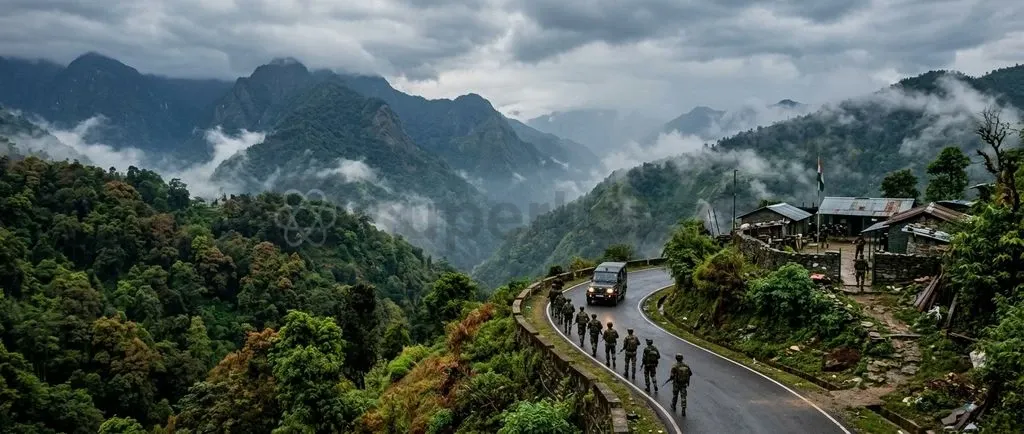
The collapse of the Suspension of Operations (SoO) agreement in Manipur marks a breakdown in internal security governance. What began as a 2008 tripartite ceasefire between the Ministry of Home Affairs, the Manipur government, and 25 Kuki-Zo insurgent groups has become an unresolved federal flashpoint.
The pact originally confined over 2,200 cadres to monitored hill camps under strict ground rules. However, escalating ethnic conflict, state government opposition, and disputed renegotiations have dismantled the consensus required to sustain peace.
Why in the News: The Expiry and Non-Extension of the SoO Pact
The formal consensus behind the pact fractured after the Manipur Legislative Assembly unanimously adopted an abrogation resolution on 29 February 2024.
This legislative action followed widespread valley protests and escalating friction:
- Valley Civil Society Rallies: Organisations including Meira Paibis conducted torch rallies across Imphal Valley, demanding an immediate termination of the pact, the rollout of a National Register of Citizens, and the withdrawal of central forces.
- Representations to Leadership: The Coordinating Committee on Manipur Integrity submitted formal representations to the Union Home Minister and the Governor of Manipur, alleging that insurgent sanctuaries facilitated cross-border influx and armed violence.
- Bilateral MHA Intervention: The Ministry of Home Affairs intervened on 4 September 2025, signing a renegotiated one-year agreement with umbrella insurgent bodies.
Valley-based civil society groups rejected the extension immediately. They argued that signing the pact under President's Rule without state assembly concurrence made it illegitimate.
Discuss with Superkalam
Recall the two major Kuki-Zo insurgent umbrella platforms that entered into the 2008 Suspension of Operations agreement with the government.
Ask NowWhat is the Suspension of Operations (SoO) Agreement?
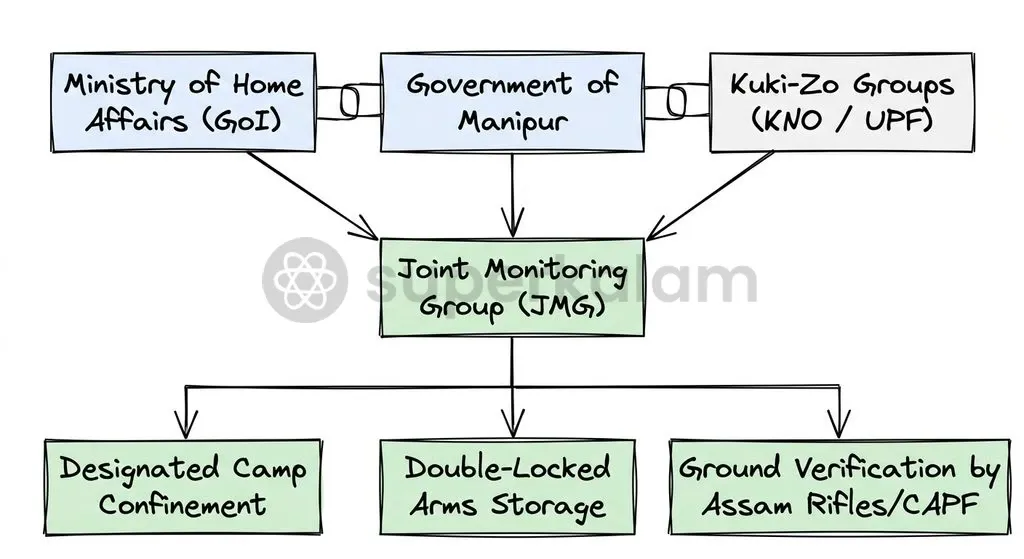
The Suspension of Operations framework is an institutional ceasefire mechanism designed to freeze armed conflict in the hill areas. Under rules drafted by the Ministry of Home Affairs, security forces halt kinetic counter-insurgency operations. In return, insurgent groups accept strict spatial confinement and surrender day-to-day access to their arms.
The operational architecture relies on a Joint Monitoring Group with representatives from the Ministry of Home Affairs, the Manipur Home Department, the State Police, the Assam Rifles, and signatory outfits. This body oversees adherence to agreed protocols, enforces administrative discipline, and coordinates regular roll-calls across designated camps.
| Framework Dimension | 2008 Original Ground Rules | 2024–2025 Renegotiated Framework |
|---|---|---|
| Signatory Architecture | Tripartite (Centre, State Government, KNO, UPF) | Bilateral renegotiation (Centre and Insurgent Umbrellas) |
| Cadre Confinement | 14 designated camps across hill districts | Relocation of 7 vulnerable border camps mandated |
| Arms Custody Protocol | Double-locking system in designated camp armouries | Secure deposit at central security force installations |
| Monitoring Agency | Joint Monitoring Group and Assam Rifles | Enhanced inspection by Central Armed Police Forces |
| Political Objective | General cessation of hostilities and dialogue | Demands for Union Territory with legislature |
Origins: The 2008 Tripartite Agreement and Ground Rules
The tripartite Suspension of Operations pact was formally signed on 22 August 2008 by the Ministry of Home Affairs, the Government of Manipur, and two Kuki-Zo umbrella bodies. The initiative aimed to de-escalate decades of ethnic skirmishes, curb highway extortion, and bring underground cadres into a structured peace process.
The formal agreement instituted several mandatory ground rules to protect public safety:
- Designated Camp Confinement: All registered insurgent fighters must reside exclusively within designated camps established in specific hill districts.
- Prohibition of Armed Movement: Cadres cannot move outside camp perimeters with weapons or engage in public intimidation.
- Cessation of Unlawful Activities: The agreement bans extortion, forced taxation, and fresh recruitment of combatants into signatory factions.
- Armoury Double-Lock Protocol: Weapons must remain secured inside camp storage under a double-locking system, where one key is held by the camp commander and the second key remains with the designated security force authority.
- Physical Cadre Audits: Monitoring units must execute regular physical roll-calls and maintain updated biometric registries to prevent illicit movements.
The Assam Rifles and Central Armed Police Forces are the primary ground monitoring agencies across 14 designated camps. Their personnel verify cadres, monitor logistics, and inspect storage units to ensure weapons inventories match official registries.
Discuss with Superkalam
Explain how the 'double-locking system' for armouries was intended to function under the original 2008 SoO ground rules.
Ask NowKey Insurgent Groups: KNO, UPF, and the Kuki-Zomi Umbrella
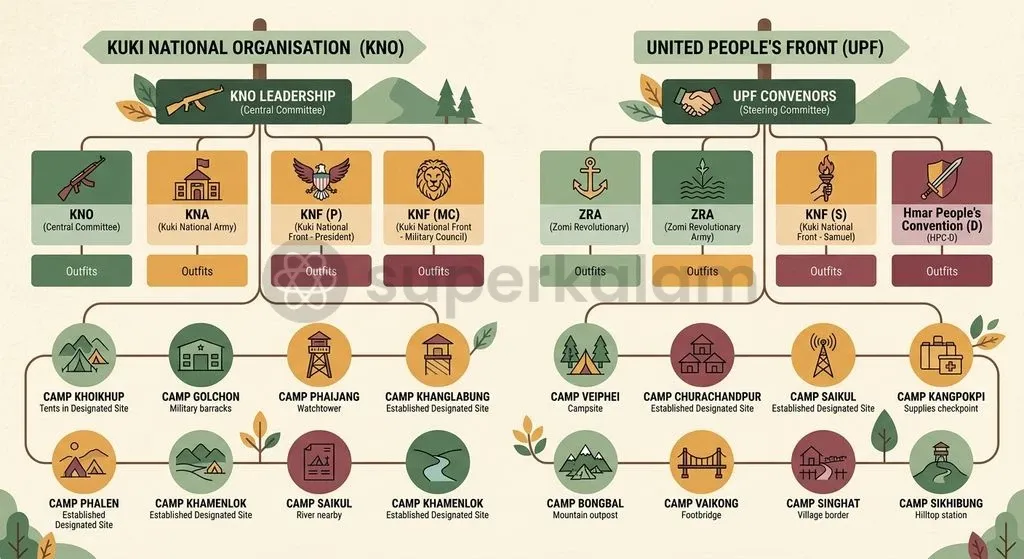
The framework encompasses 24 to 25 underground armed factions representing over 2,200 registered cadres. These outfits operate under two major confederacies: the Kuki National Organisation and the United People's Front.
Both umbrella bodies maintain distinct operational structures and political mandates:
- Kuki National Organisation (KNO): An apex political and military platform representing armed constituent groups such as the Kuki National Army.
- United People's Front (UPF): A confederacy representing factions including the Zomi Revolutionary Army.
- Joint Negotiating Position: While individual factions retain tactical commanders, both umbrella platforms negotiate collectively with Union interlocutors.
According to joint communiqués from KNO and UPF leadership, the pact provides an essential legal framework for regional stability. They view it as a constitutional bridge toward securing a Union Territory with legislature. The groups argue that dismantling the agreement removes statutory protections for hill communities and shuts down peaceful avenues for political self-determination.
The 2024-2025 Renegotiation Attempts and Core Friction Points
Efforts by the Ministry of Home Affairs to salvage the ceasefire culminated in revised terms on 4 September 2025. The central government sought to address ground-level vulnerabilities while keeping cadres inside a monitored regulatory net.
The renegotiated pact introduced strict operational modifications to curb buffer-zone skirmishes:
- Relocation of Sensitive Camps: Seven designated camps along contested ethnic boundary lines were marked for shifting deeper into hill areas.
- Central Storage of Armaments: Custody of licensed firearms was transferred from camp armouries directly into the secure perimeters of central security force posts.
- Enhanced Verification Checks: The Central Armed Police Forces received an expanded mandate to conduct unannounced bi-weekly roll-calls and monitor camp logbooks.
Despite these adjustments, the bilateral format of the talks triggered intense opposition. Valley civil bodies and political representatives argued that executing an agreement without an elected state government violated the foundational tripartite principle of the 2008 pact.
Discuss with Superkalam
If you were appointed as a central interlocutor, how would you address the conflict between state-level abrogation demands and central security containment objectives?
Ask NowWhy the Pact Has Not Been Extended: State Objections vs Centre's Stance
The collapse of the SoO consensus stems from divergent security assessments between the Manipur State Government and the Union Ministry of Home Affairs. This institutional friction reflects conflicting priorities regarding regional stability, territorial integrity, and law enforcement.
The state government initiated formal disengagement on 10 March 2023, when the State Cabinet resolved to withdraw from the pact regarding the KNA and ZRA over alleged involvement in forest reserve protests. The administrative divide widened when state authorities declined to attend the tripartite review meeting on 29 February 2024, producing a profound federal divergence between state and central leadership.
The debate between the state executive and central security agencies centres on distinct arguments:
State Government and Valley Civil Society Objections
- Violations of Camp Ground Rules: State agencies alleged that armed cadres regularly roamed outside designated perimeters, indulged in extortion, and initiated targeted attacks on valley settlements.
- Illicit Narcotics and Deforestation: Authorities linked militant networks to illegal poppy cultivation, pointing out that enforcement agencies eradicated 19,135.6 acres of illicit poppy across 12 districts between 2017 and January 2024.
- Cross-Border Infiltration Concerns: Civil organisations asserted that porous border tracts allowed foreign combatants from Myanmar to seek shelter in designated camps.
Union Government Strategic Considerations
- Containment of Armed Cadres: The Ministry of Home Affairs maintained that keeping over 2,200 armed cadres bound to documented registries prevents open guerrilla warfare across the Northeast.
- Preservation of Dialogue Channels: Central interlocutors viewed the SoO pact as the only viable mechanism to negotiate lasting administrative solutions under the Indian Constitution.
- Mitigating Tactical Escalation: Abrogating the agreement outright risks dispersing trained cadres into dense jungle redoubts, severely complicating intelligence gathering and security operations.
Discuss with Superkalam
Analyse why the exclusion of the state government in the September 2025 bilateral renegotiation intensified ethnic and political polarization in Manipur.
Ask NowInternal Security Fallout: Ethnic Polarization and Border Vulnerabilities
The operational uncertainty surrounding the SoO agreement has accelerated security risks across Manipur. Security assessments highlight that the breakdown of institutional containment creates immediate risks of complete re-militarisation.
The collapse of the pact has driven three acute security vulnerabilities:
- Dual-Front Armed Conflict: Unmonitored cadre movements risk triggering clashes between hill-based outfits and valley-based insurgent groups (VBIGs).
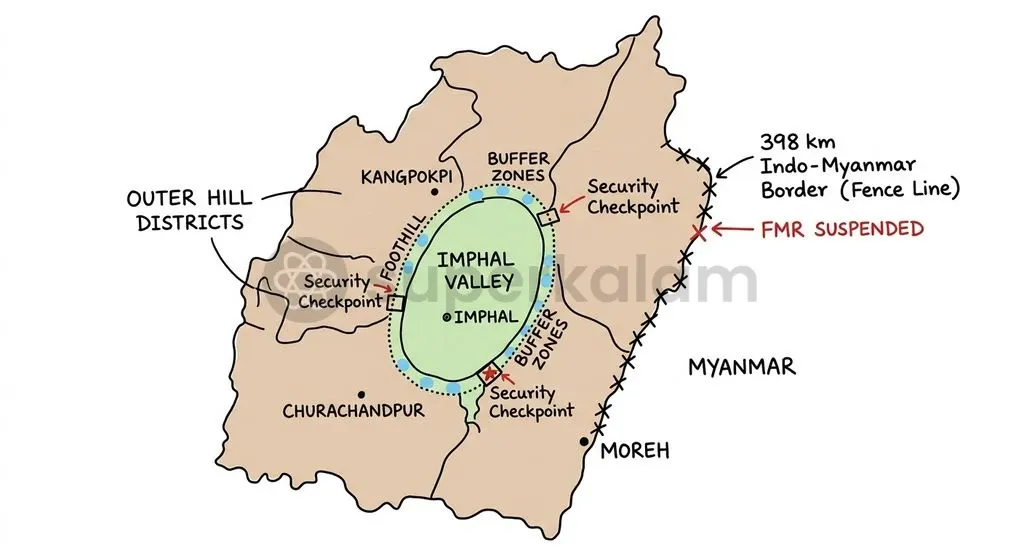
- Border Infiltration and Fencing: The lapse of ground enforcement has complicated security along Manipur's 398 km international border with Myanmar, prompting the Union Government to revoke the Free Movement Regime (FMR) and initiate border fencing.
- Fragmented Policing Command: Disagreements over camp inspections, buffer-zone management, and jurisdictional authority have strained cooperation between state police and central security apparatuses.
These command disputes have created localised security vacuums across contested valley-foothill corridors.
Way Forward: Rebuilding Institutional Trust and Border Management
Resolving the security impasse requires a clear strategy that reconciles constitutional federalism, border policing, and political dialogue. Restoring stability depends on shifting from ad-hoc extensions to durable institutional frameworks.
A sustainable path forward should focus on four structural priorities:
- Restoring Tripartite Consensus: Future ceasefire frameworks must re-engage elected state institutions, ensuring that local administrative concerns and legislative resolutions are formally integrated into policy decisions.
- Technological Border Infrastructure: The Ministry of Home Affairs must accelerate smart fencing and deploy advanced thermal imaging along the 398 km border to eliminate cross-border infiltration and illicit trafficking networks.
- Independent Ground Auditing: The Joint Monitoring Group should incorporate biometric surveillance, geo-tagged daily cadre tracking, and joint inspection teams combining central forces and state police to ensure absolute compliance with camp rules.
- Comprehensive Alternative Livelihoods: Expanding development initiatives to replace illicit poppy cultivation across hill tracts will dismantle the illicit economic networks that sustain insurgent infrastructure.
Discuss with Superkalam
Weigh the trade-offs between completely abrogating a ceasefire pact versus maintaining a renegotiated bilateral agreement with insurgent outfits during active civil unrest.
Ask NowKey Takeaways
- The Suspension of Operations pact was formalised as a tripartite agreement on 22 August 2008 between the Ministry of Home Affairs, the Manipur government, and Kuki-Zo groups (KNO and UPF).
- The framework covers approximately 24 to 25 underground factions with over 2,200 registered cadres confined to designated hill camps.
- Weapons in SoO camps were historically stored under a double-locking system supervised by camp commanders and central security forces.
- On 29 February 2024, the Manipur Legislative Assembly unanimously passed a resolution demanding the total abrogation of the SoO pact.
- A renegotiated one-year pact signed by the MHA on 4 September 2025 mandated relocating seven sensitive camps and securing weapons at central security posts.
- Regional security remains strained along Manipur's 398 km border with Myanmar, prompting the scrapping of the Free Movement Regime and the commencement of border fencing.
Mains Question
"The transition of the Suspension of Operations (SoO) agreement in Manipur from a tripartite architecture to a bilateral renegotiation highlights emerging fault lines in cooperative federalism and internal security governance." Critically analyse. (15 Marks)
Evaluate NowMains Question
Examine the effectiveness of institutional mechanisms like the Joint Monitoring Group (JMG) and designated ground rules in containing insurgent violence in border states, with special reference to Manipur. (10 Marks)
Evaluate NowPractice MCQs
QUESTION 1
With reference to the Suspension of Operations (SoO) agreement in Manipur, consider the following statements:
- It was originally established in 2008 as a tripartite agreement between the Ministry of Home Affairs, the Government of Manipur, and Kuki-Zo insurgent groups.
- Under the original 2008 ground rules, weapons were kept under a double-locking system where one key was held by the camp commander and the other by security forces.
- The operational architecture of the SoO relies on a Joint Monitoring Group to oversee adherence to agreed ground rules.
Which of the statements given above are correct?
QUESTION 2
Consider the following statements regarding the insurgent umbrella platforms in Manipur:
- The Kuki National Organisation (KNO) and the United People's Front (UPF) encompass around 24 to 25 underground factions.
- The constituent insurgent groups under the SoO framework have collectively articulated a political demand for a Union Territory with a legislature.
- The Zomi Revolutionary Army operates as a constituent group under the Kuki National Organisation.
Which of the statements given above is/are correct?
QUESTION 3
Regarding the 2024–2025 renegotiated framework for the Suspension of Operations (SoO) in Manipur, consider the following modifications:
- Relocation of seven vulnerable designated border camps deeper into hill districts.
- Transfer of licensed firearms custody directly into the perimeters of central security force posts.
- Formal ratification and signing of the renegotiated pact by the Manipur Legislative Assembly.
Which of the modifications given above were part of the renegotiated terms?
QUESTION 4
With reference to internal security administration in Manipur, the primary ground monitoring agencies responsible for verifying registered cadres across the 14 designated SoO camps are:
QUESTION 5
Consider the following statements regarding the institutional actions surrounding the SoO agreement in Manipur:
- The Manipur State Cabinet resolved to withdraw from the pact regarding the KNA and ZRA in March 2023.
- The Manipur Legislative Assembly unanimously adopted a resolution seeking the abrogation of the SoO agreement in February 2024.
- The Central Government mandated a complete disarmament and dissolution of all 25 constituent groups in September 2025.
Which of the statements given above is/are correct?