Right to Vote in India: Constitutional or Statutory Right?
Article 326 provides adult suffrage, while election laws govern voting. See how the Supreme Court has classified the right to vote and related freedoms.
Sep, 2026
•11 min read
Overview
The right to vote in India operates as a constitutional right under Article 326, regulated through the Representation of the People Act, 1951. While the Supreme Court historically treated the franchise as an ordinary statutory right, recent jurisprudence links the ballot directly to democratic governance and free expression.
Classifying the franchise sets the precise standard of judicial review. It determines how far Parliament can restrict citizen participation and what remedies remain open when voters face arbitrary exclusion.
Why the Legal Status of the Right to Vote Still Sparks Debate
The Supreme Court of India has delivered shifting interpretations on whether voting is a statutory privilege, a constitutional right, or a fundamental freedom. As of March 2026, judicial benchmarks continue to balance legislative supremacy under the Representation of the People Act, 1951 against substantive constitutional guarantees.
This doctrinal debate carries direct consequences for judicial remedies. If voting is merely statutory, Parliament can alter access through ordinary legislation. When recognised as a constitutional or fundamental right, statutory curbs must satisfy constitutional reasonableness and equality.
Indian electoral jurisprudence treats the franchise as a constitutional entitlement operationalised by statute rather than a legislative gift. This foundational status restricts arbitrary legislative exclusion while preserving Parliament's authority to maintain orderly elections.
Discuss with Superkalam
Recall the four specific grounds explicitly listed in Article 326 of the Constitution of India under which Parliament may disqualify a citizen from voting.
Ask NowConstitutional vs Statutory vs Fundamental Right: What Is the Difference?
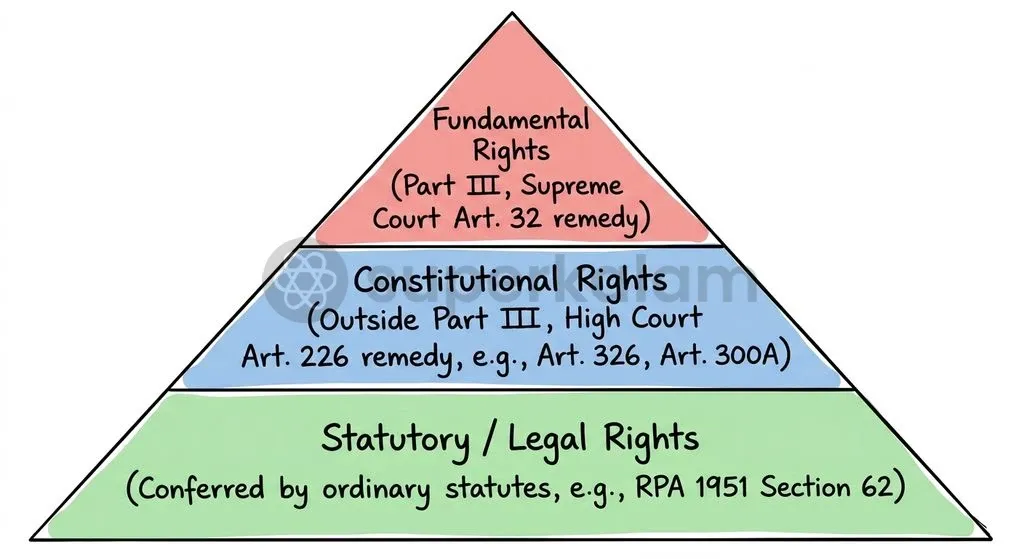
Constitutional rights derive their authority directly from the text of the Constitution. In contrast, statutory rights exist entirely as creations of ordinary enactments passed by Parliament or State legislatures. Fundamental Rights represent a specialised tier of constitutional rights protected within Part III.
Fundamental Rights under Articles 12 to 35 enjoy direct enforcement before the Supreme Court under Article 32. Non-fundamental constitutional rights, such as property under Article 300A or adult suffrage under Article 326, sit outside Part III. Citizens enforce these guarantees primarily through High Courts under writ jurisdiction under Article 226.
A statutory right remains subject to legislative amendment, modification, or repeal. In Jyoti Basu v. Debi Ghosal (1982), the Supreme Court observed that a statute defines the complete scope of the right it creates. An ordinary statute cannot override a Fundamental Right, but it establishes the procedural boundaries of a constitutional mandate.
| Category | Source of Authority | Enforcement Mechanism | Vulnerability to Ordinary Law |
|---|---|---|---|
| Fundamental Right | Part III (Articles 12–35) | Direct petition to Supreme Court (Article 32) or High Courts (Article 226) | Protected against ordinary legislative abridgement |
| Constitutional Right | Constitutional provisions outside Part III (e.g., Article 300A, Article 326) | High Court writ petitions (Article 226) or regular civil remedies | Cannot be nullified by ordinary statute without constitutional validity |
| Statutory Right | Enactments by Parliament or State legislatures (e.g., RPA 1951) | Statutory tribunals and ordinary judicial procedure | Subject to legislative amendment, conditions, and statutory repeal |
Article 326 and Universal Adult Suffrage: What the Constitution Guarantees
Article 326 of the Constitution of India provides the foundation for elections to the Lok Sabha and State Legislative Assemblies. It guarantees that every citizen of eligible age holds the constitutional entitlement to register as an elector.
The original text set the voting age threshold at twenty-one years. Parliament enacted the 61st Amendment Act, 1988, lowering the minimum voting age to 18 years, which came into force on 28 March 1989. This reform expanded democratic inclusion across the republic.
Universal adult suffrage under Article 326 is not absolute. The provision explicitly permits the legislature to disqualify citizens on four grounds:
- Non-residence: Failure to satisfy statutory residency rules within a constituency.
- Unsoundness of mind: A formal declaration of mental incapacity by a competent court.
- Crime: Disqualifications resulting from specific criminal convictions defined by law.
- Corrupt or illegal practice: Electoral offences that compromise the integrity of the vote.
Discuss with Superkalam
How does classifying the franchise as a 'constitutional right operationalised by statute' alter the standard of judicial review compared to treating it as a 'pure statutory right'?
Ask NowSection 62 of the RPA 1951: How the Law Regulates the Right to Vote
Section 62 of the Representation of the People Act, 1951 establishes the statutory machinery governing voter eligibility across India. It translates the broad mandate of Article 326 into practical administrative rules.
Under Section 62(1) of the Act, every individual registered on an electoral roll is entitled to vote in that constituency. This entitlement remains subject to the general statutory disqualifications set out in the Act.
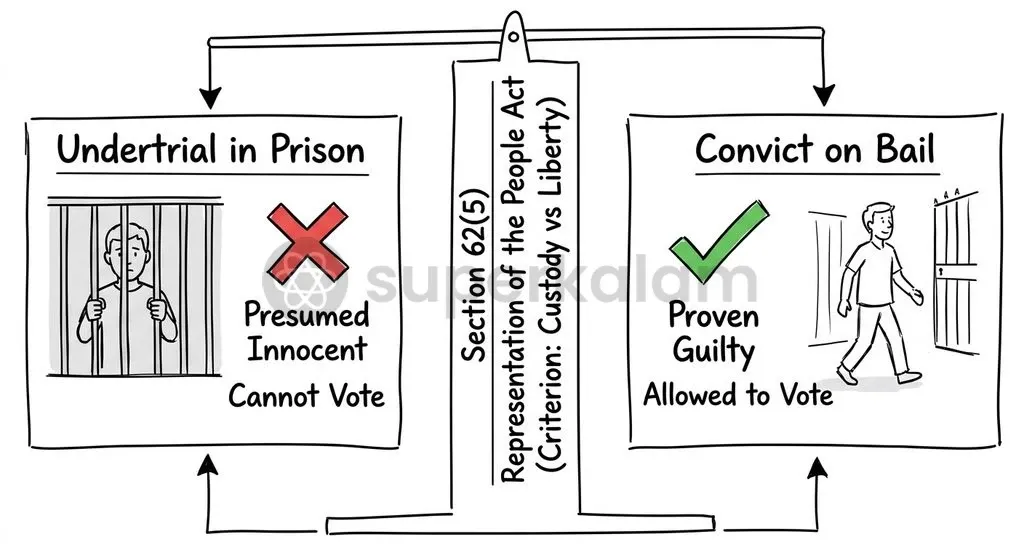
Section 62(5) of the Act bars individuals in custodial confinement from voting. The ban applies to anyone confined in prison under a sentence of imprisonment or transportation, as well as those in lawful police custody. However, the statute creates one exception: persons held under preventive detention maintain the right to vote.
Comparing the Legal Classifications of the Right to Vote
The legal classification of the franchise determines how a citizen can challenge an exclusion in court. Indian jurisprudence has engaged three distinct legal models over seven decades of constitutional interpretation:
- Statutory model: Views the franchise as a legislative grant that Parliament can condition for administrative efficiency.
- Constitutional model: Anchors the franchise in Article 326, requiring exclusions to match explicitly enumerated constitutional grounds.
- Fundamental expression model: Treats voting as a medium of political expression under Article 19(1)(a), requiring state limits to meet reasonable restrictions under Article 19(2).
| Dimension | Pure Statutory View | Constitutional Right View | Fundamental Expression View |
|---|---|---|---|
| Doctrinal Anchor | RPA 1951 (Section 62) | Article 326 of the Constitution | Article 19(1)(a) of the Constitution |
| Judicial Standard | Presumption of broad legislative competence | Review against Article 326 criteria | Strict proportionality and reasonableness review |
| Primary Remedy | Statutory appeal or High Court review | Writ petition under Article 226 | Writ petition under Article 32 or Article 226 |
| Key Precedents | Ponnuswami (1952), Jyoti Basu (1982) | Anoop Baranwal (2023) | ADR (2002), PUCL (2003, 2013) |
From Ponnuswami to Anoop Baranwal: How Supreme Court Rulings Have Evolved
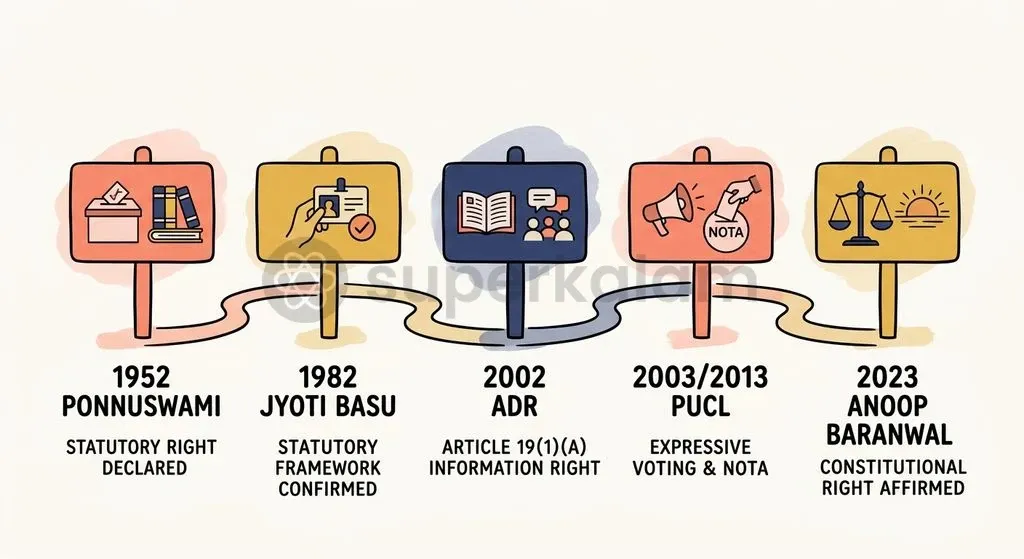
The Supreme Court has broadened its doctrinal understanding of the franchise over time. It has moved from a strict statutory reading toward an integrated constitutional model.
In N.P. Ponnuswami v. Returning Officer (1952), a Constitution Bench held that the right to vote is a creature of statute rather than a common law right. The Court reaffirmed this in Jyoti Basu v. Debi Ghosal (1982), calling the right to elect pure and simple a statutory right.
Kuldip Nayar v. Union of India (2006) maintained that while democracy is part of the basic structure, the franchise itself remains a statutory right under the RPA 1951. Rajbala v. State of Haryana (2015) similarly affirmed that statutory criteria govern the right to contest elections.
A parallel line of rulings connected the mechanics of voting to Part III freedoms. In Union of India v. Association for Democratic Reforms (2002), the Supreme Court held that a voter's right to know candidate antecedents is part of free speech under Article 19(1)(a).
Three landmark decisions expanded this framework further:
- PUCL v. Union of India (2003): Justice P. Venkatarama Reddi distinguished the statutory right to vote from the constitutional freedom of voting, identifying the ballot as an expressive act under Article 19(1)(a).
- PUCL v. Union of India (2013): The Court mandated the 'None of the Above' (NOTA) option on electronic voting machines, ruling that casting a negative vote is an essential facet of Article 19(1)(a).
- Anoop Baranwal v. Union of India (2023): A five-judge Constitution Bench ruled that the right to vote is a constitutional right flowing from Article 326 operationalised by statute, with Justice Ajay Rastogi highlighting voting as an expressive choice under Article 19(1)(a).
Discuss with Superkalam
If a registered voter is detained by the police under preventive detention on polling day, what statutory remedy under Section 62(5) of the RPA 1951 protects their right to vote?
Ask NowWhy Prisoners and Undertrials Cannot Vote Under Current Indian Law
Section 62(5) of the Representation of the People Act, 1951 imposes a blanket ban on voting for individuals in prison or lawful police custody. This statutory exclusion applies equally to convicted prisoners and undertrial detainees awaiting trial.
The Supreme Court upheld this blanket restriction in Anukul Chandra Pradhan v. Union of India (1997). The Court justified the rule on grounds of administrative logistics, resource constraints, and the objective of keeping criminal influences away from elections. The bench held that Article 14 permits reasonable classification of prisoners, denying them parity with non-confined citizens.
This statutory restriction creates an ethical and legal anomaly noted in the Law Commission of India's 255th Report on Electoral Reforms:
- Undertrials in custody: Denied the ballot despite retaining the constitutional presumption of innocence.
- Convicted persons on bail: Permitted to cast their vote as long as they remain outside prison walls.
GS Paper 4 Angle: Moral Duty vs Legal Right in Democratic Participation
Democratic participation is both a legal entitlement and an ethical obligation. Exercising the franchise requires citizens to weigh individual interests against collective civic duty.
Treating the vote as a purely passive transaction weakens democratic accountability. When electoral participation operates as a moral obligation, casting an informed vote becomes an exercise in public ethical stewardship. A voter assesses candidates based on constitutional integrity and public welfare rather than narrow personal gains.
Ethical governance also scrutinises systemic disenfranchisement. Stripping undertrial citizens of voting rights breaks their civic connection to society, running counter to the reformative goals of criminal justice.
Discuss with Superkalam
Analyze the contradiction between the constitutional presumption of innocence for undertrials and their statutory exclusion from voting under Section 62(5) of the RPA 1951.
Ask NowGlobal Perspectives: How Other Democracies Treat Voting Rights
Democratic nations adopt distinct constitutional structures to protect or restrict access to the ballot box.
| Country | Model of Suffrage | Constitutional / Legal Framework | Position on Prisoner Voting |
|---|---|---|---|
| United States | Negative anti-discrimination model | Amendments 15, 19, 24, and 26 prohibit denying votes based on race, sex, tax, or age | Varies by state; many disenfranchise felons |
| South Africa | Affirmative fundamental right | Section 19(3)(a) of the 1996 Constitution guarantees voting in the Bill of Rights | Constitutional Court upheld prisoner voting rights |
| United Kingdom | Statutory framework | Representation of the People Act 1983 (uncodified constitution) | ECHR held blanket ban unlawful in Hirst (No 2) |
The United States Constitution contains no affirmative individual right to vote in its original text. Instead, American constitutional law protects suffrage negatively through constitutional amendments—specifically the 15th, 19th, 24th, and 26th Amendments—barring disenfranchisement based on race, sex, poll tax, or age.
In contrast, Section 19(3)(a) of the 1996 Constitution of the Republic of South Africa establishes an affirmative guarantee. Its Bill of Rights ensures every adult citizen has the fundamental right to vote in regular legislative elections.
In the United Kingdom, voting is governed by statute, primarily the Representation of the People Act 1983. In Hirst v. United Kingdom (No 2) (2005), the European Court of Human Rights ruled that the UK's blanket ban on convicted prisoners voting violated Article 3 of Protocol No. 1, holding that statutory exclusions must remain proportionate rather than arbitrary.
Way Forward: Reconciling Statutory Restrictions with Democratic Principles
Aligning statutory electoral rules with constitutional values requires applying modern standards of proportionality to franchise restrictions.
The Law Commission of India recommended in Report No. 255 that Parliament review blanket custodial bans to protect undertrials from arbitrary disenfranchisement. Because undertrials retain the legal presumption of innocence, introducing postal or remote electronic voting would resolve this civil liberties contradiction.
Legislative reforms must also reflect the Supreme Court's doctrine in Anoop Baranwal (2023). Grounding the right to vote in Article 326 and Article 19(1)(a) ensures that statutory conditions under the Representation of the People Act, 1951 remain proportionate, reasonable, and democratically sound.
Key Takeaways
- Constitutional Anchor: Article 326 establishes universal adult suffrage for Lok Sabha and Assembly elections, lowering the voting age from 21 to 18 through the 61st Amendment Act, 1988.
- Statutory Operationalisation: Section 62 of the Representation of the People Act, 1951 regulates voter eligibility and imposes a blanket voting ban on prisoners and undertrials under Section 62(5), while exempting preventive detainees.
- Judicial Evolution: Supreme Court jurisprudence has transitioned from viewing voting as a pure statutory right (Ponnuswami, Jyoti Basu) to recognising it as a constitutional entitlement operationalised by statute with expressive facets under Article 19(1)(a) (PUCL, Anoop Baranwal).
- Custodial Anomaly: Undertrials are barred from voting under Section 62(5) despite maintaining the presumption of innocence, whereas convicted persons out on bail or parole are eligible to vote.
- Global Diversity: The franchise varies from negative anti-discrimination guarantees (United States) and statutory frameworks (United Kingdom) to explicit fundamental rights within a Bill of Rights (South Africa).
Mains Question
“The right to vote in India has evolved from a pure statutory privilege to a constitutional entitlement linked with fundamental expressive freedoms.” Elucidate this transition in light of judicial pronouncements. (10 Marks)
Evaluate NowMains Question
Section 62(5) of the Representation of the People Act, 1951 imposes a blanket bar on voting for prisoners and undertrials in custody. Critically examine the legal and ethical anomalies arising from this statutory restriction. (15 Marks)
Evaluate NowPractice MCQs
QUESTION 1
With reference to the Right to Vote in India, consider the following statements:
- Article 326 of the Constitution of India originally set the minimum voting age at eighteen years.
- Non-residence, unsoundness of mind, crime, or corrupt or illegal practice are grounds on which the legislature may disqualify a citizen from registration as an elector under Article 326.
- The 61st Constitutional Amendment Act, 1988 lowered the voting age to 18 years.
Which of the statements given above are correct?
QUESTION 2
Regarding Section 62 of the Representation of the People Act, 1951 (RPA 1951), consider the following statements:
- A person confined in prison under a sentence of imprisonment is prohibited from voting in an election.
- Persons subjected to preventive detention are deprived of their voting rights during confinement.
- The statutory ban on voting in custody applies equally to undertrials detained in lawful police custody.
Which of the statements given above is/are correct?
QUESTION 3
Consider the following judicial precedents and their associated rulings on the right to vote in India:
- Union of India v. Association for Democratic Reforms (2002) — Linked the voter's right to know candidate antecedents to Article 19(1)(a).
- PUCL v. Union of India (2013) — Mandated the introduction of 'None of the Above' (NOTA) as an expressive facet under Article 19(1)(a).
- Anoop Baranwal v. Union of India (2023) — Held that the right to vote is a constitutional right flowing from Article 326 operationalised by statute.
Which of the pairs given above are correctly matched?
QUESTION 4
In the context of Indian constitutional law, how does a non-fundamental constitutional right (such as under Article 326 or Article 300A) primarily differ from a Fundamental Right in Part III?
QUESTION 5
Consider the following statements regarding the legal status of the franchise in India:
- In N.P. Ponnuswami v. Returning Officer (1952) and Jyoti Basu v. Debi Ghosal (1982), the Supreme Court treated the right to vote purely as a statutory right.
- In Anukul Chandra Pradhan v. Union of India (1997), the Supreme Court struck down Section 62(5) of the RPA 1951 for violating Article 14.
Which of the statements given above is/are correct?