COP31 Antalya 2026: Dates, Host Roles and India's Priorities
COP31 is scheduled for Antalya, Türkiye, in 2026. See the agreed Türkiye-Australia roles, climate finance agenda and India's negotiating priorities.
Sep, 2026
•7 min read
Overview
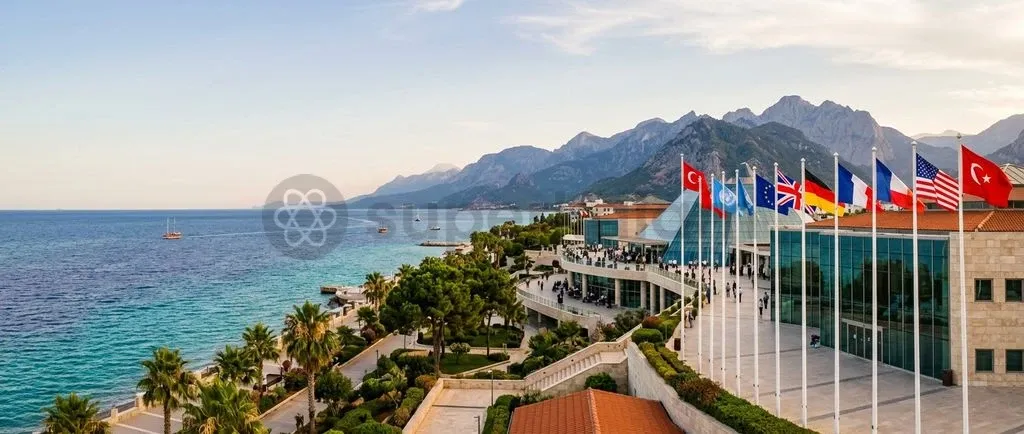
The 31st United Nations Climate Change Conference (COP31), scheduled for November 2026 in Antalya, Türkiye, marks a decisive test for global climate governance. Following a consensus split-presidency arrangement between Türkiye and Australia, the conference serves as the frontline venue for delivering post-Baku financial commitments.
For developing nations led by India, the summit centres on holding developed countries accountable to grant-based funding mechanisms while resisting unilateral trade barriers. Securing equitable carbon space under multilateral rules remains the defining priority for the Global South.
Why in the News: The Road to Antalya and the Fight to Host COP31
The United Nations Framework Convention on Climate Change formally scheduled COP31 in Antalya, Türkiye, from 9 to 20 November 2026, following a consensus agreement reached at COP30. As of late 2026, the diplomatic compromise resolved an intense contest within the Western European and Others Group by dividing summit leadership between two distinct nations.
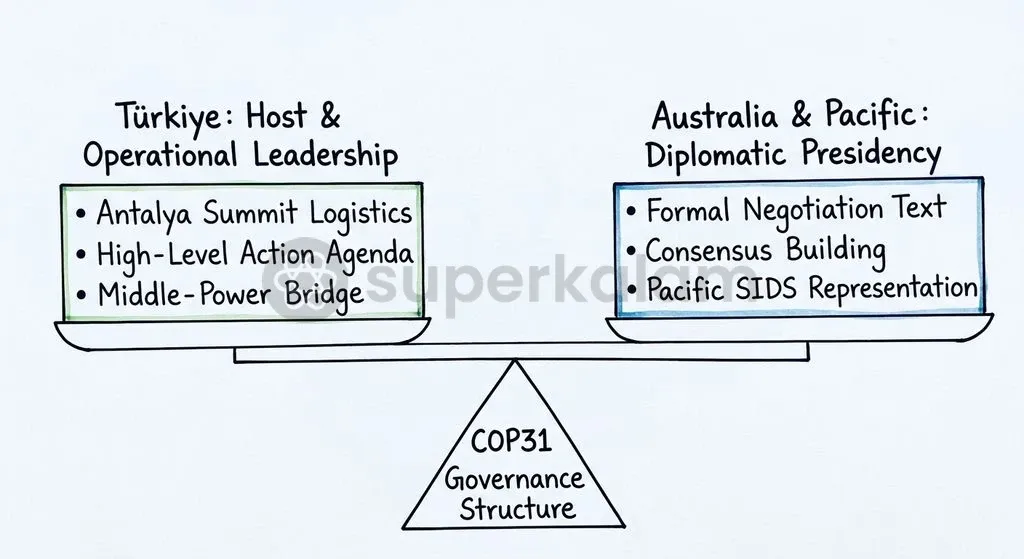
Under the finalised Türkiye-Australia Partnership Modalities, Türkiye acts as the COP31 Host President while Australia holds the role of President of Negotiations. This dual arrangement tests whether middle-power host diplomacy can bridge structural divides between donor countries and developing economies.
How UN Climate Host Politics Work: Türkiye vs the Australia-Pacific Bloc
Host selection under the UNFCCC framework operates through annual rotation among five regional United Nations groupings. It requires absolute consensus within the designated regional group to confirm a host.
When multiple states within a group seek hosting rights, intense negotiations follow to prevent procedural deadlocks. The contest for COP31 produced two distinct regional visions:
- The Pacific-Centric Bid: Australia coordinated its proposal with Pacific Island nations, designing the summit to focus attention on small island climate vulnerability and maritime security. Australia also agreed to organise a dedicated Pacific Pre-COP summit.
- The Eurasian Bridge Proposal: Türkiye advanced a competing bid framed around its geographic location and its capacity to act as a developmental bridge between the Global North and emerging economies.
| Dimension | Australia-Pacific Partnership Bid | Türkiye Host Presidency |
|---|---|---|
| Regional Group | Western European and Others Group (WEOG) | Western European and Others Group (WEOG) |
| Core Diplomatic Focus | Ocean resilience, small island survival, and regional security | Middle-power mediation, industrial energy transitions, and geographic bridging |
| Institutional Role | President of Negotiations (facilitating formal treaty texts) | COP31 Host President (managing high-level action agendas and logistics) |
| Pre-Summit Anchor | Dedicated Pacific Pre-COP Summit | Mediterranean Climate Resilience High-Level Dialogue |
Discuss with Superkalam
Recall the two distinct institutional roles assigned to Türkiye and Australia under the COP31 partnership modalities.
Ask NowWhat Is Middle-Power Diplomacy in Global Climate Talks?
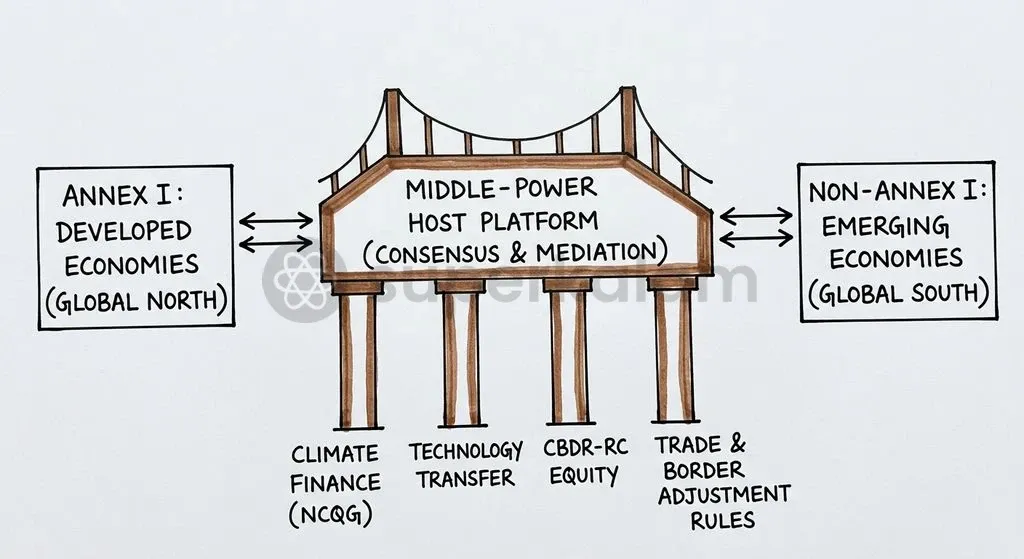
Middle-power diplomacy in international climate governance refers to the strategy where non-superpower nations use institutional mediation, bridge-building, and issue-specific coalitions to build consensus between polarised negotiating blocs. These states leverage their neutral standing to break persistent deadlocks between developed donor countries and developing nation alliances.
Türkiye occupies a unique structural position within the multilateral climate architecture:
- Annex I Classification: Unlike India and other members of the Like-Minded Developing Countries, Türkiye is an Annex I Party under the UNFCCC, having joined as an OECD member in 1992.
- Annex II Exemption: Türkiye successfully secured its removal from Annex II in 2001, exempting it from mandatory financial transfer obligations to developing nations.
- Voluntary Presidential Pledges: For COP31, Türkiye introduced the 35 x 35 Global Electrification Pledge as an Action Agenda priority, aiming for 35% of global energy demand to be met by electricity by 2035.
Discuss with Superkalam
Explain how Türkiye's status as an Annex I Party without Annex II obligations affects its role as a bridge between the Global North and Global South.
Ask NowThe Money Problem: Testing post-Baku Climate Finance Promises at COP31
Climate finance negotiations at COP31 directly inherit the implementation mandates established under the New Collective Quantified Goal adopted at COP29 in Baku. Developing nations enter the summit demanding clear accounting frameworks and enforceable delivery timetables for long-term climate funding.
The Baku finance decision established a target of at least USD 300 billion annually by 2035 from developed countries to developing nations. This sits within an overarching goal to mobilise USD 1.3 trillion per year from all sources by 2035.
To bridge the operational gap between public commitments and private mobilisation, the summit relies on a tiered finance tracking structure:
- Aggregate Mobilisation Goal: USD 1.3 trillion per year by 2035 from public, private, and bilateral sources.
- Core Developed Country Target: USD 300 billion annually by 2035 in public climate finance.
- Operational Roadmap: The Baku-to-Belém Roadmap guides multilateral implementation between COP29 and COP31.
India and fellow developing nations formally criticised the USD 300 billion commitment as inadequate to match real adaptation and mitigation needs. Indian delegates emphasised that finance must consist primarily of grant-based and concessional funds rather than market-rate loans that worsen sovereign debt burdens.
Discuss with Superkalam
Analyse why developing countries consider grant-based funding essential compared to market-rate loans within the USD 300 billion Baku climate finance framework.
Ask NowWhy COP31 Matters Directly to India: Coal, Growth, and Climate Justice
India approaches COP31 with the core objective of protecting its socio-economic developmental space while expanding domestic clean energy capacity. The country anchors its negotiating platform on the foundational principle of Common But Differentiated Responsibilities and Respective Capabilities under the UNFCCC.
Multilateral pressure on emerging markets to enforce accelerated timelines on fossil fuels faces firm pushback from Indian negotiators. India consistently advocates for a phase down of unabated coal rather than an immediate phase out, citing base-load energy stability requirements and the necessity of powering industrial poverty eradication programmes.
India coordinates its technical strategy across three primary negotiating blocs to safeguard its developmental space:
- BASIC Coalition (Brazil, South Africa, India, China): Coordinates joint technical positions to defend carbon budget integrity and equitable space.
- Like-Minded Developing Countries (LMDC): Protects the equity framework and enforces CBDR-RC differentiation against developed bloc pressures.
- G77 + China Alliance: Pushes for binding accountability on public adaptation finance delivery without debt creation.
Ethical arguments on climate justice remain central to India's position. Historical assessments show that developed economies have consumed more than 70% of the historical global carbon budget since 1850 while accounting for less than 20% of the world population, making equitable carbon allocations an economic necessity.
Discuss with Superkalam
Evaluate whether unilateral carbon border taxes violate the spirit of Article 3.5 of the UNFCCC or serve as necessary instruments for global decarbonisation.
Ask NowWay Forward: How India Can Build Strategic Alliances in Antalya
India must deploy targeted coalition diplomacy at COP31 to maintain the integrity of multilateral climate rules while advancing practical clean technology partnerships:
- Enforce Climate Finance Verification: Indian negotiators should coordinate across the G77+China to establish strict multilateral accounting standards, ensuring that post-Baku financial transfers represent new and additional public grant resources rather than reclassified commercial loans.
- Build Common Fronts Against Green Protectionism: India should mobilise support within the BASIC and LMDC coalitions to push for explicit COP decisions restricting unilateral trade barriers that contravene Article 3.5 of the UNFCCC.
- Engage the Split Presidency Strategically: India can collaborate with host-nation Türkiye on technical components of the 35 x 35 Electrification Pledge while working with Australia to guarantee balanced representation for adaptation and loss-and-damage priorities.
- Advance Clean Technology Transfer Mechanisms: India should demand operationalised technology transfer frameworks that grant developing nations access to critical energy storage, grid stability, and industrial decarbonisation patents on concessional terms.
Key Takeaways
- COP31 will take place in Antalya, Türkiye, from 9 to 20 November 2026, led through an unprecedented split-presidency arrangement with Australia.
- The summit acts as the primary review mechanism for operationalising the New Collective Quantified Goal target of USD 300 billion annually by 2035.
- India's negotiating platform firmly defends Common But Differentiated Responsibilities and Respective Capabilities to preserve base-load energy security and poverty eradication priorities.
- Unilateral trade mechanisms like carbon border taxes face sustained legal opposition from India under Article 3.5 of the UNFCCC.
- Climate justice demands an equitable distribution of remaining global carbon space, grounded in historical emissions data showing developed nations consumed over 70% of the historical budget.
Mains Question
"Unilateral green trade measures and inadequate grant-based climate finance have emerged as primary points of friction between developed and developing economies." In the context of the upcoming COP31 in Antalya, elucidate India's strategic priorities in defending multilateral climate justice. (10 Marks)
Evaluate NowMains Question
"The consensus split-presidency arrangement between Türkiye and Australia for COP31 tests whether middle-power host diplomacy can bridge structural divides in multilateral climate governance." Critically analyse the structural challenges and prospects of this dual leadership model in advancing global climate action. (15 Marks)
Evaluate NowPractice MCQs
QUESTION 1
With reference to the host diplomacy and governance structure of COP31, consider the following statements:
- Under the finalised partnership modalities, Türkiye acts as the COP31 Host President while Australia serves as the President of Negotiations.
- Both Türkiye and Australia belong to the Western European and Others Group (WEOG) under the UNFCCC.
- Türkiye is classified as an Annex II Party under the UNFCCC, requiring it to make mandatory financial transfers to developing nations. Which of the statements given above are correct?
QUESTION 2
Regarding the New Collective Quantified Goal (NCQG) on climate finance established at COP29 in Baku, consider the following statements:
- It mandates developed countries to provide a core target of at least USD 300 billion annually by 2035 in public climate finance.
- It includes an overarching mobilisation goal of USD 1.3 trillion per year from all sources by 2035.
- The Baku-to-Belém Roadmap serves as the operational guide for multilateral implementation leading up to COP31. Which of the statements given above is/are correct?
QUESTION 3
Consider the following statements regarding international climate governance and India's negotiating positions:
- India advocates for an immediate and complete phase-out of all coal usage to safeguard carbon budget integrity.
- Article 3.5 of the UNFCCC prohibits unilateral trade measures that constitute arbitrary discrimination or disguised restrictions on international commerce.
- Developed economies have consumed more than 70% of the historical global carbon budget since 1850 despite representing under 20% of the world population. Which of the statements given above are correct?
QUESTION 4
Consider the following statements regarding climate initiatives and national policies mentioned in the context of COP31:
- The 35 x 35 Global Electrification Pledge introduced by Türkiye aims for 35% of global energy demand to be met by electricity by 2035.
- Türkiye established a domestic Emissions Trading System under its national Climate Law to align with EU standards due to its 1995 Customs Union. Which of the statements given above is/are correct?
QUESTION 5
Which of the following legal and historical provisions exempts Türkiye from mandatory climate financial transfer obligations to developing nations under the UNFCCC framework?