Missing Adult FIR: What the Supreme Court Said in G. Ganesh
The Supreme Court's G. Ganesh ruling addresses missing-person FIRs while raising questions about adult autonomy. See the actual direction and its limits.
Sep, 2026
•8 min read

Overview
In G. Ganesh v. State of Tamil Nadu, the Supreme Court ruled that police nationwide must immediately register a First Information Report for every missing person regardless of age or gender. This ruling effectively extends the mandatory presumption of criminal foul play from children to adults.
The directive eliminates preliminary enquiries under Section 154 of the Code of Criminal Procedure. The Court designed this shift to capitalise on critical "golden hours" after a disappearance. Yet it sparks constitutional friction by treating an adult's voluntary departure as a presumptive penal offence under the Bharatiya Nyaya Sanhita, 2023.
Balancing swift anti-trafficking enforcement with an adult citizen's fundamental right to personal liberty, privacy, and free movement under Articles 19(1)(d) and 21 presents an urgent operational test for Indian criminal jurisprudence.
Why in the News?
A Supreme Court bench of Justices Ahsanuddin Amanullah and R. Mahadevan issued landmark directions in G. Ganesh v. State of Tamil Nadu & Ors. to standardise missing person investigations nationwide.
In its order dated August 5, 2026, the bench clarified key operational rules:
- Universal Scope: The May 2026 mandate directing the registration of a First Information Report (mandatory FIR) applies to all individuals without distinction of age or gender.
- Trafficking Risks: Administrative delay during early search windows frustrates tracing efforts and aids organised human trafficking syndicates.
- Contempt Notices: The Supreme Court issued contempt show-cause notices to Chief Secretaries and Directors General of Police across non-compliant States and Union Territories that failed to submit compliance affidavits.
Background: How the Law Handles Missing Persons in India
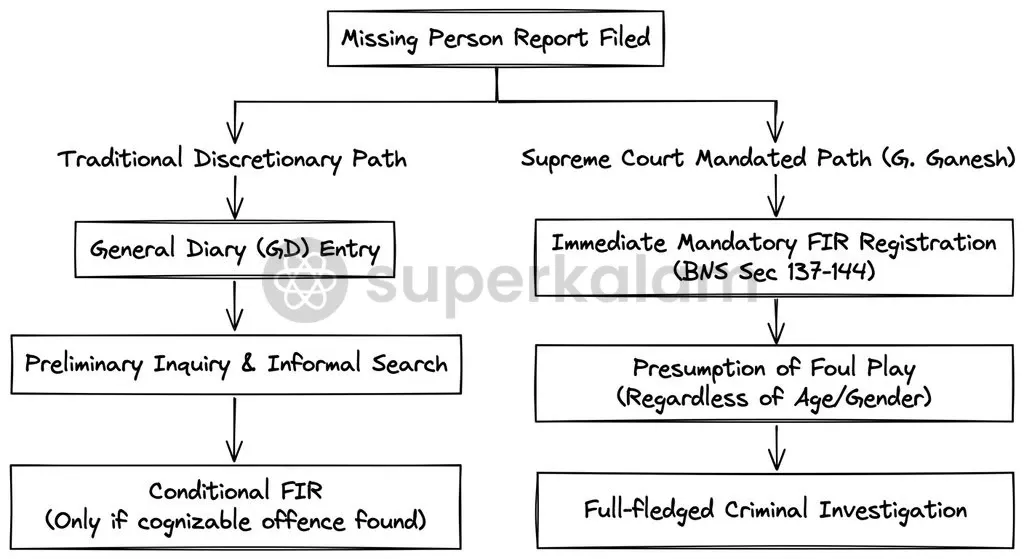
The Code of Criminal Procedure, 1973 (CrPC) and its successor, the Bharatiya Nagarik Suraksha Sanhita, 2023 (BNSS), historically drew a sharp line between cognizable offences and non-cognizable missing reports. Mere disappearance is not defined as a penal offence under the Indian Penal Code or the Bharatiya Nyaya Sanhita, 2023 (BNS).
Historically, Indian criminal jurisprudence processed missing reports through three distinct procedural tracks:
- Conventional Missing Reports: Unexplained disappearances were entered into the General Diary (GD) or a Missing Person Register rather than an FIR.
- Missing Children (Bachpan Bachao Andolan, 2013): Whenever a minor child goes missing, law enforcement must entertain an initial legal presumption of kidnapping or trafficking under statutory law, making the immediate registration of an FIR under Section 154 of the CrPC mandatory.
- Adult Disappearances (Lalita Kumari, 2014): The five-judge Constitution Bench established that an FIR is mandatory under Section 154 only if the received information discloses a cognizable offence, expressly permitting a preliminary enquiry when criminal conduct is not evident on the face of the complaint.
Discuss with Superkalam
Which specific penal sections of the Bharatiya Nyaya Sanhita, 2023 did the Supreme Court order to be included in all missing person FIRs?
Ask NowThe Case Explained: What Happened in G. Ganesh v State of Tamil Nadu
The Supreme Court heard G. Ganesh v. State of Tamil Nadu & Ors. (SLP Crl. No. 11263/2025) to tackle systemic paralysis in tracing missing persons across India. Station officers routinely delayed active investigations by logging complaints as non-cognizable administrative matters. That delay allowed perishable digital and physical evidence to vanish during initial search windows.
Evaluating the institutional gaps in inter-state coordination, the Supreme Court issued wide-ranging continuing directions to re-engineer police response systems:
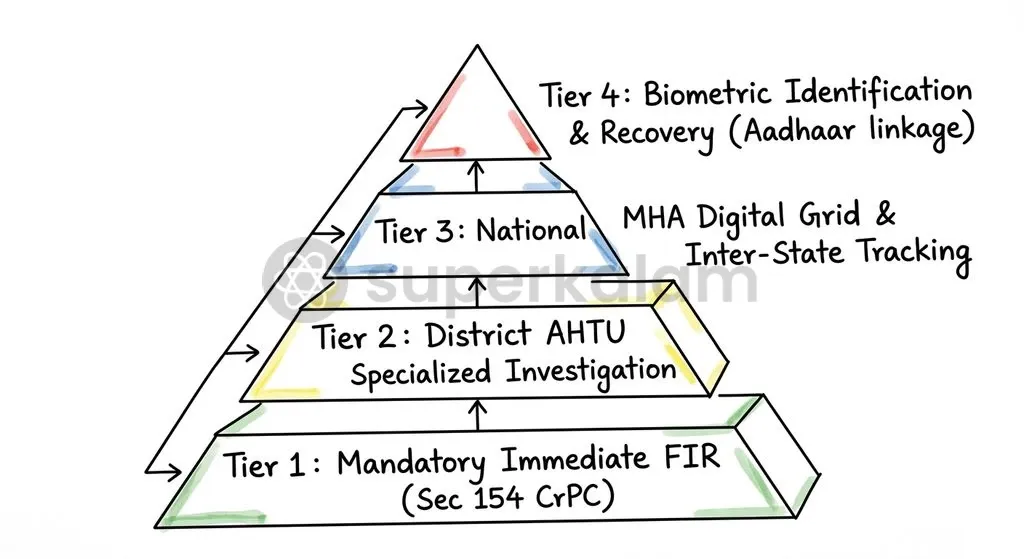
- Police stations nationwide must register an immediate FIR upon receiving a missing person report without conducting a preliminary enquiry.
- All States and Union Territories must fully operationalise District Anti-Human Trafficking Units (AHTUs) with dedicated personnel and specialised investigative resources.
- The Ministry of Home Affairs must build an all-India digital portal grid to track missing women, children, and human trafficking networks across inter-state borders.
- Every rescued or traced individual must undergo Aadhaar biometric verification to establish definitive identity and prevent repeated trafficking cycles.
What the Supreme Court Actually Held on Mandatory FIRs
The Supreme Court directed that every missing person FIR must mandatorily incorporate penal provisions relating to kidnapping, abduction, or trafficking under Sections 137 to 144 of the Bharatiya Nyaya Sanhita, 2023. According to the Court, prompt invocation of statutory criminal law is indispensable to mobilise formal investigative powers during the golden hours immediately following a disappearance.
This order introduces a profound doctrinal evolution when reconciled with the landmark Constitution Bench ruling in Lalita Kumari (2014):
- Reconciling Doctrinal Conflict: Lalita Kumari permits a preliminary enquiry if a complaint does not prima facie reveal a crime. Under the Bharatiya Nyaya Sanhita, 2023, an adult's unexplained absence is not inherently a crime. G. Ganesh overrides this distinction by effectively imposing a blanket judicial presumption of criminality on all disappearances, prioritising swift anti-trafficking mobilisation over the discretionary threshold set in Lalita Kumari.
- Elimination of Investigatory Discretion: Police officers can no longer hold complaints in the General Diary pending initial verification. The directive treats time as the decisive parameter in saving lives, converting missing person reporting into an automatic statutory trigger.
Discuss with Superkalam
Explain why the legal presumption applied to missing children under Bachpan Bachao Andolan cannot be seamlessly extended to missing adults.
Ask NowKey Differences: Missing Children vs Missing Adults
The Supreme Court extended rules originally framed for child protection directly to adults, creating a sharp contrast in legal assumptions and constitutional protections.
| Dimension | Missing Children (Under 18 Years) | Missing Adults (18 Years and Above) |
|---|---|---|
| Legal Foundation | Bachpan Bachao Andolan v. UOI (2013) | G. Ganesh v. State of Tamil Nadu (2026) |
| Presumption of Crime | Strict presumption of kidnapping or trafficking | Presumption of abduction/trafficking mandated under BNS Sections 137–144 |
| Role of Individual Consent | Immaterial; a minor lacks legal capacity to give valid consent | Central; a competent adult possesses the right of voluntary departure |
| Constitutional Right Engaged | Article 21 (right to protection) and Article 39 (protection against exploitation) | Article 21 (liberty, privacy) and Article 19(1)(d) (freedom of movement) |
| Statutory Conflict | Clear cognizable penal offence under child protection statutes | Tension between statutory penal codes and individual civil autonomy |
Personal Liberty (Article 21) vs Family Rights: Why Adults Can Leave
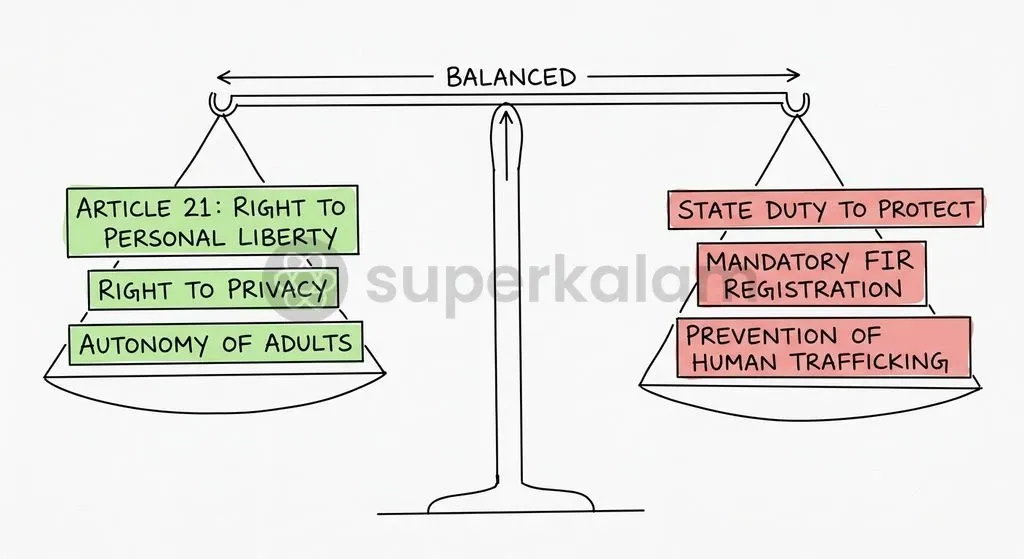
The Constitution of India protects the fundamental right of every adult citizen to live independently, exercise bodily autonomy, and choose their own relationships. As established in K.S. Puttaswamy v. Union of India (2017), personal liberty under Article 21 encompasses informational privacy and the autonomous right of competent individuals to make intimate life decisions without unwarranted state surveillance.
When a competent adult chooses to walk away from their marital home, family, or community, they exercise rights guaranteed under Article 19(1)(d) and Article 21:
- Absence of a Legal Wrong: An adult leaving home without informing family commits no civil or penal wrong under Indian law.
- Limits of Familial Claim: While families experience severe emotional distress, family rights cannot override an individual's fundamental right to privacy and personal liberty.
- Protection Against Involuntary Return: The police cannot legally compel, detain, or return a consenting adult to their family once their safety and independent consent are established.
Discuss with Superkalam
How might a mandatory kidnapping FIR under Section 137-144 BNS impact consenting adults who leave home to enter an inter-caste marriage?
Ask NowEthical and Administrative Challenges for the Police (GS-4)
The mandate to register kidnapping FIRs for all missing adults places law enforcement at a difficult crossroad between protective duty and civil liberty. Law enforcement officers face complex public administration challenges in implementing this directive:
- Weaponisation by Families: An immediate criminal FIR can be misused by conservative families against consenting adults entering inter-caste, inter-faith, or non-traditional relationships, as analysed by legal scholars. Converting an autonomous adult choice into an alleged kidnapping offence exposes consenting partners to unlawful arrest and harassment.
- State Paternalism vs Citizen Autonomy: Paternalistic state machinery risks treating adult citizens as property of their families rather than autonomous rights-bearing individuals.
- Stigmatisation and Coercion: A formal criminal FIR activates coercive investigative processes, such as mobile tracking and public look-out notices, directly compromising an individual's reputational privacy.
- Wasted Institutional Bandwidth: Compelling District Anti-Human Trafficking Units to investigate consensual departures diverts critical investigative resources away from genuine abductions and organised trafficking syndicates.
Discuss with Superkalam
Weigh the benefits of rapid anti-trafficking mobilisation during the 'golden hours' against the risk of infringing on an adult's Article 21 privacy rights.
Ask NowWay Forward: A Clear Standard Operating Procedure for Missing Persons
The Supreme Court directives in G. Ganesh require a refined administrative protocol to reconcile rapid anti-trafficking action with individual constitutional rights. Standardising police procedures across all States and Union Territories will ensure both safety and civil liberty:
- Tiered Standard Operating Procedures: State police departments should implement protocols that distinguish between high-risk adult disappearances (involving suspected violence or ransom) and cases of voluntary departure, as highlighted by administrative experts.
- Confidential Non-Coercive Welfare Checks: When an adult is traced, the police must record their statement privately. If the individual confirms their departure was voluntary, police must close the enquiry and keep their location confidential from estranged relatives to preserve individual privacy.
- Capacity Building for AHTUs: Anti-Human Trafficking Units must receive institutional training to handle sensitive domestic disputes, matrimonial discord, and inter-community partnerships with constitutional empathy.
- Digital Oversight and Safeguards: The national digital missing persons portal must incorporate strict data protection safeguards to prevent the misuse of personal location data and biometric records.
Key Takeaways
- The Supreme Court in G. Ganesh v. State of Tamil Nadu made the registration of a First Information Report mandatory for all missing individuals, explicitly including adults.
- FIRs must incorporate penal provisions for kidnapping, abduction, or human trafficking under Sections 137 to 144 of the Bharatiya Nyaya Sanhita, 2023 to protect investigative golden hours.
- This directive modifies the preliminary enquiry mechanism permitted under Lalita Kumari (2014) by establishing a blanket procedural presumption of crime in disappearance cases.
- Competent adults possess the fundamental right under Article 21 and Article 19(1)(d) to leave their families voluntarily without being subjected to criminal proceedings.
- A balanced administrative Standard Operating Procedure is essential to prevent the weaponisation of FIRs against inter-caste and consensual adult relationships while preserving anti-trafficking safeguards.
Mains Question
"The mandatory registration of FIRs for missing adults under Sections 137 to 144 of the Bharatiya Nyaya Sanhita, 2023, while aimed at curbing human trafficking during the critical 'golden hours', creates significant friction with fundamental rights under Articles 19(1)(d) and 21." Critically examine. (15 Marks)
Evaluate NowMains Question
In light of the rulings in Lalita Kumari (2014) and G. Ganesh v. State of Tamil Nadu (2026), evaluate the shift in judicial doctrine regarding preliminary enquiries for missing persons. (10 Marks)
Evaluate NowPractice MCQs
QUESTION 1
With reference to Indian jurisprudence on missing persons, consider the following statements:
- Under the ruling in Bachpan Bachao Andolan (2013), law enforcement must entertain an initial legal presumption of kidnapping or trafficking whenever a minor goes missing.
- In Lalita Kumari (2014), the Constitution Bench held that a preliminary enquiry is permissible when the complaint does not prima facie disclose a cognizable offence.
- The Supreme Court in G. Ganesh v. State of Tamil Nadu directed that mandatory FIR registration applies exclusively to missing children and vulnerable women. Which of the statements given above are correct?
QUESTION 2
Consider the following institutional directives issued by the Supreme Court in G. Ganesh v. State of Tamil Nadu:
- Mandating the full operationalisation of District Anti-Human Trafficking Units (AHTUs) across all States and Union Territories.
- Directing the Ministry of Home Affairs to construct an all-India digital portal grid to track trafficking networks and missing persons.
- Requiring Aadhaar biometric verification for every rescued or traced individual to confirm identity. Which of the statements given above are correct?
QUESTION 3
With reference to the legal status of missing adults in India, consider the following statements:
- The unexplained voluntary departure of a competent adult is explicitly classified as a cognizable penal offence under the Bharatiya Nyaya Sanhita, 2023.
- Under Article 21, personal liberty encompasses informational privacy and the right of competent adults to make autonomous decisions without unwarranted state surveillance.
- Following the G. Ganesh ruling, police officers retain the statutory discretion to hold missing person complaints in the General Diary pending initial verification. Which of the statements given above is/are correct?
QUESTION 4
Under the Supreme Court's ruling in G. Ganesh v. State of Tamil Nadu, missing person FIRs must mandatorily incorporate penal provisions relating to kidnapping, abduction, or trafficking under which specific sections of the Bharatiya Nyaya Sanhita, 2023?
QUESTION 5
Consider the following statements regarding procedural compliance in missing person investigations:
- The Supreme Court issued contempt show-cause notices to Chief Secretaries and Directors General of Police of non-compliant States and UTs for failing to submit compliance affidavits.
- Registration of an immediate FIR without preliminary enquiry is designed to capitalise on the critical 'golden hours' following a disappearance. Which of the statements given above is/are correct?