Right to Protest in India: Article 19 and Section 163 BNSS
Article 19 protects peaceful assembly, subject to lawful restrictions. See how Section 163 BNSS affects protests and replaces Section 144 CrPC.
Oct, 2026
•13 min read
Overview
Section 163 of the Bharatiya Nagarik Suraksha Sanhita, 2023 replaced the colonial-era Section 144 of the Code of Criminal Procedure on 1 July 2024. The new provision reproduces the historic framework of preventive executive restraint while leaving modern judicial guardrails uncodified.
Executive Magistrates retain summary authority to issue emergency prohibitory directives across districts. They may act to prevent nuisance, annoyance, or perceived threats to public order. This statutory repetition maintains an executive-centric policing model, declining to integrate decades of Supreme Court safeguards.
At the same time, companion reforms under Section 223 of the Bharatiya Nyaya Sanhita, 2023 sharpen custodial and financial sanctions. Evaluating Section 163 requires assessing whether criminal law reform modernised preventive governance or merely entrenched historical administrative dominance over democratic assembly.
Why Section 163 BNSS Is Facing Scrutiny Today
Section 163 of the Bharatiya Nagarik Suraksha Sanhita, 2023 took effect on 1 July 2024, replacing Section 144 of the Code of Criminal Procedure, 1973 amid intense debate over civil liberties. According to Ministry of Home Affairs Notification S.O. 850(E), the transition marked a wholesale legislative overhaul of India's criminal procedure. As of July 2024, legal scholars and civil liberties advocates have focused scrutiny on whether this statutory transition delivers genuine reform or preserves executive dominance.
The core controversy stems from how preventive power interacts with democratic dissent. District administrations frequently deploy prohibitory orders to preempt civil assemblies, labour strikes, and political demonstrations:
- Administrative Preemption: Authorities issue blanket prohibitory decrees before public gatherings can convene.
- Statutory Continuity: The mechanism for restricting assemblies remains practically identical to its 19th-century predecessor.
- Chilling Effects: Citizens face heightened criminal deterrence for exercising constitutional rights to assemble.
This legislative continuity raises serious constitutional concerns regarding executive overreach. Section 163 grants broad magisterial discretion without incorporating the substantive limits developed by the higher judiciary over five decades. Understanding its practical impact requires examining how the Constitution of India defines and protects the right to assemble.
Discuss with Superkalam
Which specific constitutional grounds are exhaustively enumerated under Article 19(3) to restrict the right to assemble peaceably?
Ask NowConstitutional Foundation: The Interplay of Articles 19(1)(a), 19(1)(b), and 19(2)
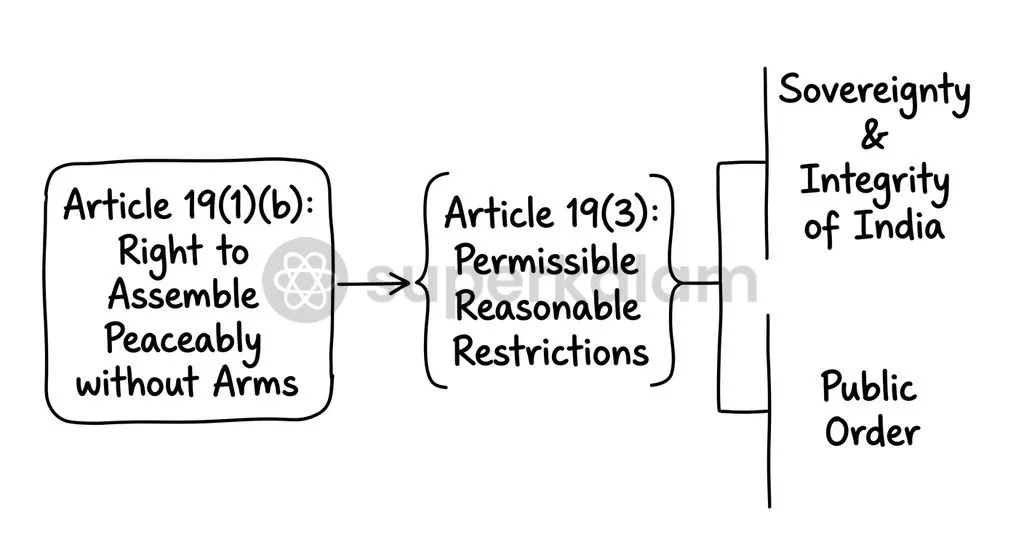
Article 19(1)(b) of the Constitution of India guarantees citizens the fundamental right to assemble peaceably and without arms, forming a structural pillar of democratic governance. According to the Constitution of India, this freedom operates alongside Article 19(1)(a), which secures the right to freedom of speech and expression. Together, these provisions ensure that collective civic expression remains a protected fundamental right rather than a state-granted concession.
| Constitutional Provision | Scope and Operational Boundary | Constitutional Purpose |
|---|---|---|
| Article 19(1)(b) | Guarantees the fundamental right to assemble peaceably and without arms | Protects collective civic assembly and political dissent |
| Article 19(3) | Exhaustive restriction grounds: sovereignty and integrity of India, or public order | Limits state restrictions to strictly enumerated security grounds |
The exercise of these freedoms is not absolute and remains subject to specific constitutional boundaries. Under Article 19(3), the State may enact laws imposing reasonable restrictions on peaceful assembly exclusively on two grounds: the sovereignty and integrity of India or public order. The absence of grounds such as "decency", "morality", or "general public interest" in Article 19(3) demonstrates that the constitutional threshold for curbing assemblies is exceptionally narrow.
Judicial precedent has firmly established that administrative convenience cannot be equated with threats to public order. Peaceful assembly is an indispensable democratic safety valve, enabling citizens to express collective dissent and petition public authorities. When executive authorities use statutory mechanisms to suppress assemblies arbitrarily, they infringe upon this constitutional baseline.
From Section 144 CrPC to Section 163 BNSS: What Changed and What Stayed the Same?
Section 163 of the Bharatiya Nagarik Suraksha Sanhita, 2023 preserves the core statutory language and administrative architecture of the erstwhile Section 144 of the Code of Criminal Procedure, 1973. According to a statutory comparison of both codes, Section 163 retains the substantive grounds, magistrate powers, and procedural structures wholesale. The new provision does not alter the fundamental mechanism through which the executive imposes preventive curbs.
Under Section 163(1) BNSS, a District Magistrate, Sub-divisional Magistrate, or specially empowered Executive Magistrate may issue a written order when immediate prevention or speedy remedy is necessary. The magistrate must state the material facts of the case and determine that the direction is likely to prevent:
- Obstruction, annoyance, or injury to any person lawfully employed;
- Danger to human life, health, or safety; or
- A disturbance of the public tranquility, a riot, or an affray.
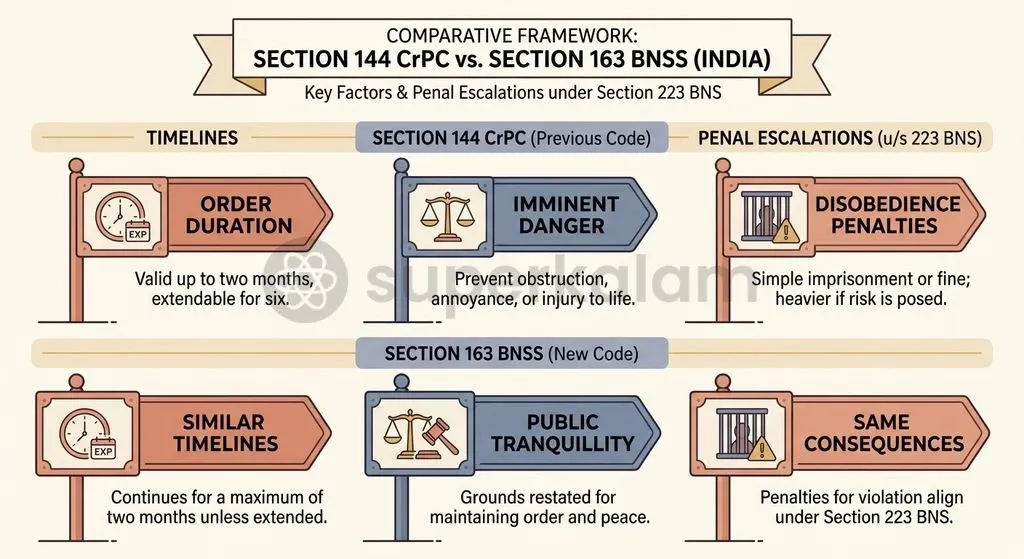
Emergency and ex-parte provisions remain completely intact under the new framework. Section 163(2) BNSS allows a Magistrate to pass prohibitory orders ex parte in cases of emergency or where circumstances make serving notice on affected individuals impractical. The default validity of any such order remains capped at two months under Section 163(4), with State Governments retaining the power to extend the order for up to six additional months.
The primary divergence between the regimes lies in the punitive consequences of disobedience. Disobedience of an order lawfully promulgated under Section 163 BNSS is now penalised under Section 223 of the Bharatiya Nyaya Sanhita, 2023, which replaced Section 188 of the Indian Penal Code. The Bharatiya Nyaya Sanhita significantly escalates both financial penalties and custodial sentences, increasing the deterrent cost of non-violent civic disobedience.
Discuss with Superkalam
How does the statutory mechanism of Section 163 BNSS allow executive magistrates to issue ex parte orders without prior notice?
Ask NowSide-by-Side: Procedural Comparison Between Section 144 CrPC and Section 163 BNSS
Procedural comparisons between Section 144 of the Code of Criminal Procedure, 1973 and Section 163 of the Bharatiya Nagarik Suraksha Sanhita, 2023 highlight statutory continuity alongside heightened criminal deterrence. The underlying administrative machinery remains structurally unaltered across both procedural regimes.
| Dimension | Section 144 CrPC (1973) | Section 163 BNSS (2023) | Exam Significance |
|---|---|---|---|
| Empowered Authority | District Magistrate, Sub-divisional Magistrate, or specially empowered Executive Magistrate | District Magistrate, Sub-divisional Magistrate, or specially empowered Executive Magistrate | Executive primacy retained; no judicial magistrate oversight required. |
| Threshold Condition | Apprehension of obstruction, annoyance, danger to life, or disturbance of tranquility | Apprehension of obstruction, annoyance, danger to life, or disturbance of tranquility | Identical threshold preserving wide administrative discretion. |
| Ex-Parte Powers | Permitted in emergencies under Section 144(2) CrPC | Permitted in emergencies under Section 163(2) BNSS | Summary administrative powers preserved without prior notice. |
| Initial Validity Period | Maximum 2 months from date of order | Maximum 2 months from date of order | Identical baseline validity window under Section 163(4). |
| State Extension Limit | Up to an additional 6 months | Up to an additional 6 months | State executive retains authority to extend curbs up to half a year. |
| Remedy Against Order | Application to Magistrate or State Government under Section 144(5)-(6) | Application to Magistrate or State Government under Section 163(5)-(6) | Internal executive review retained; hearing required under Section 163(7). |
| Penal Sanction for Simple Disobedience | Up to 1 month simple imprisonment or fine up to ₹200 (Section 188 IPC) | Up to 6 months simple imprisonment or fine up to ₹2,500 (Section 223(a) BNS) | Six-fold increase in jail term; over twelve-fold increase in fine. |
| Penal Sanction for Disobedience Causing Danger / Riot | Up to 6 months imprisonment or fine up to ₹1,000 (Section 188 IPC) | Up to 1 year imprisonment or fine up to ₹5,000 (Section 223(b) BNS) | Doubling of imprisonment; five-fold increase in financial sanction. |
The comparative matrix confirms that procedural safeguards were neither expanded nor reformed. Section 163(7) BNSS carries forward the rule that magistrates must provide an early hearing and record written reasons if a rescission application is rejected. However, Parliament chose not to codify the extensive procedural guardrails mandated by modern Supreme Court jurisprudence directly into the statute.
Judicial Guardrails: From Madhu Limaye to the Shaheen Bagh Rulings
The Supreme Court of India established enduring constitutional boundaries for preventive magistrate orders through landmark rulings stretching from Madhu Limaye in 1970 to Amit Sahni in 2020. The constitutional bench in Madhu Limaye v. Sub-Divisional Magistrate, Monghyr (1970) upheld the validity of Section 144 CrPC, ruling that the provision confers an extraordinary emergency power to be invoked only in urgent situations of imminent danger. Chief Justice M. Hidayatullah emphasised that the power is not ordinary executive authority and cannot be used to suppress lawful civic expression.
In Himat Lal K. Shah v. Commissioner of Police, Ahmedabad (1973), a five-judge Constitution Bench ruled that the right to hold public meetings on public streets flows directly from Article 19(1)(b). The Supreme Court held that while the State may regulate assemblies to maintain traffic and peace, regulatory regimes must contain defined objective standards rather than functioning as arbitrary licensing systems.
| Year | Landmark Precedent | Core Constitutional Doctrine Established |
|---|---|---|
| 1970 | Madhu Limaye v. SDM, Monghyr | Upheld preventive power strictly as an emergency remedy for imminent danger. |
| 1973 | Himat Lal K. Shah v. Commr. of Police | Street assembly protected; arbitrary executive licensing regimes prohibited. |
| 2012 | In Re: Ramlila Maidan Incident | Executive apprehension of inconvenience does not equal imminent public threat. |
| 2018 | Mazdoor Kisan Shakti Sangathan v. UOI | Indefinite, blanket prohibitory orders around protest venues declared unlawful. |
| 2020 | Anuradha Bhasin v. Union of India | Four-prong proportionality test made mandatory for preventive orders. |
| 2020 | Amit Sahni v. Commr. of Police | Right to protest balanced against commuter rights of public way access. |
The Supreme Court reinforced these limits in In Re: Ramlila Maidan Incident (2012), ruling that executive magistrates must distinguish between peaceable assemblies and imminent threats to public order. The Court held that force and prohibitory powers cannot be deployed casually or based merely on an apprehension of administrative inconvenience.
In Mazdoor Kisan Shakti Sangathan v. Union of India (2018), the Court struck down indefinite prohibitory orders around New Delhi's Jantar Mantar, characterising peaceful demonstration as an essential democratic safety valve. In Amit Sahni v. Commissioner of Police (2020), the Supreme Court balanced protest rights with commuter mobility during the Shaheen Bagh demonstrations, holding that public ways cannot be blocked indefinitely and that protests must occur in designated areas.
Discuss with Superkalam
If a district administration issues a blanket prohibitory order under Section 163 BNSS ahead of a planned civic demonstration, how can affected citizens seek statutory recourse under the Sanhita?
Ask NowThe Anuradha Bhasin Test: Applying the Four-Prong Proportionality Standard to Preventive Curbs
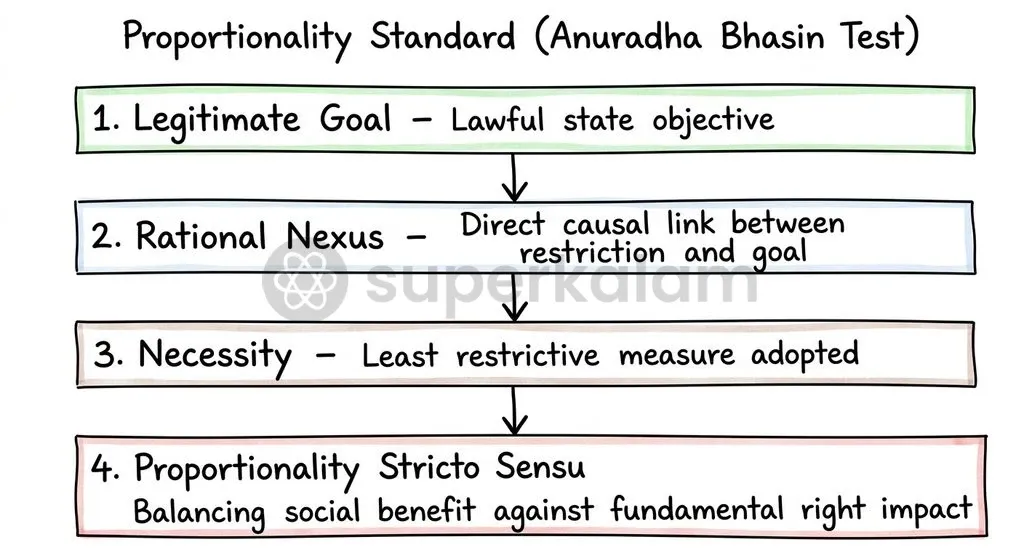
The Supreme Court established a binding four-prong proportionality standard for executive prohibitory orders in the landmark judgment of Anuradha Bhasin v. Union of India in 2020. Delivered in the context of indefinite restrictions in Jammu and Kashmir, the ruling made clear that preventive orders under Section 144—and by extension Section 163 BNSS—must satisfy rigorous constitutional scrutiny.
| Proportionality Prong | Constitutional Requirement | Administrative Threshold |
|---|---|---|
| 1. Legitimate Goal | Order must pursue an authorised constitutional objective | Grounded strictly in Article 19(2) or 19(3) public order needs |
| 2. Rational Connection | Demonstrable nexus between the curb and the disorder | Executive must prove prohibition directly remedies the specific threat |
| 3. Necessity | Selection of the least invasive restriction available | Executive must exhaust non-coercive measures before blanket curbs |
| 4. Balanced Impact | Harm to rights must not outweigh administrative benefit | Proportionality stricto sensu balancing fundamental civic rights |
The Court articulated four mandatory prongs that every magistrate must evaluate before issuing a prohibitory order:
- Legitimate Goal: The restriction must pursue an authorised constitutional objective under Article 19(2) or 19(3), such as safeguarding public order or state sovereignty;
- Rational Connection (Suitability): A direct, demonstrable nexus must link the specific prohibition to the goal of preventing disorder;
- Necessity (Least Restrictive Means): The executive must choose the least invasive measure available, exhausting non-coercive alternatives before issuing blanket curbs;
- Balanced Impact (Proportionality Stricto Sensu): The administrative benefit of the restriction must not be disproportionate to the infringement upon fundamental freedoms.
In addition to this four-prong test, Anuradha Bhasin mandated transparency and proactive publication. The Supreme Court ruled that repetitive or indefinite prohibitory orders are an abuse of statutory power. It established that all orders must be published openly to enable judicial review. Because Parliament omitted this four-prong standard from the text of Section 163 BNSS, executive magistrates remain vulnerable to issuing orders that violate this binding test.
Executive Discretion vs Fundamental Freedoms: Key Operational and Human Rights Concerns
Executive discretion exercised under Section 163 of the Bharatiya Nagarik Suraksha Sanhita, 2023 raises significant operational concerns regarding the preventive criminalisation of legitimate democratic protest. The Parliamentary Standing Committee on Home Affairs noted that preserving subjective magistrate satisfaction without codifying judicial limits creates a substantial chilling effect on civic participation. Prohibitory orders are frequently promulgated on broad, formulaic grounds before any actual breach of public peace takes place.
This dynamic alters the relationship between the citizen and the state in several operational ways:
- Preemptive Criminalisation: Summary orders transform ordinary civic assembly into a cognisable penal offence before any unlawful conduct occurs;
- Information Asymmetry: Ex-parte orders passed under Section 163(2) deny organisers an opportunity to present mitigating security arrangements;
- Chilling Civic Participation: Heightened penal sanctions under Section 223 BNS discourage citizens from participating in peaceful public demonstrations;
- Delayed Judicial Redress: Because prohibitory orders are temporary, legal challenges often become infructuous before constitutional courts can hear them.
The combination of unchecked administrative discretion and steep criminal penalties creates a substantial barrier to democratic discourse. When executive authorities use Section 163 as a standard administrative tool rather than an emergency remedy, the rule of law is undermined. Balancing public safety with civil liberties requires active institutional restraint and clear procedural accountability.
Discuss with Superkalam
Compare the penal implications of Section 223 BNS against Section 188 IPC: why does heightened criminal deterrence impact non-violent dissent differently than administrative preemption?
Ask NowReforming Preventive Orders: Striking the Balance Between Public Order and Democratic Dissent
Reforming executive orders under Section 163 of the Bharatiya Nagarik Suraksha Sanhita, 2023 requires structural alignment between local administrative policing and modern constitutional jurisprudence. The Supreme Court highlighted in Anita Thakur v. State of Jammu & Kashmir (2016) that public authorities bear an affirmative duty to use calibrated crowd management rather than blanket prohibitions. Calibrated policing—such as designating demonstration zones, altering traffic routes, and deploying marshals—must take priority over summary bans.
To institutionalise constitutional standards, state governments and the judiciary should introduce concrete administrative reforms:
- Statutory Codification of Proportionality: State amendments should incorporate the Anuradha Bhasin four-prong test into local rules governing Section 163;
- Mandatory Digital Gazetting: All prohibitory orders must be published immediately on district portals to uphold transparency and enable prompt legal review;
- Narrow Spatial Scoping: Magistrates should issue site-specific restrictions rather than enforcing sweeping district-wide bans;
- Independent Magisterial Audits: High Courts should establish periodic reviews of Section 163 invocations to deter repetitive or routine use.
Democratic governance relies on public spaces functioning as arenas for collective expression. By moving from summary prohibition to calibrated facilitation, executive authorities can preserve public order while upholding fundamental rights guaranteed under Article 19.
Key Takeaways
- Statutory Continuity: Section 163 BNSS replaced Section 144 CrPC on 1 July 2024, retaining its grounds, ex-parte powers, and validity timelines wholesale.
- Escalated Penal Sanctions: Disobedience is now punished under Section 223 BNS, raising maximum penalties to six months for simple disobedience and one year for acts threatening safety or rioting.
- Constitutional Standards: Under Article 19(3), peaceful assembly can be restricted solely in the interests of sovereignty, integrity, or public order.
- The Proportionality Test: The Supreme Court in Anuradha Bhasin (2020) made the four-prong proportionality test mandatory for all executive prohibitory orders.
- Procedural Reform Deficit: Section 163 BNSS omits explicit judicial guardrails, maintaining broad executive discretion that risks chilling lawful public dissent.
Mains Question
"Section 163 of the Bharatiya Nagarik Suraksha Sanhita, 2023 reproduces the historic framework of preventive executive restraint while leaving modern judicial guardrails uncodified." Critically examine this statement in light of the constitutional guarantee under Article 19(1)(b). (15 Marks)
Evaluate NowMains Question
While Section 163 of the Bharatiya Nagarik Suraksha Sanhita, 2023 maintains procedural continuity with the colonial-era Code of Criminal Procedure, Section 223 of the Bharatiya Nyaya Sanhita, 2023 sharpens penal consequences. Discuss the implications of this statutory design on public order and democratic dissent. (10 Marks)
Evaluate NowPractice MCQs
QUESTION 1
With reference to the constitutional grounds for restricting the freedom of peaceful assembly under the Constitution of India, consider the following statements: 1. Under Article 19(3), the State may impose reasonable restrictions on peaceful assembly on the grounds of decency and morality. 2. The grounds of restriction under Article 19(3) are exhaustively confined to the sovereignty and integrity of India and public order. Which of the statements given above is/are correct?
QUESTION 2
Regarding the procedural provisions of Section 163 of the Bharatiya Nagarik Suraksha Sanhita (BNSS), 2023, consider the following statements: 1. A Magistrate is empowered to pass prohibitory orders ex parte in situations of emergency. 2. The default validity of an initial order promulgated under Section 163 is capped at six months. 3. The State Government possesses the statutory power to extend the operation of an order for up to six additional months. Which of the statements given above are correct?
QUESTION 3
Consider the following statements regarding the penal consequences of disobeying prohibitory orders under Section 223 of the Bharatiya Nyaya Sanhita (BNS), 2023 as compared to the erstwhile Section 188 of the Indian Penal Code (IPC): 1. Section 223 BNS replaced Section 188 IPC for penalising disobedience of lawfully promulgated orders. 2. For simple disobedience, Section 223(a) BNS prescribes simple imprisonment of up to six months or a fine up to ₹2,500. 3. For disobedience causing danger to human life or causing a riot, the maximum term of imprisonment under Section 223(b) BNS has been doubled compared to Section 188 IPC. Which of the statements given above are correct?
QUESTION 4
Consider the following statements regarding the authorities and procedural mandates under Section 163 of the Bharatiya Nagarik Suraksha Sanhita, 2023: 1. Section 163 introduces mandatory prior oversight by a Judicial Magistrate before an order is issued. 2. A Sub-divisional Magistrate or a specially empowered Executive Magistrate can lawfully issue orders under Section 163(1). 3. If an application to rescind or alter a prohibitory order is rejected, the magistrate is statutorily required to record written reasons under Section 163(7). Which of the statements given above is/are correct?
QUESTION 5
In the landmark judgment of Madhu Limaye v. Sub-Divisional Magistrate, Monghyr (1970), what did the Supreme Court of India hold regarding the nature of preventive prohibitory powers under criminal procedure?