MP OBC Reservation Verdict 2026: 27% Quota and the 50% Ceiling
The MP High Court's OBC quota verdict examines the rise from 14% to 27%, the 50% reservation ceiling and the need for evidence.
Oct, 2026
•8 min read
Overview
The Madhya Pradesh High Court invalidated the state's statutory enhancement of Other Backward Classes reservation from 14% to 27% on October 9, 2026. The bench confirmed that state quotas cannot breach the mandatory 50% constitutional ceiling without empirical proof of extraordinary isolation from the national mainstream.
This ruling reinforces the enduring principles settled in Indra Sawhney v. Union of India. Population proportions alone cannot legally justify expanding affirmative action. By striking down the 2019 legislative amendment, the Jabalpur Bench affirmed that judicial review checks executive action when statutes lack contemporaneous, quantifiable data on social and educational backwardness.
Why in the News: The Madhya Pradesh High Court Quashes the 27% OBC Quota Hike
The Madhya Pradesh High Court struck down the state's statutory enhancement of Other Backward Classes (OBC) reservations on October 9, 2026, invalidating the hike from 14% to 27%. A Division Bench delivered the ruling in Ashita Dubey & Ors. v. State of Madhya Pradesh, declaring the measure unconstitutional and ultra vires.
As of October 2026, this judicial pronouncement restores the operational OBC quota in state public employment and educational institutions to 14%.
The bench evaluated the statutory dispute across core constitutional grounds:
- Constitutional mandate: State-sponsored affirmative action remains governed under Articles 15(4) and 16(4).
- Absence of justification: The state administration failed to prove any emergent situations or extraordinary circumstances that would justify surpassing the binding 50% ceiling.
- Legal finality: The ruling effectively settled a protracted legal battle over state legislative limits.
Discuss with Superkalam
What baseline statutory reservation percentage was allocated to OBCs under Section 4 of the Madhya Pradesh Lok Seva Arakshan Adhiniyam, 1994?
Ask NowInside the MP Dispute: How the 2019 Ordinance Pushed Total Reservations to 73%
The Madhya Pradesh legislative assembly enacted the contested quota expansion by amending its statutory framework in 2019. The executive branch initially promulgated Madhya Pradesh Ordinance No. 2 of 2019 on March 8, 2019. The state legislature subsequently replaced it with the Madhya Pradesh Lok Seva Sanshodhan Adhiniyam, 2019 (M.P. Act No. 12 of 2019).
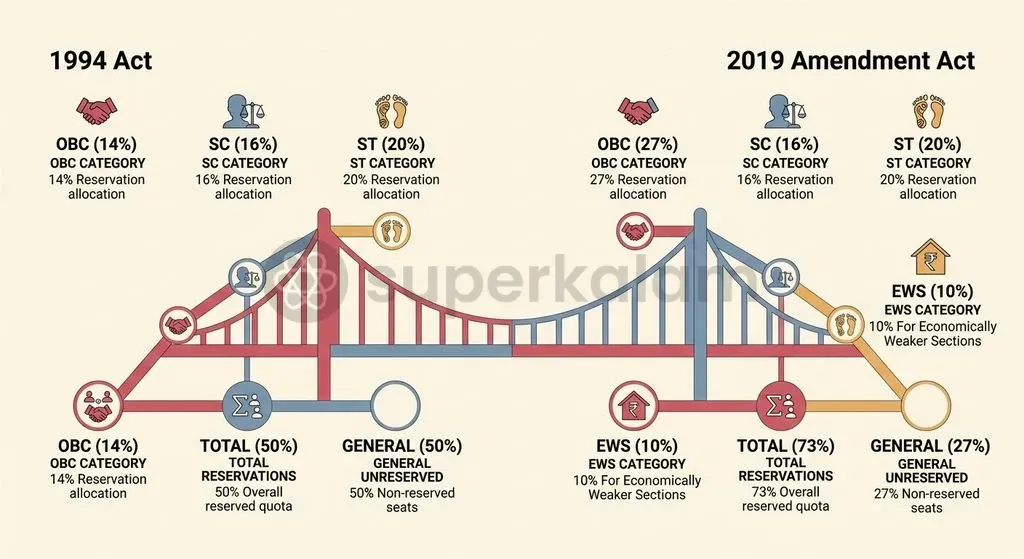
Statutory reservations in the state were previously anchored to the Madhya Pradesh Lok Seva Arakshan Adhiniyam, 1994 (Act No. 21 of 1994). Section 4 of the 1994 parent statute distributed vertical reservations evenly up to the constitutional boundary:
- Scheduled Tribes (ST): 20% allocation reflecting demographic concentrations.
- Scheduled Castes (SC): 16% allocation.
- Other Backward Classes (OBC): 14% allocation.
The baseline statutory framework totalled precisely 50%. By raising the OBC quota to 27%, the 2019 amendment increased caste-based vertical reservation to 63%.
When combined with the 10% horizontal allocation for Economically Weaker Sections (EWS), aggregate reservations reached 73%. The bench noted that the state executed the statutory change in undue haste without mandatory consultation with the National Commission for Backward Classes under Article 338B.
The State's Justification: Quantifiable Backwardness Data and Why the Court Found It Inadequate
The Madhya Pradesh government defended its quota hike by arguing that OBC communities form an overwhelming majority of the state population. The state presented the historical findings of the 1983 Ramji Mahajan Backward Classes Commission alongside a 2023 study by the Dr. B.R. Ambedkar University of Social Sciences in Mhow to substantiate the expansion.
Judicial scrutiny revealed that these submissions lacked contemporaneous empirical rigour. Official administrative records directly contradicted the state's claim of inadequate representation under Article 16(4):
- Higher education representation: OBC candidates occupied 33.87% of higher education enrolments across state universities.
- Public service employment: OBC employees secured 28.16% of posts across various tiers of state public services.
- Open-competition recruitment: Candidates from backward classes routinely obtained appointments within the unreserved merit quota without relying on affirmative action.
These verified datasets prove that backward classes in Madhya Pradesh actively participate in the mainstream. Article 16(4) addresses inadequacy of representation rather than strict proportional representation based on census estimates. Consequently, the state's empirical defence collapsed under judicial examination.
Discuss with Superkalam
Explain how the Supreme Court differentiates between 'inadequacy of representation' and 'proportional representation' when evaluating affirmative action under Article 16(4).
Ask NowThe 50% Ceiling Doctrine: From Indra Sawhney to the Rejection of MP's Exceptional Circumstances
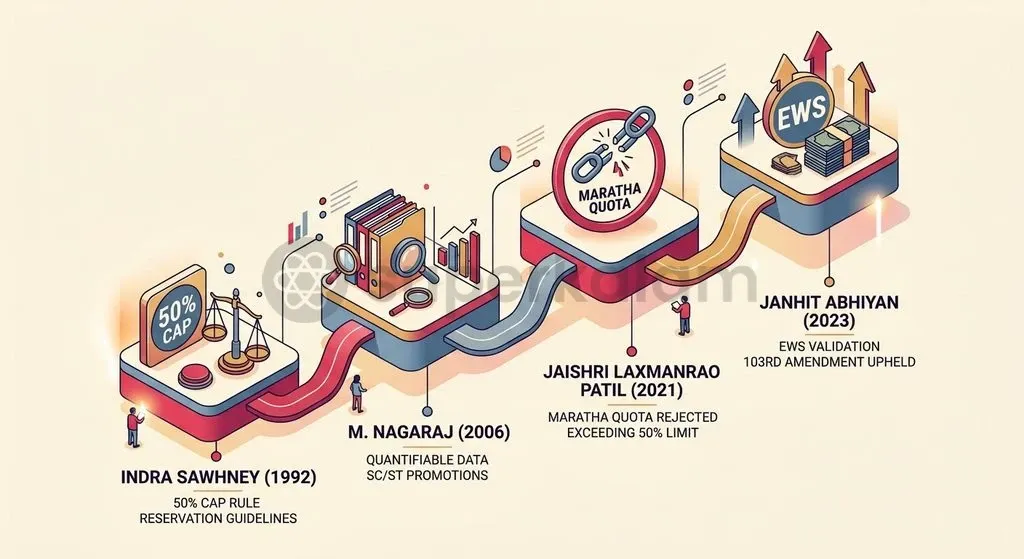
The Supreme Court established the binding nature of the 50% ceiling in the landmark nine-judge ruling in Indra Sawhney v. Union of India. The nine-judge bench explained that Article 16(4) must balance equality of opportunity under Article 16(1) to prevent special provisions from completely eclipsing the general rule. The apex court permitted relaxation of this threshold only in far-flung, remote areas whose populations remain wholly segregated from national life.
Subsequent constitutional benches have consistently preserved this legal barrier:
| Constitutional Precedent | Bench Strength | Core Legal Principle on Reservations |
|---|---|---|
| Indra Sawhney v. Union of India (1992) | 9 Judges | Fixed the 50% ceiling on vertical reservations; limited exceptions to remote, isolated border populations. |
| M. Nagaraj v. Union of India (2006) | 5 Judges | Conditioned state affirmative policies on backwardness data, inadequate representation, and Article 335 efficiency. |
| Jaishri Laxmanrao Patil v. Chief Minister, Maharashtra (2021) | 5 Judges | Reaffirmed the 50% ceiling; held that high population proportions do not constitute extraordinary circumstances. |
| Janhit Abhiyan v. Union of India (2023) | 5 Judges | Upheld the 10% EWS quota (3:2); affirmed that the 50% ceiling applies strictly to caste-based reservations. |
The Jabalpur Bench anchored its decision in these precedents. The court observed that the state had attempted an identical executive hike in 2003, which was struck down in State of M.P. v. K.L. Balmiki.
Similarly, the Patna High Court invalidated the Bihar Reservation (Amendment) Act, 2023 on June 20, 2024. That legislation had raised backward quotas to 65%, highlighting nationwide judicial consistency against breaching the 50% threshold.
Comparing State Playbooks: Why MP Failed While Tamil Nadu's 69% Quota Remains Protected
State legislatures often contrast their overturned quota expansions with Tamil Nadu's enduring affirmative action framework. Tamil Nadu provides 69% aggregate reservation under the Tamil Nadu Backward Classes, Scheduled Castes and Scheduled Tribes Act, 1993 (T.N. Act 45 of 1994).
Constitutional protection shields the Tamil Nadu enactment through an exceptional parliamentary route. Parliament passed the Constitution (Seventy-Sixth Amendment) Act, 1994, placing the Tamil Nadu statute directly into the Ninth Schedule as Entry 257A. This structural buffer immunised the statute against immediate fundamental rights challenges under Article 31B.
The legal realities separating both states reflect distinct constitutional pathways:
- Ninth Schedule Protection: Tamil Nadu secured parliamentary constitutional amendment backing, whereas Madhya Pradesh enacted an ordinary state statute subject to immediate judicial review.
- Applicability of Judicial Review: The nine-judge bench in I.R. Coelho v. State of Tamil Nadu affirmed that any statute added to the Ninth Schedule after April 24, 1973 remains open to basic structure scrutiny.
- Procedural Exposure: Madhya Pradesh's law faced direct constitutional examination under Articles 14 and 16(4) from its inception, leaving it vulnerable to established precedents.
Discuss with Superkalam
If an Indian state with 60% backward population seeks to raise reservations past the 50% ceiling today, how would the tests from Indra Sawhney and Jaishri Laxmanrao Patil apply to that legislation?
Ask NowAdministrative Gridlock in MP: What the Ruling Means for 87-13 Formula Recruitment and Aspirants
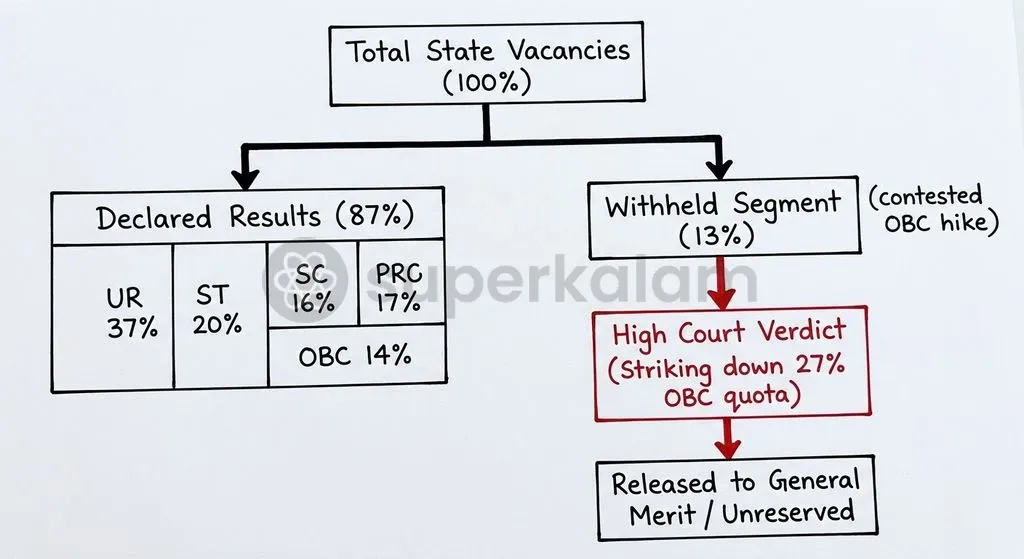
The prolonged litigation over the 2019 statutory amendment created extensive administrative uncertainty across Madhya Pradesh recruiting agencies. To declare examination results without violating interim judicial stays, the state General Administration Department issued Circular No. C 3-10/2022/1/3 on September 29, 2022, establishing the 87:13 formula.
State bodies such as the MPPSC and the MP Employees Selection Board (MPESB) implemented this mechanism across multiple recruitment cycles:
- Uncontested Appointments (87%): Agencies finalised results for undisputed posts, comprising 14% OBC, 16% SC, 20% ST, and 37% unreserved merit positions.
- Withheld Contested Segment (13%): Recruiting bodies withheld final selection lists for the contested 13% quota, generating parallel provisional merit lists for both unreserved and OBC candidates pending final adjudication.
The High Court resolved this recruitment backlog by issuing strict administrative directions. The division bench directed state agencies to release the withheld 13% vacancies exclusively to unreserved merit candidates within three months.
For OBC candidates selected under the 27% quota between September 2, 2019, and September 29, 2022, the court granted prospective protection. This shielded their appointments from cancellation while ordering excess posts adjusted across three subsequent recruitment cycles.
Constitutional Way Forward: Demonstrating Empirical Inadequacy Without Breaching the Rule of Law
The invalidation of the Madhya Pradesh amendment demonstrates that affirmative action policies must align with constitutional discipline. States cannot treat reservation quotas as political instruments disconnected from empirical proof of social disadvantage.
Constitutional compliance requires state governments to adopt rigorous institutional safeguards:
- Conducting Comprehensive Empirical Surveys: State backward classes commissions must gather contemporaneous, field-level data on income, education, and administrative representation, fulfilling the parameters established in M. Nagaraj.
- Consulting Statutory and Constitutional Bodies: Mandatory consultation with the National Commission for Backward Classes under Article 338B ensures procedural integrity prior to statutory amendments.
- Focusing on Substantive Empowerment: State investment should prioritise primary education, technical skilling, and entrepreneurial infrastructure rather than expanding vertical reservation quotas beyond judicial thresholds.
- Respecting Administrative Efficiency: Legislative bodies must reconcile affirmative action measures with Article 335, maintaining institutional competence across technical and administrative state cadres.
Adherence to these standards prevents legal disruption and ensures that social justice initiatives remain durable, equitable, and constitutionally viable.
Discuss with Superkalam
Analyse why the empirical data on higher education enrolments (33.87%) and public service posts (28.16%) undermined the state's legal defense under Article 16(4).
Ask NowKey Takeaways
- The Madhya Pradesh High Court quashed M.P. Act No. 12 of 2019 on October 9, 2026, restoring state OBC reservation in public employment and education to 14%.
- Total reservations in the state had reached 73% (63% caste-based vertical quota plus 10% EWS), in direct violation of the 50% limit laid down in Indra Sawhney.
- The court rejected demographic population shares as extraordinary grounds, citing official datasets showing OBCs hold 33.87% of higher education seats and 28.16% of state public posts.
- The bench ordered state recruiting bodies to release the 13% recruitment vacancies withheld under the interim 87:13 formula to unreserved merit candidates within three months.
- Appointments completed under the 27% OBC quota between September 2019 and September 2022 received prospective protection, with excess allocations adjusted over three future recruitment cycles.
Mains Question
"Article 16(4) addresses inadequacy of representation rather than strict proportional representation based on census estimates." In light of the Madhya Pradesh High Court's verdict invalidating the 27% OBC reservation hike, critically analyse the constitutional and empirical prerequisites required to breach the 50% ceiling. (15 Marks)
Evaluate NowMains Question
Examine the differential constitutional mechanisms that shield Tamil Nadu's 69% reservation statute under the Ninth Schedule as compared to ordinary state enactments like the Madhya Pradesh Lok Seva Sanshodhan Adhiniyam, 2019. (10 Marks)
Evaluate NowPractice MCQs
QUESTION 1
Consider the following statements regarding affirmative action and reservation limits in India as detailed in judicial precedents:
- In Indra Sawhney v. Union of India, the Supreme Court ruled that relaxation of the 50% reservation ceiling is permissible only for far-flung, remote areas with populations segregated from national life.
- In Jaishri Laxmanrao Patil v. Chief Minister, Maharashtra, the Supreme Court held that high population proportions do not constitute extraordinary circumstances to exceed the 50% quota ceiling.
- In Janhit Abhiyan v. Union of India, the Supreme Court held that the 50% ceiling applies strictly to caste-based vertical reservations. Which of the statements given above are correct?
QUESTION 2
With reference to the statutory reservation framework in Madhya Pradesh, consider the following statements:
- Under the parent Madhya Pradesh Lok Seva Arakshan Adhiniyam, 1994, vertical reservations were distributed as 20% for ST, 16% for SC, and 14% for OBC.
- The 2019 legislative amendment increased vertical caste-based reservation to 63%, which pushed total reservations to 73% when combined with the 10% EWS allocation.
- The High Court observed that the statutory enhancement in 2019 was enacted with prior mandatory consultation with the National Commission for Backward Classes under Article 338B. Which of the statements given above is/are correct?
QUESTION 3
Consider the following statements regarding the constitutional protection of state quota laws:
- Tamil Nadu's 69% reservation law was placed into the Ninth Schedule as Entry 257A via the Constitution (Seventy-Sixth Amendment) Act, 1994.
- According to the ruling in I.R. Coelho v. State of Tamil Nadu, laws placed in the Ninth Schedule after April 24, 1973 remain open to basic structure scrutiny.
- The Madhya Pradesh High Court in Ashita Dubey & Ors. v. State of Madhya Pradesh held that population proportions alone constitute sufficient empirical proof of inadequacy of representation under Article 16(4). Which of the statements given above is/are correct?
QUESTION 4
In the context of recruitment in Madhya Pradesh, what did the administrative '87:13 formula' established by the General Administration Department entail?
QUESTION 5
Regarding empirical datasets evaluated by the Madhya Pradesh High Court in Ashita Dubey & Ors. v. State of Madhya Pradesh, consider the following statements:
- Administrative records showed that OBC candidates occupied 33.87% of higher education enrolments across state universities.
- In state public service employment, OBC employees secured 28.16% of posts across various tiers. Which of the statements given above is/are correct?