ECI Form 7 Rules 2026: Voter Deletion Limits Explained
ECI's Form 7 limits cover 10 applications during revision and five per month during continuous updation, with verification and hearing safeguards.
Oct, 2026
•7 min read
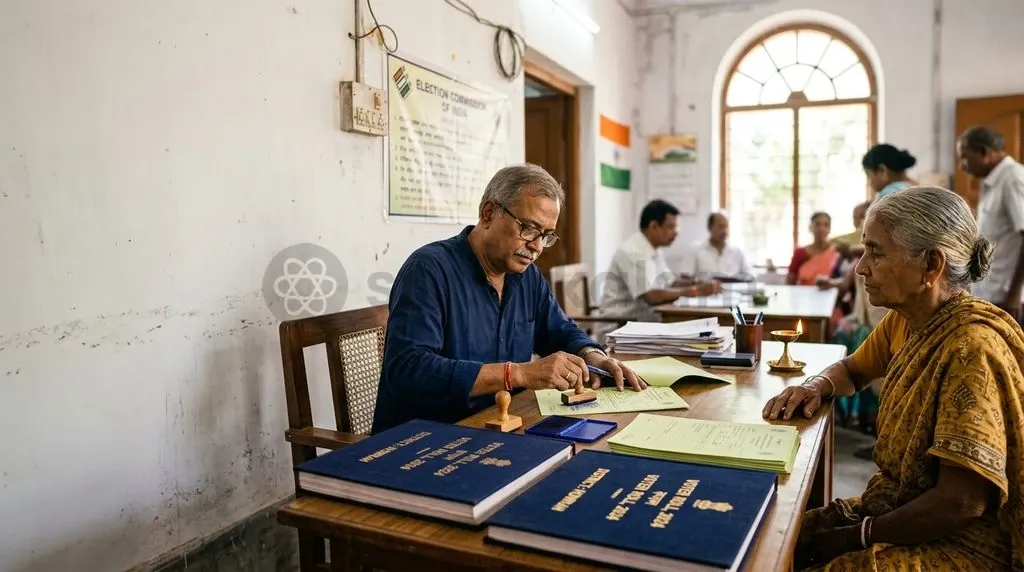
Overview
As of October 2026, the Election Commission of India has capped individual voter deletion requests submitted via Form 7 to a maximum of 10 during revision periods and five per month during continuous updation, creating strict evidentiary and hearing barriers to curb arbitrary deletions. This procedural shift protects electors by mandating preliminary verification of the objector before any deletion notice is dispatched.
Administrative scrutiny under the Representation of the People Act, 1950 now links directly to constitutional protections under Articles 324 and 326. This structure safeguards universal adult franchise from partisan weaponisation.
Why in the News: Tightening the Gates on Voter Roll Deletions
On October 9, 2026, the Election Commission of India (ECI) established uniform ceilings on voter deletion applications to halt mass disenfranchisement during electoral roll revisions.
Previously, digital portals allowed batches of six online submissions at a time subject to disposal, while physical filings had no formal ceiling. Unverified bulk objections frequently exploited this gap. Under the new directive, both channels operate under identical numeric ceilings:
- Revision periods: Individual Form 7 submissions are capped at a maximum of 10 applications.
- Continuous updation: Submissions cannot exceed five per month per applicant.
- Channel parity: Digital and physical submissions face identical limits to ensure procedural fairness across jurisdictions.
The reform enforces statutory safeguards under the Representation of the People Act, 1950 and the Registration of Electors Rules, 1960. Requiring a mandatory preliminary hearing for the objector aligns roll maintenance directly with natural justice requirements affirmed in court rulings.
Discuss with Superkalam
Which statutory rule under the Registration of Electors Rules, 1960 mandates that an objector filing Form 7 must belong to the same Assembly constituency?
Ask NowThe Core Vulnerability: How Form 7 Opened Doors to Arbitrary Deletions
Form 7 is the statutory instrument for objecting to an entry or seeking a deletion under Rule 13(2) of the Registration of Electors Rules, 1960. Rule 13(2) requires that only an elector registered within that specific Assembly constituency may file an objection. Structural loopholes, however, allowed syndicates to bypass that requirement.
Organised groups submitted mass objections using pre-filled templates with missing credentials to trigger ex parte deletions per The Indian Express and The Hindu investigations (as reported, 10 October 2026). Flooded with automated objections, Electoral Registration Officers (EROs) could not verify applicant identities. This practice directly violated Paragraph 11.3.2(ii) of the ECI Manual on Electoral Rolls (2023), which prohibits bulk claims submitted by an individual, including postal filings.
This exploitation inverted basic legal safeguards. Under official guidelines, the onus of proof rests entirely on the applicant filing the objection. In practice, unvetted objections shifted this burden onto ordinary citizens, who faced disenfranchisement if they missed administrative hearings.
| Parameter | Statutory Provision | Operational Misuse |
|---|---|---|
| Filing Locus Standi | Rule 13(2), Registration of Electors Rules, 1960 requires elector to be registered in the same constituency | Third-party entities filed objections using forged local identities |
| Submission Mode | Para 11.3.2(ii), ECI Manual prohibits bulk filings by an individual | Unchecked physical submission of hundreds of forms to local offices |
| Burden of Proof | ECI Form 7 Guidelines place evidentiary burden entirely on applicant | Presumption of non-residence forced targeted voters to prove their existence |
| Notice Standard | Section 22 Proviso, RP Act, 1950 mandates reasonable opportunity of hearing | Undelivered notices led to unilateral ex parte deletions |
What Changed: New Procedural Safeguards and Caps on Form 7 Submissions
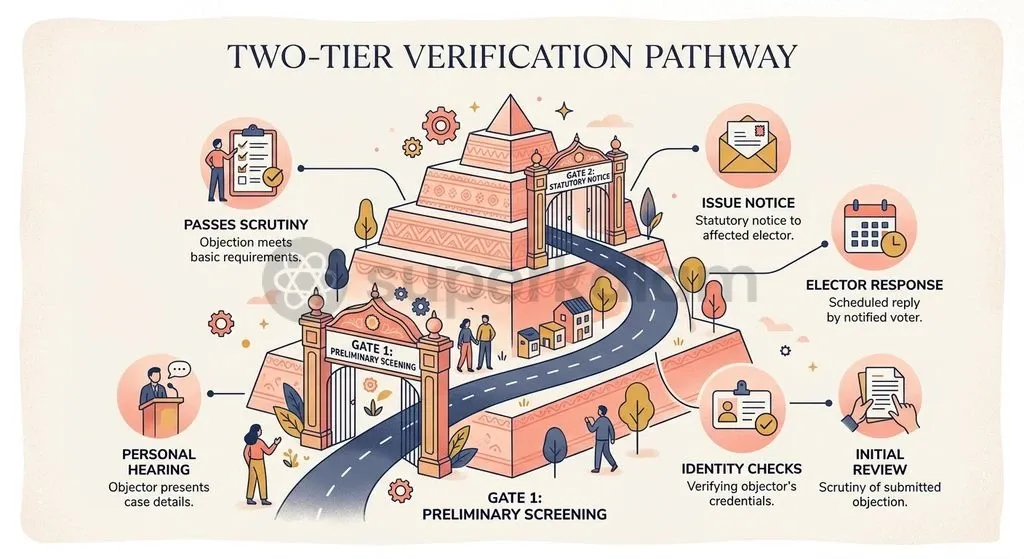
ECI Instruction Letter No. 23/Inst/2026-ERS sets up a two-tier verification filter to discard frivolous claims early. The primary shift requires the Electoral Registration Officer to summon and question the objector first. The ERO must serve notice on the objector, conduct a personal hearing, and record a separate statement for every individual form submitted.
Only after the applicant makes out a prima facie case with verifiable proof can the ERO issue notice to the targeted elector under Rules 19 and 20 of the Registration of Electors Rules, 1960. Field officers must reject applications immediately under Rule 17 if forms lack an original physical signature or show incomplete identity data.
Specific operational quotas now govern submissions across different actors:
- Individual Electors: Capped at a maximum of 10 Form 7 filings across the claims period, and five per month during continuous updation.
- Booth Level Agents (BLAs): Permitted up to 50 Form 7 applications daily before draft roll publication during Special Intensive Revisions, dropping to 10 forms daily after draft publication.
- Mandatory Documentation: Applicants must present verified identity credentials alongside documentary evidence proving death, transfer, or statutory disqualification.
- Serialised Tracking: Standardised digital logging tracks physical and online submissions together to prevent applicants from circumventing ceilings.
Discuss with Superkalam
Explain why requiring an Electoral Registration Officer to examine the objector first shifts the burden of proof back to where the law originally intended.
Ask NowThe Administrative Bottleneck: Why Booth Level Officers Bear the Brunt
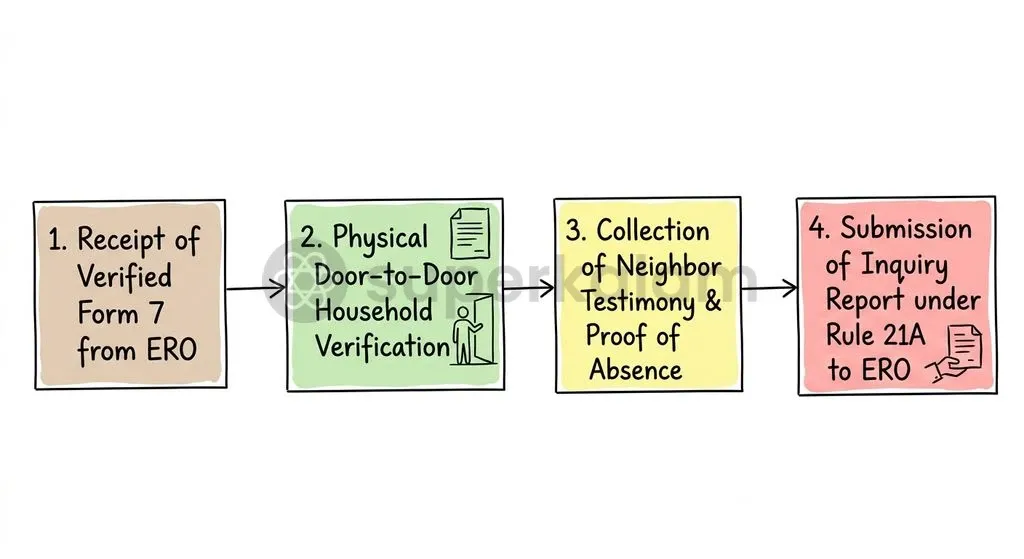
The Booth Level Officer (BLO) is the core field investigator under Section 22 of the Representation of the People Act, 1950. According to the Handbook for Booth Level Officers, these roles fall to grassroots public workers, including Anganwadi workers, primary school teachers, and village accountants. These workers manage electoral verifications alongside their primary public duties.
Large volumes of deletion requests strain local capacity during tight revision windows. Field duties present several operational bottlenecks:
- Mandatory door-to-door visits: BLOs must inspect physical residences to verify relocation or death under Rule 21A of the Registration of Electors Rules, 1960.
- Compressed timelines: Tight deadlines force field staff to rely on informal neighbour testimony rather than documentary checks.
- Risk of wrongful deletion: Incomplete verification reports lead EROs to issue summary deletion orders, leaving electors unaware until polling day.
Administrative fatigue creates direct constitutional vulnerabilities. When verification falters, the burden falls entirely on the voter.
Constitutional Balance: Electoral Integrity Versus Universal Adult Suffrage
In Lal Babu Hussain v. Electoral Registration Officer (1995), the Supreme Court ruled that a registered elector cannot be removed without individual notice and a hearing. The court held that summary disenfranchisement violates natural justice principles. In PUCL v. Union of India (2003) and Kuldip Nayar v. Union of India (2006), the bench confirmed that the statutory right to vote derives its core strength directly from Article 326.
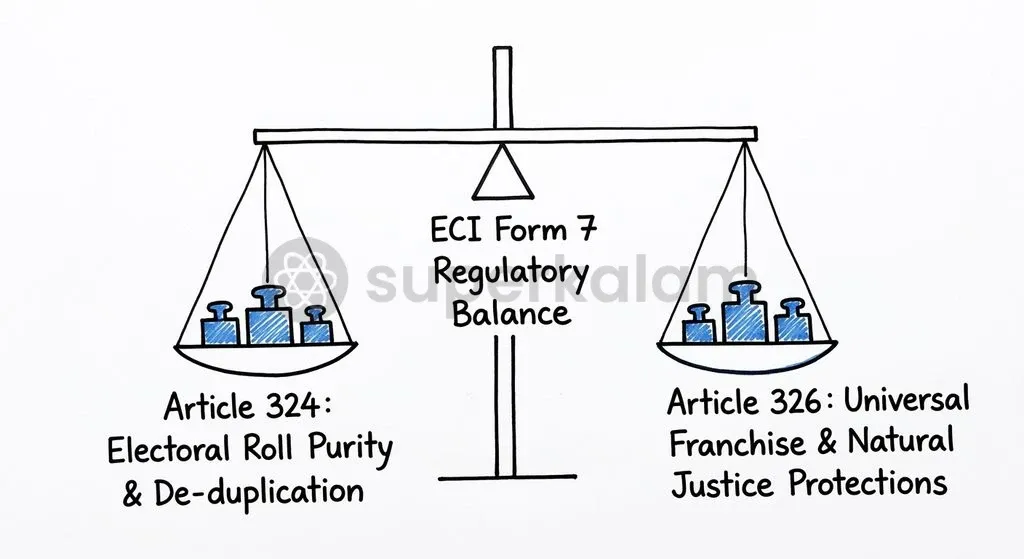
Article 324 grants the ECI broad authority over roll maintenance, creating twin obligations. The Commission must purge invalid names while defending eligible voters under Article 326:
- Limited disqualification: Article 326 permits disqualification only for non-residence, unsoundness of mind, crime, or corrupt practices.
- Protection of marginalised electors: Unvetted objections disproportionately hit migrant labourers, rural women, and daily wage earners lacking resources to attend administrative summonses.
- Affirmative state duty: The state must protect the franchise rather than enable a frictionless deletion pipeline.
Procedural barriers on objections preserve democratic representation by protecting vulnerable citizens from targeted disenfranchisement.
Discuss with Superkalam
Analyse how mass, automated Form 7 submissions disproportionately impact migrant laborers and rural women compared to other voter demographics.
Ask NowWay Forward: Building Transparent Rolls Without Sacrificing Citizen Rights
Section 22 of the Representation of the People Act, 1950 sets out the framework for amending electoral entries. Crucially, the proviso to Section 22 requires that electors receive a reasonable opportunity of being heard prior to deletion. Preserving this guarantee requires concrete administrative measures:
- Digital Transparency via Public Dashboards: EROs should publish Form 7 objection lists online and at local municipal offices, allowing public scrutiny before orders are issued.
- Enforcing Section 23(3) Freezes: Electoral authorities must enforce Section 23(3) of the RP Act, 1950, which halts amendments and deletions once nomination dates close.
- Strengthening Statutory Appeals: Electors require clear access to appeals under Section 24 of the RP Act, 1950, routing through the District Magistrate to the Chief Electoral Officer.
- Professionalising Field Verification: Establishing dedicated roll-management staff reduces reliance on overburdened school teachers and improves on-ground accuracy.
- Penalising Malicious Objections: Authorities must enforce Rule 17 alongside statutory penalties to prosecute individuals submitting fraudulent bulk deletion claims.
Discuss with Superkalam
Evaluate whether placing numerical caps on Form 7 objections adequately reconciles the ECI's duty to purge invalid entries under Article 324 with the protection of suffrage under Article 326.
Ask NowKey Takeaways
- The Election Commission capped Form 7 deletion requests to a maximum of 10 during roll revision and five per month during continuous updation.
- New ceilings apply equally across digital and physical modes, ending the unchecked submission of bulk forms at local electoral offices.
- Electoral Registration Officers must summon the objector and establish a valid prima facie case before issuing notice to the affected elector.
- The proviso to Section 22 of the Representation of the People Act, 1950 mandates a reasonable opportunity of being heard before deleting an elector's entry.
- The Supreme Court ruled in Lal Babu Hussain (1995) that registered electors cannot be removed without individual notice and fair hearing.
- Under Article 326 and Article 324, the state bears an affirmative constitutional duty to preserve adult suffrage against procedural disenfranchisement.
Mains Question
The Election Commission of India's ceiling on Form 7 submissions seeks to balance roll purity with universal adult suffrage under Article 326. In the context of the Representation of the People Act, 1950, examine how these procedural safeguards curb arbitrary disenfranchisement while addressing grassroots administrative challenges. (10 Marks)
Evaluate NowMains Question
'Summary disenfranchisement violates the principles of natural justice and conflicts with the constitutional obligations of the State under Articles 324 and 326.' In light of the Supreme Court's observations in Lal Babu Hussain and related rulings, discuss the structural vulnerabilities in voter roll deletion mechanisms and measures required to protect the franchise. (15 Marks)
Evaluate NowPractice MCQs
QUESTION 1
With reference to the Election Commission of India's (ECI) guidelines regarding Form 7 applications for voter roll deletions, consider the following statements:
- An individual elector is permitted to submit a maximum of 10 Form 7 applications during roll revision periods.
- Under continuous updation, individual submissions are capped at five applications per month.
- The statutory onus of proof rests entirely on the elector whose name is objected to, rather than the applicant filing the objection. Which of the statements given above is/are correct?
QUESTION 2
Consider the following statements regarding the statutory framework governing electoral roll maintenance in India:
- Under Rule 13(2) of the Registration of Electors Rules, 1960, an objection via Form 7 can be submitted by any registered elector residing within the same State.
- The proviso to Section 22 of the Representation of the People Act, 1950 mandates giving a reasonable opportunity of being heard before an elector's entry is deleted.
- Section 23(3) of the Representation of the People Act, 1950 permits modifications and deletions of entries even after the last date for making nominations has passed. Which of the statements given above is/are correct?
QUESTION 3
Regarding the procedural safeguards introduced under ECI Instruction Letter No. 23/Inst/2026-ERS, consider the following statements:
- Booth Level Agents (BLAs) are allowed up to 50 Form 7 applications daily prior to draft roll publication during Special Intensive Revisions.
- The daily submission ceiling for Booth Level Agents drops to 10 forms after the publication of the draft roll.
- Electoral Registration Officers are mandated to summon and hear the objector and record an individual statement before issuing notice to the targeted elector. Which of the statements given above is/are correct?
QUESTION 4
In which of the following judgments did the Supreme Court of India hold that an elector's name cannot be deleted from the electoral roll without individual notice and hearing, establishing that summary disenfranchisement violates the principles of natural justice?
QUESTION 5
With reference to the constitutional and administrative provisions governing the franchise in India, consider the following statements:
- Article 326 of the Constitution permits disqualification from the electoral roll on grounds of non-residence, unsoundness of mind, crime, or corrupt practices.
- Under Section 24 of the Representation of the People Act, 1950, statutory appeals by electors against deletion orders are routed through the District Magistrate to the Chief Electoral Officer. Which of the statements given above is/are correct?