Nobel Peace Prize 2026 Winner Navi Pillay: Why She Won
Navi Pillay won the 2026 Nobel Peace Prize for promoting peace and international law. See her tribunal work and its significance for global justice.
Oct, 2026
•11 min read
Overview
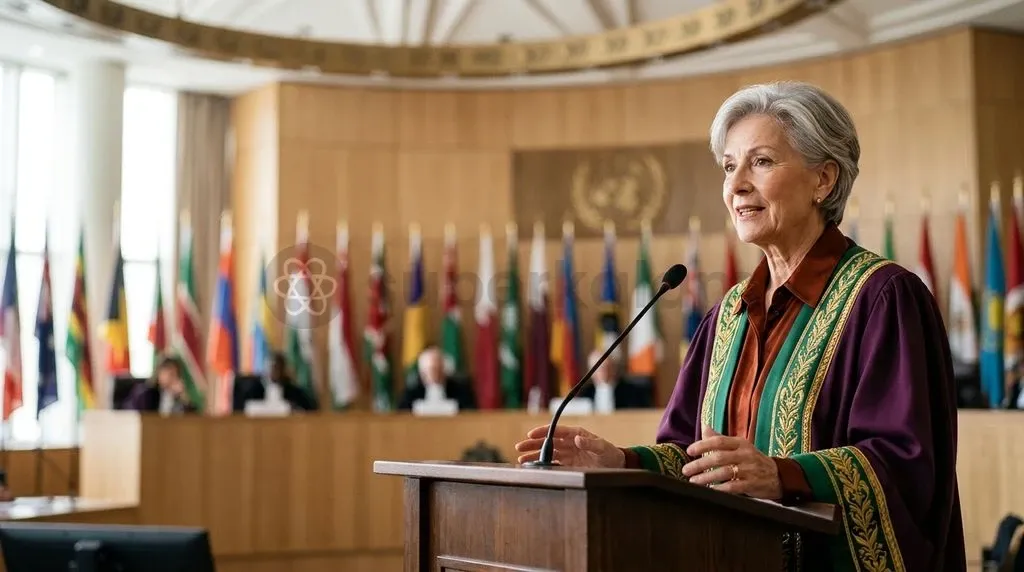
South African jurist Navi Pillay was awarded the Nobel Peace Prize on 9 October 2026. The honour marks her lifelong defence of international law across global tribunals and human rights bodies.
As of October 2026, the Norwegian Nobel Committee recognised her five-decade career. That span includes anti-apartheid advocacy, precedent-setting decisions at the International Criminal Tribunal for Rwanda, and stewardship of the UN human rights office.
Pillay also sat as an appellate judge at the International Criminal Court and an ad hoc judge at the International Court of Justice in The Gambia v Myanmar. In addition, she chaired the UN Commission of Inquiry on the Occupied Palestinian Territory and Israel. Her award reinforces that prosecuting mass atrocities is essential to durable global peace.
Why in the News?
The Norwegian Nobel Committee awarded the 2026 Nobel Peace Prize to South African jurist Navi Pillay on 9 October 2026. According to the official citation released by the Committee, Pillay received the honour for her efforts to promote peace and international law.
This recognition arrives as multilateral legal bodies encounter political resistance and non-compliance from major world powers. The central lesson of Pillay's career is that lasting stability depends on binding legal accountability rather than political compromise, even as international enforcement collides with state immunity.
Discuss with Superkalam
Which international criminal tribunal first categorized systematic rape as an act of genocide?
Ask NowCareer Timeline: From Anti-Apartheid Defense to Global Benches
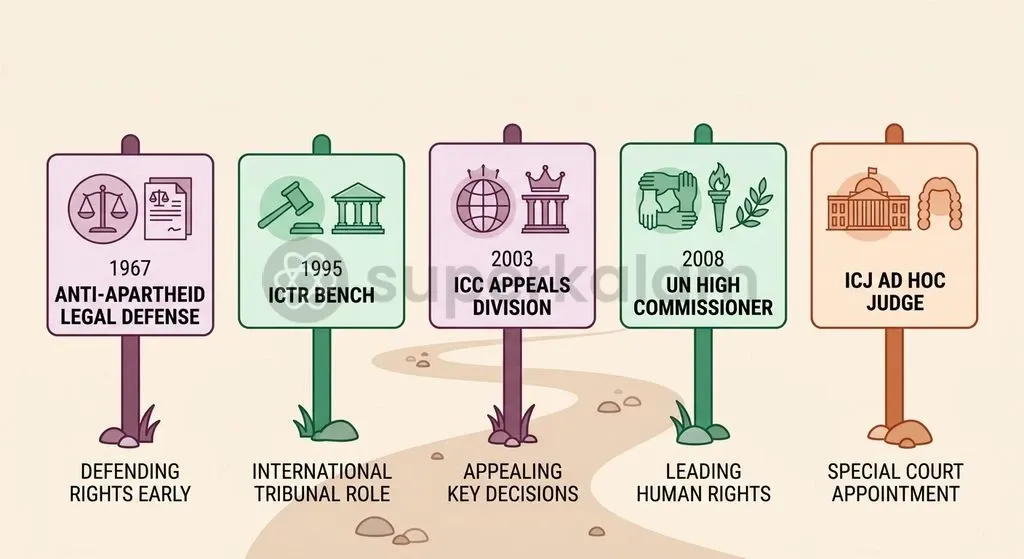
Navi Pillay built her legal career defending anti-apartheid activists in South Africa before advancing to the bench of multiple international criminal tribunals. Born in Durban, South Africa, Pillay overcame severe racial and gender barriers to establish her own law practice in 1967. During apartheid—an institutionalised system of racial segregation and white minority rule—she represented political detainees and trade unionists, exposing unlawful detention conditions.
South Africa's transition to constitutional democracy led to her appointment as an acting judge on the High Court of South Africa in 1995. Her international legal career developed across five major phases:
- International Criminal Tribunal for Rwanda (1995–2003): Appointed as a judge by the United Nations General Assembly, Pillay served eight years at the tribunal in Arusha, Tanzania, including four years as its President.
- International Criminal Court (2003–2008): Elected during the inaugural cohort of ICC judges in The Hague, where she sat on the Appeals Division.
- UN High Commissioner for Human Rights (2008–2014): Headed the Office of the United Nations High Commissioner for Human Rights (OHCHR), championing economic rights, gender equality, and minority protections.
- UN Commission of Inquiry on Palestine and Israel (2021–2024): Chaired the Independent International Commission of Inquiry investigating root causes of systemic discrimination and conflict in the Occupied Palestinian Territory and Israel.
- International Court of Justice (2020–present): Appointed as an ad hoc judge—a temporary judge selected by a party state lacking a national on the permanent bench—in the genocide proceedings brought by The Gambia against Myanmar.
Defining Rape as Genocide: The Landmark Jean-Paul Akayesu Ruling
The International Criminal Tribunal for Rwanda delivered a historic judgment in the 1998 Jean-Paul Akayesu case. It ruled that sexual violence constitutes an act of genocide. Jean-Paul Akayesu was the bourgmestre (mayor) of Taba commune during the 1994 Rwandan genocide, where over 800,000 ethnic Tutsis and moderate Hutus were systematically murdered.
During the trial, witness testimonies exposed widespread sexual assaults committed against Tutsi women with the encouragement of municipal authorities. Initial indictments omitted sexual violence charges. Pillay actively questioned witnesses from the bench about these assaults, prompting prosecutors to amend the indictment.
The tribunal's ruling established three landmark principles in international humanitarian law:
- Sexual violence as physical destruction: The chamber interpreted the 1948 Genocide Convention to rule that systematic rape constitutes genocide when committed with the intent to destroy a targeted group in whole or in part.
- Rape defined under international law: The chamber defined rape conceptually as a physical invasion of a sexual nature committed under coercive conditions, moving beyond statutory formulas of physical penetration.
- Sexual violence as torture and a crime against humanity: The chamber held that sexual assault caused severe physical and mental suffering, crossing the international threshold for torture.
The Akayesu decision transformed international criminal jurisprudence by eliminating impunity for wartime sexual violence. Subsequent instruments, including the Rome Statute of the ICC, explicitly incorporated sexual violence into core definitions of war crimes and crimes against humanity.
Discuss with Superkalam
How does complementary jurisdiction under the Rome Statute differ from the contentious jurisdiction exercised by the International Court of Justice?
Ask Now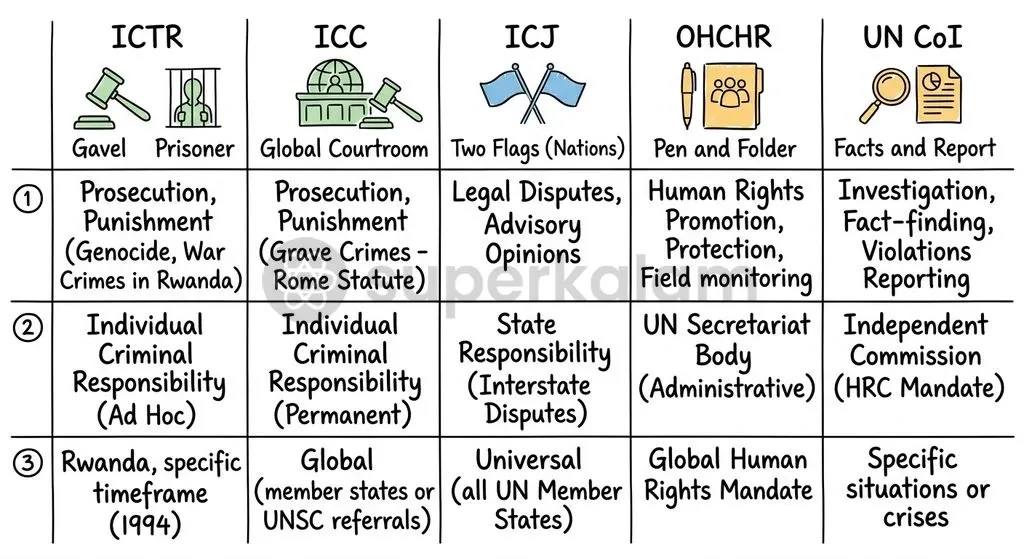
Leading the OHCHR and the UN Commission of Inquiry
Navi Pillay headed the Office of the United Nations High Commissioner for Human Rights before leading the UN Commission of Inquiry on the Occupied Palestinian Territory and Israel. As High Commissioner from 2008 to 2014, Pillay opposed political exceptionalism in human rights protection. She championed equal protection regardless of sexual orientation, securing the first formal UN Human Rights Council resolution affirming LGBT rights in 2011.
Pillay also instituted high-level fact-finding missions in conflict zones, including inquiries into violations in Sri Lanka and Syria. Her scrutiny of actions taken by powerful nations drew frequent diplomatic resistance from permanent members of the UN Security Council.
In 2021, the UN Human Rights Council appointed Pillay to chair an independent commission of inquiry covering the Occupied Palestinian Territory and Israel. The panel investigated systemic discrimination, land dispossession, and violations of international humanitarian law.
The Commission of Inquiry encountered sharp political controversy:
- Allegations of institutional bias: State actors and allied critics challenged the inquiry's open-ended temporal mandate, alleging an asymmetric focus on state military conduct over non-state actors.
- Sovereign non-cooperation: Fact-finding teams faced access bans and visa denials, underscoring the structural fragility of multilateral inquiries that lack coercive enforcement power.
- Fact-finding vs judicial adjudication: Legal analysts note that findings from a UN commission of inquiry carry evidentiary weight, but they do not constitute binding judicial rulings from an international court like the ICJ.
Discuss with Superkalam
How can evidence gathered by non-judicial UN Commissions of Inquiry be effectively utilized in formal proceedings before the International Court of Justice?
Ask NowIndia's Position on International Justice and the Rome Statute
India has refused to sign or ratify the Rome Statute of the International Criminal Court due to core sovereignty concerns. Although New Delhi participated actively in the 1998 Rome Diplomatic Conference, it abstained from voting on the final treaty establishing the court.
India’s objections centre on three structural features within the Rome Statute framework:
- Subordination to the UN Security Council: Article 13(b) allows the UN Security Council to refer situations involving non-party states to the ICC prosecutor. India argues that granting the permanent five members veto power over referrals creates a discriminatory, two-tiered system of global justice.
- Universal jurisdiction and national sovereignty: India maintains that sovereign domestic courts hold primary constitutional authority over crimes on their territory. Bypassing national jurisdiction infringes upon Article 51 of the Indian Constitution, which directs the state to foster respect for international law alongside sovereign autonomy.
- Omission of state-sponsored terrorism: During negotiations, India urged negotiators to list cross-border terrorism and weapons of mass destruction as core crimes. The exclusion of terrorism, combined with ambiguous definitions of aggression, hardened New Delhi’s opposition.
Despite declining ICC accession, India selectively utilizes international judicial forums. New Delhi litigates interstate disputes before the International Court of Justice, as seen in the Kulbhushan Jadhav case under the 1963 Vienna Convention on Consular Relations.
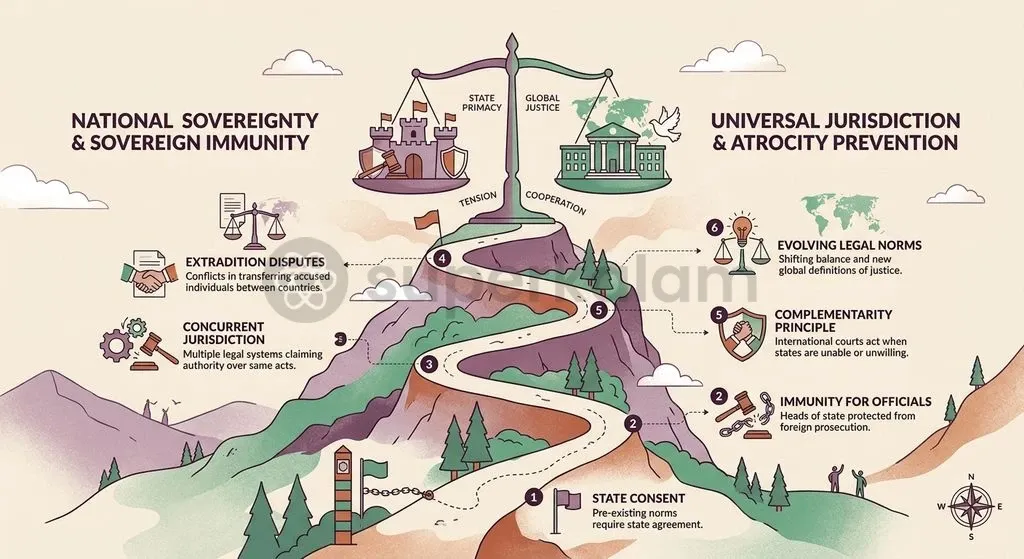
Ethical Dilemmas in International Law and Enforcement
International humanitarian law grapples with an enduring ethical dilemma when universal accountability clashes with sovereign immunity and great-power realpolitik. Universal justice presupposes that every state and individual answers equally to legal standards. In reality, international enforcement remains fundamentally asymmetrical.
Practical application reveals three persistent ethical rifts:
- Selective jurisdiction: Ad hoc tribunals and inquiries have predominantly scrutinised post-colonial administrations, defeated states, or developing countries. Permanent members of the UN Security Council routinely shield themselves and allies from formal prosecution.
- Peace versus justice trade-offs: Mediators contend that issuing arrest warrants against sitting leaders jeopardises peace negotiations. Conversely, jurists like Pillay insist that amnesties guarantee renewed conflict by institutionalising impunity.
- The impartiality of international jurists: International adjudicators face acute pressure to demonstrate neutrality while interpreting dynamic human rights standards. Accusations of political bias undermine public trust, complicating fact-finding in polarised conflicts.
Pillay insisted that an international jurist's primary duty is to apply codified treaties without diplomatic deference. Her jurisprudence affirms that state sovereignty cannot shield mass atrocities or systemic human rights violations.
Discuss with Superkalam
Compare India's willingness to litigate before the International Court of Justice with its reluctance to ratify the Rome Statute of the International Criminal Court.
Ask NowThe Path Ahead for Global Accountability
Rebuilding institutional credibility requires shielding international legal mandates from geopolitical pressure. The award of the 2026 Nobel Peace Prize to Navi Pillay underscores the need to restore trust in multilateral accountability mechanisms.
Strengthening the global legal architecture requires concrete reforms:
- Restricting Security Council vetoes on atrocity crimes: Member states have proposed voluntary codes of conduct urging permanent Security Council members to refrain from using the veto during situations involving genocide, war crimes, and crimes against humanity.
- Strengthening the principle of complementarity: The ICC operates under complementarity, meaning it acts only when national courts are genuinely unwilling or unable to prosecute. Enhancing national judicial capabilities reduces the need for external interventions while reinforcing domestic rule of law.
- Universal treaty ratification: Bridging the divide between non-signatory global powers—including the United States, China, Russia, and India—requires addressing structural representation deficits and jurisdictional overreach within the Rome Statute framework.
- Standardising fact-finding methodologies: UN commissions of inquiry must adhere to transparent, verifiable evidentiary standards to withstand geopolitical scrutiny and supply admissible evidence for future judicial proceedings.
Lasting peace depends on applying legal accountability equally across all sovereign states. As Navi Pillay’s record demonstrates, international institutions must remain capable of holding even the most powerful actors to account under international law.
Key Takeaways
- Nobel Peace Prize 2026: South African jurist Navi Pillay was awarded the Nobel Peace Prize on 9 October 2026 for her efforts to promote peace and international law.
- Landmark Akayesu Precedent: In the 1998 Jean-Paul Akayesu case at the International Criminal Tribunal for Rwanda, Pillay established that rape and sexual violence constitute acts of genocide under the 1948 Genocide Convention.
- Broad Institutional Leadership: Pillay served as President of the ICTR, Judge of the International Criminal Court, UN High Commissioner for Human Rights, chair of the UN Commission of Inquiry on Palestine and Israel, and ad hoc judge at the ICJ in The Gambia v Myanmar.
- India's Rome Statute Stand: India refuses to join the ICC due to sovereign immunity protections, the veto power of the UN Security Council over case referrals, and the exclusion of cross-border terrorism from the court's core crimes.
- Complementarity and Sovereignty: International criminal justice relies on complementarity, reinforcing that domestic judiciaries hold primary responsibility for prosecuting core crimes before international tribunals intervene.
Mains Question
"Granting the UN Security Council referral powers under the Rome Statute creates a discriminatory, two-tiered architecture of international justice." In light of this statement, examine the structural reasons behind India's non-accession to the International Criminal Court. (10 Marks)
Evaluate NowMains Question
The jurisprudence established in the 1998 Jean-Paul Akayesu ruling marked a watershed moment in international humanitarian law. Elucidate how this judgment redefined mass atrocity crimes and evaluate the subsequent operational challenges faced by international fact-finding bodies in securing accountability. (15 Marks)
Evaluate NowPractice MCQs
QUESTION 1
With reference to the landmark Jean-Paul Akayesu ruling (1998) of the International Criminal Tribunal for Rwanda (ICTR), consider the following statements:
- It interpreted the 1948 Genocide Convention to hold that systematic sexual violence constitutes an act of genocide when committed with the intent to destroy a targeted group in whole or in part.
- It defined rape strictly based on statutory formulas requiring physical penetration.
- It established that sexual assault causing severe physical and mental suffering crossed the international threshold for torture.
Which of the statements given above are correct?
QUESTION 2
Consider the following statements regarding the institutional distinctions between international legal bodies:
- The International Criminal Tribunal for Rwanda (ICTR) was an ad hoc body established under UN Security Council Resolution 955 under Chapter VII.
- The International Criminal Court (ICC) exercises complementary criminal jurisdiction over individuals rather than sovereign states.
- Findings of a UN Human Rights Council Commission of Inquiry constitute legally binding judicial rulings equivalent to judgments of the International Court of Justice.
Which of the statements given above is/are correct?
QUESTION 3
Regarding India's position on the Rome Statute and international judicial bodies, consider the following statements:
- India signed the Rome Statute in 1998 but has refused to ratify it due to constitutional concerns under Article 51.
- India objected to Article 13(b) of the Rome Statute because it grants the UN Security Council power to refer situations involving non-party states to the ICC prosecutor.
- India opposed the Rome Statute partly due to the omission of state-sponsored cross-border terrorism from its core list of crimes.
Which of the statements given above are correct?
QUESTION 4
Consider the following pairs regarding Navi Pillay's tenure across international institutions:
- International Criminal Tribunal for Rwanda — Tribunal President
- International Criminal Court — Appeals Division Judge
- International Court of Justice — Ad hoc Judge in The Gambia v Myanmar
- Office of the UN High Commissioner for Human Rights — High Commissioner
How many of the pairs given above are correctly matched?
QUESTION 5
Which of the following international judicial or investigative bodies has contentious jurisdiction strictly over sovereign states rather than criminal jurisdiction over individuals?