Removal of Chief Election Commissioner: Article 324(5) Explained
The Opposition is preparing a removal motion against CEC Gyanesh Kumar in both Houses of Parliament. Article 324(5) makes the process identical to removing a Supreme Court judge.
Sep, 2026
•8 min read

Overview
Under the first proviso to Article 324(5) of the Constitution of India, the Chief Election Commissioner (CEC) cannot be removed easily. The process mirrors the removal of a Supreme Court Judge under Article 124(4), requiring proved misbehaviour or incapacity.
This constitutional design insulates the Election Commission of India from executive interference. The President can only issue a removal order after Parliament passes an address by a special majority in both Houses. The statutory mechanism under the Judges (Inquiry) Act, 1968 enforces mandatory judicial scrutiny before any vote.
However, this strict shield protects only the CEC directly. Other Election Commissioners can be removed by the President on the recommendation of the CEC, creating a structural asymmetry within the body.
Why the Removal Process of the CEC Matters for Indian Democracy
Free and fair elections form an unalterable part of the basic structure of the Constitution, as held by the Supreme Court of India in Indira Nehru Gandhi v. Raj Narain (1975). A compromised election watchdog undermines democratic legitimacy at its foundation.
The constitutional mechanism governing the removal of the CEC is the primary barrier against executive encroachment. By anchoring tenure security to the highest judicial benchmark, the Constitution prevents ruling parties from using dismissals as leverage against unfavourable decisions.
Collegiate autonomy remains vital. The core constitutional debate centres on whether protecting the CEC alone provides sufficient insulation, or whether leaving other Commissioners exposed to executive discretion weakens institutional independence.
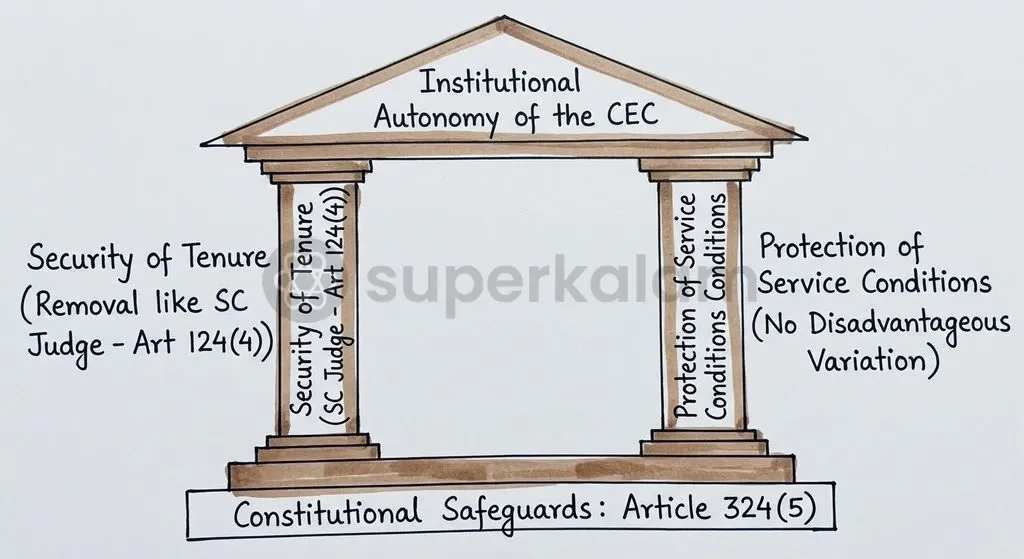
Constitutional Safeguards: What Article 324(5) Guarantees the CEC
Article 324(5) of the Constitution of India establishes a dual protective shield for the Chief Election Commissioner regarding tenure and conditions of service. According to the first proviso to Article 324(5), the Chief Election Commissioner shall not be removed from office except in like manner and on the like grounds as a Judge of the Supreme Court.
This provision establishes two vital constitutional guarantees:
- Substantive Grounds for Removal: By cross-referencing Article 124(4), the CEC can only be removed on the established grounds of proved misbehaviour or incapacity. Disagreement with executive policy or political decisions does not constitute a valid legal ground.
- Protection Against Service Disadvantage: The first proviso to Article 324(5) explicitly stipulates that the conditions of service shall not be varied to the disadvantage of the Chief Election Commissioner after appointment. This prevents financial or administrative reduction of powers during the incumbent's tenure.
Discuss with Superkalam
What are the two constitutionally specified grounds under Article 124(4) on which a Chief Election Commissioner can be removed?
Ask NowStep-by-Step Procedure: How a CEC is Removed Under Indian Law
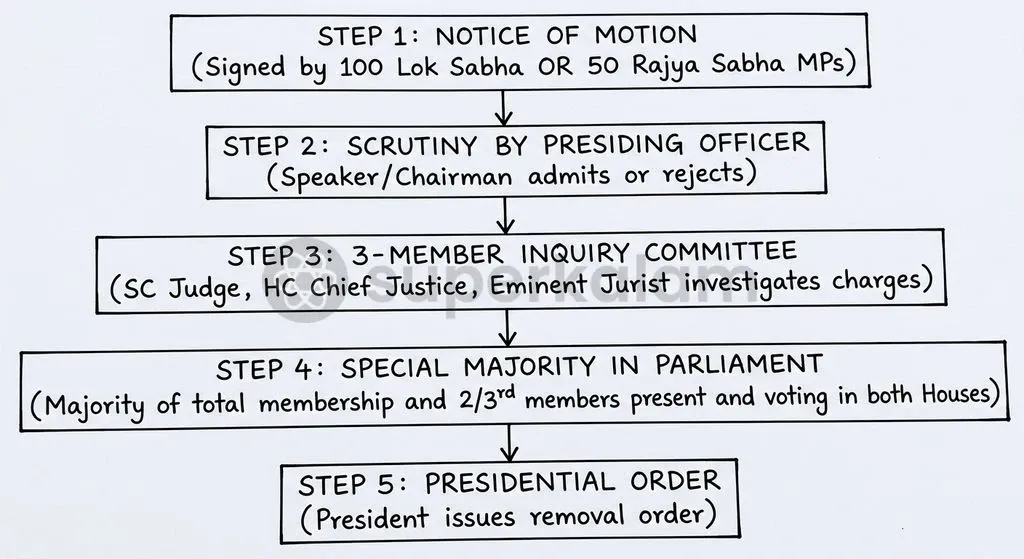
The removal of the Chief Election Commissioner requires a structured legislative procedure governed by Article 124(4) and operationalised under the Judges (Inquiry) Act, 1968. A removal proceeding cannot be initiated by executive order alone.
The process follows five sequential stages under the constitutional framework:
- Submission of Notice: A formal notice of motion seeking removal is submitted to the presiding officer in either House of Parliament.
- Admission and Scrutiny: The Speaker of the Lok Sabha or the Chairman of the Rajya Sabha evaluates the motion and decides whether to admit or reject it.
- Judicial Inquiry: If admitted, an independent statutory inquiry committee investigates the charges of misbehaviour or incapacity.
- Parliamentary Consideration: If the committee finds the incumbent guilty, the motion is taken up for consideration and voted upon in each House.
- Presidential Order: Following passage by both Houses with the requisite special majority in the same session, the President issues a formal order of removal.
The Judges (Inquiry) Act 1968: Investigation, Committee, and Voting Thresholds
The Judges (Inquiry) Act, 1968 operationalises the statutory procedure required to investigate allegations of misbehaviour or incapacity against the Chief Election Commissioner. The statute establishes mandatory procedural thresholds to prevent frivolous or politically motivated motions.
Under Section 3(1) of the Judges (Inquiry) Act, 1968, a removal motion requires a signed notice by at least 100 members in the Lok Sabha or at least 50 members in the Rajya Sabha before presentation to the presiding officer. The presiding officer possesses discretionary power to admit or refuse the notice.
Once admitted, Section 3(2) mandates the formation of a three-member inquiry committee. This committee consists of:
- A sitting Judge of the Supreme Court of India;
- A Chief Justice of a High Court; and
- A distinguished jurist selected by the presiding officer.
The committee conducts a formal fact-finding inquiry and submits its report to Parliament. Under Section 6(1) of the Act, if the committee exonerates the incumbent, the parliamentary motion is permanently dropped and no further proceedings take place.
If the committee records a finding of proved misbehaviour or incapacity, Parliament proceeds with voting under Article 124(4). The motion must be passed by a special majority in each House:
- A majority of the total membership of that House; and
- A majority of not less than two-thirds of the members present and voting.
Discuss with Superkalam
Explain why the Constitution mandates the recommendation of the Chief Election Commissioner as a precondition for removing other Election Commissioners.
Ask NowCEC vs Election Commissioners: The Asymmetry in Removal Protections
Article 324(5) of the Constitution of India establishes a structural distinction between the Chief Election Commissioner and other Election Commissioners regarding security of tenure. While the CEC enjoys judicial-style protection, other Election Commissioners do not possess identical constitutional safeguards.
Under the second proviso to Article 324(5), an Election Commissioner or Regional Commissioner cannot be removed from office except on the recommendation of the Chief Election Commissioner. The President executes the removal, but the recommendation of the CEC is a mandatory constitutional precondition.
| Dimension | Chief Election Commissioner (CEC) | Election Commissioners (ECs) |
|---|---|---|
| Constitutional Basis | First proviso to Article 324(5) | Second proviso to Article 324(5) |
| Removal Mechanism | Parliamentary address via Article 124(4) | Presidential order on CEC recommendation |
| Statutory Investigation | Mandatory inquiry under Judges (Inquiry) Act, 1968 | No statutory judicial inquiry mandated |
| Parliamentary Role | Special majority required in both Houses | No parliamentary vote involved |
| Grounds Specified | Strictly proved misbehaviour or incapacity | Not constitutionally specified |
| Variation of Service Terms | Barred to disadvantage after appointment | Governed by statutory provisions |
This institutional asymmetry creates functional complications within the Election Commission. Because the Chief Election Commissioner and Election Commissioners exercise equal voting weight in administrative decisions, unequal tenure security exposes the collegiate structure to institutional vulnerability.
Discuss with Superkalam
How does the 'first among equals' ruling in T.N. Seshan conflict functionally with the unequal removal protections under Article 324(5)?
Ask NowKey Judicial Rulings: T.N. Seshan and Anoop Baranwal on Institutional Independence
The Supreme Court of India has examined the institutional structure and removal protections of the Election Commission across several landmark rulings. The jurisprudence balances collegiate parity against the explicit textual differences contained in Article 324(5).
Key judicial interpretations include:
- S.S. Dhanoa v. Union of India (1991): The Supreme Court upheld the constitutional validity of differential security of tenure between the CEC and other Election Commissioners. The Court affirmed that the Constitution intentionally created distinct offices with varying levels of tenure protection.
- T.N. Seshan v. Union of India (1995): A Constitution Bench ruled that the CEC is first among equals regarding the transaction of business within the multi-member commission. However, the Court maintained that this functional equality did not erase the constitutional distinction in removal procedures enacted under Article 324(5).
- Anoop Baranwal v. Union of India (2023): A five-judge Constitution Bench addressed the appointment and independence of the Election Commission. In his concurring opinion, Justice Ajay Rastogi observed that it is desirable to accord equal protection against removal to Election Commissioners as enjoyed by the Chief Election Commissioner under Article 324(5).
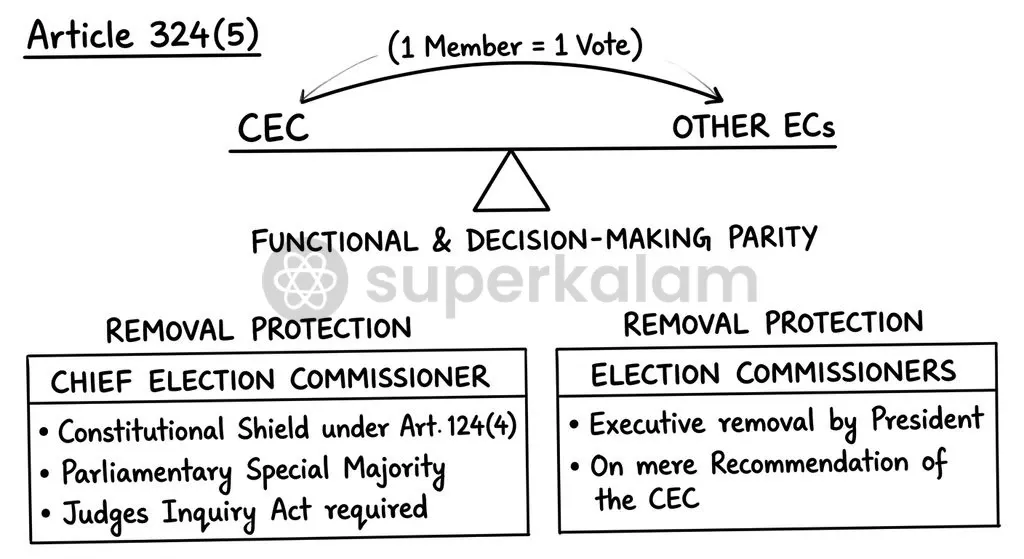
Ethical and Governance Challenges in Protecting the Election Commission
Institutional autonomy within the Election Commission demands internal ethical independence alongside external insulation from partisan political pressures. When removal protections are unequal, systemic vulnerabilities emerge across multiple dimensions:
- Chilling Effect on Decision-Making: Because an Election Commissioner lacks parliamentary impeachment protection, the risk of executive pressure remains elevated. This dynamic can compromise collegiate decision-making during contentious electoral disputes.
- Collegiate Vulnerability: The disparity in tenure security undermines the principle of collegiate equality, potentially making junior commissioners hesitant to dissent against executive preferences.
- Statutory Gaps: Parliament passed the Chief Election Commissioner and other Election Commissioners (Appointment, Conditions of Service and Term of Office) Act, 2023 without modifying the removal framework. The statute maintained the existing distinction under Article 324(5), leaving the structural parity debate unresolved in statutory law.
The Way Forward: Equalising Protections and Strengthening Electoral Autonomy
Sustaining democratic integrity requires institutional reforms that harmonise the security of tenure for all members of the Election Commission of India. Multiple expert bodies have advocated for constitutional amendments to establish institutional parity:
- Dinesh Goswami Committee on Electoral Reforms (1990): Recommended that Election Commissioners should be removed only through the parliamentary impeachment process mandated for the CEC. This reform sought to insulate the entire collegiate body from external interference.
- Law Commission of India (255th Report, 2015): Reinforced this stance by recommending an amendment to Article 324(5) to provide identical constitutional protection against removal for all Election Commissioners on par with the Chief Election Commissioner.
Implementing these recommendations would fortify the basic structure of the Constitution by ensuring comprehensive independence across India's electoral machinery.
Discuss with Superkalam
Evaluate whether extending parliamentary impeachment protections to Election Commissioners is necessary to ensure the institutional independence of the Election Commission.
Ask NowKey Takeaways
- Article 324(5) Safeguards: The Chief Election Commissioner can only be removed in like manner and on like grounds as a Supreme Court Judge under Article 124(4), requiring proved misbehaviour or incapacity.
- Judges (Inquiry) Act, 1968 Application: A removal motion requires 100 Lok Sabha or 50 Rajya Sabha signatures, followed by a mandatory three-member judicial committee inquiry before parliamentary debate.
- Strict Voting Thresholds: Removal requires a special majority in both Houses of Parliament—a majority of total membership and a two-thirds majority of members present and voting.
- Tenure Asymmetry: Other Election Commissioners can be removed by the President solely upon the recommendation of the CEC under the second proviso to Article 324(5).
- Historical Precedent: As of September 2026, no Chief Election Commissioner in Indian history has ever been removed through this parliamentary procedure.
Mains Question
The first proviso to Article 324(5) insulates the Chief Election Commissioner with a dual protective shield against executive encroachment. Elucidate. (10 Marks)
Evaluate NowMains Question
'The structural asymmetry in removal protections between the Chief Election Commissioner and other Election Commissioners undermines the collegiate integrity of the Election Commission.' Critically analyse in light of judicial pronouncements. (15 Marks)
Evaluate NowPractice MCQs
QUESTION 1
With reference to the constitutional protections available to the Election Commission of India under Article 324(5), consider the following statements:
- The Chief Election Commissioner cannot be removed from office except on grounds of proved misbehaviour or incapacity.
- The conditions of service of the Chief Election Commissioner cannot be varied to their disadvantage after appointment.
- Election Commissioners enjoy the same parliamentary impeachment protection as the Chief Election Commissioner. Which of the statements given above are correct?
QUESTION 2
Consider the following statements regarding the procedure under the Judges (Inquiry) Act, 1968 for the removal of the Chief Election Commissioner:
- A notice of motion requires the signatures of at least 100 members in the Lok Sabha or 50 members in the Rajya Sabha.
- The statutory inquiry committee includes a sitting Supreme Court Judge, a High Court Chief Justice, and a distinguished jurist.
- If the inquiry committee exonerates the incumbent, Parliament can still proceed to vote on the motion through a special majority. Which of the statements given above is/are correct?
QUESTION 3
With reference to landmark Supreme Court rulings on the Election Commission of India, consider the following statements:
- In Indira Nehru Gandhi v. Raj Narain (1975), free and fair elections were held to be part of the basic structure of the Constitution.
- In T.N. Seshan v. Union of India (1995), the Supreme Court held that the Chief Election Commissioner is 'first among equals' in decision-making.
- In S.S. Dhanoa v. Union of India (1991), the Supreme Court struck down the differential tenure security between the CEC and Election Commissioners as unconstitutional. Which of the statements given above are correct?
QUESTION 4
What voting threshold is mandated in each House of Parliament under Article 124(4) read with Article 324(5) to pass an address for the removal of the Chief Election Commissioner?
QUESTION 5
Consider the following statements regarding the removal mechanism of Election Commissioners:
- The President can remove an Election Commissioner only on the recommendation of the Chief Election Commissioner.
- The Chief Election Commissioner and other Election Commissioners (Appointment, Conditions of Service and Term of Office) Act, 2023 equalised the removal process of Election Commissioners with that of the CEC. Which of the statements given above is/are correct?