OBC Creamy Layer Criteria: Supreme Court Rulings and Rules Explained
The Centre has asked the Supreme Court to apply its March 2026 creamy-layer judgment only prospectively, citing administrative chaos. What the criteria are and what changes.
Sep, 2026
•11 min read
Overview
The Supreme Court of India has established that creamy layer exclusion under Article 16(4) turns on parental social rank, not crude salary figures. Affirmative action exists to redress deep structural disadvantage. When administrative bodies treat gross salary as disqualifying wealth, they bypass the core principles framed by the Justice Ram Nandan Committee.
Adhering strictly to the 1993 parent norms protects eligible candidates from bureaucratic overreach while barring elite capture within reserved quotas.
Why the Creamy Layer Rule Is Back in the Spotlight
Administrative confusion over creamy layer rules has routinely disqualified eligible Other Backward Classes (OBC) candidates from government jobs. As of September 2026, the legal framework governing OBC reservations faces renewed scrutiny following significant judicial pronouncements on bureaucratic implementation.
On 11 March 2026, a Division Bench of Justices P.S. Narasimha and R. Mahadevan delivered a landmark verdict in Union of India v. Rohith Nathan. The Supreme Court ruled that parental salary income cannot serve as the sole criterion to exclude OBC candidates under the creamy layer rule. The Court observed that administrative bodies had unlawfully penalised the children of employees working in Public Sector Undertakings (PSUs), nationalised banks, and the private sector.
The Bench highlighted two central constitutional failures in current bureaucratic practice:
- Hostile discrimination: Revenue officers routinely conflated parental salaries with taxable wealth under Category VI, creating hostile discrimination against public sector staff compared to civil servants in violation of Article 14 and Article 16.
- Remedial relief: The Court directed the Union Government to create supernumerary posts for candidates wrongfully denied allocation in the Civil Services Examination.
The Union Government subsequently sought a prospective application and a two-year window to formalise post-equivalence frameworks, on which the Supreme Court reserved orders on 24 September 2026.
Discuss with Superkalam
What are the six operational categories formulated by the Justice Ram Nandan Committee in 1993 to identify creamy layer individuals?
Ask NowHow the Creamy Layer Concept Evolved: From Mandal to Indra Sawhney
The constitutional foundation of the creamy layer doctrine emerged from the nine-judge Constitution Bench ruling in Indra Sawhney v. Union of India (1992). The Court upheld 27% reservation for OBCs under Article 16(4) while establishing a mandatory exclusion mechanism.
Affirmative action must benefit socially backward communities rather than their forward members. When individuals within backward classes achieve high social and educational standing, their constitutional disability ceases. Retaining them inside the reserved quota deprives the truly disadvantaged of state support.
Following the Indra Sawhney mandate, the Government of India set up the Justice Ram Nandan Prasad Committee in 1993. The committee formulated objective socio-economic criteria for creamy layer identification. It stressed that social status and institutional rank determine backwardness, whereas economic capacity is merely secondary.
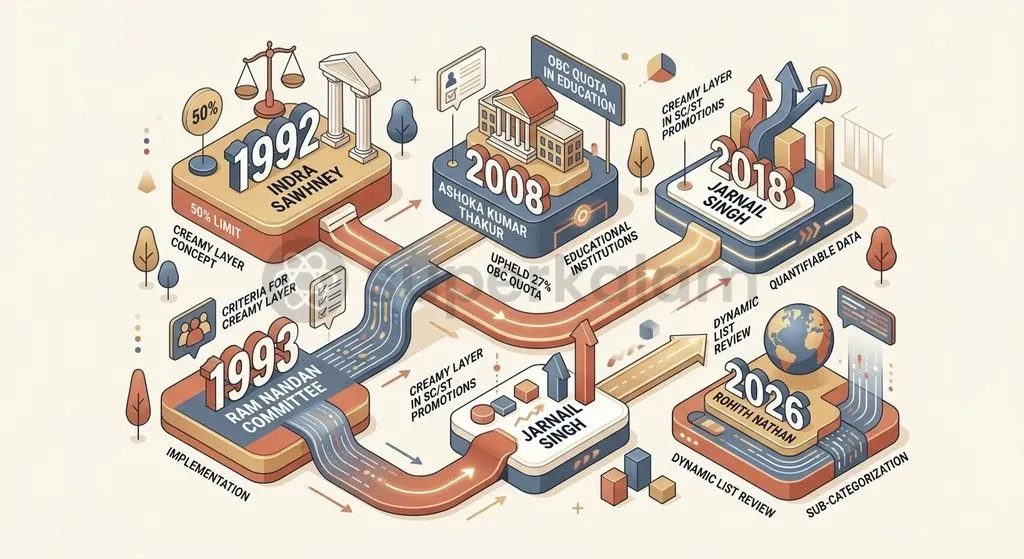
| Year | Landmark Milestone | Core Constitutional Verdict | Key Impact |
|---|---|---|---|
| 1992 | Indra Sawhney v. UOI | Upheld 27% OBC quota under Article 16(4) | Mandated creamy layer exclusion |
| 1993 | Ram Nandan Committee | Established 6 socio-economic categories | Made social status primary over income |
| 2008 | Ashoka Kumar Thakur v. UOI | Creamy layer integral to equality code | Applied exclusion to central educational admissions |
| 2018 | Jarnail Singh v. Lachhmi Narain Gupta | Applied creamy layer to SC/ST promotions | Extended equality doctrine under Articles 14 and 16 |
| 2021 | Pichra Warg Kalyan Mahasabha Haryana | Struck down pure income criteria | Barred economic-only state quotas |
| 2026 | Union of India v. Rohith Nathan | Barred salary-based exclusion | Struck down arbitrary 2004 circulars |
The Supreme Court expanded this equality doctrine in Ashoka Kumar Thakur v. Union of India (2008). The Bench held that the creamy layer principle is an integral component of equality under Articles 14, 15, and 16.
The doctrine widened further in Jarnail Singh v. Lachhmi Narain Gupta (2018). A five-judge Constitution Bench extended the creamy layer test to Scheduled Castes and Scheduled Tribes in promotional quotas.
Discuss with Superkalam
Why is parental occupational rank considered a more accurate indicator of social status than gross annual salary in affirmative action frameworks?
Ask NowHow the Current Income and Parental Status Criteria Actually Work
The Department of Personnel and Training (DoPT) operationalised the Ram Nandan Committee recommendations through Office Memorandum No. 36012/22/93-Estt.(SCT) on 8 September 1993. This foundational document established six operational categories to identify creamy layer individuals across society.
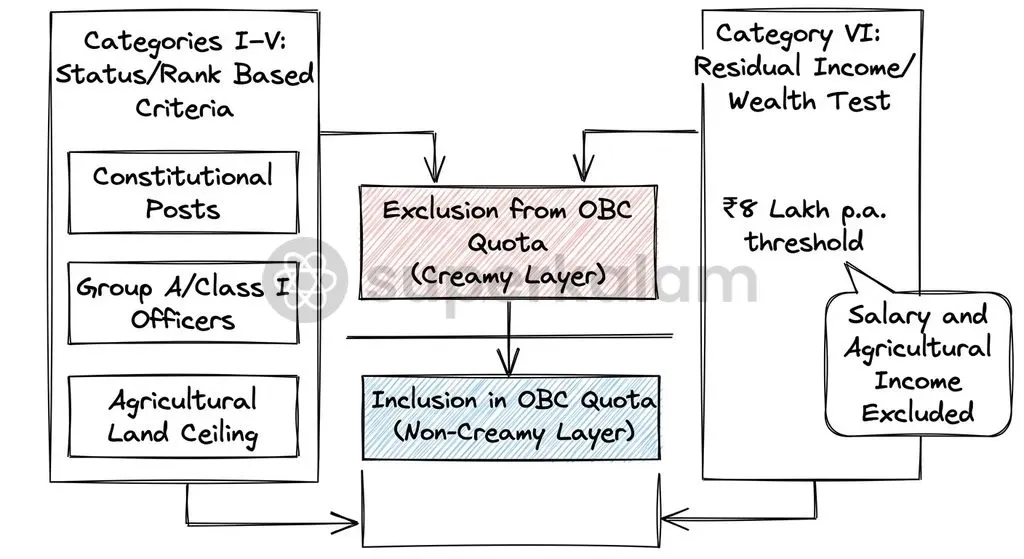
Status-based categories (Categories I to V) are evaluated first. The income test (Category VI) operates strictly as a residual filter:
- Category I (Constitutional Posts): Excludes children of the President, Vice-President, Supreme Court and High Court Judges, UPSC members, and Election Commissioners.
- Category II (Service Category): Evaluates parental occupational rank, excluding children of direct Group A/Class I officers or parents who are both direct Group B/Class II officers.
- Category III (Armed Forces and Paramilitary): Excludes children of parents holding the rank of Colonel or above in the Army, or equivalent ranks in the Navy, Air Force, and Paramilitary forces.
- Category IV (Professional Class and Trade/Industry): Applies to individuals in medicine, law, engineering, or large commercial ventures reflecting independent high status.
- Category V (Property Owners): Covers agricultural landowners whose holdings exceed statutory ceilings. Landholdings consisting exclusively of un-irrigated agricultural land do not trigger creamy layer exclusion.
- Category VI (Income and Wealth Test): Applies residually to persons outside Categories I to V. It assesses non-salary wealth while explicitly excluding parental salaries and agriculture.
| Category Parameter | Direct Status Exclusion (Categories I–V) | Residual Income Test (Category VI) |
|---|---|---|
| Primary Assessment Metric | Parental occupational rank and constitutional post | Independent wealth, trade earnings, and capital assets |
| Salary Assessment | Rank governs status; salary amount is irrelevant | Salary is explicitly excluded from income aggregation |
| Agricultural Income | Assessed strictly against state statutory land ceilings | Agricultural income is excluded from income aggregation |
| Current Financial Threshold | No financial ceiling applies; rank dictates exclusion | ₹8.0 lakh gross annual income over three consecutive years |
| Applicable Target Group | Civil servants, military officers, constitutional posts | Unorganised business, professionals, unclassified sectors |
The gross annual income ceiling under Category VI has been upgraded periodically to account for inflation. The threshold was fixed at ₹1 lakh per annum in 1993, increased to ₹2.5 lakh in 2004, ₹4.5 lakh in 2008, ₹6.0 lakh in 2013, and currently stands at ₹8.0 lakh per annum since September 2017.
Discuss with Superkalam
How should a district revenue officer evaluate an OBC candidate whose parent is an executive in a public sector bank without an official post-equivalence table?
Ask NowWhere the Administrative System Broke Down: The Salary Versus Wealth Dilemma
The administrative machinery governing OBC certification has suffered severe distortion at the district level. Revenue authorities routinely misinterpret the Schedule to the 1993 DoPT Office Memorandum.
Officers inspect Form 16 certificates or Income Tax Returns (ITR) submitted by parents in PSUs, public sector banks, and private firms. When gross salary exceeds ₹8 lakh per annum, authorities summarily deny the non-creamy layer certificate. This practice violates Category VI, which mandates that income from salaries shall not be clubbed into the calculation.
This breakdown stems from a long-standing failure to establish formal post-equivalence. The sequence of administrative failure unfolds in five steps:
- Parental Employment: A parent works in a PSU, public bank, university, or the private sector.
- Equivalence Vacuum: Executive departments fail to issue formal post-equivalence tables under Category II(C).
- Mishandled Documentation: District revenue authorities inspect Form 16 or taxable gross salary rather than occupational rank.
- Illegal Aggregation: Salaried income is treated as commercial wealth under Category VI.
- Erroneous Denial: Eligible candidates are denied non-creamy layer certificates in direct breach of the 1993 rules.
The National Commission for Backward Classes (NCBC) highlighted this persistent administrative failure in its statutory reports.
Established as a statutory body in 1993, the NCBC received constitutional status under Article 338B through the 102nd Constitutional Amendment Act, 2018. The NCBC clarified that a bank employee cannot be evaluated on raw salary when a regular government employee with comparable duties receives protection under Category II occupational filters.
Discuss with Superkalam
How does the administrative confusion between salary aggregation and commercial wealth lead to hostile discrimination under Articles 14 and 16?
Ask NowWhat the Supreme Court Clarified and Struck Down
The Supreme Court corrected these administrative deviations in Union of India v. Rohith Nathan (2026). The Bench examined whether an executive clarification issued by the DoPT on 14 October 2004 could permit authorities to evaluate PSU and private sector employees purely on gross salary.
The judgment established three core constitutional principles:
- Subordination of circulars: The 2004 executive clarification could not override or expand the parent 1993 Office Memorandum, which explicitly excludes salary income under Category VI.
- Protection of equality: Excluding candidates based solely on parental salary constitutes an arbitrary classification violating Article 14 and Article 16(1).
- Nominal vs social status: Pay commission hikes increase nominal salaries without conferring advanced social status, making raw pay an illegitimate proxy for backwardness.
The Court ordered the Union to enforce status equivalence and protect eligible candidates who secured merit positions in competitive examinations.
Discuss with Superkalam
Should the creamy layer criteria rely entirely on functional post-equivalence frameworks, or is a simplified transparent wealth metric more effective in reducing administrative disputes?
Ask NowFixing Implementation: A Fairer Path for Caste and Income Verification
Administrative bodies must overhaul the OBC verification ecosystem to remove arbitrary discretion and ensure fairness. Key institutional reforms include:
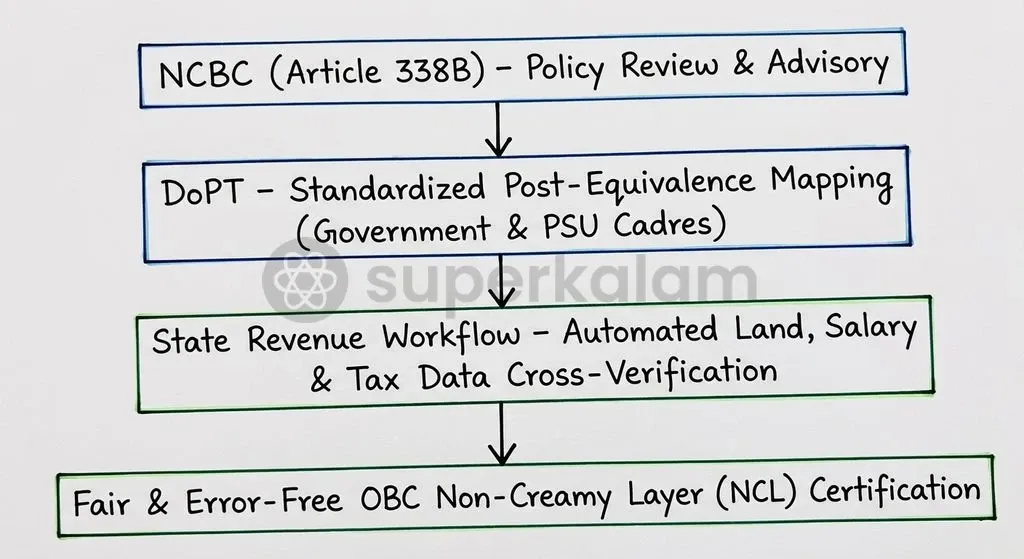
- Expedited Post-Equivalence Notification: The DoPT and the Ministry of Social Justice and Empowerment must publish a comprehensive equivalence schedule under Category II(C). Managerial grades across public sector enterprises, state PSUs, nationalised banks, and universities must map directly to Group A and Group B civil posts.
- Standardised Verification Guidelines for Revenue Officers: District magistrates, tehsildars, and revenue inspectors require binding circulars instructing them not to evaluate Form 16 or agricultural land income when assessing Category VI thresholds.
- Periodic Revision of Financial Ceilings: The Union Government, in consultation with the National Commission for Backward Classes under Article 338B, should index the Category VI income threshold to regular cost-of-living adjustments.
- Digital Certification Portals: States must deploy automated certification systems that separate parental occupational status from non-salary asset calculations, ending harassment and ensuring compliance with judicial verdicts.
| Implementing Body | Mandated Reform Action | Targeted Constitutional Outcome |
|---|---|---|
| DoPT & Line Ministries | Notify Category II(C) post-equivalence schedules for PSUs and banks | Eliminates discrimination between civil servants and PSU employees |
| State Revenue Departments | Issue binding orders prohibiting Form 16 salary checks under Category VI | Prevents unlawful certificate rejections at the tehsil level |
| NCBC & Union Government | Periodically index Category VI income ceilings against inflation indices | Maintains realistic socio-economic threshold under Article 338B |
| State IT Departments | Deploy automated non-creamy layer verification portals | Ensures objective, transparent processing free of bureaucratic bias |
Key Takeaways
- The nine-judge Constitution Bench in Indra Sawhney (1992) established the creamy layer doctrine under Article 16(4) to ensure affirmative action benefits reach genuinely backward sections.
- The Ram Nandan Committee (1993) created six categories for creamy layer identification, establishing that occupational rank in Categories I to V supersedes pure income calculations.
- Under Category VI of the 1993 DoPT OM, parental salaries and agricultural income are explicitly excluded from the gross annual income threshold calculation.
- In Union of India v. Rohith Nathan (2026), the Supreme Court prohibited the exclusion of candidates based solely on parental salary and reaffirmed the primacy of the 1993 parent memorandum.
- In Pichra Warg Kalyan Mahasabha Haryana (2021), the Supreme Court affirmed that economic criteria alone cannot be the sole basis for creamy layer exclusion without social and educational indicators.
- The National Commission for Backward Classes, established in 1993 and granted constitutional status under Article 338B by the 102nd Amendment Act in 2018, advises on creamy layer guidelines and list revisions.
Mains Question
"Exclusion of the creamy layer is rooted in the principle that affirmative action must target social backwardness rather than mere economic capacity." In light of the Justice Ram Nandan Committee recommendations and subsequent judicial pronouncements, elucidate. (10 Marks)
Evaluate NowMains Question
Administrative failure to establish formal post-equivalence under Category II(C) of the 1993 DoPT guidelines has resulted in hostile discrimination against public sector employees. In view of the Supreme Court's ruling in *Union of India v. Rohith Nathan* (2026), critically examine the structural defects in OBC creamy layer verification and suggest remedial measures. (15 Marks)
Evaluate NowPractice MCQs
QUESTION 1
With reference to the criteria for determining the 'creamy layer' among Other Backward Classes (OBCs) in India, consider the following statements:
- The identification norms formulated by the Justice Ram Nandan Prasad Committee prioritize parental occupational status over crude financial income.
- Under Category VI (Income and Wealth Test) of the 1993 DoPT guidelines, income derived from parental salaries and agricultural land is aggregated to determine the financial ceiling.
- The current gross annual income threshold under the residual income test stands at ₹8.0 lakh per annum.
Which of the statements given above is/are correct?
QUESTION 2
Consider the following statements regarding landmark judicial decisions on affirmative action and the creamy layer doctrine:
- In Indra Sawhney v. Union of India (1992), the Supreme Court upheld 27% reservation for OBCs and mandated the exclusion of the creamy layer.
- In Ashoka Kumar Thakur v. Union of India (2008), the Supreme Court held that the creamy layer principle applies to central educational admissions.
- In Jarnail Singh v. Lachhmi Narain Gupta (2018), a Constitution Bench extended the application of the creamy layer test to Scheduled Castes and Scheduled Tribes in promotional quotas.
Which of the statements given above are correct?
QUESTION 3
Regarding the Category-wise classification under the DoPT 1993 Office Memorandum for creamy layer exclusion, consider the following statements:
- Children of parents holding constitutional posts under Category I are subject to an annual income assessment ceiling.
- In Category II (Service Category), children of direct Group A/Class I officers are excluded based on parental occupational rank.
- In Category V (Property Owners), agricultural landholdings consisting exclusively of un-irrigated land do not trigger creamy layer exclusion.
Which of the statements given above is/are correct?
QUESTION 4
In the context of Indian constitutional provisions and statutory bodies, consider the following statements:
- The National Commission for Backward Classes (NCBC) was conferred constitutional status under Article 338B via the 102nd Constitutional Amendment Act, 2018.
- In Union of India v. Rohith Nathan (2026), the Supreme Court ruled that conflating parental salaries with commercial wealth for PSU employees violates Article 14 and Article 16.
Which of the statements given above is/are correct?
QUESTION 5
Under the 1993 DoPT guidelines for OBC creamy layer determination, which of the following is evaluated strictly as a residual test only after status-based categories (Categories I to V) are exhausted?






Social Backwardness Versus Pure Wealth: The Constitutional Debate
Constitutional jurisprudence under Article 15(4) and Article 16(4) affirms that economic position alone cannot determine social advancement. The Supreme Court has repeatedly struck down state policies that reduce creamy layer determination to simple income tax brackets.
In Pichra Warg Kalyan Mahasabha Haryana v. State of Haryana (2021), the Supreme Court struck down Haryana government notifications from 2016 and 2018. The state had introduced sub-quotas based purely on income brackets of ₹3 lakh and ₹6 lakh per annum.
The constitutional distinction between caste disability and financial standing rests on key criteria:
By defending the Ram Nandan Committee framework, the judiciary has preserved the boundary between poverty alleviation and substantive constitutional equality.