Regional Benches of Supreme Court vs National Court of Appeal: Solving Apex Pendency
While regional benches widen geographic access, apex decongestion hinges on checking routine Article 136 petitions that sideline vital constitutional review.
Nov, 2026
•10 min read
Context
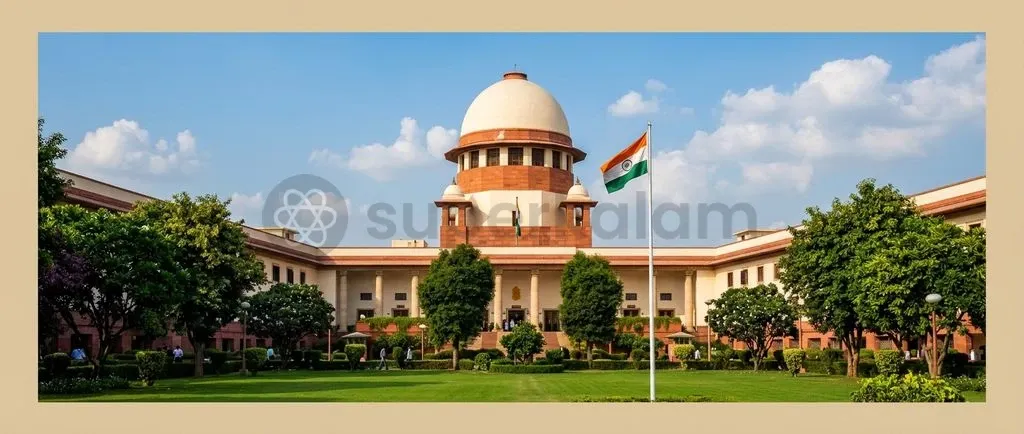
The Supreme Court of India faces an institutional crisis. Over eighty-three thousand pending cases have turned the apex constitutional body into a routine court of correction. Unconstrained special leave petitions now crowd out vital constitutional adjudication.
Administrative regional benches under Article 130 and a bifurcated National Court of Appeal aim to ease geographic barriers. Yet physical decentralisation alone cannot resolve systemic delay. Sustainable reform requires disciplined procedural gatekeeping under Article 136 to filter routine appellate admissions.
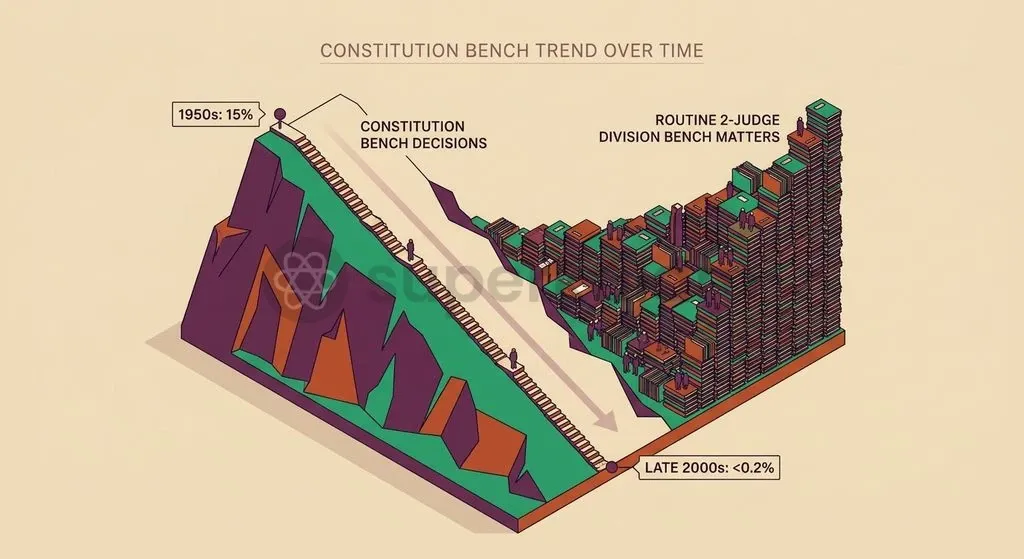
Without strict filters, geographic expansion simply multiplies conflicting division bench rulings across new regional centres while diluting the court's unitary authority. Empirical records reveal that Constitution Bench decisions collapsed from fifteen percent of verdicts in the 1950s to under point two percent by the late 2000s, leaving structural constitutional questions unresolved.
Why in the News: The Long-Standing Call to Decongest the Apex Court
The Supreme Court docket crisis remains unresolved as over eighty-three thousand matters stay pending before the apex court according to National Judicial Data Grid records. As of November 2026, the proposal to establish a National Court of Appeal remains pending before a five-judge Constitution Bench of the Supreme Court following the 2016 reference in V. Vasanthakumar v. H.C. Bhatia.
Recent institutional moves have reignited the debate:
- 133rd Parliamentary Report: The Department-related Parliamentary Standing Committee on Personnel, Public Grievances, Law and Justice presented its report, Judicial Processes and Their Reforms, recommending regional benches in four or five locations under Article 130.
- Executive Concurrence: In its 144th Action Taken Report, the committee noted that the Union Ministry of Law and Justice accepted in principle the proposal to set up regional benches.
Discuss with Superkalam
According to the Law Commission's 229th Report, what percentage of the Supreme Court's total filings are accounted for by Special Leave Petitions?
Ask NowHow the Supreme Court Became a Court of Ordinary Appeal
The framers designed the Supreme Court primarily as a constitutional arbiter, not an ordinary appellate forum. Under Article 145(3) of the Constitution, the minimum number of judges deciding substantial questions of constitutional interpretation must be five. In early post-independence decades, the Court regularly convened full Constitution Benches to settle foundational questions of governance.
Judicial practice shifted dramatically over subsequent decades, altering the nature of the bench:
- Collapse in constitutional benches: Analysis by legal scholar Nick Robinson revealed that Constitution Bench decisions fell from roughly 15 percent of all decisions in the 1950s to fewer than 0.2 percent by the late 2000s.
- Rise of error correction: The Court evolved into a routine appellate forum, operating through dozens of two-judge benches disposing of statutory appeals.
- Judicial acknowledgement: In Bihar Legal Support Society v. Chief Justice of India (1986), a five-judge bench noted that the Court was never intended as a regular court of appeal against High Court orders.
The Core Bottleneck: Unrestricted SLPs and Judicial Polyvocality
Article 136 confers extraordinary plenary jurisdiction on the Supreme Court to grant special leave against any judicial order. Conceived as an exceptional safety valve for gross miscarriages of justice, liberal admissions turned this power into a routine appellate route.
The volume of petitions creates distinct institutional distortions:
- Massive docket share: The Law Commission of India observed in its 229th Report that Special Leave Petitions (SLPs) constitute approximately 80 percent of total filings.
- Routine subject matter: The docket is inundated with rent disputes, bail pleas, service matters, and interlocutory challenges. In Mathai @ Joby v. George (2010), the Court admitted SLPs were turning it into an ordinary appellate forum, yet declined to curb Article 136.
- Judicial polyvocality: Because the Court sits in multiple two-judge and three-judge benches simultaneously, different benches frequently deliver conflicting interpretations of identical laws.
Contradictory rulings foster speculative litigation and leave subordinate courts without uniform guidance.
Discuss with Superkalam
Explain how the Supreme Court's practice of sitting in numerous two-judge benches contributes to the problem of 'judicial polyvocality'.
Ask NowModel 1: Regional Benches under Article 130 (Decentralising Access)
Article 130 provides that the Supreme Court shall sit in Delhi or in other places appointed by the Chief Justice with Presidential approval. Creating regional benches represents an administrative decentralisation of the existing court rather than an entirely new judicial tier.
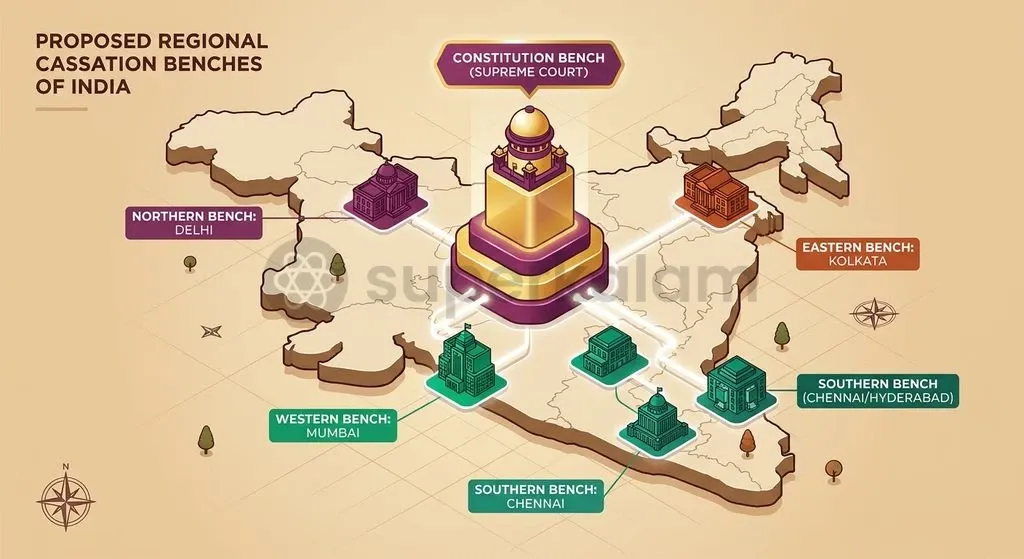
The Law Commission outlined a concrete regional model in its 229th Report, chaired by Justice Dr. AR. Lakshmanan. It recommended a permanent Constitution Bench in New Delhi alongside four regional Cassation Benches:
- Northern Cassation Bench: Situated at New Delhi to cover northern states.
- Southern Cassation Bench: Established at Chennai or Hyderabad for southern jurisdictions.
- Eastern Cassation Bench: Located at Kolkata to serve eastern and north-eastern regions.
- Western Cassation Bench: Based at Mumbai to adjudicate western disputes.
The Full Court has repeatedly rejected this approach. On February 18, 2010, it passed a unanimous resolution stating it found no justification for regional benches outside Delhi. The Court argued geographic dispersal would dilute its apex unitary authority and produce divergent regional rulings.
Model 2: National Court of Appeal (Structural Bifurcation)
A National Court of Appeal introduces structural bifurcation by inserting an appellate tier between High Courts and the Supreme Court. Under this framework, the Supreme Court in New Delhi would hear only constitutional disputes.
This structural division has deep roots across Indian judicial reports:
- 95th Report of the Law Commission (1984): Chaired by Justice K.K. Mathew, the Commission recommended splitting the Court into a Constitutional Division and a Legal Division.
- 125th Report of the Law Commission (1988): Led by Justice D.A. Desai, the Commission recommended a Constitutional Court at Delhi and a Federal Court of Appeal across five zonal seats.
- V. Vasanthakumar v. H.C. Bhatia (2016): A three-judge bench led by CJI T.S. Thakur referred the concept of a National Court of Appeal to a five-judge Constitution Bench, framing eleven substantial constitutional questions.
During Vasanthakumar, amicus curiae K.K. Venugopal submitted that four regional appellate courts should absorb approximately 140 categories of routine appellate cases. These cover matrimonial, labour, rent, and land disputes. Attorney General Mukul Rohatgi opposed the proposal, arguing that Article 136 is an inalienable apex power that cannot be diverted.
An intermediate court requires a constitutional amendment under Article 368. Parliament would have to amend Articles 132, 133, 134, and 136 to give regional appellate benches statutory finality.
Discuss with Superkalam
If regional cassation benches were established under Article 130, how might this impact filing rates from High Courts that currently display low appeal percentages like Madras or Odisha?
Ask NowSide-by-Side Comparison: Regional Benches vs National Court of Appeal vs Procedural Gatekeeping
Evaluating solutions to the judicial docket crisis requires comparing structural adjustments, administrative decentralisation, and procedural reform.
| Dimension | Model 1: Regional Benches (Article 130) | Model 2: National Court of Appeal | Model 3: Procedural Gatekeeping (Article 136) |
|---|---|---|---|
| Constitutional Mechanism | Administrative order by the CJI with Presidential approval under Article 130 | Constitutional amendment under Article 368 restructuring appellate provisions | Judicial self-discipline or framed rules under Article 145 |
| Institutional Architecture | Unitary Supreme Court sitting in multiple regional locations | New intermediate appellate tier between High Courts and the Supreme Court | Existing unitary structure retained at New Delhi |
| Impact on Docket Arrears | Redistributes case volume geographically without curbing admissions | Offloads routine civil and criminal appeals to the intermediate court | Drastically cuts case admissions by enforcing exceptional thresholds |
| Risk of Polyvocality | High; contradictory rulings between regional benches of the same court | Moderate; resolved by the separate apex Constitutional Court | Low; fewer benches hear appeals, preserving doctrinal consistency |
| Litigant Geographic Access | Substantially improved across southern, western, and eastern states | Substantially improved through regional appellate benches | Unchanged; non-Delhi litigants still travel to the capital |
| Implementation Hurdle | Institutional resistance from the Supreme Court Full Bench | Substantial legislative threshold requiring special parliamentary majorities | Judicial reluctance to surrender broad discretionary powers |
Why Physical Decentralisation Fails Without Strict Article 136 Reform
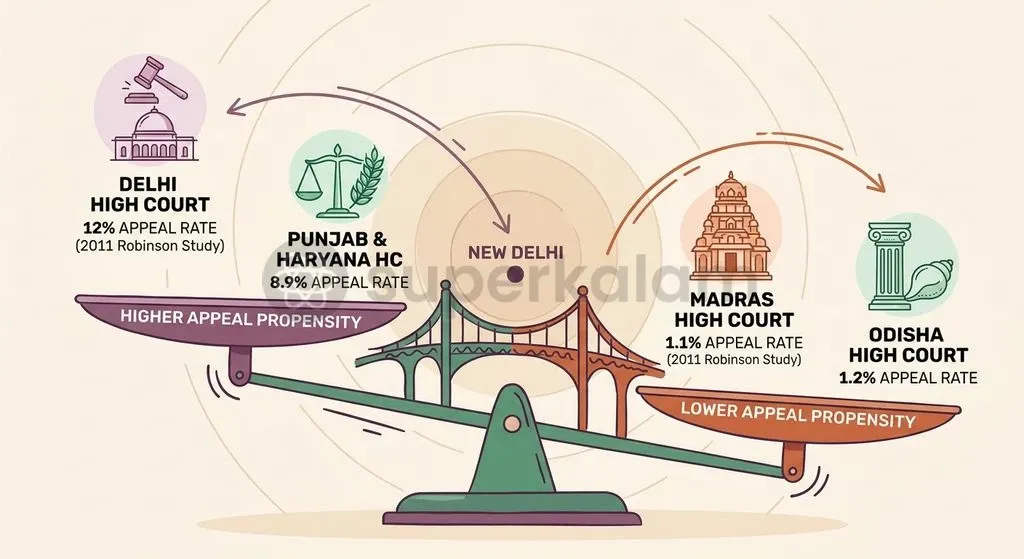
Physical decentralisation alone cannot clear docket arrears because adding courtrooms does not reduce admission rates. Nick Robinson's empirical workload study revealed stark proximity bias in Supreme Court filings.
Filing rates reflect geographical distance rather than the legal merits of cases:
- Close proximity: In 2011, approximately 12 percent of decisions from the Delhi High Court and 8.9 percent from the Punjab & Haryana High Court reached the Supreme Court on appeal.
- Distant jurisdictions: Only 1.1 percent of decisions from the Madras High Court and 1.2 percent from the Odisha High Court reached the Court over the same period.
Opening regional benches without tightening Article 136 admissions will spur a surge in filings from distant states. Without gatekeeping, judicial polyvocality will multiply across regional centres. The legal system would face an expanded volume of conflicting division bench precedents, worsening uncertainty.
Discuss with Superkalam
Analyse the trade-off between expanding physical access to justice for distant litigants and maintaining doctrinal uniformity across the Indian judicial system.
Ask NowGlobal Precedents: How the US, UK, and Continental Courts Handle Appeals
Comparative constitutional frameworks maintain institutional focus by strictly limiting routine appeals. The Supreme Court of the United States regulates filings through the discretionary writ of certiorari, established under the Judiciary Act of 1925. It grants review with oral arguments to only 60 to 80 cases out of more than 7,000 petitions filed annually.
The UK Supreme Court maintains an equally focused appellate scope. Created under the Constitutional Reform Act 2005 to replace the Appellate Committee of the House of Lords, the court acts strictly as a court of last resort. It hears approximately 50 to 80 appeals per year, choosing matters that raise arguable legal questions of broad public significance.
Continental civil law jurisdictions divide constitutional questions from routine cassation:
- France: The Cour de Cassation functions as the highest appellate body for civil and criminal disputes, while the Conseil Constitutionnel handles constitutional review.
- Germany: The Basic Law separates the Federal Constitutional Court (Bundesverfassungsgericht) in Karlsruhe from ordinary federal appellate courts such as the Bundesgerichtshof.
These systems insulate apex constitutional bodies from routine statutory backlogs.
Discuss with Superkalam
Design a procedural gatekeeping mechanism under Article 136 that preserves the Supreme Court's role as an exceptional safety valve while preventing it from acting as an ordinary court of appeal.
Ask NowEthical and Constitutional Dimensions: Equal Access to Justice vs Legal Certainty
Reforming the apex judiciary requires balancing two fundamental constitutional imperatives:
- Right to accessible justice: Article 39A directs the State to ensure equal justice is not denied by economic or geographic disability. In Anita Kushwaha v. Pushap Sudan (2016), the Court affirmed that access to justice is a fundamental right under Articles 14 and 21, covering both physical accessibility and financial affordability.
- Need for doctrinal certainty: Article 141 requires the apex court to provide definitive, uniform rulings binding all domestic courts. Uncontrolled decentralisation risks fracturing national jurisprudence into divergent regional precedents.
New Delhi's geographic monopoly imposes disproportionate costs on distant citizens. Litigants from southern, eastern, and north-eastern states must bear hefty travel bills and retain specialised Supreme Court advocates alongside local lawyers. This disparity directly strains the constitutional guarantees of Articles 14 and 21.
Way Forward: A Roadmap for Appellate Gatekeeping and Constitutional Focus
A workable solution pairs procedural gatekeeping under Article 136 with phased structural adjustments. The Supreme Court must first exercise self-restraint by framing objective admission rules under Article 145. Special leave petitions should be confined to cases involving serious constitutional interpretation, inter-state conflicts, or clear statutory invalidity.
Institutional reform should follow a structured progression:
- Restoring Permanent Constitution Benches: The Chief Justice of India should designate permanent five-judge Constitution Benches to clear foundational questions, fulfilling the mandate of Article 145(3).
- Adjudicating the Vasanthakumar Reference: The five-judge bench must deliver a definitive verdict on the 2016 reference, clarifying whether a National Court of Appeal aligns with the basic structure of the Constitution.
- Establishing Intermediate Cassation Benches: If structural bifurcation is enacted via Article 368, intermediate regional courts of appeal should be granted statutory finality over ordinary civil, criminal, and commercial appeals.
- Digital Decongestion: The judiciary should expand virtual hearings to provide equitable geographic access without dispersing permanent physical benches until disciplined gatekeeping mechanisms are operational.
Key Takeaways
- Pendency in the Supreme Court has surpassed 83,000 cases, with Special Leave Petitions under Article 136 accounting for roughly 80 percent of all filings.
- Empirical studies confirm that Constitution Bench decisions collapsed from 15 percent in the 1950s to under 0.2 percent by the late 2000s, sidelining constitutional review.
- Article 130 allows administrative regional benches with Presidential approval, whereas a National Court of Appeal requires an Article 368 constitutional amendment to establish an intermediate tier.
- Physical decentralisation without strict Article 136 reform risks multiplying judicial polyvocality, generating conflicting division bench precedents across regional centres.
- Comparative models in the US, UK, France, and Germany demonstrate that apex courts maintain authority by capping annual appellate admissions to select cases of significant public importance.
Mains Question
"The transformation of the Supreme Court into a routine court of error-correction via unrestricted Article 136 petitions has diluted its core mandate as a constitutional arbiter." In light of this statement, critically analyse the comparative viability of Regional Benches under Article 130 versus an intermediate National Court of Appeal. (15 Marks)
Evaluate NowMains Question
Highlighting the empirical findings on 'proximity bias' in appellate filings, evaluate whether administrative decentralisation under Article 130 can alone resolve the crisis of access and pendency in the Supreme Court. (10 Marks)
Evaluate NowPractice MCQs
QUESTION 1
Consider the following statements regarding the structural proposals for reforming the Supreme Court of India:
- Under Article 130 of the Constitution, the Chief Justice of India may appoint places other than Delhi for the Supreme Court to sit, subject to Presidential approval.
- In its 229th Report, the Law Commission of India recommended establishing a Constitution Bench in New Delhi alongside four regional Cassation Benches.
- Establishing a National Court of Appeal as an intermediate tier between High Courts and the Supreme Court requires an administrative notification without necessitating a Constitutional amendment under Article 368.
Which of the statements given above are correct?
QUESTION 2
With reference to the functioning and jurisdiction of the Supreme Court of India, consider the following statements:
- Article 145(3) mandates that the minimum number of judges deciding cases involving a substantial question of constitutional law shall be five.
- In Bihar Legal Support Society v. Chief Justice of India (1986), the Supreme Court affirmed that it was primarily designed to function as an ordinary appellate forum against High Court judgments.
- According to the Law Commission's 229th Report, Special Leave Petitions (SLPs) filed under Article 136 constitute approximately 80 percent of the Court's total filings.
Which of the statements given above is/are correct?
QUESTION 3
Consider the following statements regarding the institutional debate over Supreme Court pendency:
- In V. Vasanthakumar v. H.C. Bhatia (2016), the proposal for a National Court of Appeal was referred to a five-judge Constitution Bench.
- The Full Court of the Supreme Court in 2010 unanimously passed a resolution accepting the recommendation to establish regional benches outside Delhi.
- Empirical analysis by legal scholar Nick Robinson revealed that Constitution Bench verdicts fell from roughly 15 percent of all decisions in the 1950s to under 0.2 percent by the late 2000s.
Which of the statements given above is/are correct?
QUESTION 4
Regarding the geographic distribution of litigation before the Supreme Court, empirical evidence on 'proximity bias' indicates which of the following?
QUESTION 5
Consider the following pairs of Law Commission of India Reports and their primary structural recommendations:
- 95th Report (1984) : Splitting the Supreme Court into a Constitutional Division and a Legal Division
- 125th Report (1988) : Setting up a Constitutional Court at Delhi and a Federal Court of Appeal across five zonal seats
- 229th Report (2009) : Abolition of Special Leave Petitions under Article 136
How many of the pairs given above are correctly matched?