India Forex Reserves (As of November 2026): Components, RBI Management, Import Cover and Why It Matters
India's forex reserves stood at $719.55 billion in the week ended 6 November 2026. What goes into them, how RBI manages them, and why import cover matters.
Nov, 2026
•15 min read
Overview
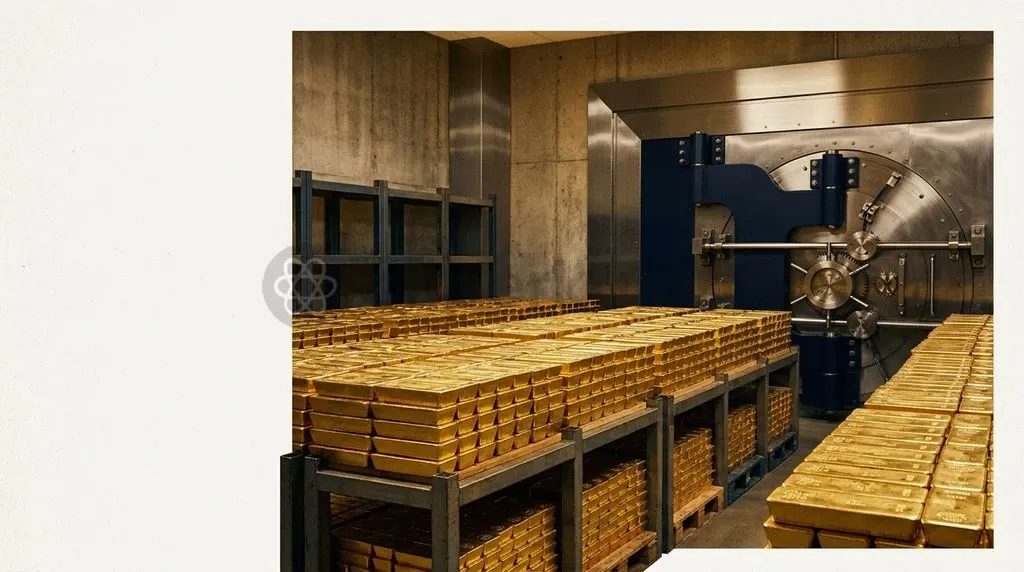
India's foreign exchange strategy is undergoing a structural pivot. Policy has shifted from passive dollar accumulation toward active geopolitical de-risking. This recalibration is characterised by physical gold repatriation, active forward-market interventions, and bilateral trade settlement in local currencies under the Reserve Bank of India.
This transition directly mitigates the high domestic cost of sterilisation. It curbs exposure to volatile capital flows and insulates cross-border trade against the unilateral weaponisation of western payment systems.
Headline reserves no longer guarantee financial security during deep global fragmentation. Authorities are anchoring sovereign assets domestically and settling trade via bilateral channels. These steps forge an external buffer for a multipolar monetary order.
Why India's Reserve Pile Is Facing a Fresh Stress Test
The Reserve Bank of India faces a demanding global landscape. Trade frictions, shifting interest differentials, and sudden capital reversals continue to test the country's currency buffers.
As of November 2026, headline reserves reached US$ 719.547 billion according to the RBI Weekly Statistical Supplement. While this tally ranks among the largest sovereign holdings worldwide, headline scale can conceal underlying balance-of-payments strain.
Central banks build reserve war chests as self-insurance against external shocks. These disruptions usually stem from sudden capital flight or abrupt import price spikes.
India's Current Account Deficit remains structurally exposed to global energy markets. The country imports over 85 percent of its domestic crude consumption requirements, as documented by the Ministry of Petroleum and Natural Gas. When international oil prices jump, the national import bill expands rapidly, fueling immediate dollar demand across spot markets.
External trade pressures cascade through three sequential stages:
- Merchandise Trade Gap: Elevated crude oil prices instantly inflate the national import bill.
- Dollar Demand Spike: Domestic importers step up purchases of greenbacks in spot markets.
- Rupee Pressure: Outflows squeeze systemic liquidity and depress reserve adequacy metrics.
Reserve adequacy cannot be judged by headline billions alone. The Reserve Bank of India tracks external vulnerability across three core indicators:
- Import Cover: Headline reserves supported 10.8 months of imports on a Balance of Payments basis as of end-December 2025, moderating from 11.3 months recorded at end-September 2025.
- Short-Term Debt Coverage: The ratio of short-term external debt by original maturity to total foreign exchange reserves stood at 21.9 percent at end-December 2025.
- Volatile Capital Buffer: The ratio of volatile capital flows—defined as cumulative portfolio inflows and outstanding short-term debt—to total reserves was 69.1 percent at end-December 2025.
Nearly seven-tenths of India's foreign assets are matched by volatile external liabilities. Under these conditions, nominal reserve growth does not equal unencumbered wealth. A sudden risk-off episode can spark rapid portfolio liquidations, forcing central bank interventions to protect currency stability.
Discuss with Superkalam
Can you recall the four statutory components of India's foreign exchange reserves and their governing Acts?
Ask NowThe Four Pillars of the Reserve Chest: What the Headline Number Hides
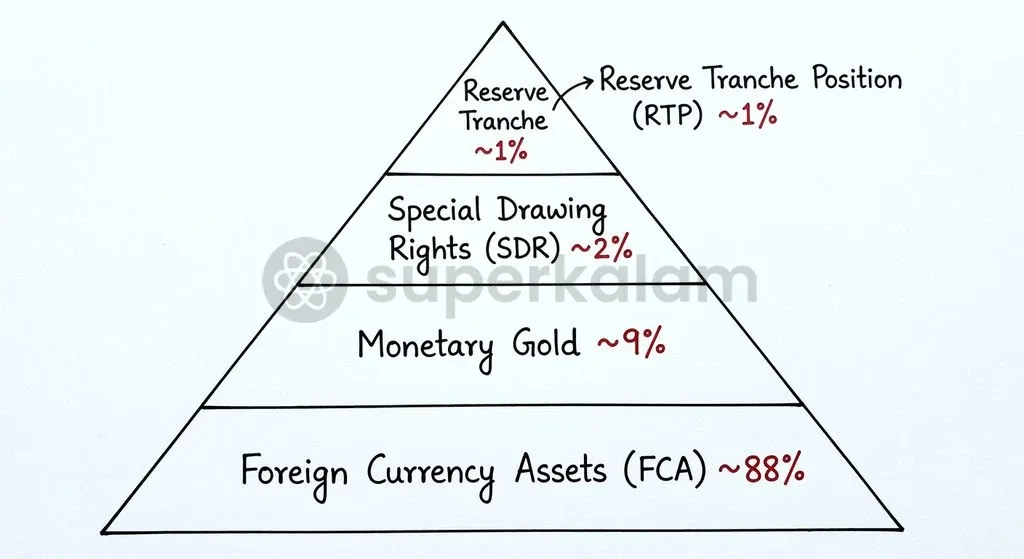
India's foreign exchange reserves comprise four statutory components governed by the Reserve Bank of India Act, 1934 and the Foreign Exchange Management Act, 1999. Per the RBI Half-Yearly Report on Management of Foreign Exchange Reserves, these assets divide into Foreign Currency Assets, Gold, Special Drawing Rights, and the Reserve Tranche Position at the International Monetary Fund.
Each asset balances liquidity, sovereign safety, and portfolio yield across the balance sheet.
| Reserve Component | Value (US$ Billion) | Share of Total (%) | Primary Asset Composition | Key Functional Role |
|---|---|---|---|---|
| Foreign Currency Assets (FCA) | US$ 591.350 | ~82.2% | US Treasuries, sovereign bonds, overseas bank deposits | Liquid market intervention and import financing |
| Monetary Gold | US$ 104.796 | ~14.6% | Physical bullion (vaulted domestically and overseas) | Sovereign hedge against fiat currency debasement |
| Special Drawing Rights (SDR) | US$ 18.610 | ~2.6% | Unconditional international reserve asset created by IMF | Supplementary reserve liquidity via basket allocation |
| Reserve Tranche Position (RTP) | US$ 4.791 | ~0.7% | Liquid claim on IMF quota contribution | Immediate, unconditional drawing line during emergencies |
Data as of November 6, 2026.
Foreign Currency Assets are the operational workhorse of India's reserve framework. Accounted for in US dollars, this component holds sovereign bonds of major economies, deposits with foreign central banks, and obligations of supranational institutions. Holding over four-fifths of sovereign external wealth in foreign debt creates an unavoidable exposure to overseas monetary policy cycles.
Monetary gold forms the second-largest pillar. It reflects an intentional strategy of diversifying sovereign risk away from pure fiat assets. Physical gold carries no counterparty default risk, sovereign credit downgrade risk, or foreign sanctions exposure.
The remaining holdings—Special Drawing Rights and the Reserve Tranche Position—stem from India's membership in the International Monetary Fund. Special Drawing Rights represent potential claims on the freely usable currencies of IMF member nations, allocated based on member quotas.
The Reserve Tranche Position reflects India's quota subscription paid in foreign currencies or liquid assets. It is an unconditional liquidity line. The government can tap it during acute balance-of-payments distress without facing IMF structural conditionality.
Valuation Swings vs. Dollar Defense: How Reserves Actually Rise and Fall
Headline reserve changes reflect two distinct operational drivers: central bank market interventions and accounting valuation adjustments. Data in the RBI Sources of Variation in India's Foreign Exchange Reserves highlights that weekly adjustments rarely reflect pure dollar acquisitions or sales by the central bank.
Valuation changes take place because the RBI holds reserves in several global currencies—including the Euro, Pound Sterling, and Japanese Yen—alongside sovereign paper and physical bullion. Because the headline portfolio is expressed in US dollars, exchange-rate shifts alter the recorded total without any market trade occurring.
When the US dollar appreciates against the Euro or Yen, the dollar value of India's non-dollar assets falls, producing an accounting valuation loss. When major global currencies strengthen against the dollar, or when global bullion prices climb, headline reserves experience passive accounting gains. Bond yields introduce a similar dynamic: falling sovereign bond yields lift the capital value of foreign government securities, expanding the headline total.
| Operational Driver | Primary Transmission Mechanism | Domestic Liquidity Impact |
|---|---|---|
| Valuation Effects | Currency exchange fluctuations (EUR, GBP, JPY vs USD) and mark-to-market shifts in sovereign bond yields | No impact on liquidity in the domestic interbank market |
| Transaction Effects | Direct RBI interventions through cash spot-dollar purchases or spot-dollar sales | Direct expansion or absorption of rupee reserve money |
Transaction effects, by contrast, stem from direct market operations. When portfolio inflows climb or export receipts outpace demand, the RBI buys dollars in the spot market to curb speculative rupee appreciation. Conversely, when capital outflows create sharp depreciation pressure on the domestic currency, the monetary authority sells foreign currency to feed dollar liquidity to authorised dealers.
To limit spot volatility without depleting its physical war chest, the central bank intervenes across derivative markets. The RBI Bulletin on Operations in Foreign Exchange Market indicates that authorities regularly deploy forward and futures currency contracts.
By taking offsetting positions in forward maturities, the central bank smooths currency expectations. This approach absorbs exchange-rate shocks without triggering immediate headline spot reserve drawdowns.
Discuss with Superkalam
How do exchange-rate valuation changes alter headline reserves without impacting domestic interbank liquidity?
Ask NowBringing the Bullion Home: The Strategic Logic of RBI's Gold Repatriation
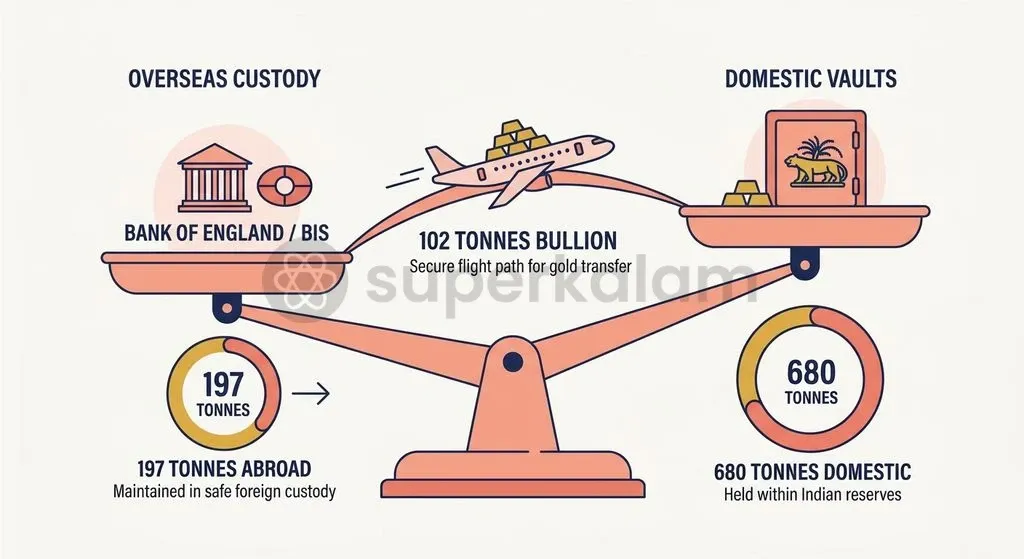
Between March and September 2024, the Reserve Bank of India completed a major logistical operation. It repatriated 102 metric tonnes of gold from custody at the Bank of England and the Bank for International Settlements to secure domestic vaults. This was the largest physical gold transfer by Indian monetary authorities in modern economic history.
Custodial distribution illustrates the scale of this structural realignment. According to the RBI 46th Half-Yearly Report on Management of Foreign Exchange Reserves, the central bank held 880.52 metric tonnes of gold as of end-March 2026. Of this total, 680.05 metric tonnes were housed within domestic vaults across India, while 197.67 metric tonnes remained in overseas custody with the Bank of England and the Bank for International Settlements.
| Custody Location | Holding (Metric Tonnes) | Share of Total | Primary Strategic Function |
|---|---|---|---|
| Domestic Vaults (India) | 680.05 MT | 77.2% | Direct sovereign physical custody, immune to foreign freezing orders |
| Overseas Custody (BoE & BIS) | 197.67 MT | 22.8% | Operational access to liquidity, short-term swaps, and global settlements |
This repatriation carries profound geopolitical weight. Central banks historically kept bullion in London or Zurich to tap deep lending markets, execute swaps, and streamline international settlements. That environment shifted after the 2022 decision by G7 nations to freeze roughly $300 billion in Russian sovereign reserves, as documented in an IMF Working Paper on Sanctions and Reserve Currency Composition.
That enforcement showed that sovereign assets stored in Western jurisdictions carry legal and political vulnerabilities during geopolitical crises. For non-aligned emerging economies, overseas custodial deposits represent counterparty exposure to foreign policy decisions. By transferring over three-quarters of its bullion into domestic vaults, India effectively mitigates custodial seizure risks and reinforces monetary sovereignty.
Repatriation also optimises balance-sheet costs. Storing bullion domestically eliminates recurring custody fees paid to foreign institutions. Retaining an operational allocation in London maintains access to international swap lines, while domestic vaults keep the core of India's unencumbered wealth under direct sovereign control.
Discuss with Superkalam
If global crude prices jump sharply, how does India's high import dependence cascade into pressure on rupee liquidity and reserve adequacy?
Ask NowDiscuss with Superkalam
Weigh the benefits of vaulting gold domestically for geopolitical immunity against keeping it in London or Basel for international swaps and market liquidity.
Ask NowSanction-Proofing Trade: Vostro Accounts and Rupee Settlement in Practice
To limit carrying costs and insulate trade from currency sanctions, India is internationalising the rupee. Invoicing cross-border trade in the domestic currency lowers the demand for foreign exchange reserves during external settlements.
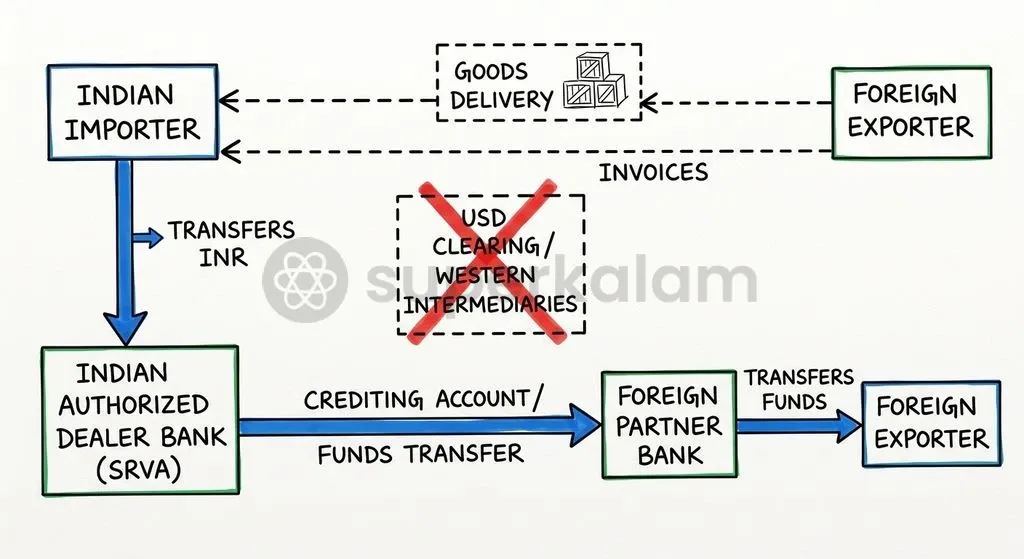
The regulatory structure arrived via RBI circular A.P. (DIR Series) No. 10 on July 11, 2022. It established rules for invoicing, payment, and settlement of international trade in Indian Rupees. Foreign correspondent banks open dedicated Special Rupee Vostro Accounts (SRVA) with domestic Authorised Dealer Category-I banks.
A Vostro account—meaning "your account with us" in Latin—lets an overseas bank hold rupee balances in India. When an Indian importer buys goods from abroad, payment is made in rupees into the foreign exporter's Vostro account. Indian exporters receive rupees debited from those same balances, eliminating foreign currency intermediaries such as the US dollar or the Euro.
Cross-border trade bypasses offshore clearing channels in two operational steps:
- Import Clearing: The Indian importer pays rupees directly into the partner nation bank's domestic Special Rupee Vostro Account.
- Export Settlement: Rupee funds deposited in that same Vostro account are debited to compensate Indian exporters, completely bypassing western correspondent banking systems.
To accelerate adoption, the RBI issued circular A.P. (DIR Series) No. 08 on August 5, 2025. This circular permitted Authorised Dealer Category-I banks to open Special Rupee Vostro Accounts without prior central bank approval. Under the RBI Consolidated Circular on Special Rupee Vostro Accounts, foreign entities with surplus rupees may also invest those balances in Indian Government Securities and Treasury Bills within FEMA guidelines.
Adoption has expanded across critical trade corridors:
- Global Footprint: Commercial banks from over 22 partner nations, including Russia, the United Kingdom, Singapore, Mauritius, and Sri Lanka, have established operational Special Rupee Vostro Accounts with domestic institutions.
- Bilateral Currency Systems: The Reserve Bank of India signed a memorandum of understanding with the Central Bank of the UAE in July 2023 to operationalise a Local Currency Settlement System (LCSS), enabling cross-border payments in Indian Rupees and UAE Dirhams.
- Bilateral Swap Backstops: As a structural safety net, the RBI renewed its bilateral currency swap agreement with the Bank of Japan in March 2026, securing access to US$ 75 billion in swap facilities to handle contingent liquidity constraints.
Structural bottlenecks still hinder this framework. In trade corridors where India runs heavy deficits—such as with Russia—foreign exporters build up large rupee balances they cannot easily repatriate or deploy under current capital controls. Broadening rupee adoption requires deeper domestic corporate bond markets, increased capital convertibility, and more balanced bilateral trade flows.
Discuss with Superkalam
How can emerging market central banks design an external buffer strategy that protects sovereign assets against weaponised payment systems while preserving exchange-rate stability?
Ask NowWay Forward: Building Reserve Resilience in a Fragmented World Economy
Navigating rising protectionism and financial fragmentation requires transforming reserve management from passive dollar stocking into an active sovereign risk framework. A resilient reserve policy balances domestic carrying costs against external geopolitical insulation.
| Strategic Dimension | Traditional Reserve Strategy | Modern Resilient Architecture |
|---|---|---|
| Core Anchor | Passive US dollar accumulation for import cover | Active diversification and geopolitical de-risking |
| Bullion Custody | Heavy custody concentration in Western centres | Repatriation to secure domestic sovereign vaults |
| Trade Invoicing | Third-party reserve currencies (USD, EUR) | Bilateral local currency settlement (SRVA, LCSS) |
| Contingency Funding | Spot reserve liquidations with carry drag | Bilateral swap arrangements and multilateral lines |
The RBI Report of the Inter-Departmental Group on Internationalisation of INR outlines three practical steps to scale this transition:
- Invoicing Bilateral Trade in Rupees: Expanding rupee settlement frameworks across regional trade corridors to reduce dollar conversion demand.
- Integrating Sovereign Debt in Global Indices: Encouraging index inclusion to attract stable foreign inflows into central government bonds.
- Interlinking Digital Payment Platforms: Connecting Unified Payments Interface (UPI) with foreign fast-payment systems for instant cross-border settlement.
In tandem, the Reserve Bank of India must diversify its foreign asset base geographically and institutionally. Outright de-dollarisation remains impractical given the scale and depth of US capital markets. Expanding bilateral currency swaps—such as the US$ 75 billion swap facility with Japan—delivers contingency foreign exchange without forcing the balance sheet to bear high domestic sterilisation costs.
Physical custody of gold must remain a cornerstone of sovereign defense. Storing bullion domestically immunises national assets against foreign confiscation risks. By coupling domestic macro-prudential tools with bilateral settlement agreements and sovereign gold custody, India can construct a durable defense against global monetary fragmentation.
Key Takeaways
- India's headline foreign exchange reserves reached US$ 719.547 billion as of November 6, 2026, comprising Foreign Currency Assets (US$ 591.350 billion), Gold (US$ 104.796 billion), SDRs (US$ 18.610 billion), and the IMF Reserve Tranche (US$ 4.791 billion).
- Headline reserve shifts reflect a dual dynamic: physical central bank intervention in currency markets versus non-dollar accounting valuation effects driven by exchange-rate swings and sovereign bond yield adjustments.
- Reserve adequacy indicators highlight structural vulnerabilities, with import cover declining to 10.8 months and volatile capital flows accounting for 69.1 percent of total reserves at end-December 2025.
- The RBI transferred 102 metric tonnes of gold back to India in 2024; by end-March 2026, 680.05 metric tonnes of its 880.52 metric tonne holding were stored domestically to mitigate custodial freeze risks following western sanctions on Russian assets.
- Accumulating foreign assets imposes a negative cost of carry, forcing the central bank to sterilise domestic high-powered rupee injections through the Market Stabilization Scheme (MSS) and the Standing Deposit Facility (SDF).
- To conserve reserves, the RBI is operationalising cross-border rupee settlement via Special Rupee Vostro Accounts (SRVA) across 22 partner nations, backed by local currency mechanisms like the India-UAE Local Currency Settlement System.
Mains Question
'Nearly seven-tenths of India\'s foreign assets are matched by volatile external liabilities. Under these conditions, nominal reserve growth does not equal unencumbered wealth.' In the light of this observation, critically analyse the adequacy of India's external buffers against global economic headwinds. (15 Marks)
Evaluate NowMains Question
Following the freezing of approximately $300 billion in Russian sovereign reserves by G7 nations, central banks worldwide are re-evaluating reserve security. In this context, elucidate the strategic rationale behind the Reserve Bank of India's physical gold repatriation and domestic vaulting. (10 Marks)
Evaluate NowPractice MCQs
QUESTION 1
With reference to the management of India's foreign exchange reserves, consider the following statements:
- Foreign Currency Assets (FCA) constitute more than four-fifths of India's total foreign exchange reserves.
- The Reserve Tranche Position (RTP) with the International Monetary Fund provides an unconditional drawing line accessible without policy conditionality.
- Monetary gold held by the Reserve Bank of India is entirely free from overseas custodial and counterparty default risks regardless of storage location. Which of the statements given above are correct?
QUESTION 2
Consider the following statements regarding the operational drivers of India's foreign exchange reserves:
- Accounting valuation gains or losses in headline reserves directly alter the rupee reserve money in the domestic interbank market.
- A depreciation of major non-dollar currencies against the US dollar results in an accounting valuation loss in India's headline reserves.
- The Reserve Bank of India utilizes forward and futures currency contracts to smooth exchange-rate volatility without immediately drawing down spot reserves. Which of the statements given above is/are correct?
QUESTION 3
Consider the following indicators tracked by the Reserve Bank of India to evaluate external reserve adequacy:
- The import cover on a Balance of Payments basis stood at over 10 months as of end-December 2025.
- The ratio of short-term external debt by original maturity to total foreign exchange reserves exceeded 50 percent at end-December 2025.
- The volatile capital buffer ratio reflects that nearly seven-tenths of India's total foreign reserves are matched by volatile external liabilities. Which of the statements given above is/are correct?
QUESTION 4
Regarding the Reserve Bank of India's gold holdings and custody distribution, consider the following statements:
- Between March and September 2024, the Reserve Bank of India repatriated over 100 metric tonnes of physical gold to domestic vaults.
- As of end-March 2026, the majority of the central bank's gold reserves remained housed in overseas custody to facilitate operational liquidity and swaps. Which of the statements given above is/are correct?
QUESTION 5
Which of the following legal statutes govern the composition and management of India's foreign exchange reserves?