RBI Forex Reporting Rules: MSME Compliance vs Ease of Doing Business
As tighter forex repatriation timelines curb trade mis-invoicing, small exporters struggle with operational bottlenecks across commercial banking channels.
Oct, 2026
•9 min read

Context
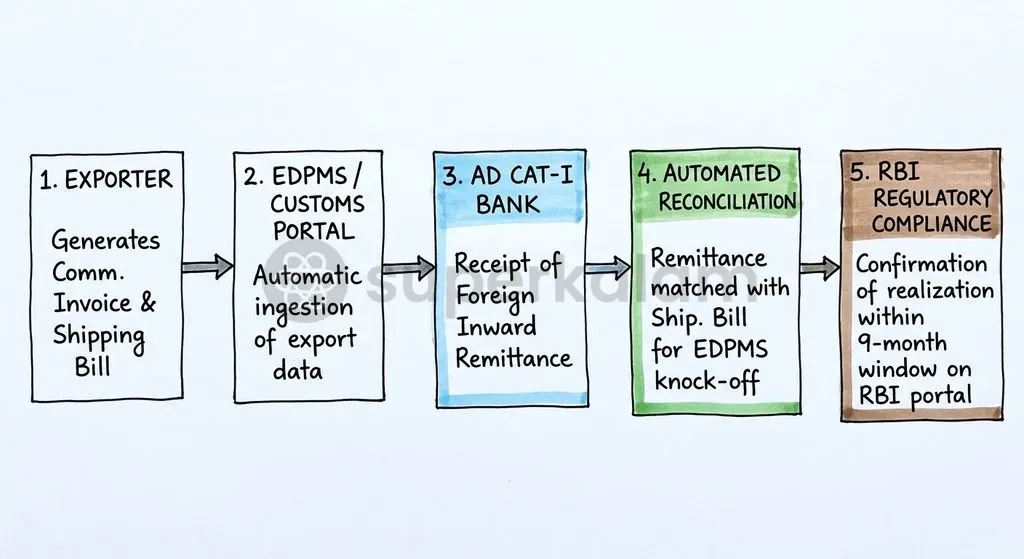
The Reserve Bank of India updated its cross-border regulatory architecture under the Foreign Exchange Management Regulations, 2026, compelling exporters to realise and repatriate foreign exchange within nine months while mandating granular digital declaration filings across commercial banking channels. Effective from 1 October 2026, these revised operational norms seek to curb trade-based money laundering and plug external surveillance loopholes. However, the uniform administrative burden creates severe frictional costs for micro, small, and medium enterprises. While tightened surveillance safeguards macro-financial stability, applying rigid documentation rules across asymmetric enterprise capacities penalises small-scale exporters unless accompanied by proportionate, automated regulatory relief.
Why Forex Reporting Rules Are in the News
The Reserve Bank of India introduced stricter cross-border monitoring norms that took effect on 1 October 2026, triggering widespread compliance concerns across micro, small, and medium enterprises. According to RBI Notification No. FEMA 23(R)/2026-RB, the Foreign Exchange Management (Export and Import of Goods and Services) Regulations, 2026 superseded the earlier 2015 regulatory framework to modernise external trade oversight.
Under the amended regime, the central bank reduced the standard realization and repatriation window for export proceeds from 15 months to 9 months from the date of shipment or service invoice, as specified in RBI Notification No. FEMA 23(R)/(1)/2026-RB. For export transactions invoiced or settled in Indian Rupees, authorities established a realization ceiling of 12 months.
The policy shift prompted formal resistance from business federations. As reported by the India SME Forum on 14 October 2026, industry representatives submitted a formal petition on 7 October 2026 requesting the central bank to suspend recurring Export Declaration Form filing rules for micro and small service exporters for 90 days. Addressing mounting confusion, Reserve Bank of India Governor Sanjay Malhotra clarified during a monetary policy press conference on 7 October 2026 that individuals conducting personal transactions or providing individual services to overseas clients remain exempt from mandatory declaration rules.
Discuss with Superkalam
What is the statutory realization timeline for foreign exchange under the 2026 regulations for foreign currency exports versus Rupee-denominated exports?
Ask NowWhat Are the RBI Foreign Exchange Reporting Norms for Exporters?
Section 7 of the Foreign Exchange Management Act, 1999 anchors the statutory mandate requiring every exporter to declare the full value of goods and services sent abroad. Under Section 8 of the same statute, Indian residents must take all reasonable steps to realise and repatriate accrued foreign exchange within prescribed periods.
The operational pipeline relies on Authorised Dealer Category-I commercial banks. According to RBI Directions issued under A.P. (DIR Series) Circular No. 20, banks reconcile trade movements through two digital platforms: the Export Data Processing and Monitoring System for outward shipments and the Import Data Processing and Monitoring System for inward goods.
Service exporters operate under specific timelines. As set out in RBI Notification No. FEMA 23(R)/2026-RB, service providers must submit an Export Declaration Form within 30 days from the end of the month in which an invoice is raised. If exceptional approvals or extended timelines are required, Authorised Dealer banks must process regulatory references to the Reserve Bank of India via the PRAVAAH portal.
Why the RBI Is Tightening Cross-Border Transaction Tracking
The Reserve Bank of India enforces stringent cross-border monitoring to safeguard the external financial architecture against illicit international capital transfers. A joint study by the Financial Action Task Force and the Egmont Group identified trade mis-invoicing as an established technique for trade-based money laundering, where illicit actors manipulate invoice values to move untaxed capital across sovereign borders.
Electronic surveillance through EDPMS and IDPMS allows the central bank to cross-match Customs documentation directly against banking records. By verifying shipping bills against realised inward foreign exchange remittances, the system systematically flags artificial discrepancies, uncollected balances, and capital flight.
Granular tracking also gives policymakers accurate, real-time insight into foreign exchange liquidity. Matching export-import entries enables monetary authorities to distinguish genuine trade credit cycles from structural defaults, protecting foreign reserves against systemic settlement shocks.
Discuss with Superkalam
How does trade mis-invoicing enable trade-based money laundering, and how do electronic surveillance platforms like EDPMS and IDPMS restrict it?
Ask NowSide-by-Side: Regulatory Financial Oversight vs MSME Operational Reality
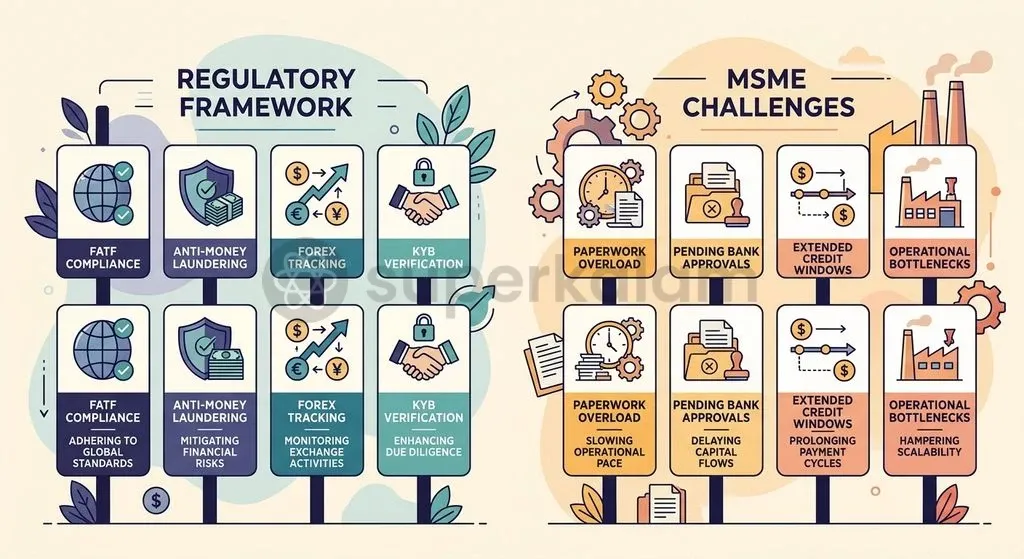
Regulatory compliance expectations diverge sharply from the daily operational capacities of small enterprises. Large corporations maintain automated enterprise resource planning systems and dedicated treasury teams, whereas small manufacturing units and boutique software agencies operate on constrained administrative budgets.
| Compliance Dimension | Regulatory Macro-Oversight Objective | MSME Operational Ground Reality |
|---|---|---|
| Realization Timeline | 9-month ceiling prevents capital parking overseas and supports domestic currency liquidity. | Micro-enterprises operating in competitive global value chains frequently face client payment terms exceeding 270 days. |
| Declaration Frequency | Monthly service filings ensure real-time visibility into cross-border intangible receipts. | High-frequency, low-ticket software contracts generate recurring clerical burdens for single-person studios. |
| Data Reconciliation | Strict matching across Customs, banks, and invoices deters illicit trade mis-invoicing. | Bank-level document matching is frequently manual, resulting in blocked inward payments. |
| Relief Thresholds | Self-declaration closures allowed up to ₹10 lakh per bill to reduce procedural congestion. | Low awareness among Authorised Dealer branches limits the adoption of consolidated quarterly closures. |
| Operational Guidance | Clear central frameworks issued to standardise banking trade operations across lenders. | Only two out of 90 Authorised Dealer banks had published public procedural frameworks per FEDAI data on 25 October 2026. |
How Reporting Friction Hurts Working Capital and Global Competitiveness
Operational bottlenecks inside commercial banking channels convert procedural reporting into financial distress for small enterprises. As reported by The Indian Express on 24 October 2026, Authorised Dealer banks routinely withhold inward remittances to micro-exporters pending manual verification of multi-page Export Declaration Forms.
Administrative delays create compounding working capital stress. Small enterprises depend on rapid invoice liquidation to meet domestic payroll and raw material commitments, making unexpected payment freezes destabilising to production cycles.
High compliance friction also handicaps boutique digital exporters. As reported by The Indian Express on 24 October 2026, software-as-a-service providers and freelancers process high-frequency, low-ticket transactions that each demand separate customer, country, and service-classification entries. Such administrative requirements erode operating margins and discourage small firms from pursuing overseas clients.
Banking system unreadiness aggravates these structural frictions. Industry survey data compiled by the Foreign Exchange Dealers' Association of India on 25 October 2026 showed that only two of 90 Authorised Dealer banks—HDFC Bank and State Bank of India—had published operational procedures for the revised regulations. This institutional gap leaves branch managers interpreting complex central guidelines without uniform standard operating procedures.
To cushion these pressures, the central bank maintains targeted procedural flexibilities. Under RBI Circular A.P. (DIR Series) Circular No. 12, Authorised Dealer Category-I banks are authorised to close pending EDPMS and IDPMS entries for transactions up to ₹10 lakh per bill relying solely on exporter self-declarations. The same directive permits quarterly consolidated filings for bulk closures and explicitly prohibits banks from levying penal documentation charges on small enterprises. Furthermore, under A.P. (DIR Series) Circular No. 20, banks can accept reductions in invoice value up to ₹10 lakh on self-declaration, while exporters may exploit expanded set-off flexibility to balance goods export receivables against service import payables.
Discuss with Superkalam
Compare the de minimis reporting models of Germany and Ireland with the complete surveillance approach followed by South Africa. Which is more suited for developing economies?
Ask NowLessons from Peer Economies on Trade Compliance for Small Businesses
International trade regulators rely on de minimis exemptions and risk-tiered supervision to balance financial integrity against small-firm efficiency. The European Union and leading Asian trading nations apply distinct operational thresholds to insulate small businesses from statistical bureaucracy.
Under Germany's amended Foreign Trade Statistics Act (AHStatG), businesses dispatching goods below €1,000,000 annually are exempt from filing Intrastat statistical reports. Official figures from the German Federal Ministry for Economic Affairs and Climate Action confirm this carve-out relieves approximately 42% of cross-border traders from recurring documentation duties.
Ireland takes a similar administrative approach. The Revenue Commissioners of Ireland enforce a statutory €750,000 annual threshold for export dispatches, below which enterprises remain free from monthly filing obligations.
China incorporates targeted flexibilities within foreign exchange administration. State Administration of Foreign Exchange Circular No. 11 (2020) exempts qualified micro and small cross-border e-commerce enterprises from mandatory enterprise directory registration, permitting consolidated foreign currency settlements through authorized digital payment institutions.
In contrast, South Africa enforces an absolute monitoring standard. The South African Reserve Bank mandates via Exchange Control Circular No. 23/2026 that commercial banks electronically report all transactions down to R0.01 without exception, deliberately accepting administrative overhead to ensure complete foreign exchange surveillance.
Discuss with Superkalam
Propose an automated regulatory framework that balances the RBI's anti-money laundering surveillance needs with the operational realities of micro and small service exporters.
Ask NowWay Forward: Designing a Proportionate Compliance Shield for MSMEs
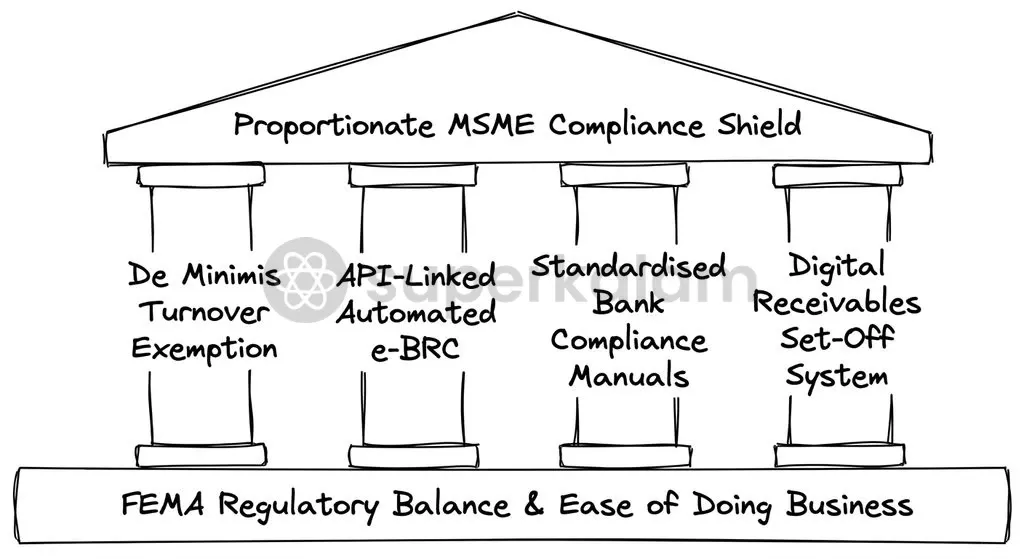
Reconciling macroeconomic integrity under FEMA with the ease of doing business requires shifting from universal transaction screening to proportionate, risk-calibrated supervision. Micro-enterprises should not face the same procedural oversight designed to monitor multi-crore industrial conglomerates.
First, the Reserve Bank of India should institute an annual entity-level turnover exemption for micro-exporters, mirroring European Intrastat thresholds. Rather than requiring invoice-by-invoice reconciliation, the central bank could permit enterprises below a defined threshold to file consolidated annual declarations.
Second, the central bank and the Directorate General of Foreign Trade must establish automated Application Programming Interface linkages connecting Authorised Dealer banks with the National Single Window System. Automating the flow of electronic Bank Realisation Certificates would eliminate manual branch visits and prevent improper delays on inward remittances.
Third, regulatory oversight over commercial banks requires immediate tightening. Because only two Authorised Dealer banks published customer guidance following the 2026 regulatory shift, the central bank should mandate standard operating procedures across all foreign exchange branches. Enforcing the explicit ban on penal charges for small transactions would prevent commercial intermediaries from shifting administrative costs onto vulnerable enterprises.
Finally, expanding digital set-off mechanisms will preserve operational liquidity. Allowing micro-exporters to automatically offset cross-border software subscriptions against export receipts through verified banking portals would unlock working capital and sharpen India's global competitiveness.
Key Takeaways
- Sections 7 and 8 of the Foreign Exchange Management Act, 1999 mandate the formal declaration, realization, and repatriation of export proceeds within timelines defined by the Reserve Bank of India.
- The 2026 trade regulations reduced the standard export proceeds repatriation timeline from 15 months to 9 months, creating acute liquidity pressures for small exporters operating on extended payment cycles.
- Digital reconciliation platforms like EDPMS and IDPMS curb trade mis-invoicing and illicit capital flight, but manual banking reconciliation frequently freezes inward remittances for micro-enterprises.
- Existing relief mechanisms permit Authorised Dealer banks to close pending EDPMS entries up to ₹10 lakh per bill via self-declaration, yet uneven branch-level awareness restricts enterprise access.
- International models in Germany and Ireland demonstrate that statutory de minimis thresholds can eliminate compliance friction for small exporters without compromising national financial stability.
Mains Question
'While tightened regulatory surveillance under the Foreign Exchange Management Act safeguards macro-financial stability, applying uniform documentation rules across asymmetric enterprise capacities penalises small-scale exporters.' Critically examine. (15 Marks)
Evaluate NowMains Question
Highlighting the operational frictions introduced by the Foreign Exchange Management Regulations, 2026, elucidate how compliance bottlenecks impact the working capital and global competitiveness of micro, small, and medium enterprises (MSMEs). (10 Marks)
Evaluate NowPractice MCQs
QUESTION 1
With reference to the revised foreign exchange reporting framework notified by the Reserve Bank of India under FEMA in 2026, consider the following statements:
- The standard window for realization and repatriation of export proceeds has been reduced from 15 months to 9 months.
- For export transactions invoiced or settled in Indian Rupees, the realization ceiling has been fixed at 12 months.
- Service exporters are required to submit the Export Declaration Form within 30 days from the date of realization of foreign exchange. Which of the statements given above are correct?
QUESTION 2
Consider the following statements regarding the regulatory and operational mechanisms for cross-border trade in India:
- Reconciliations of outward physical shipments and inward trade flows are processed through EDPMS and IDPMS respectively.
- Authorised Dealer Category-I commercial banks can process exceptional approvals or timeline extensions via the PRAVAAH portal.
- Section 7 of the Foreign Exchange Management Act, 1999 explicitly exempts small-scale service exporters from declaring the full value of exported services. Which of the statements given above is/are correct?
QUESTION 3
With reference to procedural reliefs available under the Reserve Bank of India directions for small exporters, consider the following statements:
- Authorised Dealer Category-I banks are permitted to close pending EDPMS and IDPMS entries up to ₹10 lakh per bill based on exporter self-declarations.
- Authorised Dealer banks are prohibited from accepting reductions in invoice value exceeding ₹1 lakh even with self-declarations.
- Exporters are permitted to set off receivables from goods exports against service import payables. Which of the statements given above is/are correct?
QUESTION 4
Which among the following global jurisdictions enforces an absolute foreign exchange monitoring standard by requiring commercial banks to electronically report cross-border transactions down to R0.01 without any de minimis exemption?
QUESTION 5
Regarding cross-border trade documentation and de minimis reporting regimes across peer economies, consider the following pairs:
- Germany: Exemption from Intrastat reporting for dispatch values below €1,000,000 annually.
- Ireland: Statutory annual dispatch threshold of €750,000 for exemption from monthly filings.
- China: Full exemption of all manufacturing conglomerates from enterprise directory registration. How many of the pairs given above are correctly matched?