Property Tax in India: Assessment, Collection and Reforms
Property tax is a key municipal revenue source. Read how valuation and collection work, why yields are low and what reforms could improve city finances.
Oct, 2026
•8 min read

Overview
India's urban local bodies face an acute fiscal crisis. Property tax collections stagnate between 0.15% and 0.2% of Gross Domestic Product. Discretionary devolution under Article 243X, litigated rent-control assessment models, and outdated physical registers constrain these yields.
According to the Reserve Bank of India, total municipal revenue receipts stand at roughly 0.61% to 0.72% of GDP. This leaves cities critically reliant on upper-tier budgetary transfers.
With local levies such as octroi subsumed under the Goods and Services Tax, property taxation represents the single most viable instrument for municipal own-source revenue. Reversing this trend requires moving from discretionary rent models to transparent capital-value assessments, deploying Geographic Information System mapping, and securing statutory fiscal transfers.
Why Municipal Finances Are Back in the Spotlight
Urban centres generate a substantial share of economic output. Yet city governments operate with a severely constrained fiscal base.
The Reserve Bank of India highlighted this structural gap in its Report on Municipal Finances, tracing city distress to three core fiscal bottlenecks:
- Stagnant own-tax yields: Municipal own tax revenue sits at merely 0.21% to 0.22% of GDP, while total municipal revenue receipts linger between 0.61% and 0.72% of GDP.
- Erosion of local levies: Following the rollout of the Goods and Services Tax, municipal corporations lost discretionary handles like octroi, turning property tax into the predominant own tax source.
- Escalating capital demands: As of November 2024, municipal budgets face accelerating pressures for urban transit, water networks, and sanitation, making property tax buoyancy indispensable for capital expenditure.
This prolonged revenue shortfall leaves cities precariously dependent on intergovernmental fiscal transfers.
Discuss with Superkalam
Identify the constitutional articles governing municipal taxation powers and State Finance Commissions introduced by the 74th Amendment.
Ask NowThe Constitutional Promise: How the 74th Amendment Left City Budgets Weak
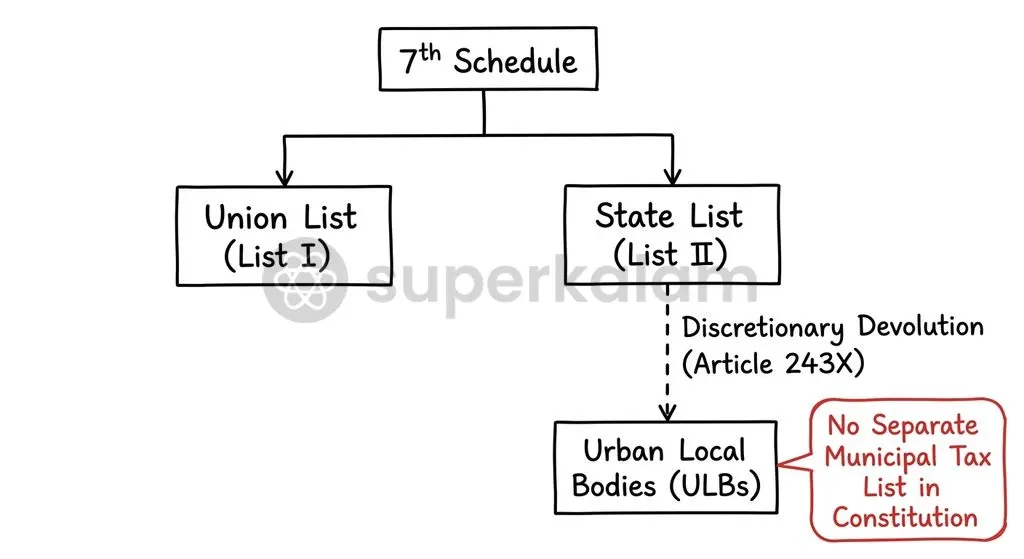
The 74th Constitutional Amendment Act 1992 omitted an independent municipal taxation chapter. Urban financial devolution remains subject to state legislative discretion under Article 243X.
The Seventh Schedule demarcates sovereign legislative competencies between the Union and the States. In contrast, the Constitution provides no exclusive municipal tax list. State legislatures retain plenary authority over which taxes urban local bodies may levy, collect, and appropriate.
| Constitutional Level | Governing Provision | Nature of Taxing Authority |
|---|---|---|
| Union and State Governments | Seventh Schedule | Sovereign, exclusive taxing powers |
| Urban Local Bodies | Article 243X (74th Amendment) | Discretionary devolution delegated by states |
Article 243Y sought to counterbalance this vulnerability by mandating the establishment of a State Finance Commission to review municipal finances. However, state governments routinely bypass this mechanism through delayed appointments and unheeded recommendations.
Article 285(1) also bars municipalities from taxing Union government properties unless Parliament legislates otherwise, carving out extensive land tracts from local tax rolls.
How Property Taxes Are Calculated: Rent-Based vs Capital Value Systems
Indian municipal corporations determine tax liabilities using three calculation models: Annual Rateable Value, Unit Area Value, and Capital Value Systems. The historic default has been the Annual Rateable Value system, which calculates liability using a property's hypothetical annual letting value.
The Annual Rateable Value model creates severe fiscal distortions. In Dewan Daulat Rai Kapoor v. New Delhi Municipal Committee (1980), the Supreme Court ruled that assessments cannot exceed the statutory standard rent fixed by rent control legislation. Because rent laws froze rental valuations for decades, municipal tax bases detached completely from market real estate values.
Alternative valuation methods provide objective formulas to limit administrative discretion:
| Assessment System | Valuation Anchor | Core Strengths | Operational Vulnerabilities |
|---|---|---|---|
| Annual Rateable Value (ARV) | Hypothetical annual letting value | Familiar administrative lineage | Frozen standard rents, litigation, high assessor discretion |
| Unit Area Value (UAV) | Built-up area multiplied by designated per-unit base rate | Transparent formula, reduced corruption, predictable assessments | Ignores micro-market surges, requires complex classification grids |
| Capital Value System (CVS) | Percentage of market value pegged to official circle rates | Buoyant tax yields, automatic indexing with market prices | Vulnerable to stamp-duty under-reporting, attracts ratepayer resistance |
The Unit Area Value system multiplies built-up area by a baseline rate per square foot, adjusting for age, occupancy status, and location. In contrast, the Capital Value System links liabilities directly to state-notified circle rates or stamp duty ready reckoners.
Discuss with Superkalam
Explain why the Annual Rateable Value (ARV) system failed to capture rising real estate values in Indian urban centres.
Ask NowWhy Property Tax Collection Falls Short: Outdated Rolls and Low Coverage
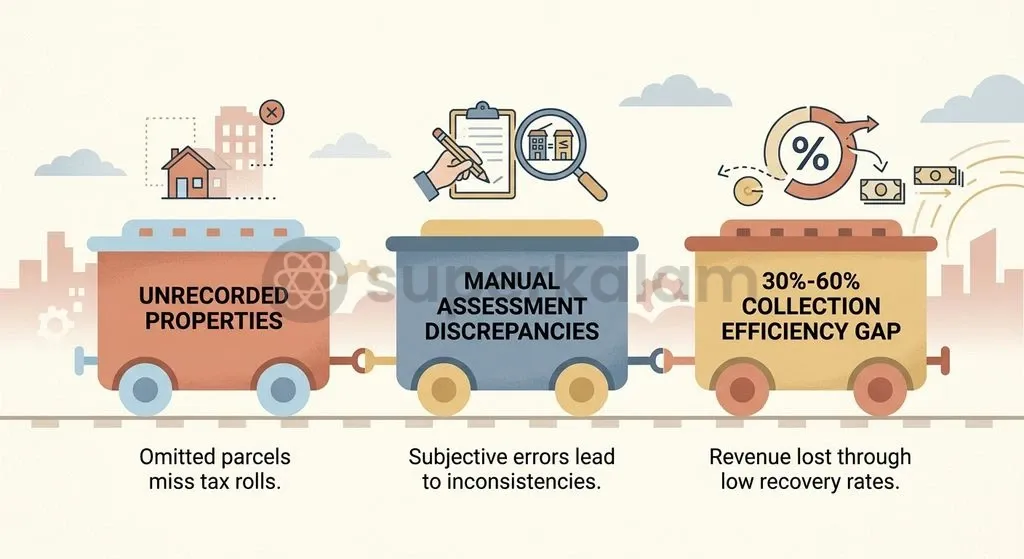
A World Bank study found that property tax collection efficiency across Indian municipal corporations hovers between 30% and 60%. This shortfall highlights severe structural and administrative gaps. Defective cadastre records and weak enforcement machinery consistently depress realised revenue.
A primary survey by the Reserve Bank of India revealed that manual physical assessment remains the primary valuation method across urban local bodies. Manual enumeration invites discretionary under-reporting. It also lets unrecorded real estate expansions evade municipal rolls.
Drone surveys and Geographic Information System mapping under the AMRUT scheme frequently uncovered between 20% and 50% unassessed properties missing from municipal registers.
Administrative bottlenecks depress collection through a predictable sequence:
- Outdated field registers fail to reflect physical building alterations.
- Manual inspections generate arbitrary assessments and rent-seeking.
- Protracted valuation disputes trigger judicial stay orders.
- Depressed collection yields stall between 30% and 60% of potential liability.
The Governance Trap: Why State Governments Hold Back City Revenue
State Finance Commissions established under Article 243Y remain systematically underutilised. State governments routinely delay their constitution and ignore their revenue-sharing recommendations.
While the Union Finance Commission functions as an autonomous constitutional arbiter, State Finance Commissions face prolonged administrative vacancies. They also lack permanent research secretariats. This administrative neglect curtails municipal autonomy across states.
Weak internal revenue generation directly damages institutional borrowing capacity. Outstanding municipal bonds represent less than 0.1% of India's corporate bond market. City bodies struggle to pledge buoyant property tax flows into credible escrow accounts. Consequently, institutional investors avoid municipal debt paper.
The Fifteenth Finance Commission introduced institutional sanctions to break this stalemate:
- Central local body grants will not be released after March 2024 to states that fail to constitute their State Finance Commission.
- States must demonstrate concrete action on commission recommendations to unlock subsequent funding tranches.
Discuss with Superkalam
If a municipal corporation transitions from manual surveys to GIS mapping under AMRUT, how would this alter its property tax coverage and fiscal capacity?
Ask NowHow India Compares Internationally: The Municipal Tax-to-GDP Gap
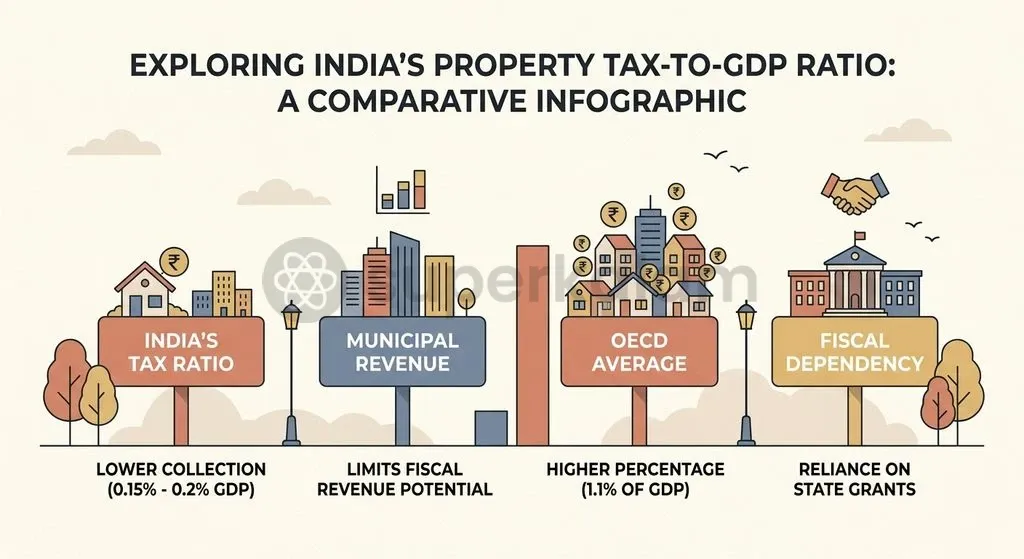
Cross-country data compiled by the World Bank demonstrates that India's property tax yield of 0.15% to 0.2% of GDP lags significantly behind developed and emerging economies. Advanced federations rely on property taxes as the primary fiscal pillar for basic civic utilities. In contrast, Indian municipalities capture only a minor fraction of urban land value appreciation.
| Metric | India | OECD Average |
|---|---|---|
| Property Tax-to-GDP Ratio | ~0.15% – 0.20% | ~1.10% |
| Municipal Revenue-to-GDP Ratio | ~0.61% – 0.72% | Substantially higher (>5% in decentralised federations) |
| Primary Valuation Anchor | Predominantly manual/rent-based | Capital value / Market valuation cadastre |
In OECD nations, property tax averages roughly 1.1% of GDP, underpinning municipal self-sufficiency and local creditworthiness. Indian cities, however, remain trapped in fiscal dependency. They cannot fund civic infrastructure without conditional transfers from higher tiers of government.
Fixing City Revenues: GIS Mapping, Reform Grants, and Fiscal Devolution
The 15th Finance Commission instituted mandatory fiscal performance criteria for urban local bodies:
- Municipalities must notify property tax floor rates to qualify for performance-linked grants.
- Collections must match the five-year average growth of Gross State Domestic Product.
Spatial technology provides the fastest path to expanding the tax base. Municipalities implementing Geographic Information System mapping under AMRUT match satellite property databases with electricity consumer numbers. This process uncovers hidden floor space and expands tax rolls without manual friction.
A viable modernisation pipeline requires sequential technical and institutional steps:
- GIS cadastre surveys map unassessed properties against utility connections.
- Unit or capital value adoption removes assessor subjectivity.
- Statutory floor rates guarantee revenue buoyancy across real estate cycles.
- Structured escrow accounts unlock credit ratings for municipal bonds.
Institutional independence remains essential for lasting solvency. The 13th Finance Commission recommended establishing a permanent Property Tax Board in every state to automate valuation updates and insulate rate revisions from local political pressures. In parallel, urban authorities can leverage the Ministry of Housing and Urban Affairs' 2017 Value Capture Finance Policy Framework to recoup infrastructure gains through targeted betterment levies.
Discuss with Superkalam
Compare the Unit Area Value system with the Capital Value System in terms of administrative simplicity versus revenue buoyancy.
Ask NowKey Takeaways
- India's municipal property tax receipts stagnate between 0.15% and 0.2% of GDP, falling far behind the OECD average of roughly 1.1%.
- Article 243X provides no sovereign municipal taxation jurisdiction, subordinating urban revenue handles entirely to the discretion of state legislatures.
- The Annual Rateable Value system crippled municipal tax yields after the Supreme Court pegged assessments to rent-control ceilings in Dewan Daulat Rai Kapoor (1980).
- Municipal tax collection efficiency hovers between 30% and 60%, constrained by manual enumeration and registers missing up to 50% of real properties.
- Under the Fifteenth Finance Commission's framework, urban local bodies must notify minimum property tax floor rates and match state GSDP growth rates to secure performance grants.
Mains Question
"The omission of an independent municipal taxation chapter under the 74th Constitutional Amendment Act has relegated Urban Local Bodies to fiscal subordinates of state governments." Critically examine in light of Article 243X and the functioning of State Finance Commissions. (15 Marks)
Evaluate NowMains Question
"Stagnant valuation models and administrative deficits have severely depressed property tax yields across Indian cities." Elucidate the structural weaknesses in property tax administration and explain how modern valuation reforms can improve municipal buoyancy. (10 Marks)
Evaluate NowPractice MCQs
QUESTION 1
With reference to the constitutional and fiscal status of Urban Local Bodies (ULBs) in India, consider the following statements:
- The 74th Constitutional Amendment Act provides an exclusive municipal taxation chapter in the Seventh Schedule.
- Under Article 243X, the power of municipalities to levy and collect taxes is subject to delegation by the concerned state legislature.
- Article 285(1) of the Constitution prevents municipal corporations from levying property tax on Union government properties unless Parliament provides otherwise by law. Which of the statements given above are correct?
QUESTION 2
Regarding property tax valuation methods used by municipal corporations in India, consider the following statements:
- Under the Annual Rateable Value (ARV) system, assessments historically decoupled from market values due to judicial limits tied to statutory standard rents.
- The Unit Area Value (UAV) method automatically indexes liabilities directly with state-notified circle rates.
- The Capital Value System (CVS) links property tax assessments to capital market values or stamp duty ready reckoners. Which of the statements given above is/are correct?
QUESTION 3
In the context of the recommendations of the Fifteenth Finance Commission concerning local bodies, consider the following statements:
- Central local body grants would not be released after March 2024 to states that fail to constitute their State Finance Commissions.
- States are required to demonstrate concrete action on State Finance Commission recommendations to access subsequent funding tranches. Which of the statements given above is/are correct?
QUESTION 4
According to Reserve Bank of India reports and studies cited on municipal finances, which of the following is the primary reason why outstanding municipal bonds constitute less than 0.1% of India's corporate bond market?
QUESTION 5
Consider the following statements regarding municipal finances and property taxation in India:
- According to the Reserve Bank of India, total municipal revenue receipts stand between 0.61% and 0.72% of GDP.
- India's property tax collection efficiency across municipal corporations averages above 80%.
- The property tax-to-GDP ratio in India ranges roughly from 0.15% to 0.20%, compared to an OECD average of around 1.10%. Which of the statements given above are correct?