Project Cheetah at Gandhi Sagar: Translocation and Conservation
As Kuno hits carrying capacity, establishing Gandhi Sagar tests India's ability to build a connected, resilient cheetah metapopulation across central India.
Sep, 2026
•8 min read
Overview
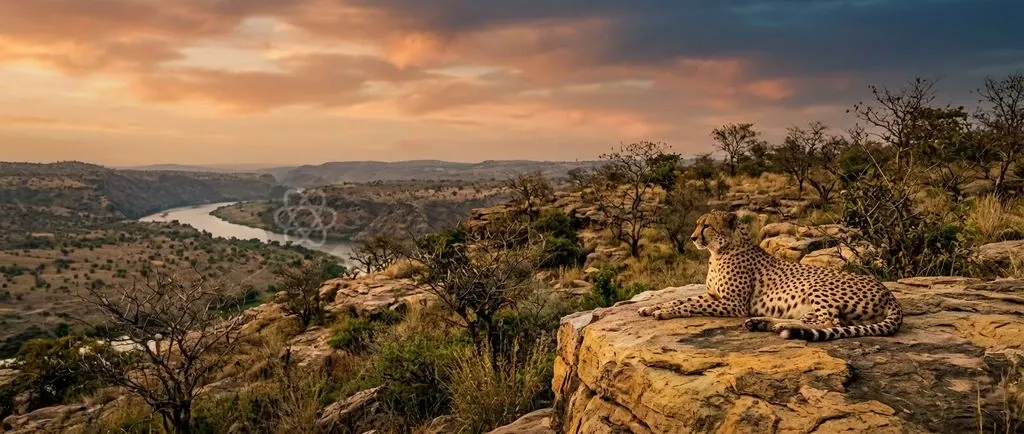
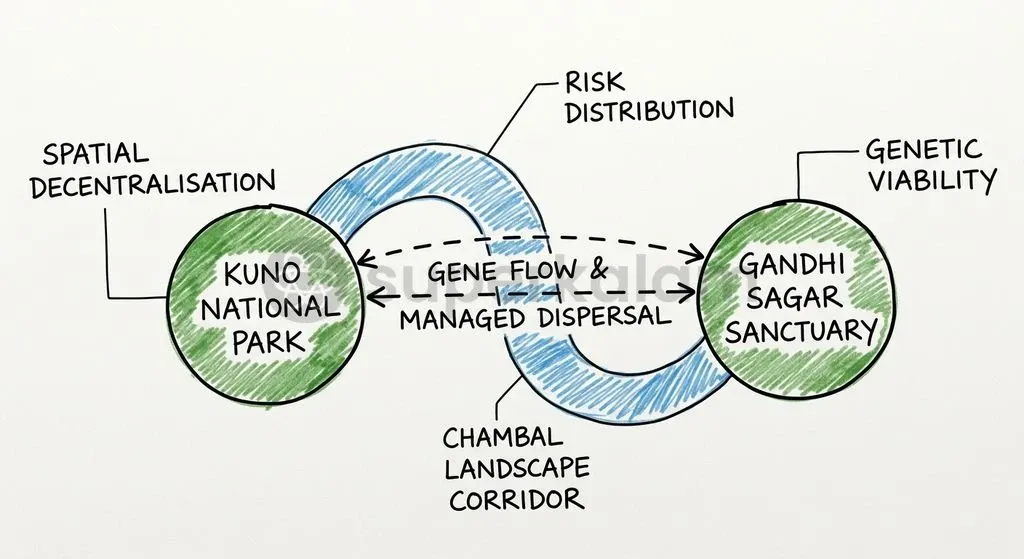
India is operationalising Gandhi Sagar Wildlife Sanctuary in Madhya Pradesh as a second cheetah habitat. This decentralisation relieves demographic pressure on Kuno National Park, distributes mortality risks, and helps build a genetically viable metapopulation across central India.
The National Tiger Conservation Authority designated the sanctuary to address spatial overcrowding and territorial conflict at Kuno. Dispersing cheetahs across separate reserves also provides insurance against epizootic outbreaks, localised pathogens, and inbreeding bottlenecks. This shift transforms an isolated reintroduction effort into a landscape-scale conservation framework.
Why is Gandhi Sagar Sanctuary in the News?
The National Tiger Conservation Authority designated Gandhi Sagar Wildlife Sanctuary in Madhya Pradesh as the primary second release site to establish an independent cheetah subpopulation and alleviate overcrowding at Kuno. As of December 2023, official evaluations highlighted the urgent necessity of decentralising predator density away from a single geographic pocket.
Key ecological pressures driving this expansion include:
- Carrying capacity limits: Kuno National Park features a notified core area spanning approximately 748 square kilometres. Wildlife biologists calculated an ecological carrying capacity of 21 adult cheetahs within this core habitat.
- Spatial bottlenecks: As the population expanded, spatial bottlenecks made territorial infighting and exploratory dispersal into human-dominated agrarian fringes far more frequent.
Preparing a secondary home provides immediate demographic relief while anchoring long-term reintroduction goals. This strategic expansion marks the second operational phase of Project Cheetah under the Ministry of Environment, Forest and Climate Change.
Discuss with Superkalam
Which two districts in western Madhya Pradesh encompass the Gandhi Sagar Wildlife Sanctuary?
Ask NowThe Ecological Case for a Second Cheetah Habitat
Establishing multiple independent release sites across the central Indian landscape provides essential biological insurance against localised catastrophic mortality. A single isolated population remains highly vulnerable to environmental stochasticity, demographic fluctuations, and sudden pathogen transmission.
Under the National Tiger Conservation Authority framework, distributing cheetahs across separate geographic pockets acts as a safeguard against epizootic outbreaks, severe tick-borne illnesses, and fatal septicemic infections. Isolating all individuals in one reserve magnifies the risk of total population collapse if a virulent disease emerges.
| Habitat Node | Core Area & Capacity | Landscape Characteristics | Long-Term Metapopulation Target |
|---|---|---|---|
| Kuno National Park | Mixed deciduous forest and riverine woodland | Part of the planned 60 to 70 cheetahs across 17,000 sq km by 2032 | |
| Gandhi Sagar Sanctuary | ~368 sq km (64 sq km boma) | Flat rocky sandstone plateau and open savanna | Node for assisted gene flow and managed dispersal |
Project Cheetah's long-term conservation blueprint targets a managed metapopulation of 60 to 70 cheetahs distributed across an interconnected 17,000-square-kilometre landscape by 2032. Achieving demographic stability requires multiple functional habitat nodes connected by functional multi-use corridors.
Kuno vs Gandhi Sagar: Comparing Landscape, Prey Base, and Capacity
Landscape ecology and prey profiles differ substantially between the Chambal river basin plateau of Gandhi Sagar and the undulating valley terrain of Kuno. These physical variations directly shape carnivore densities, hunting efficiency, and spatial movement patterns.
Gandhi Sagar Wildlife Sanctuary covers approximately 368 square kilometres across Mandsaur and Neemuch districts in western Madhya Pradesh. The sanctuary sits on a flat rocky plateau with shallow topsoil, bisected by the Chambal River into distinct western and eastern sectors. This open savanna-woodland contrasts with Kuno's denser deciduous woodlands and interspersed alluvial grasslands.
| Dimension | Kuno National Park | Gandhi Sagar Wildlife Sanctuary |
|---|---|---|
| Notified Core Area | ~748 sq km | ~368 sq km |
| Topography & Terrain | Undulating valleys, riverine woodland, mixed deciduous forest | Flat sandstone plateau, shallow topsoil, vast open savanna-woodland |
| Primary Drainage | Kuno River basin | Chambal River system and reservoir backwaters |
| Enclosure Infrastructure | Multiple soft-release bomas of varying sizes | 64 sq km predator-proof fenced enclosure in West Range |
| Key Ecological Role | Primary reintroduction epicentre and breeding hub | Secondary subpopulation site and metapopulation refuge |
The open grassland-scrub matrix at Gandhi Sagar offers high visibility and unobstructed running terrain, which suits high-speed cursorial hunting. However, shallow soil profiles limit dry-season forage regeneration, demanding continuous prey-base monitoring.
Discuss with Superkalam
How does the flat sandstone plateau of Gandhi Sagar create different ecological advantages and challenges for cheetah hunting compared to Kuno's deciduous valleys?
Ask NowHow Gandhi Sagar is Preparing: Fencing, Prey Augmentation, and Governance
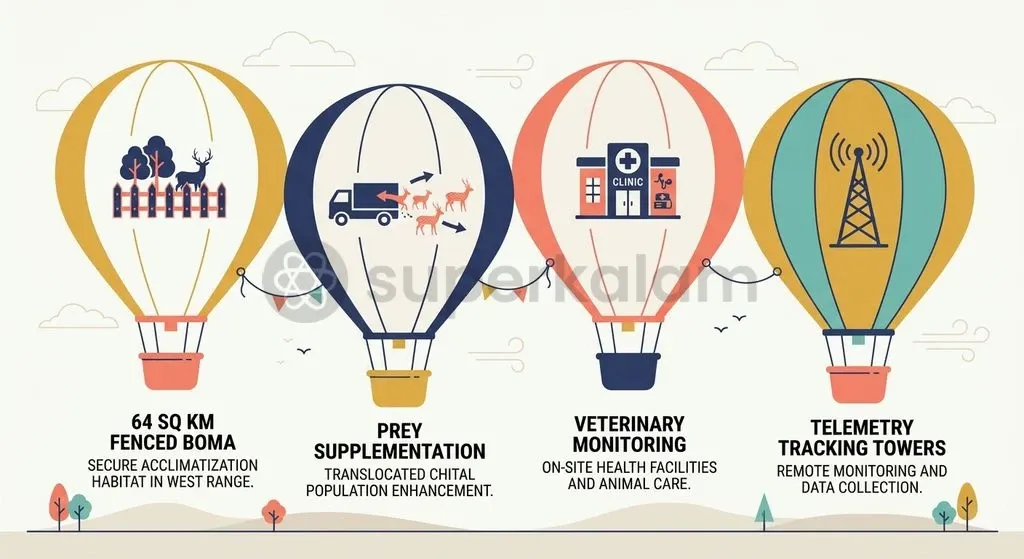
The Madhya Pradesh Forest Department constructed a specialized 64-square-kilometre predator-proof fenced soft-release enclosure within the sanctuary's West Range. This massive boma along the Chambal river basin ensures translocated animals undergo gradual ecological acclimatisation prior to free-ranging release.
Prey density represents the foremost limiting factor for establishing apex carnivores. According to the Madhya Pradesh Forest Department status reports, authorities translocated over 1,250 spotted deer (chital) from source habitats including Kanha National Park, Satpura Tiger Reserve, and Narsinghgarh Wildlife Sanctuary [per Down To Earth / MP Forest Department Status Report 2023-24 (as reported, October 2024)]. This herbivore supplementation stabilizes prey availability before predator introduction.
Key site-preparation workflows implemented at Gandhi Sagar include:
- Prey Augmentation: Supplementing herbivore numbers by translocating over 1,250 chital from major regional reserves.
- Carnivore Management: Capturing resident leopards inside the fenced enclosure to reduce direct competition and protect cubs.
- Infrastructure & Telemetry: Establishing a 64 sq km boma, dedicated veterinary wards, and radio tracking stations.
Managing interspecific carnivore competition remains vital for cub survival and kill retention. As reported by field reports, forestry teams captured and relocated resident leopards out of the fenced enclosure to reduce direct competition [per The Indian Express Report on Gandhi Sagar Leopard Management (as reported, December 2024)].
Project Cheetah functions under a multi-tiered administrative structure led by the National Tiger Conservation Authority, a statutory body under the Wild Life (Protection) Act, 1972. The Cheetah Project Steering Committee and the Wildlife Institute of India coordinate scientific telemetry, veterinary interventions, and genetic transfer protocols.
Major Conservation and Structural Challenges Ahead
Long-range dispersal beyond protected sanctuary boundaries presents severe monitoring and management hurdles for wildlife managers. Wide-ranging exploratory movements frequently lead big cats into densely populated agricultural matrices across state borders.
- Telemetry and tracking: Wildlife guidelines mandate that all adult cheetahs must be fitted with satellite radio collars and Very High Frequency (VHF) transmitters. These digital telemetry systems track movement across human-dominated multi-use corridors in Madhya Pradesh and neighbouring Rajasthan to enable rapid response interventions before livestock conflict arises.
- Interspecific competition: Outside the fenced boma, thriving populations of resident leopards, striped hyenas, and feral dog packs compete directly for kills and vulnerable cubs, presenting a persistent mortality risk.
Discuss with Superkalam
Why is an isolated single-site population vulnerable to sudden collapse, and how does establishing separate habitat nodes provide insurance against epizootic outbreaks?
Ask NowBalancing Conservation with Local Livelihoods and Pastoral Communities
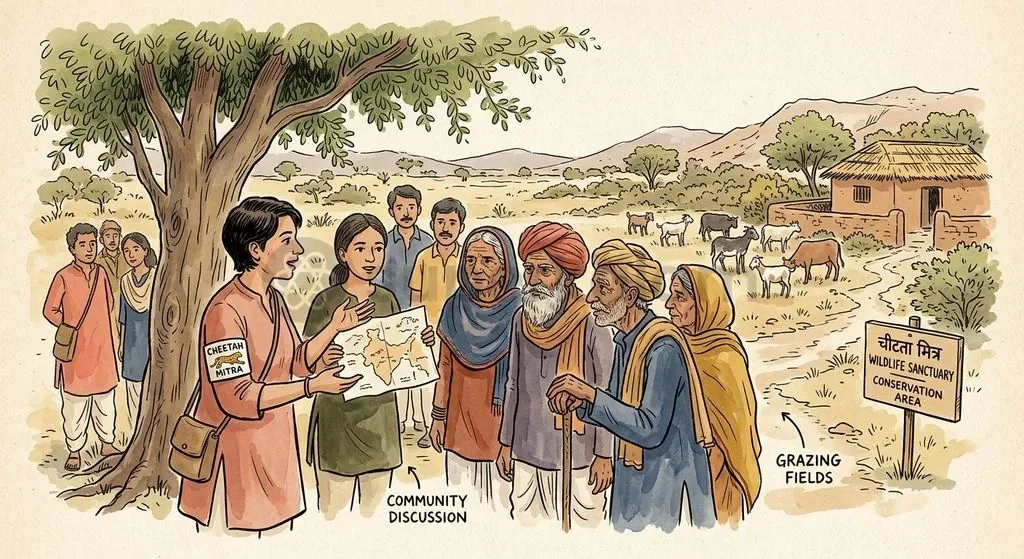
Wildlife authorities mobilized over 450 local community volunteers as Cheetah Mitras to build rural social consensus around the sanctuary landscape. These community delegates sensitize pastoralist herders, monitor livestock grazing patterns, and facilitate prompt reporting of predator movements.
Traditional pastoral grazing practices create potential spatial friction along sanctuary fringes. Forest management must balance the legal protection mandates of the Wild Life (Protection) Act, 1972, with the customary grazing access of local livestock rearers.
To align local interests with conservation goals, the project relies on two main economic mechanisms:
- Grassroots stewardship: Over 450 Cheetah Mitras lead village-level conflict mitigation and early warning reporting.
- Ecotourism revenue sharing: The Madhya Pradesh ecotourism policy mandates a 5% revenue share allocation directly to local Village Eco-Development Committees.
Channeling ecotourism dividends to local institutions incentivizes grassroots conservation stewardship and diversifies rural household incomes.
Way Forward: Building a Resilient Cheetah Metapopulation in India
Sustaining a free-ranging carnivore population across central India requires transitioning from isolated reintroductions to landscape-level connectivity. Fostering institutional coordination across administrative boundaries is essential for the long-term persistence of the species.
- Establish ecological movement corridors: State forest departments in Madhya Pradesh and Rajasthan must align land-use planning to safeguard wildlife transit paths between Kuno, Gandhi Sagar, and Mukundra Hills.
- Implement periodic assisted gene flow: Wildlife managers must systematically translocate breeding individuals between disjunct reserves to prevent inbreeding depression and maintain genetic diversity.
- Scale up community-centric development: Strengthen Village Eco-Development Committees by ensuring equitable benefit distribution from safari tourism and establishing rapid compensation mechanisms for livestock loss.
- Institutionalize disease surveillance: Veterinary teams must implement rigorous prophylactic healthcare regimens, vector control protocols, and continuous monitoring for parasitic loads.
Discuss with Superkalam
How effectively does the combination of Cheetah Mitras and a 5% ecotourism revenue share reconcile traditional pastoral grazing rights with the mandates of the Wild Life (Protection) Act, 1972?
Ask NowKey Takeaways
- The National Tiger Conservation Authority designated Gandhi Sagar Wildlife Sanctuary (~368 sq km) in Madhya Pradesh as the secondary site for Project Cheetah to address spatial saturation at Kuno National Park.
- Kuno's core area (~748 sq km) possesses an estimated carrying capacity of approximately 21 adult cheetahs, necessitating spatial decentralisation to reduce territorial clashes.
- Managing cheetahs across independent habitats protects the reintroduction programme from single-event catastrophic losses caused by epizootic outbreaks and parasitic infections.
- Project Cheetah targets a stable metapopulation of 60 to 70 individuals across an interconnected 17,000-square-kilometre landscape by 2032.
- A 64-square-kilometre predator-proof enclosure in Gandhi Sagar's West Range provides an acclimatisation zone supported by translocated prey populations.
- Community integration is supported by more than 450 Cheetah Mitras and a 5% ecotourism revenue share allocated to local Village Eco-Development Committees.
Mains Question
"Establishing multiple independent release sites across the central Indian landscape provides essential biological insurance against localised catastrophic mortality." In this context, examine the ecological imperatives and landscape-level challenges in establishing Gandhi Sagar Wildlife Sanctuary as Project Cheetah's second home. (15 Marks)
Evaluate NowMains Question
"The long-term sustainability of large carnivore reintroduction projects relies critically on balancing statutory protection with community stewardship." Evaluate this statement in light of the governance and socio-economic measures adopted at Gandhi Sagar Wildlife Sanctuary. (10 Marks)
Evaluate NowPractice MCQs
QUESTION 1
With reference to the ecological landscape of Gandhi Sagar Wildlife Sanctuary, consider the following statements:
- It is situated across Mandsaur and Neemuch districts on a flat sandstone plateau bisected by the Chambal River.
- The sanctuary features a 64-square-kilometre predator-proof fenced soft-release enclosure in its West Range.
- Unlike Kuno National Park, its shallow topsoil facilitates rapid forage regeneration throughout the dry season.
Which of the statements given above is/are correct?
QUESTION 2
Consider the following statements regarding the site-preparation and prey augmentation workflows for Project Cheetah at Gandhi Sagar:
- Over 1,250 spotted deer (chital) were translocated from Kanha National Park, Satpura Tiger Reserve, and Narsinghgarh Wildlife Sanctuary.
- Resident leopards inside the 64-square-kilometre fenced boma were captured and relocated to reduce interspecific competition.
- The reintroduction is administered directly by the Wildlife Institute of India as a statutory body under the Wild Life (Protection) Act, 1972.
Which of the statements given above is/are correct?
QUESTION 3
Regarding the biological rationale for establishing a secondary cheetah release site in India, consider the following statements:
- It relieves spatial bottlenecks and territorial infighting at Kuno National Park, whose core carrying capacity is estimated at 21 adult cheetahs.
- Distributing cheetahs across multiple separate reserves provides insurance against localized epizootic outbreaks and tick-borne pathogens.
- The long-term conservation plan targets an unmanaged isolated population confined entirely to Madhya Pradesh by 2032.
Which of the statements given above is/are correct?
QUESTION 4
Consider the following statements regarding community involvement and institutional mechanisms under Project Cheetah:
- Over 450 local volunteers have been mobilized as 'Cheetah Mitras' to monitor grazing and mitigate human-wildlife conflict.
- The Madhya Pradesh ecotourism policy mandates a 5% revenue share allocation to local Village Eco-Development Committees.
Which of the statements given above is/are correct?
QUESTION 5
To augment the prey base before releasing cheetahs at Gandhi Sagar Wildlife Sanctuary, herbivore translocations were sourced from which of the following protected areas?
- Kanha National Park
- Satpura Tiger Reserve
- Narsinghgarh Wildlife Sanctuary
Select the correct answer using the code given below: