Project 75I: Germany's $8 Billion Submarine Deal with India Explained
Germany is ready to sign an $8 billion deal for six Project 75I submarines with AIP, to be built by TKMS and MDL in India; CCS approval is now the last step.
Sep, 2026
•11 min read
Overview
India’s Project 75(India) submarine programme aims to procure six advanced conventional attack submarines equipped with fuel-cell Air Independent Propulsion at an estimated cost exceeding ₹40,000 crore under the Strategic Partnership model. This capital acquisition bridges the Indian Navy’s underwater force deficit while transferring advanced submarine design and manufacturing technology to domestic shipyards.
The 1999 thirty-year submarine construction plan targeted a modernised fleet of 24 indigenous submarines by 2030. However, systemic procurement delays, stringent liability stipulations, and vendor attrition have stretched acquisition timelines.
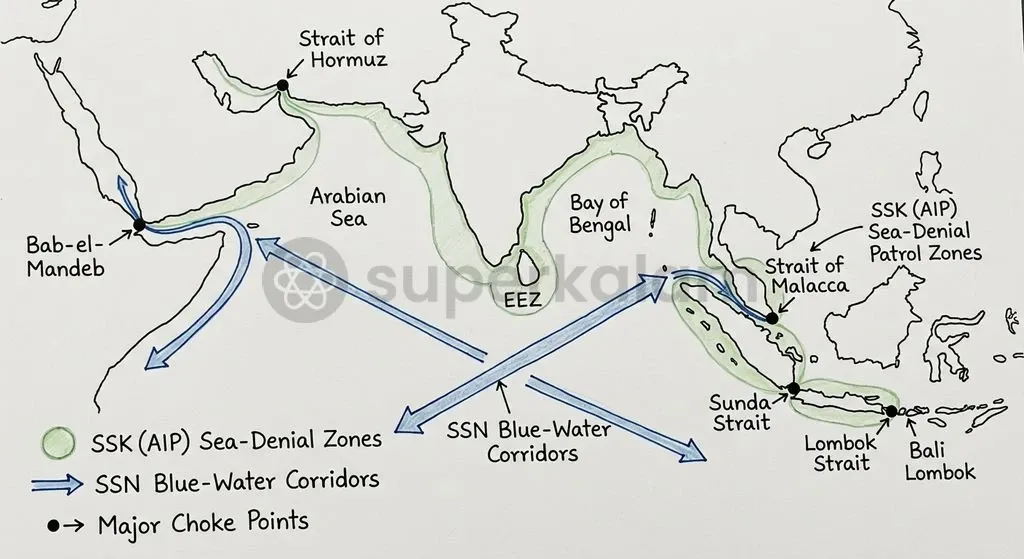
Deploying proven fuel-cell propulsion remains vital to preserving sea-denial capabilities across key Indo-Pacific choke points amidst expanding regional undersea deployments by China and Pakistan.
Why Is the Project 75I Deal with Germany in the News?
Project 75(India), designated as P-75(I), is the Indian Navy's flagship conventional submarine procurement programme under Chapter 7 of the Defence Acquisition Procedure.
As of January 2025, bilateral defence negotiations between India and Germany reached a significant milestone. Mazagon Dock Shipbuilders Limited (MDL), partnered with Germany’s ThyssenKrupp Marine Systems (TKMS), reportedly cleared the Indian Navy’s technical field evaluation trials based on the HDW Class 214 design, according to evaluation reports published by The Hindu and SP’s Naval Forces.
Key parameters defining the current procurement phase include:
- Procurement Scope: The Ministry of Defence issued the formal Request for Proposal (RFP) for Project 75(I) on July 20, 2021, inviting bids to construct six advanced conventional submarines domestically at an estimated cost exceeding ₹40,000 crore, as detailed in a Ministry of Defence Press Release.
- Preceding Foundation: The programme builds upon the operational induction of the six Scorpene-class (Kalvari-class) diesel-electric submarines constructed under the preceding Project 75 at Mazagon Dock Shipbuilders Limited.
- Propulsion Benchmark: The tender mandates that the foreign Original Equipment Manufacturer (OEM) deliver a sea-proven fuel-cell system, addressing a critical endurance gap in India's conventional undersea fleet.
What Is Project 75I and the Strategic Partnership Model?
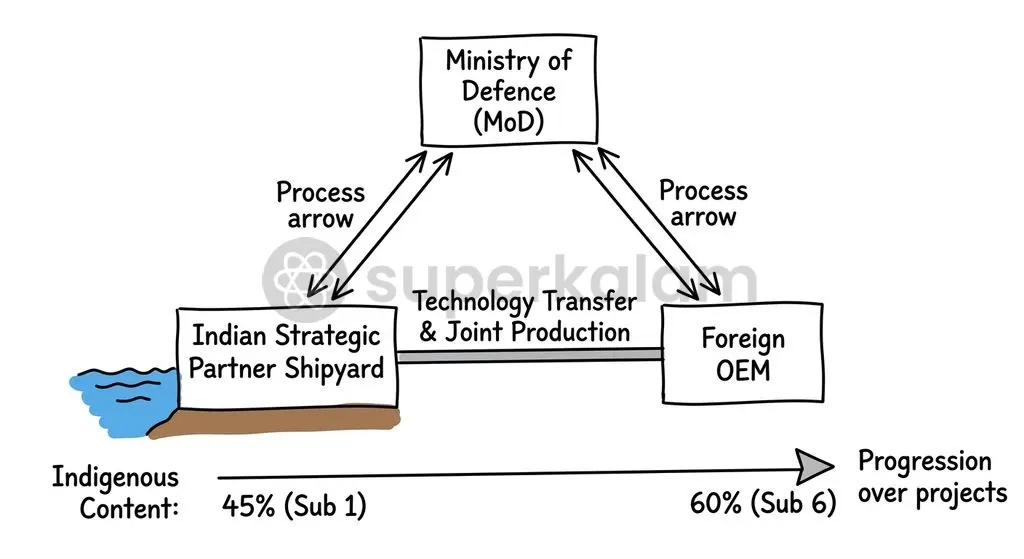
Project 75(I) is a primary test case for the Strategic Partnership (SP) model institutionalised under Chapter 7 of the Defence Acquisition Procedure (DAP) 2020. The framework builds an indigenous defence industrial ecosystem by pairing Indian shipyards with global defence manufacturers to absorb advanced design know-how and establish long-term domestic manufacturing lines.
Under the mandate approved by the Cabinet Committee on Security (CCS), Project 75(I) sets progressive indigenisation thresholds across the build cycle:
- Initial Vessel Content: According to the Ministry of Defence Project 75(I) RFP Guidelines, the procurement stipulates a minimum indigenous content of 45% for the first submarine constructed.
- Fleet End-State Target: Domestic participation must escalate systematically to achieve 60% domestic content by the sixth vessel.
The historical foundation for this acquisition traces back to July 1999, when the Cabinet Committee on Security approved the 30-year Submarine Construction Plan, as documented by the Parliamentary Standing Committee on Defence (2019–20). That blueprint envisaged a force of 24 indigenous submarines divided between conventional attack vessels (SSKs) and nuclear-powered submarines by 2030.
Project 75 successfully delivered six Kalvari-class boats—INS Kalvari, INS Khanderi, INS Karanj, INS Vela, INS Vagir, and INS Vagsheer—built by MDL in collaboration with France’s Naval Group, as confirmed in the Ministry of Defence Year End Review. Project 75(I) constitutes the planned second phase of this multi-decade roadmap.
Discuss with Superkalam
Recall the two byproducts generated during the electrochemical operation of a fuel-cell AIP system.
Ask NowDiscuss with Superkalam
Explain how the 'indiscretion rate' directly impacts the vulnerability of a conventional diesel-electric submarine during combat patrols.
Ask NowConventional vs. AIP vs. Nuclear Submarines: A Comparative Overview
Naval forces structure their underwater fleets across distinct propulsion paradigms depending on tactical missions, operating geography, and industrial capacities.
| Feature / Dimension | Conventional Diesel-Electric (SSK) | AIP-Equipped Conventional (SSK + AIP) | Nuclear-Powered Attack Submarine (SSN) |
|---|---|---|---|
| Primary Power Source | Diesel generators paired with lead-acid/Li-ion batteries | Diesel generators + Electrochemical Fuel Cells / Stirling Engine | Enriched Uranium Nuclear Fission Reactor |
| Submerged Endurance | 2 to 4 days before requiring snorkelling | 14 to 21 days at low patrol speeds | Limited only by onboard crew provisions and maintenance |
| Acoustic Stealth Profile | Extremely quiet on battery power; highly noisy while running diesels to snorkel | Extremely quiet continuously with no moving mechanical parts (fuel-cell type) | Constant low-frequency background hum from coolant pumps and turbine machinery |
| Speed and Mobility | Low sustained underwater speed (~6–10 knots on battery) | Low-to-moderate underwater loitering speed (~4–8 knots on AIP) | High sustained underwater transit speed (>25–30 knots indefinitely) |
| Optimal Mission Role | Littoral coastal defence and narrow choke-point ambush | Stealthy choke-point interdiction and extended shallow-water patrols | Global blue-water sea denial, open-ocean carrier escort, rapid task-force deployment |
| Capital & Maintenance Cost | Moderate capital investment and refit complexity | High initial acquisition cost; specialised industrial support required | Extremely high capital cost, specialised nuclear infrastructure required |
Why India Needs Modern Submarines: The Two-Front Indian Ocean Threat
The Indian Navy’s operating environment requires a balanced undersea architecture to counter growing coordination between regional adversaries in the Indian Ocean Region (IOR).
According to the Indian Maritime Security Strategy (IMSS-2015), the operational doctrine relies on advanced conventional submarines (SSKs) to establish sea-denial ambushes across shallow maritime choke points—including the Malacca, Sunda, and Lombok straits—while reserving nuclear attack submarines (SSNs) for wide-area blue-water surveillance and fleet escort duties.
Regional undersea developments highlight an accelerating two-front capability challenge:
- Chinese Naval Expansion: China's People's Liberation Army Navy (PLAN) currently operates the world's largest submarine fleet by vessel count, numbering over 60 hulls. According to the US Department of Defense PRC Military Developments Report, this force comprises nuclear-powered attack submarines (SSNs), ballistic missile submarines (SSBNs), and advanced Type 039A/B/C Yuan-class conventional submarines equipped with operational AIP systems. PLAN task forces deploy regularly to the northern Indian Ocean, supported by logistics infrastructure at overseas bases such as Djibouti.
- Pakistani Subsurface Modernisation: Concurrently, the Pakistan Navy is undergoing an underwater expansion via the procurement of eight Hangor-class AIP submarines under a 2015 bilateral agreement with China. According to official disclosures from Pakistan's Inter Services Public Relations (ISPR) and the Congressional Research Service, four of these vessels are being constructed at China's Wuchang Shipyard, with the remaining four built locally at Karachi Shipyard & Engineering Works (KSEW).
This concurrent expansion threatens to alter the balance of undersea capabilities in the Arabian Sea and Bay of Bengal. Timely induction of P-75(I) vessels is therefore vital to maintaining credible maritime deterrence.
Discuss with Superkalam
Analyse the distinct operational advantages of deploying fuel-cell AIP submarines in shallow maritime choke points compared to nuclear-powered submarines (SSNs).
Ask NowKey Hurdles: Technology Transfer, Cost, and Procurement Delays
The execution of Project 75(I) has faced structural hurdles under the Strategic Partnership framework. These contractual frictions explain why initial tender timelines stalled, leading to operational force-level deficits.
| Year | Strategic Milestone / Event |
|---|---|
| 1999 | CCS approves 30-Year Plan (Target: 24 indigenous submarines by 2030) |
| 2015 | Pakistan signs deal with China for 8 Hangor-class AIP submarines |
| 2021 | MoD issues Project 75(I) RFP with strict liability & sea-proven AIP clauses |
| 2022 | Major OEMs (Naval Group, Saab, Rosoboronexport) withdraw over contract terms |
| 2023 | NMRL-Naval Group sign retrofit pact; CCS advances classified SSN programme |
| 2025 | MDL-TKMS technical trials clear; force levels face a widening numbers gap |
According to an analysis by the Manohar Parrikar Institute for Defence Studies and Analyses (MP-IDSA), the original bidding conditions mandated two strict criteria:
- The foreign OEM had to supply a sea-proven, operational fuel-cell AIP system that had already been demonstrated aboard an in-service naval submarine.
- The bidding framework imposed joint and unlimited liability clauses on the foreign vendor for overall submarine performance, despite construction taking place at an Indian shipyard outside their direct corporate management.
These rigid stipulations caused several international shipbuilders—including Naval Group (France), Saab (Sweden), and Rosoboronexport (Russia)—to formally withdraw from the P-75(I) tender. While Germany’s TKMS and Spain’s Navantia eventually emerged as participants, addressing the resulting legal and technical negotiations extended procurement cycles by several years.
This prolonged contracting phase directly impacts the force-level goals established under the 1999 Thirty-Year Submarine Construction Plan. With older Sindhughosh-class (Kilo-class) and Shishumar-class (Type 209) hulls approaching technical decommissioning, the operational gap between India's conventional fleet and the combined Chinese and Pakistani AIP force continues to widen.
Way Forward: Accelerating Indigenisation and Fleet Modernisation
Addressing the undersea force gap requires a pragmatic approach that combines expedited foreign partnerships with accelerated domestic research and development.
- Streamlining Strategic Partnership Frameworks: The Ministry of Defence should refine liability clauses and technology-transfer milestones within the Defence Acquisition Procedure. Introducing balanced risk-sharing frameworks will prevent protracted negotiations and attract competitive global original equipment manufacturers.
- Fast-Tracking the DRDO Indigenous AIP Retrofit: Timely execution of the January 2023 NMRL-Naval Group integration plan is essential. Successfully installing DRDO's fuel-cell AIP into INS Kalvari during its scheduled medium refit will provide a template for modernising the remaining five Scorpene-class vessels without foreign dependency.
- Synergising Conventional and Nuclear Programmes: Conventional AIP submarines must be complemented by blue-water assets. The classified nuclear-powered attack submarine (SSN) programme approved by the Cabinet Committee on Security, as noted in the Standing Committee on Defence Demands for Grants reports, must proceed on a war footing to maintain deterrence across long-range Indo-Pacific sea lanes.
- Expanding Private Sector Integration: Domestic private engineering firms should be integrated into the submarine supply chain. Broadening tier-2 and tier-3 supplier bases for hull fabrication, electrical power units, and combat management systems will ensure that future submarine classes achieve indigenisation targets exceeding 60%.
Discuss with Superkalam
Evaluate whether the indigenisation targets (45% escalating to 60%) in the Strategic Partnership model create an optimal balance between technological self-reliance and urgent fleet modernisation.
Ask NowKey Takeaways
- Project 75(India) Mandate: Project 75(I) is a flagship Ministry of Defence programme to construct six conventional submarines with fuel-cell Air Independent Propulsion (AIP) at an estimated cost over ₹40,000 crore under the Strategic Partnership model.
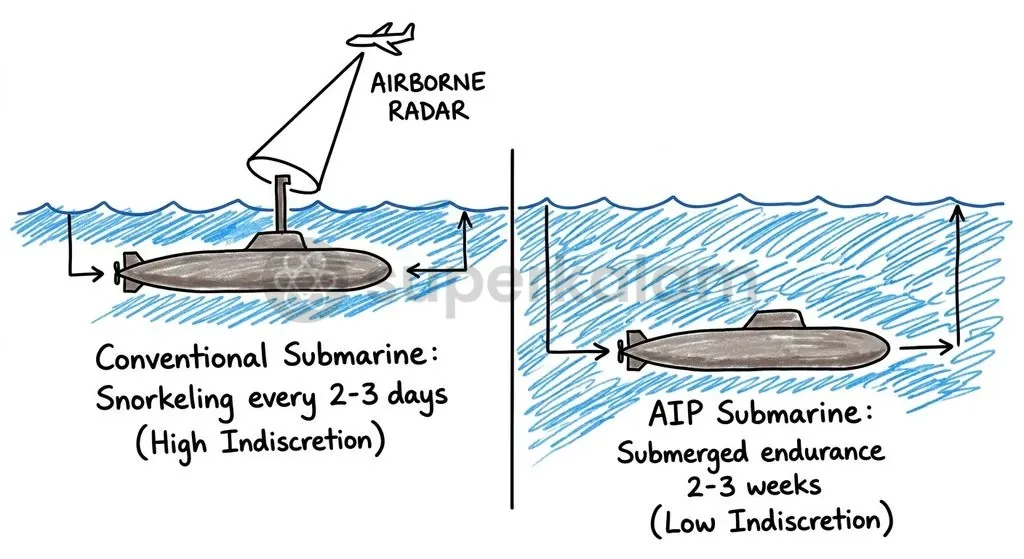
- AIP Operational Value: Fuel-cell AIP systems permit conventional diesel-electric submarines to operate submerged continuously for 2 to 3 weeks, drastically decreasing the indiscretion rate associated with frequent surface snorkelling.
- Strategic Partnership Parameters: Chapter 7 of the Defence Acquisition Procedure (DAP) 2020 governs P-75(I), mandating a progressive increase in indigenous content from 45% on the initial hull to 60% on the final vessel.
- Regional Undersea Balance: India’s 30-year submarine building plan faces capability pressures as China operates over 60 submarines (including Type 039 Yuan-class AIP boats) and Pakistan inducts 8 Chinese-designed Hangor-class AIP submarines.
- Procurement Friction: Strict requirements for sea-proven AIP systems and unlimited liability terms led to vendor attrition (including Naval Group, Saab, and Rosoboronexport), contributing to procurement delays.
- Dual-Track Modernisation: Sustaining maritime deterrence requires retrofitting the indigenous DRDO-NMRL fuel-cell AIP on existing Kalvari-class hulls alongside the Cabinet Committee on Security-approved nuclear-powered attack submarine (SSN) programme.
Mains Question
The Strategic Partnership model under Project 75(I) seeks to bridge critical undersea capability gaps while embedding an indigenous manufacturing ecosystem. In light of vendor attrition and strict liability clauses, critically examine the challenges in executing this procurement model. (10 Marks)
Evaluate NowMains Question
"Securing maritime choke points in the Indian Ocean requires a balanced underwater force architecture combining conventional AIP and nuclear-powered submarines." Discuss this statement in the context of the Indian Maritime Security Strategy and evolving regional subsurface capabilities. (15 Marks)
Evaluate NowPractice MCQs
QUESTION 1
With reference to Fuel-Cell Air Independent Propulsion (AIP) technology in submarines, consider the following statements:
- Fuel-cell AIP generates electrical energy through an electrochemical reaction between hydrogen and oxygen, producing only water and heat as byproducts.
- Unlike Stirling combustion engines, fuel-cell AIP systems operate with no major moving parts, resulting in a significantly lower acoustic signature.
- Incorporating an AIP module increases a conventional submarine's submerged endurance from 2 to 3 days up to two to three weeks without needing to snorkel. Which of the statements given above are correct?
QUESTION 2
Regarding the procurement framework and indigenisation targets of Project 75(India), consider the following statements:
- The project is executed under the Strategic Partnership model outlined in Chapter 7 of the Defence Acquisition Procedure (DAP) 2020.
- The tender mandates a minimum indigenous content of 45% for the first submarine, escalating to 60% by the sixth vessel.
- The procurement requires the foreign Original Equipment Manufacturer to deliver a sea-proven fuel-cell AIP system. Which of the statements given above are correct?
QUESTION 3
Consider the following statements comparing conventional, AIP-equipped, and nuclear-powered submarines:
- Nuclear-powered attack submarines (SSNs) are subject to a constant low-frequency acoustic hum from coolant pumps and turbine machinery.
- AIP-equipped conventional submarines can achieve higher sustained underwater transit speeds exceeding 30 knots indefinitely compared to nuclear attack submarines.
- Conventional diesel-electric submarines without AIP must snorkel every few days to recharge batteries, increasing their indiscretion rate and radar vulnerability. Which of the statements given above is/are correct?
QUESTION 4
Consider the following statements regarding regional subsurface developments in the Indian Ocean Region:
- Under a 2015 bilateral agreement, Pakistan is acquiring eight Hangor-class AIP submarines split between construction at China's Wuchang Shipyard and Karachi Shipyard & Engineering Works.
- China's People's Liberation Army Navy operates over 60 submarines, including Type 039A/B/C Yuan-class conventional submarines equipped with AIP. Which of the statements given above is/are correct?
QUESTION 5
In naval warfare doctrine, what does the term 'indiscretion rate' refer to?