Prescription Drug Advertising in India: Draft 2026 Rules Explained
Draft rules propose prior approval for advertisements of Schedule H, H1 and X medicines by licensed sellers. See the proposal and enforcement issues.
Oct, 2026
•11 min read

Overview
The Union Ministry of Health and Family Welfare has proposed draft rules under Gazette Notification G.S.R. 861(E) to prohibit retail, wholesale, and distribution licensees from advertising Schedule H, H1, and X prescription medicines without prior Central Government sanction. This intervention targets a burgeoning digital grey zone where online aggregators, tele-health portals, and surrogate promotional campaigns bypass traditional retail sales safeguards. While the amendment establishes a clear statutory prohibition on commercial promotion by supply-chain intermediaries, closing India's regulatory deficit requires closing gaps in cross-border digital liability and federal enforcement.
Why in the News: The Push to Clamp Down on Prescription Drug Advertisements
The Union Ministry of Health and Family Welfare notified draft rules under Gazette Notification G.S.R. 861(E) to halt unauthorised promotional campaigns for prescription drugs. This statutory draft inserts sub-rule (22) into Rule 65 of the Drugs Rules, 1945, explicitly prohibiting licensed distributors, wholesalers, and retailers from advertising medicines listed under Schedule H, Schedule H1, and Schedule X without the prior sanction of the Central Government.
According to the Minutes of the 93rd Drugs Technical Advisory Board (DTAB) Meeting, the proposed amendment emerged directly from technical recommendations adopted by the statutory board. Commercial practices around GLP-1 receptor agonists such as semaglutide and tirzepatide reportedly catalysed this regulatory response, per the Union Health Ministry Technical Deliberations, as retail platforms pushed aggressive discounts and online consumer advertisements. The core argument underpinning this intervention is clear: the draft amendment to Rule 65 represents a necessary structural recalibration to close commercial loopholes, but its efficacy remains severely constrained without synchronised digital-platform liability and unified federal enforcement.
Beyond the Label: Decoding Schedules H, H1, and X under Drug Regulations
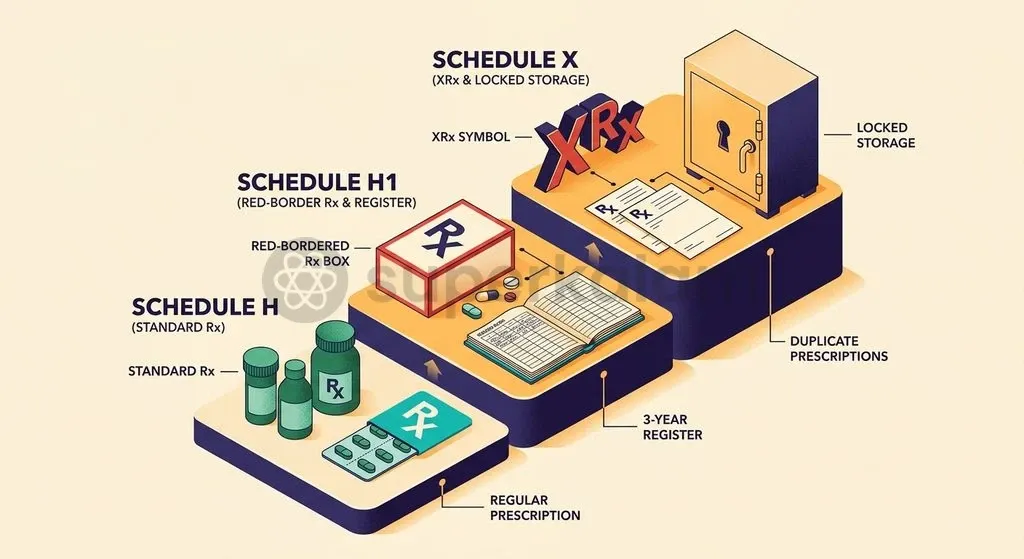
The Drugs Rules, 1945 establish graduated regulatory classifications to govern medicinal safety, dispensing protocols, and consumer risk. While Rule 65 prescribes the conditions of retail and wholesale licences, Rule 97 governs statutory packaging symbols and mandatory warning labels. These schedules separate ordinary over-the-counter remedies from formulations that carry severe risks of toxicity, dependence, or clinical misuse.
Schedule H contains hundreds of potent allopathic medicines that require professional clinical oversight. Under Rule 97(1), any drug falling within this category must display a prominent symbol of 'Rx' on the left corner of the label alongside an explicit statutory caution prohibiting retail sale without a prescription from a Registered Medical Practitioner.
Schedule H1 represents a specialised regulatory carve-out introduced via Gazette Notification G.S.R. 588(E) to combat antimicrobial resistance and curb habit-forming pharmaceutical misuse. The notification mandates that Schedule H1 packaging must display the 'Rx' symbol in red, enclosed within a distinct red-bordered box accompanied by a prominent warning against dispensing without a qualified prescription.
Schedule X represents India's most tightly controlled category of allopathic formulations, covering potent psychotropic and narcotic substances. Under Rule 97(1), these formulations must display the conspicuous 'XRx' symbol in red ink. Retail chemists must comply with Rule 65(9)(a), which mandates that Schedule X formulations may only be dispensed against duplicate prescriptions, with dispensers retaining one copy for two years while storing physical stocks securely under lock and key.
Discuss with Superkalam
Recall the exact audit trail requirement for Schedule H1 drugs versus Schedule X drugs under the Drugs Rules, 1945.
Ask NowComparison: How Restrictions Differ Across Schedule H, H1, and X Drugs
The Drugs Rules, 1945 construct distinct compliance tiers across prescription schedules to balance clinical access with administrative surveillance.
| Regulatory Parameter | Schedule H | Schedule H1 | Schedule X |
|---|---|---|---|
| Primary Statutory Objective | Preventing unsupervised self-medication of potent prescription drugs | Curbing antimicrobial resistance and habit-forming drug dependence | Preventing abuse and trafficking of psychotropic and narcotic drugs |
| Mandatory Labelling Symbol | 'Rx' symbol printed on the top left corner of the label | 'Rx' symbol in red inside a distinct red-bordered box | 'XRx' symbol printed conspicuously in red ink |
| Audit Trail and Record Retention | General prescription verification at point of retail sale | Dedicated register recording patient and prescriber data for three years | Duplicate prescription mandate with retailer retaining one copy for two years |
| Physical Storage Mandates | Standard retail pharmaceutical storage | Standard retail pharmaceutical storage | Mandatory physical storage under lock and key |
| Insertion Mechanism | Original framework of the Drugs Rules, 1945 | Inserted via Gazette Notification G.S.R. 588(E) in 2013 | Enacted under Rule 65(9)(a) of the Drugs Rules, 1945 |
These tiered distinctions create clear audit trails for point-of-sale verification. However, traditional retail dispensing provisions were designed for brick-and-mortar pharmacies, leaving modern electronic channels open to regulatory arbitrage.
Discuss with Superkalam
Explain how surrogate disease-awareness campaigns allow online aggregators to circumvent the Drugs and Magic Remedies Act, 1954.
Ask NowThe Digital Shift: Surrogate Marketing, Health Influencers, and E-Pharmacies
Digital healthcare aggregators and tele-pharmacy marketplaces operate in a statutory vacuum that challenges traditional sales restrictions. The Drugs and Magic Remedies (Objectionable Advertisements) Act, 1954 prohibits advertisements referring to drugs for the treatment of 54 conditions enumerated in its statutory Schedule, but it does not account for algorithmic digital delivery.
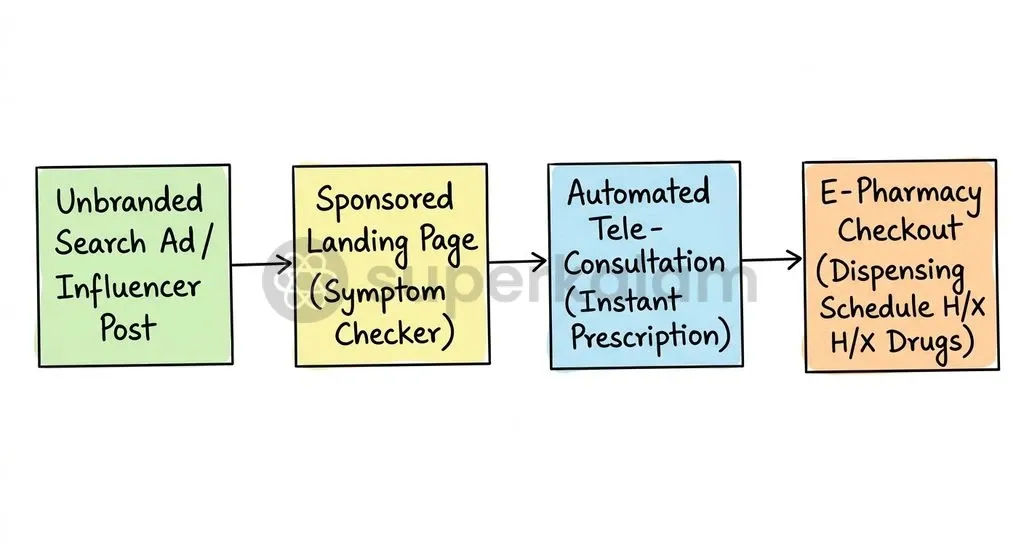
First, pharmaceutical brands increasingly deploy surrogate disease-awareness campaigns. As observed by the Parliamentary Standing Committee on Health and Family Welfare in its 145th Report, commercial campaigns frequently guide consumers from search engine advertisements to brand-sponsored portals and partnered e-pharmacies without explicitly naming the scheduled formulation in the initial banner.
Second, digital pharmacy platforms frequently integrate rapid tele-consultation funnels. According to consultation papers reviewed by the Ministry of Health, online portals use automated questionnaires to generate instant digital prescriptions, reducing clinical gatekeeping to a commercial formality.
Third, health influencers on social media regularly promote off-label uses for lifestyle and metabolic treatments. The Advertising Standards Council of India (ASCI) Healthcare Guidelines note that online video creators frequently bypass drug promotion rules by disguising promotional material as personal wellness testimonials.
Digital platforms regularly invoke intermediary safe harbour under Section 79 of the Information Technology Act, 2000 to disclaim responsibility. In the landmark matter of Zaheer Ahmed v. The Union of India & Others, the High Court of Delhi addressed unlicensed online medicine sales, highlighting how aggregators use intermediary protections to evade liability under the Drugs and Cosmetics Act, 1940.
The Enforcement Paradox: Fragmented State Regulators vs Borderless Internet
India's pharmaceutical administration divides statutory powers between national standard-setting bodies and sub-national licensing authorities. The Central Drugs Standard Control Organisation (CDSCO), headed by the Drugs Controller General of India (DCGI), approves new drug formulations and sets import standards. In contrast, State Drugs Regulatory Authorities (SDRAs) oversee retail sale licences and local pharmacy inspections.
The Mashelkar Committee Report highlighted that this bifurcated structure creates significant administrative bottlenecks. Digital pharmacy networks maintain corporate headquarters in one jurisdiction, route web traffic through central servers, and ship medications through localised retail hubs across state borders. A state drug inspector attempting to halt an unlawful digital advertisement lacks the extraterritorial jurisdiction required to sanction an out-of-state server or corporate entity.
Regulatory confusion deepens across ministerial domains. The Department of Pharmaceuticals notified the Uniform Code for Pharmaceutical Marketing Practices (UCPMP) 2024, making ethical codes binding and prohibiting manufacturers from extending gifts or hospitality to medical professionals. However, the UCPMP primarily governs pharmaceutical manufacturers rather than retail aggregators. When retail e-pharmacies fund digital ad campaigns, the enforcement mandate falls into a jurisdictional grey zone between the Central Consumer Protection Authority (under the Consumer Protection Act, 2019), state drug inspectors, and the Ministry of Electronics and Information Technology.
Discuss with Superkalam
If a consumer in one state purchases scheduled antibiotics via an e-pharmacy whose servers are based in another state, how would the jurisdictional limits of State Drugs Regulatory Authorities apply?
Ask NowPublic Health and Ethical Stakes: Self-Medication, AMR, and Misleading Claims
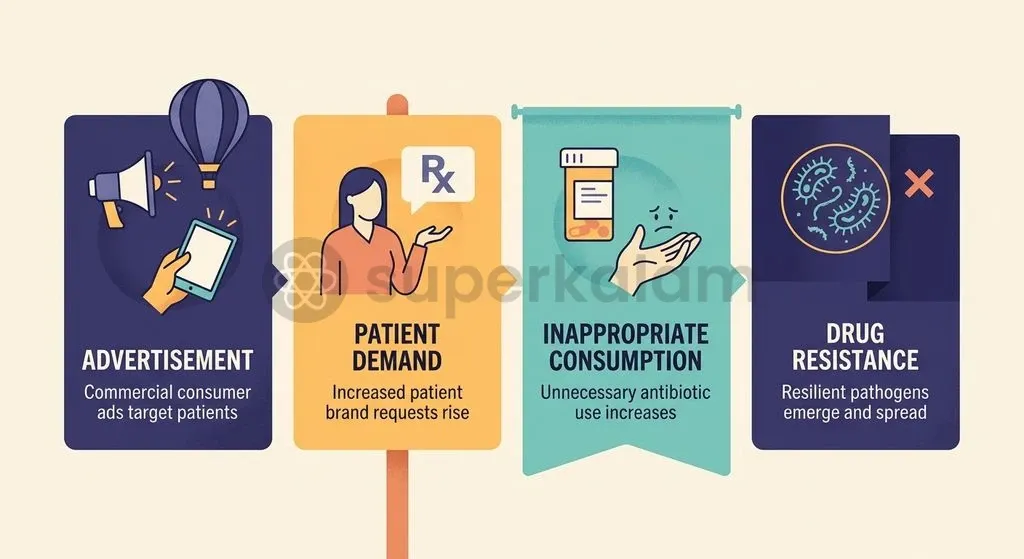
Uncontrolled direct-to-consumer promotion erodes the structural safeguards of professional clinical gatekeeping. The World Health Organization, in its 'Ethical Criteria for Medicinal Drug Promotion', warned that commercial drug advertising worsens information asymmetry between healthcare providers and patients. Promotional messaging prompts patients to demand specific brand-name formulations, converting clinical consultations into consumer transactions.
This commercial dynamic poses severe consequences for India's battle against Antimicrobial Resistance (AMR). The National Action Plan on Antimicrobial Resistance (NAP-AMR) established that unmonitored dispensing of Schedule H1 antibiotics accelerates microbial resistance across the country. Aggressive digital promotions that lower prescription verification barriers undermine antimicrobial stewardship, directly endangering public health.
The ethical dimensions under general bioethics frameworks concern patient vulnerability and distributive justice. Vulnerable patients managing chronic illnesses or metabolic conditions are susceptible to misleading claims that downplay adverse side effects. When commercial platforms incentivise self-medication through promotional discounting, they subvert the foundational medical duty of non-maleficence.
Global Precedents: How the US and EU Police Direct-to-Consumer Drug Ads
International legal systems diverge sharply in their approach to direct-to-consumer advertising (DTCA) of prescription medications. A joint review by the World Health Organization and the US Congressional Research Service confirms that direct-to-consumer advertising of prescription drugs is legally permissible in only two industrialised nations: the United States and New Zealand.
The United States permits direct-to-consumer promotion under a comprehensive regulatory oversight regime. The Food and Drug Administration (FDA) regulates prescription drug marketing under Section 502(n) of the Federal Food, Drug, and Cosmetic Act and 21 CFR § 202.1. Under 21 CFR § 202.1(e)(5)(ii), every promotional communication must maintain a statutory 'fair balance' between claims of therapeutic efficacy and disclosures of adverse side effects and contraindications.
Under FDA final rule 21 CFR § 202.1(e)(1), broadcast advertisements must convey a 'major statement' detailing primary risks in a clear, conspicuous, and neutral manner simultaneously across audio and visual formats. The FDA Office of Prescription Drug Promotion enforces compliance through formal Warning Letters and Untitled Letters. Even with these extensive disclosures, reports from the US Congressional Budget Office show sustained legislative debate regarding whether to eliminate corporate tax deductibility for pharmaceutical marketing expenses to curb healthcare spending.
The European Union adopts the opposite approach by prohibiting direct-to-consumer advertising of prescription-only medicines entirely under Article 88(1)(a) of Directive 2001/83/EC. Article 86(1) of the Directive defines medicinal advertising broadly, covering any form of door-to-door canvassing or commercial inducement designed to promote prescription, supply, or consumption.
The Court of Justice of the European Union reinforced this strict prohibition in the landmark judgment Euroaptieka (Case C-530/20). The Court held that commercial price discounts, volume promotions, and bundled retail sales run by pharmacies constitute illegal advertising under Directive 2001/83/EC. The European legal framework recognises that treating prescription drugs as standard consumer commodities stimulates irrational consumption and harms public health.
Discuss with Superkalam
Analyse the trade-off between improving patient access to medicines through digital pharmacy funnels and maintaining clinical gatekeeping to curb AMR.
Ask NowWay Forward: Building a Cohesive Regulatory Framework for Modern Healthcare
Reforming India's pharmaceutical promotional regime requires coordinated structural reforms across statutes, institutions, and digital platforms. The proposed insertion of sub-rule (22) into Rule 65 under Draft G.S.R. 861(E) provides a clear foundation by checking commercial distributors, but statutory amendments must extend across the broader digital ecosystem.
Key policy interventions should focus on four structural areas:
- Modernising Archaic Statutes: Parliament should update the Drugs and Magic Remedies (Objectionable Advertisements) Act, 1954 to reflect modern digital media. Expanding the statutory definition of advertising to match the European Union's broad framework under Directive 2001/83/EC would restrict surrogate disease-awareness campaigns, algorithmic sponsored links, and influencer marketing.
- Harmonising Platform Intermediary Liability: The Ministry of Electronics and Information Technology must coordinate with the CDSCO to draft explicit due-diligence rules under the Information Technology (Intermediary Guidelines and Digital Media Ethics Code) Rules. E-pharmacies and tele-health portals must not receive Section 79 safe-harbour protections if they host unapproved drug advertisements or facilitate automated prescriptions.
- Institutional Convergence Between Centre and States: The Union Government should implement the recommendations of the Mashelkar Committee by establishing a centralised digital enforcement cell within the CDSCO. A unified surveillance platform would enable central and state authorities to track cross-border e-pharmacy violations in real time.
- Mandatory UCPMP Enforcement and Penal Backing: The Department of Pharmaceuticals must introduce clear statutory penalties for breaches of the Uniform Code for Pharmaceutical Marketing Practices 2024. Expanding this code to cover digital health aggregators would prevent commercial entities from evading marketing rules that bind traditional manufacturers.
Key Takeaways
- The Union Health Ministry's Draft G.S.R. 861(E) amends Rule 65 of the Drugs Rules, 1945 by inserting sub-rule (22), prohibiting licensed retail, wholesale, and distribution entities from advertising Schedule H, H1, and X medicines without prior Central Government sanction.
- The Drugs Rules, 1945 classify prescription drugs into distinct tiers: Schedule H carries the 'Rx' label; Schedule H1 mandates a red 'Rx' box and a three-year sales register to combat antimicrobial resistance; Schedule X requires an 'XRx' label, duplicate prescriptions, a two-year record audit trail, and locked storage.
- E-commerce and tele-health intermediaries exploit regulatory seams through surrogate disease-awareness funnels, automated consultations, and social media influencer promotions, frequently claiming safe-harbour immunity under Section 79 of the Information Technology Act, 2000.
- International models offer clear lessons: the United States strictly polices direct-to-consumer advertising through the FDA's 'fair balance' mandate (21 CFR § 202.1), while the European Union enforces an outright ban on prescription ads under Directive 2001/83/EC, a stance reinforced by the CJEU in Euroaptieka.
- Comprehensive enforcement requires modernising the Drugs and Magic Remedies Act, 1954, instituting explicit intermediary liability rules for e-pharmacies, and establishing unified digital coordination between the CDSCO and State Drugs Regulatory Authorities.
Mains Question
"The proposed insertion of sub-rule (22) into Rule 65 of the Drugs Rules, 1945 seeks to curb unauthorised prescription drug promotions, yet structural fractures in digital intermediary liability and federal enforcement undermine its intent." Critically analyse. (15 Marks)
Evaluate NowMains Question
Highlighting the regulatory tiering among Schedule H, Schedule H1, and Schedule X drugs under the Drugs Rules, 1945, examine how unregulated digital marketing impacts the objectives of the National Action Plan on Antimicrobial Resistance (NAP-AMR). (10 Marks)
Evaluate NowPractice MCQs
QUESTION 1
With reference to the Drugs Rules, 1945, consider the following statements:
- Schedule H1 formulations must display the 'Rx' symbol in red, enclosed within a red-bordered box.
- Retailers are mandated to preserve patient and prescriber records for Schedule H1 drugs for a minimum period of two years.
- Formulations classified under Schedule X must be stored physically under lock and key and require duplicate prescriptions. Which of the statements given above is/are correct?
QUESTION 2
Consider the following statements regarding the regulatory framework governing prescription pharmaceuticals in India:
- The draft Gazette Notification G.S.R. 861(E) proposes to insert sub-rule (22) into Rule 65 of the Drugs Rules, 1945.
- The Drugs and Magic Remedies (Objectionable Advertisements) Act, 1954 explicitly enumerates 54 statutory conditions for which advertisements are prohibited.
- The Uniform Code for Pharmaceutical Marketing Practices (UCPMP) 2024 primarily establishes binding ethical obligations for retail e-pharmacy platforms and digital aggregators. Which of the statements given above is/are correct?
QUESTION 3
Consider the following statements regarding drug administration and regulatory bodies in India:
- The Central Drugs Standard Control Organisation (CDSCO) is vested with the authority to grant retail sales licences and carry out routine local pharmacy inspections.
- The Drugs Technical Advisory Board (DTAB) is the statutory body whose technical recommendations led to the proposed prohibition on advertising Schedule H, H1, and X drugs.
- Under the Information Technology Act, 2000, e-pharmacy aggregators have frequently claimed intermediary safe harbour protections under Section 79 to disclaim liability under drug laws. Which of the statements given above is/are correct?
QUESTION 4
In the context of the Drugs Rules, 1945, the conspicuous red symbol 'XRx' is statutorily required on the packaging of which of the following categories of drugs?
QUESTION 5
With reference to pharmaceutical regulations and public health challenges highlighted in national policies, consider the following statements:
- Schedule H1 was introduced specifically via Gazette Notification G.S.R. 588(E) in 2013 to curb habit-forming drugs and tackle antimicrobial resistance.
- The National Action Plan on Antimicrobial Resistance (NAP-AMR) identifies unmonitored dispensing of Schedule H1 antibiotics as a driver of microbial resistance. Which of the statements given above is/are correct?