PRAMAAN Certification: Indian Forest and Wood Certification Scheme
PRAMAAN is the certification mark under IFWCS. See the forest and wood certification framework, first recipients, audits and sustainable sourcing.
Sep, 2026
•7 min read
Overview
The Indian Forest and Wood Certification Scheme, operating under the trade mark PRAMAAN, is India's sovereign standard-setting framework. Established by the Ministry of Environment, Forest and Climate Change, it validates sustainable forestry and agroforestry value chains.
The scheme was officially launched in December 2023 and issued its inaugural certificates in September 2026. It provides third-party audited verification for timber and Non-Timber Forest Produce across state forests and private farmlands.
PRAMAAN sets national standards across Forest Management, Trees Outside Forests, and Chain of Custody. This framework mitigates foreign certification costs while helping Indian wood-based exports align with international due-diligence regulations like the European Union Deforestation Regulation.
Why in the News? The Rollout of First PRAMAAN Certificates
Union Minister Bhupender Yadav presented India's inaugural PRAMAAN certificates under the Indian Forest and Wood Certification Scheme (IFWCS) on 29 September 2026 in New Delhi.
According to the Ministry of Environment, Forest and Climate Change (MoEFCC), this event marked the full operationalisation of the domestic certification architecture. As of September 2026, the first institutional certification was awarded to the Andhra Pradesh Forest Development Corporation (APFDC) for 33,000 hectares of plantations.
The inaugural smallholder certificate was conferred on farmer Govind Mohapatra through the Odisha Bamboo Development Agency (OBDA). As reported by The Times of India on 29 September 2026, this maiden Trees Outside Forests certification covered 14.03 hectares of farm-grown bamboo across species including Bambusa vulgaris, Bambusa nutans, and Dendrocalamus strictus in Mayurbhanj district.
Discuss with Superkalam
What are the three distinct certification pillars defined under the PRAMAAN framework?
Ask NowWhat is the Indian Forest and Wood Certification Scheme (IFWCS)?
The Indian Forest and Wood Certification Scheme is India's national voluntary certification regime designed to validate sustainable forest management practices and agroforestry timber sourcing.
Launched by MoEFCC in December 2023, the scheme operates under the brand name PRAMAAN as a formal conformity mark. The certification covers both timber and Non-Timber Forest Produce (NTFP). It encompasses state forest development corporations, community-managed forests, private farmers, and wood processing industries.
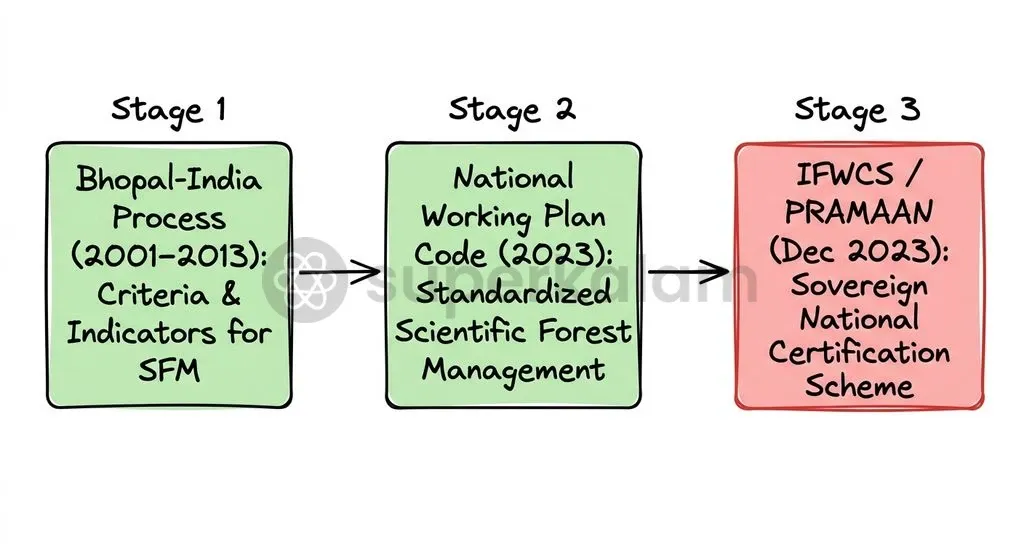
The technical foundation of the scheme originated from the Bhopal-India Process, which developed 8 criteria and 37 indicators for sustainable forest management. As detailed in scheme documents from the Indian Institute of Forest Management (IIFM), this framework was pilot-tested across 26 forest divisions in 12 states between 2001 and 2013 before its formal adoption into national standards.
Core Pillars of PRAMAAN: Understanding the Certification Categories
The PRAMAAN scheme operates through three distinct pillars: Forest Management certification, Trees Outside Forests certification, and Chain of Custody certification.
According to scheme guidelines issued by MoEFCC and IIFM, these three categories cover the entire supply chain from standing trees to finished timber products:
- Forest Management (FM) Certification: Applied to natural forests and state forest plantations. The Indian Forest Management Standard (IFMS) comprises 8 criteria, 69 indicators, and 254 verifiers, integrated directly into the National Working Plan Code 2023.
- Trees Outside Forests (TOF) Management Certification: Designed specifically for trees grown on farmlands and private plantations. The standard specifies 5 criteria, 22 indicators, and 76 verifiers tailored to agroforestry ecosystems.
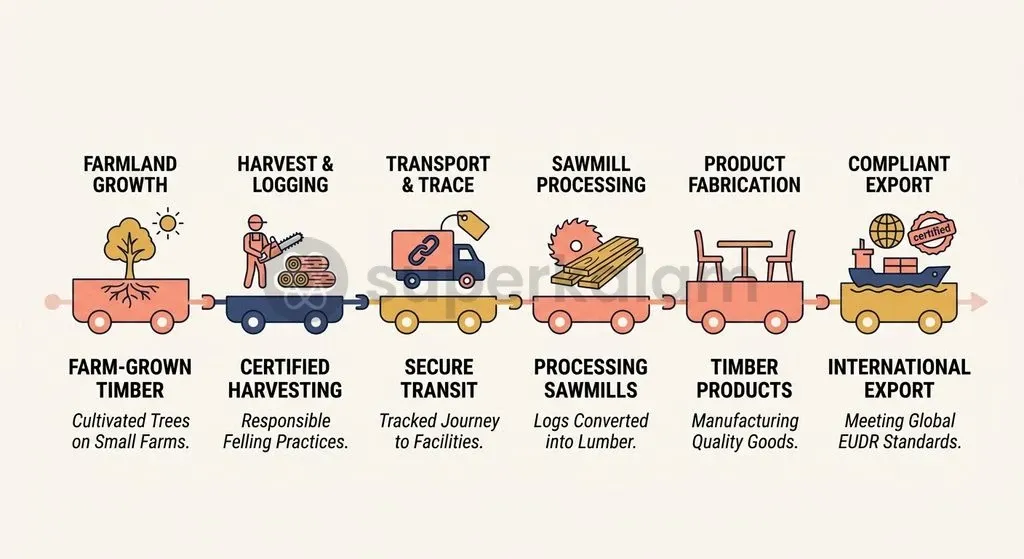
- Chain of Custody (CoC) Certification: Tracks wood products through every stage of transport, processing, and distribution to guarantee that manufactured goods originate from certified sustainable sources.
| Certification Pillar | Target Scope | Metric Architecture | Primary Beneficiaries |
|---|---|---|---|
| Forest Management (FM) | Natural forests and state plantations | 8 criteria, 69 indicators, 254 verifiers | State Forest Departments, Forest Development Corporations |
| Trees Outside Forests (TOF) | Farmlands, agroforestry, private woodlots | 5 criteria, 22 indicators, 76 verifiers | Farmers, tree growers, agricultural communities |
| Chain of Custody (CoC) | Timber transit, sawmills, manufacturing | Supply-chain traceability verifiers | Wood processing units, furniture makers, exporters |
Discuss with Superkalam
How does the separation between IIFM Bhopal and NABCB ensure institutional impartiality in standard-setting and auditing?
Ask NowInstitutional Architecture: Who Sets, Audits, and Governs the Standards?
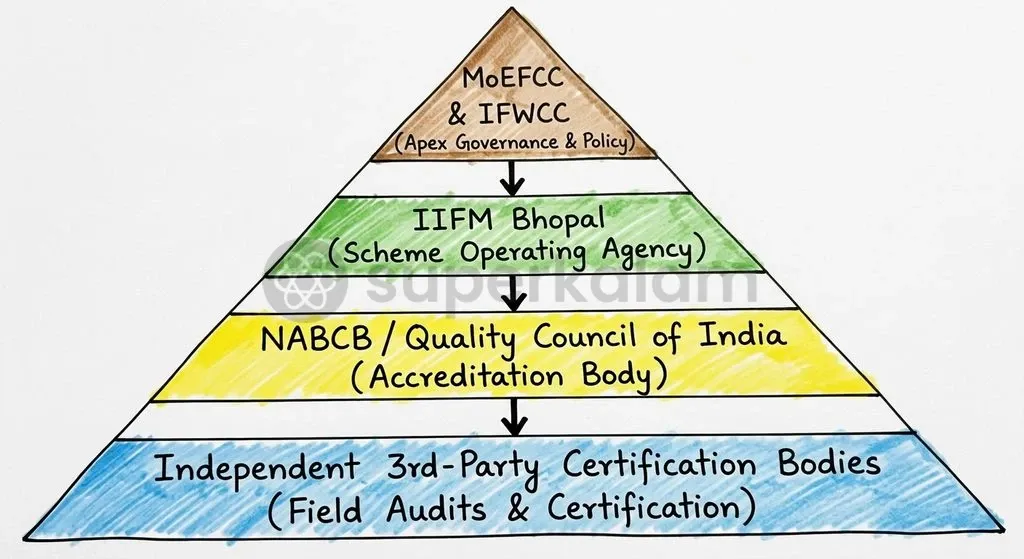
The governance of IFWCS relies on a three-tier institutional structure separating policy oversight, scheme operations, and independent third-party auditing.
At the apex sits the Indian Forest and Wood Certification Council (IFWCC), a multi-stakeholder body representing government ministries, research institutions, industry bodies, and civil society. The Indian Institute of Forest Management (IIFM), Bhopal, is the official Scheme Operating Agency, managing daily administration and standard upkeep.
Independent auditing is strictly separated from scheme governance. Under MoEFCC guidelines, certification bodies that inspect and grant PRAMAAN licences must be accredited by the National Accreditation Board for Certification Bodies (NABCB), a constituent board of the Quality Council of India.
Global Trade and EUDR: Overcoming Non-Tariff Barriers in Wood Exports
PRAMAAN certification provides domestic timber exporters with verified audit documentation to navigate stringent international trade restrictions like the European Union Deforestation Regulation.
Prior to PRAMAAN, international certification bodies had limited penetration across India. According to IIFM industry briefings, the Forest Stewardship Council (FSC) had certified approximately 1.81 lakh hectares, while PEFC-endorsed systems covered roughly 4.5 lakh hectares nationwide.
The European Union Deforestation Regulation (EUDR, Regulation 2023/1115) prohibits the import of commodities linked to deforestation and requires verified geolocation traceability. While PRAMAAN certification offers documented evidence for supply-chain due diligence, foreign regulations still require importing entities to independently submit verified due-diligence statements. PRAMAAN reduces compliance friction by providing standard, internationally traceable provenance.
Discuss with Superkalam
Why do international non-tariff measures like the EUDR pose compliance challenges for uncertified Indian agroforestry wood exports?
Ask NowImpact on Agroforestry: What PRAMAAN Means for Farmers and Industry
Agroforestry and farm-grown trees supply more than 85% of domestic industrial roundwood in India, making standardisation vital for rural livelihoods.
According to MoEFCC scheme documentation, high auditing fees charged by foreign certification agencies previously excluded marginal farmers from certified timber supply chains. PRAMAAN offers a domestic, cost-effective certification route that enables smallholders to secure price premiums for farm-grown timber.
By linking certified Trees Outside Forests directly to wood-based industries, the scheme provides legal sourcing certainty for paper, plywood, and furniture manufacturers:
- Securing Raw Material Supply: Paper and furniture manufacturers gain verified, sustainable domestic timber.
- Conserving Natural Ecosystems: Industrial reliance on farmland trees reduces extraction pressure on natural forests.
- Mobilising Private Capital: Clear standardisation encourages formal commercial tree-planting investments.
Implementation Bottlenecks: Cost, Compliance, and Smallholder Readiness
Scaling PRAMAAN nationwide faces operational challenges involving auditing costs, awareness deficits, and technical supply-chain tracking.
As highlighted in proceedings from the MoEFCC and Quality Council of India National Workshop on Sustainable Forestry, three major bottlenecks persist:
- Certification Costs for Marginal Farmers: Individual farm audits remain financially unviable for smallholders without institutional group certification models.
- MSME Processing Capacity: Small-scale sawmills and wood artisans often lack digital inventory systems needed for Chain of Custody compliance.
- International Recognition: PRAMAAN requires formal Mutual Recognition Agreements with overseas public procurement bodies to achieve full parity with legacy global standards.
Discuss with Superkalam
How can State Forest Departments and FPOs structure group certification models to make PRAMAAN cost-effective for marginal tree farmers?
Ask NowWay Forward: Building a Global Brand for Indian Certified Timber
Establishing PRAMAAN as an internationally accepted benchmark requires bilateral accreditation agreements, farmer aggregation models, and digital traceability systems.
The Ministry of Environment, Forest and Climate Change must actively pursue Mutual Recognition Agreements with major trade partners in Europe and North America. This step ensures PRAMAAN labels are accepted without secondary audits, protecting Indian handicraft and furniture exports from non-tariff trade barriers.
Domestically, State Forest Departments and agroforestry agencies should aggregate smallholders into cluster certification schemes through Farmer Producer Organisations (FPOs). Integrating digital monitoring with group verification will lower per-farmer audit expenses and establish India as a competitive exporter in the sustainable timber trade.
Key Takeaways
- Sovereign Standard: PRAMAAN is the official conformity mark of the Indian Forest and Wood Certification Scheme (IFWCS), launched by MoEFCC in December 2023 and issuing its first certificates on 29 September 2026.
- Three Pillars: The scheme provides certification across Forest Management (FM), Trees Outside Forests (TOF), and Chain of Custody (CoC) for timber and Non-Timber Forest Produce.
- Rigorous Metrics: Built on the Bhopal-India Process, the Forest Management standard comprises 8 criteria, 69 indicators, and 254 verifiers in the National Working Plan Code 2023, while TOF uses 5 criteria, 22 indicators, and 76 verifiers.
- Governance Structure: The Indian Forest and Wood Certification Council oversees the scheme, IIFM Bhopal acts as the operating agency, and QCI's NABCB manages auditor accreditation.
- Trade Alignment: PRAMAAN assists Indian wood exporters in meeting due-diligence requirements under the European Union Deforestation Regulation (EUDR) while strengthening the domestic agroforestry sector.
Mains Question
With agroforestry supplying over 85% of India's domestic industrial roundwood, the introduction of the Trees Outside Forests (TOF) pillar under the PRAMAAN scheme is considered pivotal for rural producers. Elucidate. (10 Marks)
Evaluate NowMains Question
'While domestic forest certification frameworks like PRAMAAN address sustainable management, their effectiveness in overcoming international non-tariff barriers hinges on global recognition and domestic institutional readiness.' Critically analyse. (15 Marks)
Evaluate NowPractice MCQs
QUESTION 1
With reference to the Indian Forest and Wood Certification Scheme (IFWCS) and its 'PRAMAAN' brand, consider the following statements:
- The Indian Institute of Forest Management (IIFM), Bhopal, functions as the Scheme Operating Agency.
- Independent certification bodies granting PRAMAAN licences must be accredited by the National Accreditation Board for Certification Bodies (NABCB).
- The scheme covers timber verification but specifically excludes Non-Timber Forest Produce (NTFP).
Which of the statements given above are correct?
QUESTION 2
Consider the following statements regarding the metric architecture of the PRAMAAN certification pillars:
- The Forest Management (FM) standard is integrated into the National Working Plan Code 2023 with 8 criteria, 69 indicators, and 254 verifiers.
- The Trees Outside Forests (TOF) certification standard specifies 5 criteria, 22 indicators, and 76 verifiers.
- Farmland and agroforestry trees supply less than 20% of domestic industrial roundwood in India.
Which of the statements given above is/are correct?
QUESTION 3
Consider the following statements regarding international trade alignment and the rollout of PRAMAAN certificates:
- The Andhra Pradesh Forest Development Corporation received the first institutional certification for 33,000 hectares of plantations.
- Holding a PRAMAAN certificate legally exempts European importers from independently submitting verified due-diligence statements under the EU Deforestation Regulation (EUDR).
- The technical standard of the scheme evolved from the Bhopal-India Process.
Which of the statements given above is/are correct?
QUESTION 4
Which of the following bodies serves as the apex multi-stakeholder governance entity for the Indian Forest and Wood Certification Scheme?
QUESTION 5
In the context of the PRAMAAN certification framework, the 'Chain of Custody (CoC)' certification is specifically designed to: