Poompuhar Torpedo Jar Discovery: Ancient Maritime Trade
Underwater excavations off Poompuhar validate Sangam literary accounts, proving Early Historic Tamil ports acted as pivotal trans-oceanic trading emporiums.
Oct, 2026
•8 min read
Overview
The recovery of a West Asian torpedo jar fragment off the coast of Poompuhar provides critical material evidence for ancient maritime trade. It confirms that the ancient Early Chola port city functioned as a dynamic trans-oceanic hub during the Early Historic period, connecting peninsular India with Persian Gulf and Mediterranean networks.
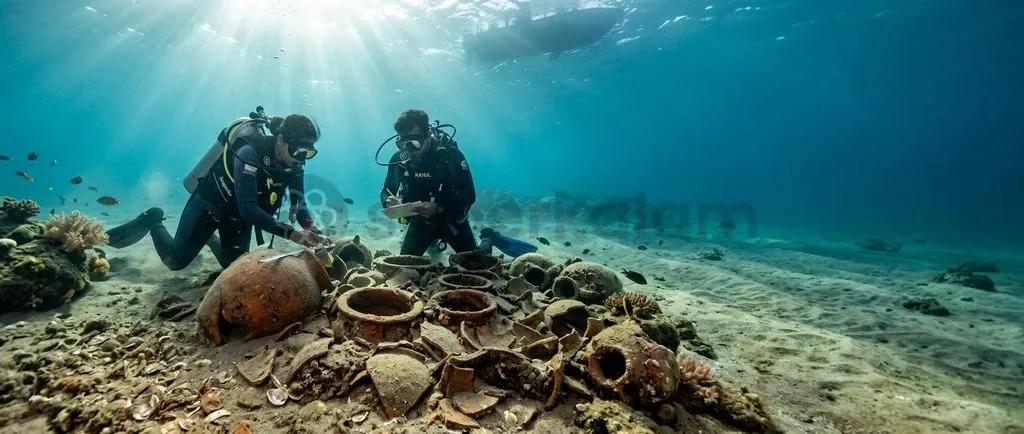
As of September 2026, marine explorations conducted by the Tamil Nadu State Department of Archaeology and the Indian Maritime University located the ceramic artefact alongside submerged ring wells and diverse regional pottery. This material discovery corroborates classical Sangam literature, verifying that Early Historic Tamil ports acted as central trans-shipment nodes rather than isolated coastal settlements.
Why in the News: Underwater Excavations off Poompuhar
The Tamil Nadu State Department of Archaeology conducted offshore underwater explorations off the coast of Poompuhar in Mayiladuthurai district to map submerged maritime heritage.
As reported by the Tamil Nadu State Department of Archaeology in September 2026, divers working in collaboration with the Indian Maritime University recovered critical seabed finds:
- West Asian torpedo jar: The first underwater fragment retrieved from the seabed, located at a water depth of 10 to 12 metres and situated roughly 1.8 to 2.2 kilometres offshore from the modern coastline.
- Terracotta ring wells: Four intact structures resting on the seabed, each measuring between 60 cm and 65 cm in diameter, per the department's exploration release.
- Ceramic assemblage: Divers retrieved over 250 ceramic sherds from the survey area, including glazed Iranian pottery and paddle-impressed ware originating from the Gangetic plains.
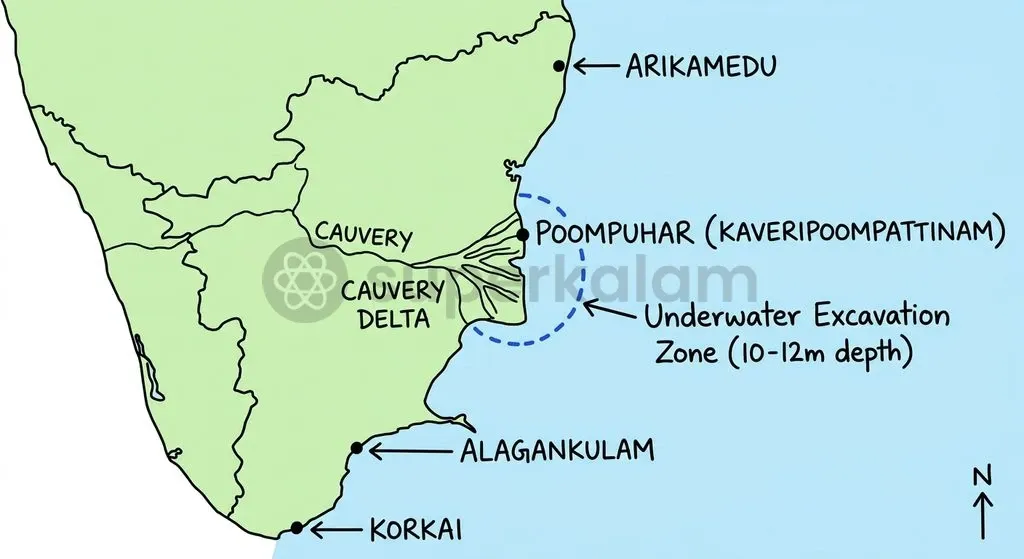
This diverse assemblage demonstrates active long-distance exchange spanning inland and oceanic routes.
Discuss with Superkalam
What specific substance was used to line the interior of West Asian torpedo jars to prevent liquid leakage?
Ask NowWhat Is Poompuhar? The Ancient Port City of Kaveripoompattinam
Poompuhar was the primary port capital of the Early Cholas, situated strategically at the mouth of the Cauvery River where it drains into the Bay of Bengal.
Historical records designate the settlement variously as Kaveripoompattinam, Puhar, or Poompuhar. Radiocarbon dating conducted by the CSIR-National Institute of Oceanography (NIO) on excavated structural timbers and wooden wharves establishes that continuous urban habitation and port activity commenced by the 4th to 5th centuries BCE.
The Tamil epic Silappadikaram, authored by Ilango Adigal, provides detailed civic documentation of Kaveripoompattinam, dividing the metropolis into three distinct zones:
- Maruvurppakkam: The coastal port quarter inhabited by foreign merchants, sailors, dockworkers, and customs officials managing harbour warehouses.
- Pattinappakkam: The inland residential and administrative sector housing royalty, ministers, nobility, and wealthy domestic traders.
- Nalangadi: The central daytime marketplace operating in the open green space separating the coastal harbour from the inland city.
Classical foreign accounts substantiate this urban prosperity. The 1st-century CE Greco-Roman navigation text Periplus of the Erythraean Sea records the port as 'Camara', identifying it as a leading commercial emporium on the Coromandel coast. In the 2nd century CE, the Greco-Egyptian geographer Claudius Ptolemy documented the city as 'Khaberis Emporion' in his treatise Geographia, explicitly situating it at the mouth of the Chaberis (Cauvery) River.
What Are Torpedo Jars and Where Did They Come From?
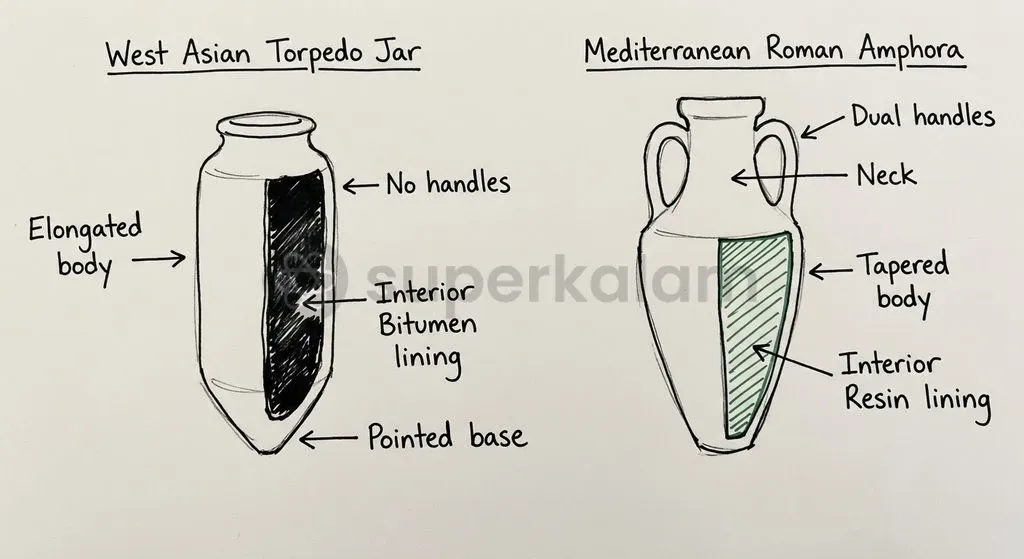
Torpedo jars are elongated, handleless ceramic transport vessels manufactured in Mesopotamia and the Persian Gulf to haul liquid commodities across oceanic trade routes.
According to research published in the Journal of Archaeological Science, these containers feature a narrow, tubular body with thick clay walls designed to withstand long voyages. The diagnostic characteristic of a torpedo jar is its internal coating of bitumen (a viscous, petroleum-derived tar). This layer sealed porous ceramic walls to prevent liquids from evaporating or spoiling.
Geochemical and organic residue analyses published in Molecules confirm that bitumen-lined torpedo jars were primarily utilised to export wine produced in Mesopotamia and the Iranian heartland under the Sasanian Empire (224–651 CE) and during the Early Islamic period.
The table below contrasts West Asian torpedo jars with Mediterranean Roman amphorae found across peninsular Indian archaeological sites:
| Feature | West Asian Torpedo Jar | Roman Amphora |
|---|---|---|
| Geographic Origin | Mesopotamia, Persian Gulf, Sasanian Iran | Mediterranean Basin (Italy, Gaul, Hispania) |
| Morphology & Design | Cylindrical, handleless, thick-walled tubular shape | Conical or globular with two opposing handles |
| Internal Sealing | Lined internally with petroleum-based bitumen | Lined with pine resin or pitch |
| Primary Commodities | Mesopotamian wine, sesame and petroleum oils | Mediterranean wine, olive oil, and garum (fish sauce) |
| Dominant Era | Sasanian and Early Islamic periods (3rd–9th c. CE) | Roman Republic and Principate (1st c. BCE–3rd c. CE) |
The specimen recovered off Poompuhar possesses a reconstructed vessel diameter of 30 cm to 35 cm, according to measurements reported by the Tamil Nadu State Department of Archaeology. This vessel profile matches standard transport containers manufactured in the Sasanian-Mesopotamian network.
Discuss with Superkalam
Explain how the co-occurrence of Mesopotamian torpedo jars and Gangetic paddle-impressed pottery proves that Poompuhar was a trans-shipment hub rather than a simple consumer market.
Ask NowTracing Sangam-Era Maritime Trade Routes Between South India and West Asia
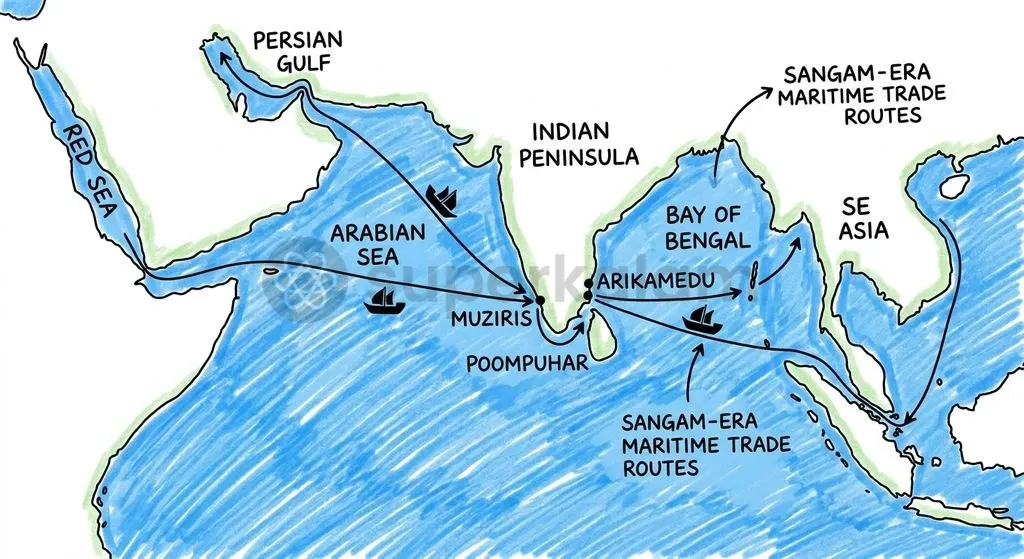
The recovery of West Asian ceramics on the Coromandel coast confirms that peninsular India operated as a central trans-shipment hub linking multiple oceanic trade systems.
Prior to the underwater discovery at Poompuhar, archaeological teams from the Tamil Nadu State Department of Archaeology recovered terrestrial torpedo jar fragments at sites such as Alagankulam, Korkai, and Porpanaikottai. The presence of these vessels demonstrates that maritime distribution extended across both littoral anchorages and inland riverine settlements.
Peninsular India did not merely consume foreign goods; its ports integrated separate regional maritime networks:
- The Western Indian Ocean Circuit: Connecting the Red Sea and Persian Gulf ports of the Roman and Sasanian empires with western Indian hubs like Muziris and eastern ports like Poompuhar.
- The Bay of Bengal Circuit: Linking Tamil ports across the Coromandel coast with the Gangetic plains, Sri Lanka, the Kra Isthmus, and the Indonesian archipelago.
- Internal Riverine Exchange: Moving imported bulk commodities from coastal river mouths along the Cauvery and Vaigai basins to inland craft centres.
According to monographs from the Indian Council of Historical Research (ICHR), the co-occurrence of Mediterranean amphorae, Persian Gulf torpedo jars, and northern Indian paddle-impressed pottery proves that Early Historic Tamilakam functioned as an intermediary clearing house rather than a passive bilateral consumer.
How Literary Evidence from Sangam Texts Matches Archaeological Findings
Material discoveries from marine explorations directly corroborate the descriptions of oceanic commerce recorded in classical Tamil Sangam literature.
The Sangam poem Pattinappalai, composed by Kadiyalur Uruttirangannanar in the Pattuppattu (Ten Idylls) anthology, records the sophisticated harbour administration at Kaveripoompattinam. The text describes warehouses where customs officers stamped the Chola tiger emblem on imported goods before releasing them into the open market, ensuring systematic tax collection.
Pattinappalai provides a precise inventory of imports converging at Poompuhar:
- Warhorses brought across the western sea by ship from Arabia and Persia.
- Finished gold brought from the northern mountains.
- Sandalwood and agil gathered from the Western Ghats.
- Natural pearls harvested from the southern Gulf of Mannar.
- Red coral imported from the eastern Mediterranean and Bay of Bengal waters.
The post-Sangam Buddhist epic Manimekalai, authored by Chithalai Chathanar, offers an explanation for the physical demise of the ancient port. The narrative records that coastal flooding and sea-level transgressions swallowed the metropolis. The recent discovery of ring wells and structural ceramics at depths of 10 to 12 metres validates this literary account of marine encroachment.
Discuss with Superkalam
Analyse how the civic division between Maruvurppakkam and Pattinappakkam reflected the socio-economic organisation of Early Historic Tamil port cities.
Ask NowWhy Marine Archaeology Matters for Reconstructing India's Maritime History
Marine archaeology provides empirical, physical data that bridges the evidentiary gaps between classical literature and terrestrial excavations.
The CSIR-National Institute of Oceanography pioneered systematic underwater explorations off Poompuhar beginning in 1981. Early surveys identified submerged brick structures, lead ingots, stone anchors, and a semi-circular jetty, establishing that early port installations extended significantly seaward from the present shoreline.
Submerged archaeological exploration in the Bay of Bengal faces severe technical constraints, including high coastal sedimentation, turbulent wave energy, and near-zero underwater visibility. Modern marine investigations deploy advanced geophysical instruments to overcome these physical barriers:
- High-Resolution Side-Scan Sonar: Emits acoustic frequencies to generate detailed photographic maps of seabed topography and exposed structural ruins.
- Sub-Bottom Profilers: Uses low-frequency sound waves to penetrate marine sediment layers, identifying cultural structural horizons buried beneath silt.
- Multibeam Bathymetry: Produces three-dimensional topographic relief maps of the continental shelf to identify paleo-channels and submerged coastal terraces.
- Remotely Operated Vehicles (ROVs): Deploys tethered submersibles equipped with high-definition cameras to inspect deep-water anomalies safely.
Discuss with Superkalam
Evaluate the reliability of post-Sangam literary narratives, such as the flooding described in Manimekalai, in light of underwater discoveries of ring wells at depths of 10 to 12 metres.
Ask NowChallenges in Underwater Exploration and the Road Ahead
Expanding underwater archaeological research requires institutional coordination, targeted technological investments, and formal conservation frameworks.
Marine artefacts retrieved from saline environments suffer rapid degradation upon exposure to atmospheric oxygen. Soluble salts crystallise within ceramic pores, causing structural flaking unless desalinated through controlled chemical baths. Preserving fragile finds like the bitumen-coated torpedo jar requires dedicated conservation laboratories stationed adjacent to excavation sites.
Inter-agency coordination remains essential to scale deep-water heritage projects. Collaborative ventures between the Archaeological Survey of India (ASI), the CSIR-NIO, the Indian Navy, and state archaeology departments can combine naval diving platforms with specialised geophysical equipment. Establishing an integrated maritime spatial database will protect high-potential submerged heritage zones along the Indian coastline from commercial dredging and port expansion.
Key Takeaways
- Offshore explorations off Poompuhar recovered the first underwater fragment of a West Asian torpedo jar alongside four submerged terracotta ring wells at depths of 10 to 12 metres.
- Torpedo jars were handleless, bitumen-lined ceramic vessels manufactured in Mesopotamia and the Persian Gulf to transport wine and oils during the Sasanian and Early Islamic periods.
- Radiocarbon dating on structural timbers confirms that urban port activity at Kaveripoompattinam began by the 4th to 5th centuries BCE under the Early Cholas.
- Material finds corroborate Sangam texts, matching descriptions in Pattinappalai regarding the Chola tiger customs seal and verifying Manimekalai's account of coastal marine inundation.
- The convergence of Mediterranean amphorae, Persian Gulf torpedo jars, and Gangetic pottery demonstrates that Early Historic Tamilakam functioned as a multi-directional oceanic trans-shipment hub.
Mains Question
"Material finds from recent marine archaeological explorations off Poompuhar directly substantiate the descriptions of urban zoning and trans-oceanic commerce preserved in Sangam literature." Elucidate. (10 Marks)
Evaluate NowMains Question
"The co-occurrence of West Asian torpedo jars, Roman amphorae, and northern Indian pottery establishes Early Historic peninsular India as an active trans-shipment nexus rather than a passive consumer terminal." Critically analyse the significance and technological challenges of marine archaeology in reconstructing this maritime network. (15 Marks)
Evaluate NowPractice MCQs
QUESTION 1
With reference to ancient maritime transport vessels, consider the following statements:
- West Asian torpedo jars were handleless cylindrical vessels internally sealed with petroleum-based bitumen.
- Roman amphorae were typically lined with pine resin or pitch and featured two opposing handles.
- Residue analyses confirm that torpedo jars were primarily utilised to haul Mediterranean olive oil and garum. Which of the statements given above are correct?
QUESTION 2
Regarding the ancient port city of Kaveripoompattinam (Poompuhar), consider the following statements:
- The 1st-century CE Greco-Roman text 'Periplus of the Erythraean Sea' records the port under the name 'Camara'.
- The epic 'Silappadikaram' describes 'Maruvurppakkam' as the inland administrative sector reserved exclusively for royalty and ministers.
- The Sangam poem 'Pattinappalai' records that customs officials stamped imported commodities with the Chola tiger emblem. Which of the statements given above is/are correct?
QUESTION 3
Consider the following statements regarding the underwater archaeological discoveries made off the coast of Poompuhar:
- Divers retrieved a West Asian torpedo jar fragment and intact terracotta ring wells at depths of 10 to 12 metres.
- The seabed ceramic assemblage included both glazed Iranian pottery and paddle-impressed ware from the Gangetic plains.
- Radiocarbon dating by CSIR-NIO establishes that port activity at Poompuhar commenced only in the 3rd century CE. Which of the statements given above is/are correct?
QUESTION 4
Which post-Sangam classical Tamil epic explicitly attributes the physical submergence and destruction of the port city of Kaveripoompattinam to coastal flooding and sea-level transgressions?
QUESTION 5
Consider the following statements regarding Early Historic trade networks in peninsular India:
- Terrestrial fragments of West Asian torpedo jars have been documented at Tamil Nadu sites including Alagankulam, Korkai, and Porpanaikottai.
- The co-occurrence of Sasanian torpedo jars and Mediterranean amphorae demonstrates that peninsular ports functioned purely as terminal consumer points. Which of the statements given above is/are correct?