PM Vishwakarma Scheme: Features, Benefits and Eligibility Explained
PM Vishwakarma covers 18 traditional trades with a ₹13,000 crore outlay, toolkits, and concessional credit - turning craft support into real social mobility is the test.
Sep, 2026
•9 min read
Overview
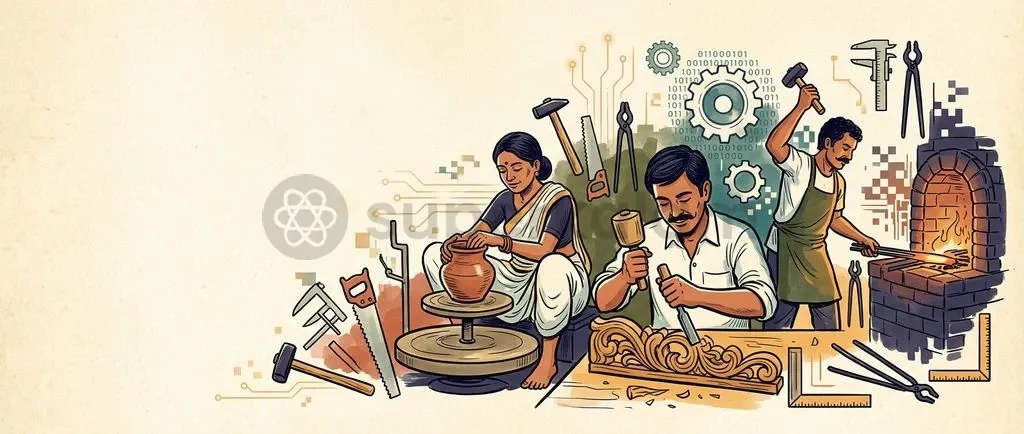
The Central Government launched the PM Vishwakarma Scheme on 17 September 2023 as a Central Sector Scheme. It delivers institutional support to unorganised traditional artisans through skill certification, modern toolkits, digital market access, and subsidised credit. With an outlay of ₹13,000 crore across five fiscal years from FY 2023-24 to FY 2027-28, the initiative addresses deep structural bottlenecks in India's informal artisanal economy.
The programme establishes an operational pipeline spanning three central ministries to transition informal craftspersons into formal micro-enterprises. Its long-term developmental impact hinges on expanding credit absorption, curbing intermediary cartels, and supporting craft preservation alongside intergenerational social mobility.
Why in the News: Formalizing India's Informal Artisan Economy
The Ministry of Micro, Small and Medium Enterprises rolled out the PM Vishwakarma Scheme to bring neglected traditional craftspeople into India's formal institutional framework. Traditional artisans have historically operated within the unorganised sector, cut off from formal banking channels, quality-testing regimes, and modern technology. As of September 2023, the scheme operates as a fully funded Central Sector Scheme with a financial commitment of ₹13,000 crore spanning from FY 2023-24 through FY 2027-28, as notified by the Press Information Bureau.
The governance architecture integrates three key central bodies:
- The Ministry of Micro, Small and Medium Enterprises (MSME) acting as the nodal administrative ministry.
- The Ministry of Skill Development and Entrepreneurship (MSDE) managing training standards and pedagogical delivery.
- The Department of Financial Services (DFS) under the Ministry of Finance overseeing concessional credit disbursals and interest subvention.
This administrative convergence shifts artisan welfare from isolated subsidies to a comprehensive enterprise development pipeline. Craftspersons receive formal recognition as micro-enterprises on the Udyam Assist Platform, bridging long-standing data deficits in the rural non-farm economy.
Who Are the Beneficiaries? Understanding the 18 Traditional Trades
The PM Vishwakarma Scheme designates 18 traditional, family-based trades where artisans work primarily using manual tools and traditional techniques in the informal sector. These trades span the rural and peri-urban manufacturing ecosystem, serving vital roles in construction, transport, domestic utility, and community maintenance. The official portal details that targeting focuses on self-employed craftspeople working without substantial mechanised infrastructure.
| Trade Category | Specific Occupations Included |
|---|---|
| Wood & Architecture | Carpenter (Suthar), Boat Maker |
| Metal & Heavy Craft | Blacksmith (Lohar), Armourer, Locksmith, Hammer and Tool Kit Maker, Sculptor (Moortikar/Stone) |
| Pottery & Earth Works | Potter (Kumhaar), Cobbler (Charmakar) |
| Construction & Sanitation | Mason (Raajmistri), Sweeper (Safaikarmi) |
| Handcraft & Apparel | Basket/Mat/Broom Maker, Doll & Toy Maker, Tailor (Darzi), Washerman (Dhobi) |
| Personal Care & Ornament | Barber (Naai), Garland Maker (Malakaar), Goldsmith (Sonar) |
The eligibility framework requires an applicant to be at least 18 years of age and actively engaged in one of these trades on the date of registration. Participation is restricted to one member per family to ensure broad spatial dispersion of fiscal resources across rural households.
Discuss with Superkalam
Which 18 traditional trades are covered under the PM Vishwakarma Scheme, and how does the one-member-per-family rule ensure spatial equity?
Ask NowThe 3-Pillar Architecture: Recognition, Up-skilling, and Collateral-Free Credit
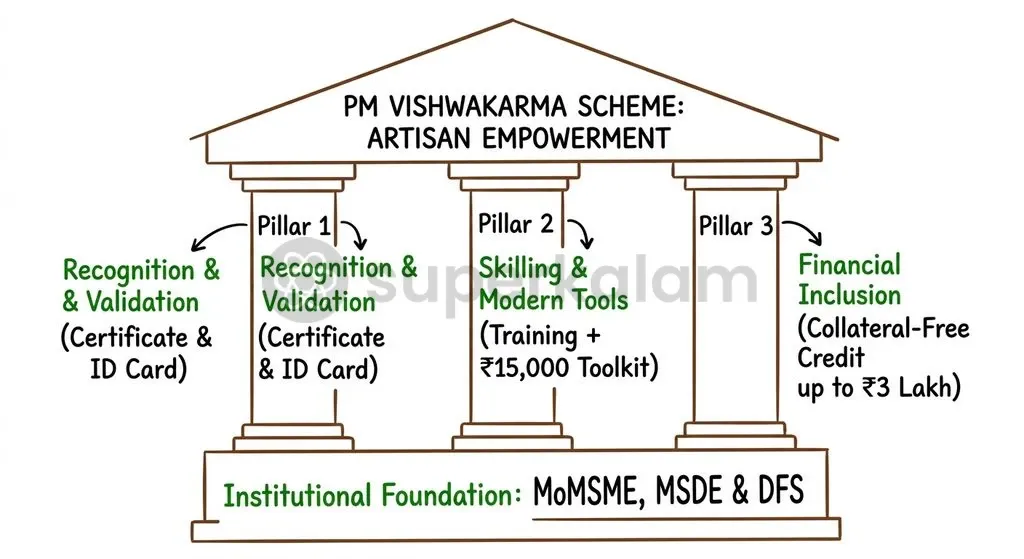
The PM Vishwakarma Scheme structures its intervention across three progressive operational pillars comprising formal validation, capacity enhancement, and credit delivery.
1. Recognition and Multi-Stage Verification
Enrolment requires a three-tier institutional screening process to prevent bogus registrations and target genuine informal producers:
- First Stage (Local Verification): Field verification carried out by the Gram Panchayat in rural areas or the relevant Urban Local Body (ULB) in urban jurisdictions.
- Second Stage (District Scrutiny): Technical vetting and profile verification conducted by the District Implementation Committee.
- Third Stage (Final Approval): Executive approval accorded by the state-level Screening Committee.
Successful applicants receive a physical and digital PM Vishwakarma Certificate and a unique PM Vishwakarma ID Card, formally recognising their skill status.
2. Up-skilling and Modern Toolkits
Skill development under the scheme blends traditional knowledge with modern technical standardisation:
- Basic Skill Training: Beneficiaries undergo foundational training of 5 to 7 days (40 hours) to learn modern techniques, workplace safety, and digital financial tools.
- Advanced Skill Training: Artisans can opt for advanced modules lasting 15 days or more (120 hours) covering advanced machinery and enterprise management.
- Wage Compensation: To offset loss of daily earnings during learning, artisans receive a daily training stipend of ₹500.
- Modern Toolkit Incentive: Upon starting Basic Skill Training, artisans receive a ₹15,000 digital voucher to purchase modern, ergonomic hand tools.
3. Collateral-Free Concessional Credit
Financial inclusion under the scheme is structured as progressive, milestone-linked enterprise credit:
- Tranche 1: An initial loan of up to ₹1 lakh with a repayment tenure of 18 months, available to artisans who complete Basic Skill Training.
- Tranche 2: A subsequent loan of up to ₹2 lakh with a repayment tenure of 30 months, accessible to beneficiaries who maintain standard repayment track records and adopt digital transactions.
- Concessional Pricing: Beneficiaries pay a concessional interest rate capped at 5% per annum, with the Central Government providing an 8% interest subvention directly to lending institutions.
- Digital Adoption Incentives: The scheme credits ₹1 per transaction directly to the artisan's bank account for up to 100 eligible digital transactions per month.
Comparison: How PM Vishwakarma Differs from Legacy Artisan Schemes
The Ministry of MSME designed PM Vishwakarma to resolve the fragmentation observed in earlier financial inclusion and craft promotion initiatives. Previous schemes like PM SVANidhi, MUDRA Yojana, and the Deendayal Antyodaya Yojana-National Rural Livelihoods Mission (DAY-NRLM) provided isolated credit or general self-help group capitalisation. PM Vishwakarma instead bundles validation, stipend-backed skilling, toolkit capital, and marketing onto a single unified digital tracking backbone.
| Analytical Dimension | PM Vishwakarma Scheme | Pradhan Mantri MUDRA Yojana (PMMY) | PM SVANidhi Scheme |
|---|---|---|---|
| Target Beneficiary | 18 traditional artisan and craft trades | All non-corporate, non-farm small/micro enterprises | Urban and peri-urban street vendors |
| Verification Architecture | Three-tier (Panchayat/ULB → District → State Screening) | Direct bank branch underwriting and lending partner checks | Urban Local Body (ULB) identification and recommendation letter |
| Skill Upgradation | Mandatory 40h Basic & optional 120h Advanced + ₹500/day stipend | No integrated skill training mandate | Digital literacy orientation only |
| Capital Tool Support | Dedicated ₹15,000 digital toolkit voucher | No direct asset voucher (general working capital) | No direct asset or tool voucher |
| Credit Tranches & Terms | ₹1 lakh (18 mos) + ₹2 lakh (30 mos) @ fixed 5% interest | Shishu (up to ₹50k), Kishore (₹50k-5L), Tarun (₹5L-10L) @ market rates | ₹10k, ₹20k, and ₹50k progressive tranches with 7% subvention |
| Platform Integration | Udyam Assist, GeM, ONDC, and National Committee for Marketing | Udyam Portal registration | Urban local databases and digital payment aggregator platforms |
Discuss with Superkalam
How does PM Vishwakarma's integrated enterprise development pipeline differ fundamentally from isolated credit schemes like PM SVANidhi or MUDRA?
Ask NowThe Structural Bottlenecks: Credit Absorption, Middlemen, and Market Linkages
The National Skill Development Corporation and policy analysts note that credit and toolkits alone cannot resolve long-standing market distortions in the informal economy. Providing working capital without building dedicated procurement pipelines risks saddling vulnerable craftspersons with debt while leaving their core business model unchanged. A field evaluation by NITI Aayog shows that without structured forward linkages and assured procurement arrangements, craftspeople remain captive to local trader cartels.
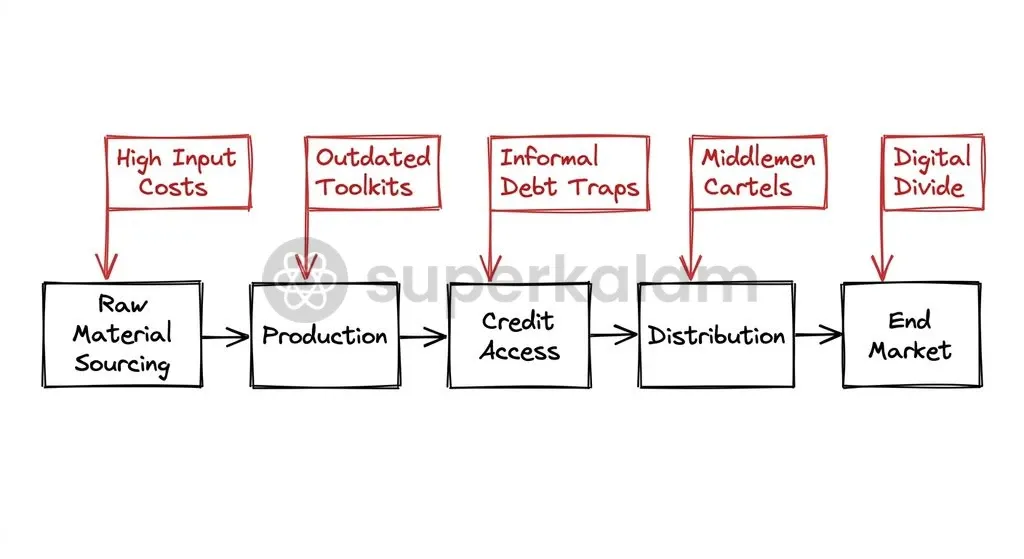
Several structural barriers continue to impair effective implementation:
- Raw Material Cartels: Artisans face volatile spot prices for primary inputs like timber, leather, brass, and iron scrap. Without institutional bulk-purchasing federations, the ₹15,000 toolkit upgrade yields limited margin expansion.
- Intermediary Extraction: Local middlemen control working-capital advances and final buyer access, siphoning off the price premiums generated by improved product finish.
- Credit Absorption Hesitancy: First-generation micro-borrowers often struggle to convert a ₹1 lakh loan into productive operating capital, occasionally diverting low-cost funds toward emergency household consumption.
- Digital Platform Disconnect: While the National Committee for Marketing (NCM) seeks to onboard artisans onto the Government e-Marketplace (GeM) and Open Network for Digital Commerce (ONDC), low digital literacy and complex listing standards limit direct consumer sales.
Discuss with Superkalam
How can the ₹15,000 toolkit voucher and ₹500/day stipend be utilized to maximize productivity for a rural blacksmith or carpenter?
Ask NowWay Forward: Integrating ONDC, GI Clusters, and Global Value Chains
The Ministry of MSME outlines strategic interventions to elevate the PM Vishwakarma Scheme from a welfare safety net into an engine for export-quality, high-value manufacturing. Sustainable economic transformation requires integrating production support with institutional market creation and intellectual property protection.
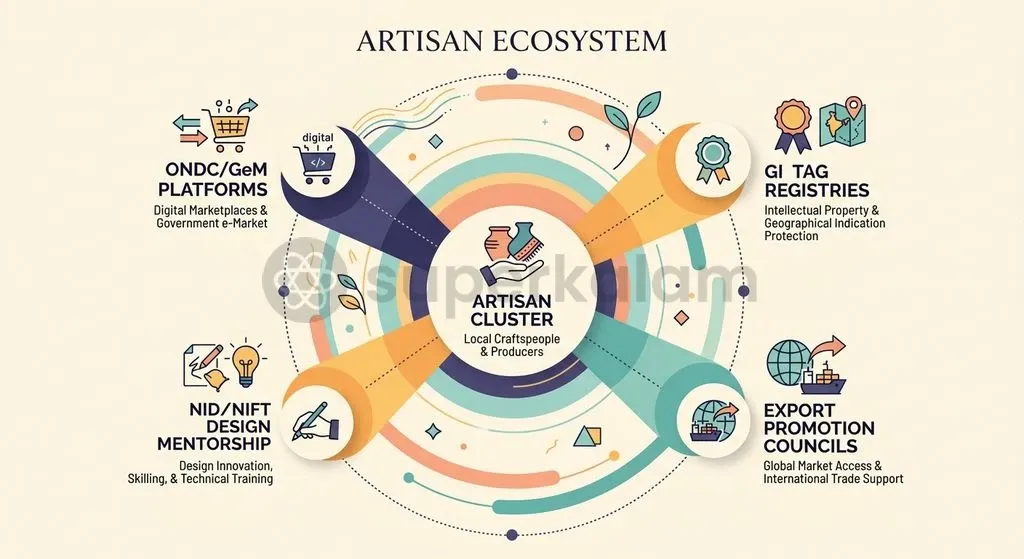
The forward policy roadmap rests on four core pillars:
- Geographical Indication (GI) Clustering: Aligning Vishwakarma trade clusters with regional GI registries protects indigenous designs and enables artisan collectives to charge authenticity premiums.
- Public Procurement Mandates: State and central public sector undertakings should reserve a fixed quota of procurement for certified Vishwakarma enterprises, particularly in furniture, uniforms, metal fixtures, and building masonry.
- Design Modernisation and Institutional Mentorship: Partnering artisan clusters with premier design bodies like the National Institute of Design (NID) and the National Institute of Fashion Technology (NIFT) adapts traditional aesthetics to contemporary global consumer markets.
- Frictionless ONDC and Export Integration: Simplifying the Open Network for Digital Commerce onboarding process and establishing export facilitation cells enables artisan collectives to bypass exploitative intermediary networks.
Discuss with Superkalam
What are the key structural bottlenecks—such as raw material cartels and digital disconnects—that prevent credit injection from automatically translating into higher artisan profit margins?
Ask NowKey Takeaways
- Financial Architecture: PM Vishwakarma is a Central Sector Scheme with an outlay of ₹13,000 crore (FY24 to FY28) providing collateral-free loans up to ₹3 lakh in two tranches at a concessional 5% interest rate, backed by an 8% government interest subvention.
- Three-Tier Institutional Validation: Beneficiary enrolment follows a mandatory three-step verification process spanning Gram Panchayats/ULBs, District Implementation Committees, and state Screening Committees.
- Skilling and Capital Incentives: The programme combines a 5–7 day Basic Training and 15+ day Advanced Training course (with a ₹500/day stipend) with a ₹15,000 modern toolkit digital voucher and transaction-based digital incentives.
- Scope and Target Group: The scheme covers 18 traditional family-based trades in the unorganised sector, formalising craftspeople as micro-enterprises on the Udyam Assist Platform.
- Structural and Sociological Caveats: Long-term success requires building forward linkages via ONDC, GeM, and GI clusters to prevent middleman dependency, while ensuring that the preservation of traditional crafts does not entrench hereditary occupational hierarchies.
Mains Question
The PM Vishwakarma Scheme attempts to transition informal craftspersons into formal micro-enterprises through an enterprise development pipeline. In this context, evaluate the effectiveness of the scheme's three-pillar architecture in addressing credit absorption and market access bottlenecks. (15 Marks)
Evaluate NowMains Question
"Credit and toolkits alone cannot resolve long-standing market distortions in the informal artisanal economy without structured forward linkages." Critically examine this statement in light of the institutional design of the PM Vishwakarma Scheme. (10 Marks)
Evaluate NowPractice MCQs
QUESTION 1
With reference to the PM Vishwakarma Scheme, consider the following statements:
- It is implemented as a Centrally Sponsored Scheme with shared financial liability between the Union and State governments.
- The eligibility framework permits only one member per family actively engaged in traditional trades to avail benefits.
- The scheme covers 18 designated traditional family-based trades operating primarily with manual tools.
Which of the statements given above are correct?
QUESTION 2
Regarding the multi-stage verification architecture under the PM Vishwakarma Scheme, consider the following stages:
- Field verification by the Gram Panchayat or Urban Local Body (ULB)
- Executive approval by the State-level Screening Committee
- Technical vetting by the District Implementation Committee
What is the correct sequential order of verification from the initial to the final stage?
QUESTION 3
With reference to credit provisioning and skill training under the PM Vishwakarma Scheme, consider the following statements:
- Beneficiaries receive a daily training stipend of ₹500 during both Basic and Advanced skill training.
- Artisans are provided a digital voucher worth ₹15,000 to procure modern toolkits upon commencing Basic Skill Training.
- Concessional loans carry an effective interest rate capped at 5% per annum for the beneficiary, supported by an 8% central interest subvention.
Which of the statements given above are correct?
QUESTION 4
Which of the following traditional occupations are explicitly included among the 18 designated trades under the PM Vishwakarma Scheme?
- Armourer
- Sculptor (Moortikar)
- Boat Maker
- Locksmith
Select the correct answer using the code given below:
QUESTION 5
Consider the following statements regarding the institutional governance of the PM Vishwakarma Scheme:
- The Ministry of Micro, Small and Medium Enterprises (MSME) acts as the nodal administrative ministry.
- The Ministry of Skill Development and Entrepreneurship manages pedagogical delivery and training standards.
- The Department of Financial Services under the Ministry of Finance oversees credit disbursals and interest subvention.
Which of the statements given above are correct?