PM Internship Scheme 2026 Revamp Explained: Higher Stipend, Wider Eligibility, Quality Gaps
Examining whether underwriting stipends through corporate social responsibility can resolve structural employability deficits without binding hiring commitments.
Oct, 2026
•9 min read

Overview
The Prime Minister's Internship Scheme uses corporate social responsibility subsidies to bridge youth into corporate workplaces, but administrative revisions underscore that underwriting entry-level placements cannot resolve India's structural employability deficit without formal training standards and firm hiring commitments. First unveiled in the Union Budget 2024–25, the scheme aims to place one crore candidates across five years. The Ministry of Corporate Affairs overhauled the model in 2026 after initial rounds revealed low uptake and steep dropout rates. By allowing companies to finance intern stipends through Section 135 mandates, the initiative reduces initial recruitment costs for private enterprises. However, treating corporate participation as regulatory compliance rather than human capital investment leaves core structural bottlenecks unaddressed. Without deep curriculum integration or binding transition pathways into regular payrolls, temporary subsidies risk funding short corporate tenures rather than durable industrial careers.
Why Is the PM Internship Scheme Being Revamped?
The Ministry of Corporate Affairs revamped the Prime Minister's Internship Scheme after administrative data revealed persistent bottlenecks in candidate uptake and completion rates across initial deployment rounds. Across the first two rounds, only 16,060 youth joined out of more than 2,46,000 posted opportunities, representing an aggregate uptake of roughly 6.5% according to official submissions to the Rajya Sabha. While the joining rate rose to 9.5% in Round III, up from 6.9% in Round I and 6.1% in Round II, programme retention remained an acute operational concern.
The completion rate among youth who joined stalled at approximately 40% across initial phases, recording 42.6% in Round I and 39.4% in Round II. Interns who abandoned their tenures frequently cited a severe absence of specialised skills, noting that daily tasks failed to prepare them for technical white-collar or industrial roles. Field reporting by The Indian Express indicated that dropouts often found themselves assigned to low-skill field assignments, such as microfinance debt recovery and basic retail payment onboarding, whereas manufacturing and software placements offered more durable learning.
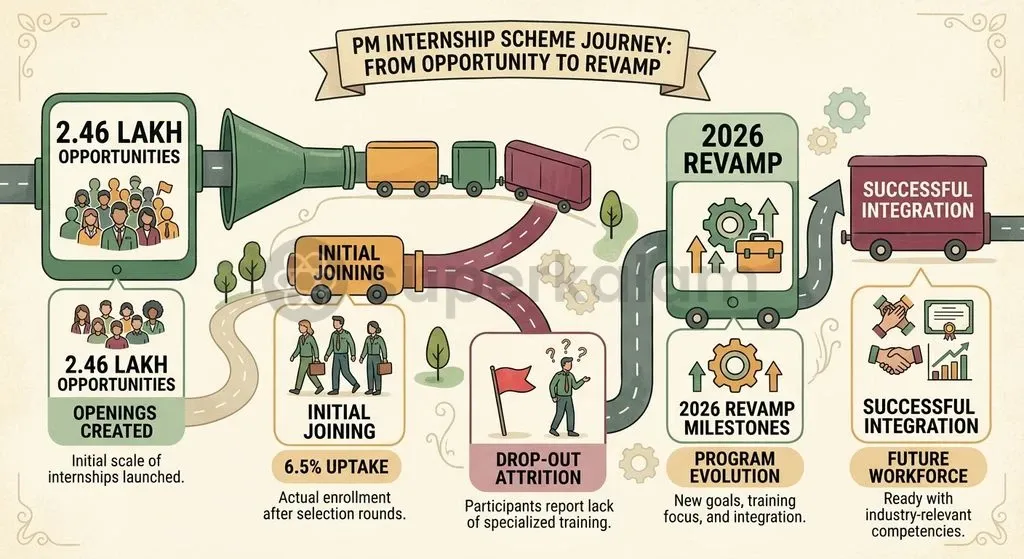
To reverse this attrition, the Ministry of Corporate Affairs adjusted key administrative levers in March 2026. Official notifications revised the mandatory 12-month internship term into a more flexible window of 6 to 9 months. In addition, the central government expanded the candidate eligibility age from the original 21–24 bracket to 18–25 years, while permitting final-year undergraduate, postgraduate, and master's degree students to enrol. Host employer eligibility was simultaneously expanded beyond the original top 500 Corporate Social Responsibility spenders to integrate micro, small, and medium enterprises and sunrise sectors.
Discuss with Superkalam
Recall the three corporate financial thresholds specified under Section 135 of the Companies Act, 2013 that trigger mandatory Corporate Social Responsibility obligations.
Ask NowHow the Revamped Model Operates: Stipends, Selection, and the CSR Role
The revamped operational architecture relies on joint financial underwriting between the central exchequer and corporate entities governed under Section 135 of the Companies Act, 2013. Section 135 requires companies with a net worth of Rs 500 crore, turnover of Rs 1,000 crore, or net profit of Rs 5 crore to deploy at least 2% of their three-year average net profits towards eligible social development initiatives. Under the scheme guidelines, participating corporate partners may fund their portion of intern stipends and associated operational training costs directly out of these statutory allocations.
| Feature Dimension | Original PMIS Framework (2024) | Revamped PMIS Architecture (2026) |
|---|---|---|
| Target Cohort Age | 21 to 24 years | 18 to 25 years |
| Permitted Educational Scope | Non-enrolled graduates and diploma holders | Final-year undergraduates, postgraduates, master's holders |
| Duration of Placement | Mandatory 12-month fixed tenure | Flexible 6 to 9 months |
| Host Employer Network | Top 500 CSR-spending corporations | Top 500 firms plus MSMEs and sunrise sectors |
| Financial Delivery Channel | Standard monthly direct benefit transfer | Enhanced direct transfer with corporate CSR co-funding |
Stipend structures were also restructured to boost candidate interest. As reported across scheme reviews by The Print and The Indian Express in October 2026, baseline allowances nearly doubled to Rs 3,000 per month, with overall payouts reaching up to Rs 9,000 per month through Rs 8,100 in central direct benefit transfers combined with a Rs 900 corporate contribution. This public-private stipend model seeks to balance state fiscal outlays against corporate human resource budgets.
Discuss with Superkalam
Explain why funding intern stipends through statutory CSR spending may reduce a firm's incentive to offer permanent employment.
Ask NowThe Corporate Dilemma: Why Subsidizing Internships Fails to Guarantee Real Jobs
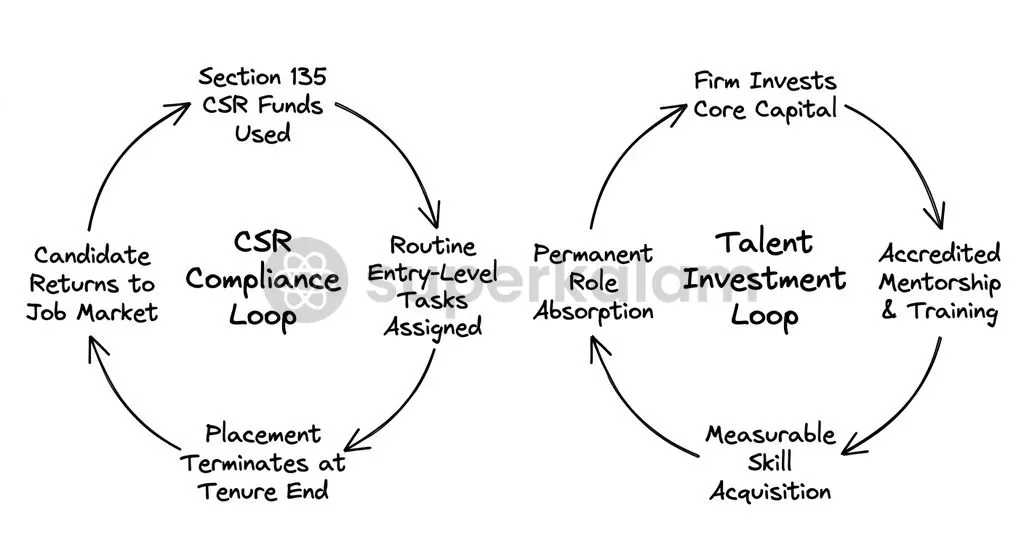
Corporate participation under the Prime Minister's Internship Scheme is structurally constrained because companies approach placement quotas as a statutory CSR compliance exercise rather than genuine talent acquisition. Findings highlighted by the Parliamentary Standing Committee on Finance observed that treating intern spending under Section 135 decouples recruitment from long-term enterprise demand. Because companies absorb trainees primarily to discharge social responsibility targets, human resource departments face minimal internal commercial incentive to integrate interns into their permanent workforce.
This dynamic creates distinct operational frictions for host enterprises:
- Zero Absorption Obligations: Guidelines issued by the Ministry of Corporate Affairs do not require host employers to retain interns or convert placements into full-time roles upon completion.
- Routine Task Allocation: Because host firms do not plan for post-programme retention, candidates are frequently assigned low-complexity clerical or retail field tasks that yield limited professional capital.
- Short-Term Substitution Risks: Subsidised cohorts can inadvertently substitute for entry-level contract staffing, allowing enterprises to cycle through successive batches of interns without expanding formal payrolls.
- Geographic Relocation Barriers: As observed in parliamentary scrutiny, the absence of dedicated housing allowances or relocation assistance makes relocating to tier-one industrial clusters uneconomic for young workers on entry stipends.
Consequently, while the subsidy removes recruitment overheads for companies, it does not alter the fundamental corporate calculus regarding full-time hiring. Without an organic commercial reason to invest in extensive on-the-job mentorship, enterprises treat the programme as a revolving door rather than a stable talent pipeline.
Beyond Token Training: Why Short Placements Do Not Fix Structural Youth Unemployment
Youth unemployment in India is fundamentally a structural mismatch between tertiary educational credentials and modern industrial productivity requirements, rather than a mere search friction. According to the Periodic Labour Force Survey Annual Report 2025 released by the Ministry of Statistics and Programme Implementation, the unemployment rate among educated individuals with secondary education and above stood at 6.5% under usual status. For broader youth aged 15–29, national unemployment reached 9.9%, escalating sharply to 18.9% among urban female youth.
The broader labour market context further illustrates the depth of this challenge. National female labour force participation for individuals aged 15 and above stood at 40.0% in 2025, but urban female participation remained severely depressed at 22.2% in urban centres. In its diagnostic study, Reimagining Skilling for Viksit Bharat@2047, NITI Aayog warned that conventional college curricula remain disconnected from real workplace needs, making passive subsidies insufficient to bridge structural gaps.
A 6-to-9-month internship cannot compensate for multi-year deficits in foundational technical training or practical skills. When placements lack structured pedagogical frameworks or accredited modular certifications, trainees complete their tenures with limited portable market value. The scheme risks churning candidates through brief corporate stints without raising their underlying employability in the broader economy.
Discuss with Superkalam
If you were advising an MSME participating in the PM Internship Scheme, how would you structure a 6-to-9-month technical placement to ensure portable skill acquisition?
Ask NowLessons from Apprenticeship Models: What India Can Adapt from Global Systems
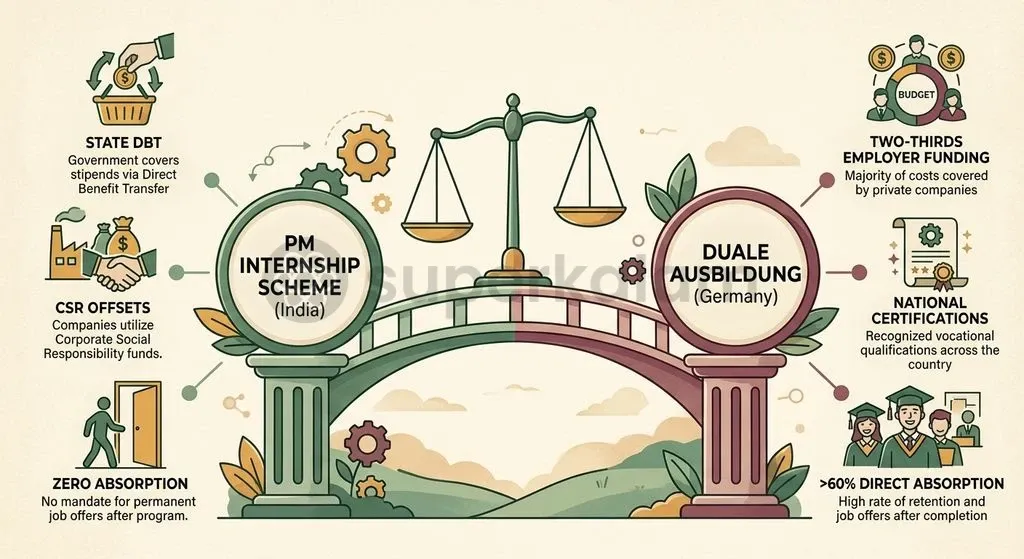
International vocational frameworks succeed because they mandate co-financed training, institutional employer ownership, and standardised national credentials rather than passive operational subsidies. In Germany's dual vocational apprenticeship model (Duale Ausbildung), trainees split their working week between municipal vocational institutions (Berufsschule) and structured workplace environments governed by binding contracts. This institutional setup aligns training directly with private industrial benchmarks.
| Operational Dimension | Indian PM Internship Scheme (PMIS) | German Dual Vocational Model (Duale Ausbildung) |
|---|---|---|
| Governing Framework | Executive guidelines via Ministry of Corporate Affairs | Statutory vocational legislation with chambers of commerce |
| Financing Structure | Public DBT heavily subsidised via corporate CSR funds | Over two-thirds funded directly by host employers |
| Curriculum Co-Design | Discretionary internal corporate assignments | Standardised national syllabi updated jointly with industry |
| Certification Outcome | Certificate of internship completion from host firm | Nationally recognised occupational chamber credential |
| Employment Conversion | Voluntary with no formal corporate retention target | Direct absorption exceeding 60% into regular payrolls |
Comparative data compiled by the Federal Institute for Vocational Education and Training and NITI Aayog indicates that German private firms absorb over 60% of their apprentices into permanent roles because businesses finance more than two-thirds of total training expenses themselves. Because companies invest substantial internal capital into curriculum delivery, retaining certified apprentices becomes commercially advantageous. By contrast, India's reliance on CSR financing insulates employers from financial stakes in the trainee's long-term technical competence, weakening the incentive to transition them into regular staff.
The Way Forward: Building Long-Term Industry Links Instead of Temporary Subsidies
Addressing structural youth underemployment requires shifting the national skilling architecture from short-term fiscal offsets to institutional co-ownership between educational bodies and industrial employers. Relying on Section 135 CSR allocations should serve as a temporary bridge rather than a permanent substitute for enterprise-led human capital investment. Public policy must realign corporate incentives so that hosting an intern is driven by long-term productivity requirements rather than routine regulatory compliance.
To build an enduring youth employment framework, policymakers can implement several targeted reforms:
- Accredited Skill Benchmarks: The Ministry of Corporate Affairs should partner with the National Skill Development Corporation to establish verifiable skill assessments, ensuring that internships culminate in portable, industry-recognised credentials rather than basic attendance letters.
- Curriculum Co-Creation: Higher education institutions must co-design vocational coursework with industrial clusters, closing the curriculum disconnect identified by NITI Aayog and ensuring tertiary degrees reflect operational industry practices.
- Conversion-Linked Fiscal Incentives: Rather than subsidising placements indiscriminately, tax credits or administrative concessions should reward host companies that convert high-performing interns into permanent payroll employees.
- Relocation and Accommodation Support: Incorporating regional housing subsidies into the central DBT component would enable candidates, particularly young women from non-metropolitan districts, to access manufacturing and tech hubs without prohibitive living expenses.
Discuss with Superkalam
Analyse the structural factors that explain why female youth unemployment in urban centres reached 18.9% under the PLFS 2025 despite general economic expansion.
Ask NowKey Takeaways
- The Ministry of Corporate Affairs restructured the PM Internship Scheme in March 2026, cutting mandatory tenures to 6–9 months and widening age eligibility to 18–25 years.
- Across the first two rounds, only 16,060 youth joined out of more than 2,46,000 posted opportunities, while completion rates hovered around 40% due to an absence of specialised technical training.
- Permitting companies to offset intern stipends through Section 135 CSR obligations creates an incentive structure centred on regulatory compliance rather than permanent workforce absorption.
- According to the Periodic Labour Force Survey 2025, educated unemployment stands at 6.5%, while urban female youth unemployment reaches 18.9%, underscoring structural imbalances that brief placements cannot bridge alone.
- International models like Germany's Duale Ausbildung achieve post-training absorption rates above 60% because employers co-fund training and adhere to nationally standardised competency credentials.
Mains Question
"Treating corporate internship funding under Section 135 of the Companies Act, 2013 risks reducing youth skilling to a statutory compliance exercise rather than an organic talent pipeline." Critically analyse. (10 Marks)
Evaluate NowMains Question
Data from the Periodic Labour Force Survey 2025 and NITI Aayog's diagnostics suggest that youth unemployment in India is fundamentally a structural employability deficit rather than a mere search friction. In this context, evaluate the efficacy of the revamped Prime Minister's Internship Scheme against international apprenticeship frameworks. (15 Marks)
Evaluate NowPractice MCQs
QUESTION 1
With reference to the revamped Prime Minister's Internship Scheme (PMIS) administrative framework, consider the following statements:
- The mandatory placement duration was revised from a fixed 12-month term to a flexible window of 6 to 9 months.
- The eligible cohort age was broadened to 18–25 years, permitting final-year undergraduate and postgraduate students to enrol.
- Host firm participation requires a statutory commitment to absorb at least 50% of trainees into permanent payrolls upon completion. Which of the statements given above is/are correct?
QUESTION 2
Under Section 135 of the Companies Act, 2013, which of the following criteria qualify a corporate entity for mandatory Corporate Social Responsibility (CSR) allocations that can be utilised for PM Internship Scheme co-funding?
- Net worth of Rs 500 crore or more
- Turnover of Rs 1,000 crore or more
- Net profit of Rs 5 crore or more Select the correct answer using the code given below:
QUESTION 3
According to the Periodic Labour Force Survey (PLFS) Annual Report 2025 cited in the context of youth employability, consider the following statements:
- The unemployment rate among educated persons with secondary education and above stood at 6.5% under usual status.
- Unemployment among youth aged 15–29 stood at 9.9% nationally, rising to 18.9% among urban female youth.
- The labour force participation rate for urban females aged 15 and above exceeded 40%. Which of the statements given above are correct?
QUESTION 4
In the context of international vocational education, how does Germany's dual vocational apprenticeship model (Duale Ausbildung) primarily differ from the Indian Prime Minister's Internship Scheme architecture?
QUESTION 5
Consider the following statements regarding the initial implementation data of the Prime Minister's Internship Scheme:
- Across the first two rounds, candidate joining uptake stood at approximately 6.5% of total posted opportunities.
- Completion rates among youth who joined hovered around 40% in initial deployment phases.
- Intern dropouts predominantly stemmed from mandatory transfers to overseas host operations. Which of the statements given above is/are correct?