PLFS Revamp from January 2027: Gig Workers, Unpaid Work to Be Counted
Revamped national employment metrics will finally bring millions of invisible gig workers and female caregivers into official economic planning.
Oct, 2026
•13 min read
Overview
The Ministry of Statistics and Programme Implementation is overhauling the Periodic Labour Force Survey from January 2027 to capture structural shifts across the Indian economy. The reform introduces dedicated sampling for digital platform workers, quantifies unpaid domestic care, and updates obsolete sampling frames.
This transition shifts national employment accounting from an industrial-era design to an agile framework under Panel 6 of the survey cycle. Capturing these realities aligns macro-level statistics with actual labour dynamics. It provides empirical grounding for social protection architecture, fiscal planning, and female workforce policy.
Why in the News: The Planned Overhaul of PLFS from January 2027
The National Statistics Office released a concept note on 23 October 2026 proposing structural modifications to the Periodic Labour Force Survey from January 2027.
Key milestones framing this transition include:
- Public Consultation: The Ministry of Statistics and Programme Implementation designated a 15-day public consultation window from 23 October 2026 to solicit feedback from policymakers, economists, and academic institutions, according to the Press Information Bureau press note.
- Panel Transition: The revamp marks the rollout of Panel 6 (2027–2028) within the survey's rotational architecture, succeeding Panel 5, which concludes at the end of December 2026.
- Preceding Pilot: An experimental trial launched in January 2026 tested schedule feasibility as field enumerators gathered preliminary data on platform work.
As of October 2026, the official proposal formalises these adjustments to institutionalise modern labour metrics across all states and union territories.
Background: How the Periodic Labour Force Survey Tracks Employment Today
The National Sample Survey Office instituted the Periodic Labour Force Survey in April 2017 to provide regular, high-frequency estimates of key national labour indicators. Prior to its launch, nationwide employment figures relied on quinquennial National Sample Survey rounds. That legacy schedule created multi-year analytical blind spots.
| Survey Metric | Reference Horizon | Analytical Focus |
|---|---|---|
| Usual Principal Status (UPS) | 365 days | Structural and chronic economic activity |
| Current Weekly Status (CWS) | 7 days | High-frequency and seasonal employment shifts |
The survey tracks three core parameters: the Labour Force Participation Rate, the Worker Population Ratio, and the Unemployment Rate. The survey operates across two distinct time horizons:
- Usual Principal and Subsidiary Status (UPSS): Measures economic activity over a reference period of 365 days, distinguishing between chronic employment and long-term structural unemployment.
- Current Weekly Status (CWS): Measures employment over a recall period of 7 days, capturing short-term, seasonal, and intermittent labour movements.
In January 2025, the ministry executed a targeted methodological revision that expanded survey frequency. According to the MoSPI concept note, this revision introduced monthly Current Weekly Status estimates at the national level. It also extended quarterly Current Weekly Status reporting to rural sectors alongside sub-state district-level estimation.
Under the existing rotational panel system, sampled households across urban areas are visited across four consecutive quarters to capture ongoing dynamics. However, the survey has continued to lean on baseline classifications that overlook irregular gig arrangements and non-market household labour.
Discuss with Superkalam
Recall the two reference periods used in PLFS to distinguish between chronic and high-frequency employment activity.
Ask Now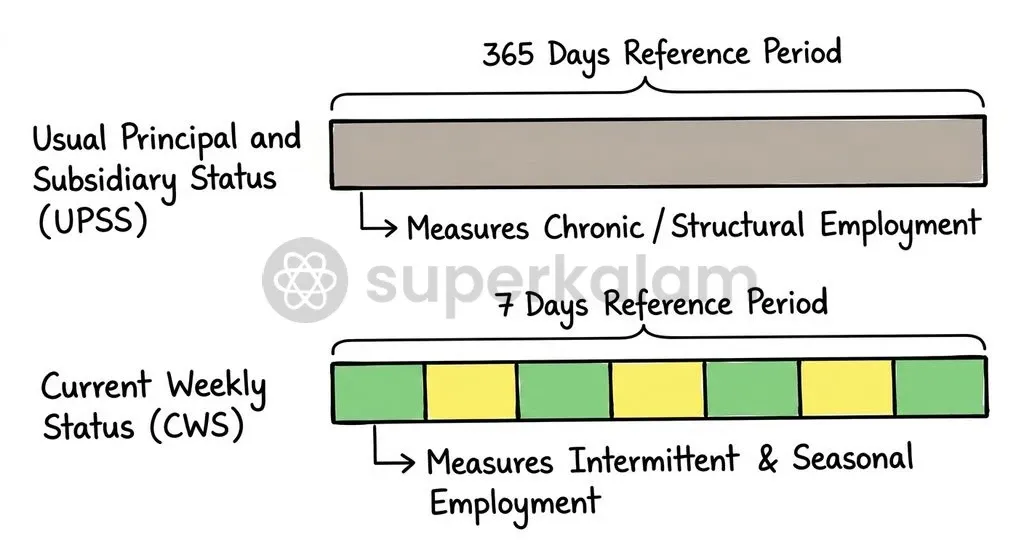
What Is Changing: Four Core Shifts in the New Survey Framework
The Ministry of Statistics and Programme Implementation has structured four fundamental technical shifts across the upcoming sixth panel cycle of the employment survey. These interventions modernise sample selection, stratification tiers, schedule rosters, and demographic coverage.
The four central structural shifts comprise:
- Dedicated Stratification for Platform Labour: Establishing separate sampling tiers specifically dedicated to digital gig and platform workers.
- Expansion of Canvas Size: Increasing the number of households canvassed within each selected First Stage Unit from 12 to 14 households.
- Institutional Measurement of Caregiving: Incorporating comprehensive activity rosters within detailed Schedule 10.4 to capture unpaid household work and domestic care.
- Transition to Modern Sampling Baselines: Abandoning obsolete Census 2011 spatial units in favour of modernised Urban Frame Survey blocks and updated district administrative boundaries.
Capturing Gig and Platform Workers: Moving Beyond Traditional Wage Categories
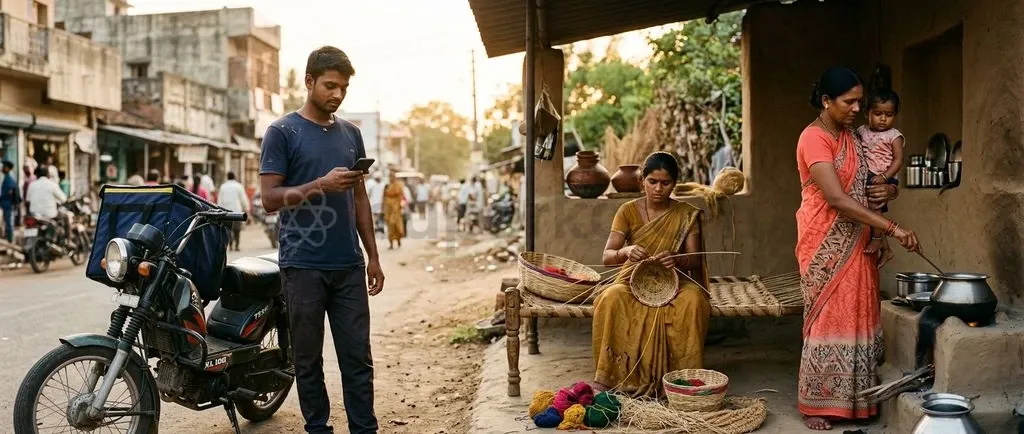
Digital platform workers represent an expanding segment of the Indian workforce that standard employment classifications have historically obscured. Traditional labour surveys classify respondents into regular wage workers, casual labourers, or self-employed individuals.
App-mediated delivery partners, ride-hailing drivers, and freelance platform professionals exhibit traits of both self-employment and contract work. This hybrid reality creates widespread classification errors in official surveys.
According to a June 2022 report by NITI Aayog, India's gig and platform workforce stood at 7.7 million workers in 2020–21, constituting 1.5% of the total workforce and 2.6% of non-agricultural employment. NITI Aayog projects this cohort to surge to 23.5 million workers by 2029–30, highlighting the urgent need for formal statistical accounting.
| Area Type | Strata Allocation | Households per First Stage Unit |
|---|---|---|
| Rural Sectors | 4 Second Stage Strata (includes platform stratum) | 14 households |
| Urban Sectors | 5 Second Stage Strata (includes platform stratum) | 14 households |
To integrate this segment, the National Statistics Office will operationalise a dedicated Second Stage Stratum for digital platform work from January 2027. According to the MoSPI concept note, this restructuring establishes four Second Stage Strata in rural areas and five in urban areas.
Enumerators will use an initial screening inquiry inside PLFS Schedule 0.0PL to identify whether any household member engaged in app-based or platform work during the reference window. Raising the canvass volume to 14 households per First Stage Unit ensures adequate statistical power for platform labour without displacing traditional occupational strata.
This statistical visibility directly intersects with statutory social policy. Under Section 114 of the Code on Social Security, 2020, aggregator contributions to the national Social Security Fund are mandated at 1% to 2% of annual turnover, capped at 5% of aggregate payouts to gig and platform workers. Precise survey enumeration provides the empirical baseline necessary to calculate worker counts, calibrate aggregator contributions, and track welfare coverage.
Discuss with Superkalam
Explain why treating unpaid domestic care work as economic inactivity distorts national Female Labour Force Participation Rates.
Ask NowMeasuring Unpaid Domestic Work and Caregiving: Impact on Female Labour Force Participation
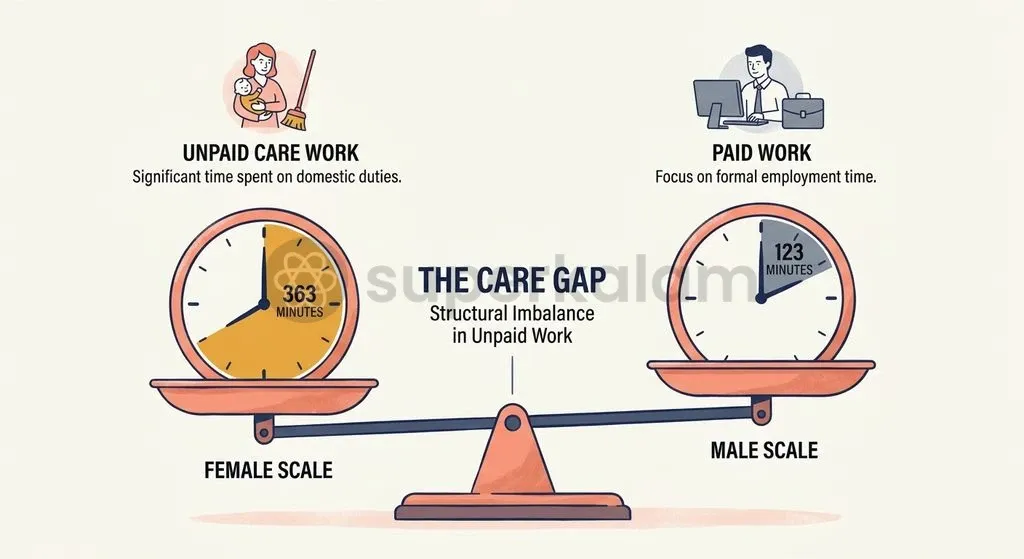
Female Labour Force Participation Rates in India have long suffered from structural measurement distortions that treat unpaid caregiving as economic inactivity. Standard survey metrics categorise women engaged in household chores, elderly care, and domestic maintenance as out of the labour force, depressing national participation indicators.
Data from MoSPI's Time Use Survey framework highlights this gender disparity. The findings show that Indian women spend approximately 363 minutes daily on unpaid domestic and care work, whereas men spend roughly 123 minutes. This unequal burden restricts women's availability for market-facing wage employment, masking significant home-based productive output.
| Cohort | Daily Allocation on Unpaid Care | Hourly Equivalent (Approx.) |
|---|---|---|
| Women | 363 minutes | ~6.0 hours |
| Men | 123 minutes | ~2.0 hours |
According to the PIB Delhi press note, the 2027 overhaul introduces dedicated questions in detailed Schedule 10.4 for individuals aged 15 years and above. The revised schedule records:
- Engagement in domestic maintenance and unpaid household services.
- Hands-on caregiving for children, the elderly, and infirm family members.
- Own-use production of goods, encompassing subsistence agriculture, fuel gathering, and animal tending.
- Formal and informal volunteer work across communities.
- Unremunerated training and unpaid trainee work.
Capturing these categories directly addresses the institutional distortion where millions of economically productive women are recorded simply as non-workers in headline metrics.
New Sampling Frame: Updating from 2011 Census to Real-Time Urban and Rural Realities
Panel 6 of the Periodic Labour Force Survey formally updates its foundational sampling frame to eliminate reliance on the outdated Census 2011 enumeration. Rapid urbanisation, peri-urban sprawl, and administrative boundary shifts over the past fifteen years have rendered Census 2011 primary sampling units unrepresentative of contemporary demographic realities.
To address this geographical divergence, the National Statistics Office will execute Panel 6 using the latest Urban Frame Survey blocks. These are complemented by administrative reconciliations reflecting newly carved, bifurcated, and merged districts.
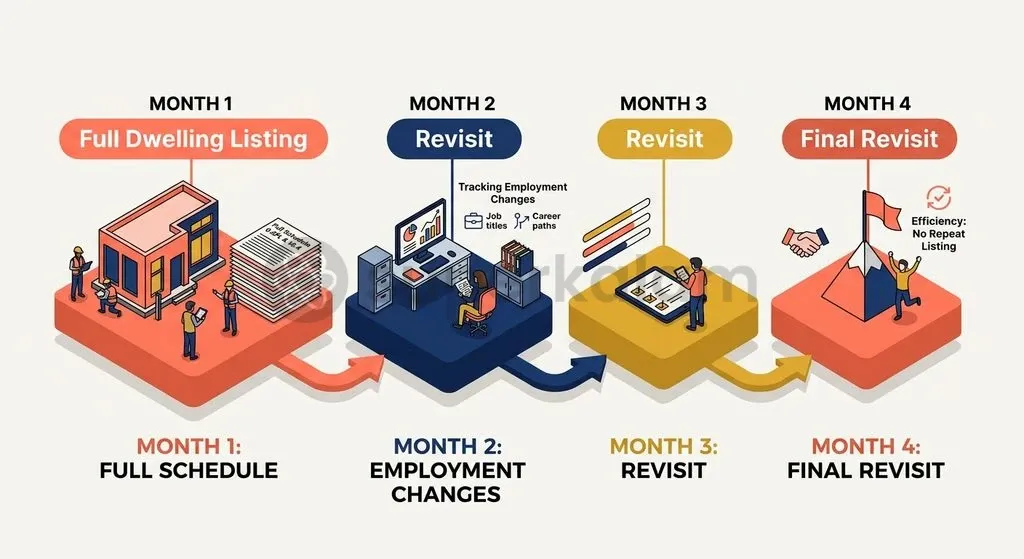
The structural mechanics of the rotational panel will follow an intensive monthly visiting rhythm. According to the MoSPI concept note, each sampled household is visited four times over four consecutive months:
- Month 1 (Visit 1): Enumerators administer the comprehensive, full first-visit schedule alongside complete household listing.
- Month 2 (Visit 2): Enumerators conduct the first revisit schedule tracking short-term employment shifts without re-listing the dwelling unit.
- Month 3 (Visit 3): Field staff execute the second revisit schedule focused exclusively on short-term activity updates.
- Month 4 (Visit 4): Investigators carry out the final revisit schedule to conclude the four-month household panel cycle.
Managing this architectural change requires a structured bridge period. During the first transition quarter from January to March 2027, the National Statistics Office will pool households drawn concurrently from outgoing Panel 5 and incoming Panel 6 frames. Official quarterly findings for this transition window will be released without separate error variances to prevent statistical misinterpretation while the baseline stabilises.
Discuss with Superkalam
Compare how classifying app-based delivery partners under traditional wage categories differs from enumerating them through a dedicated Second Stage Stratum.
Ask NowComparison: Existing PLFS Design vs the Proposed 2027 Framework
The structural transition between Panel 5 and Panel 6 introduces critical methodological refinements across sampling, stratification, and thematic coverage. Evaluating these frameworks side-by-side demonstrates how the statistical apparatus adapts to an evolving labour market.
| Dimension | Existing Framework (Panel 5, Concluding 2026) | Proposed Framework (Panel 6, From January 2027) | UPSC Answer Relevance |
|---|---|---|---|
| Primary Sampling Frame | Census 2011 primary enumeration blocks and older village registries | Updated Urban Frame Survey combined with newly realigned district jurisdictions | Eliminates spatial selection bias stemming from outdated census baselines |
| First Stage Unit Sampling Size | 12 households canvassed per First Stage Unit | 14 households canvassed per First Stage Unit | Expands sample size to accommodate emerging employment categories |
| Gig and Platform Worker Capture | Subsumed unreliably into general self-employment or casual work | Dedicated Second Stage Stratum (4 strata in rural areas, 5 in urban areas) via Schedule 0.0PL | Generates precise headcounts required under the Code on Social Security, 2020 |
| Unpaid Household and Care Work | Excluded from primary activity rosters; categorized as out of labour force | Dedicated activity modules in Schedule 10.4 capturing care, volunteering, and own-use production | Corrects chronic undercounting in the Female Labour Force Participation Rate |
| Rotational Visiting Rhythm | Quarterly visits across urban areas; semi-annual or annual rounds across rural sectors | Four consecutive monthly visits for selected households, combining one full schedule and three revisits | Captures high-frequency, seasonal, and short-tenure labour mobility |
| Transition Bridge Architecture | Standard isolated rotational handoffs without joint panel pooling | Pooled estimation during January–March 2027 bridging Panel 5 and Panel 6 samples | Prevents artificial statistical volatility during methodology shifts |
Why Accurate Data Matters for Welfare Delivery and Macroeconomic Planning
Sound macroeconomic planning and targeted social safety nets in India depend heavily on granular, accurate labour statistics. Distorted employment numbers mislead capital allocation, obscure sectoral vulnerabilities, and undermine state capacity during economic disruptions.
According to the Economic Survey 2023-24, granular quantification of gig employment and unpaid domestic work directly enhances the delivery of national social protection systems:
- Aggregator Contribution Enforcement: Clear data enables statutory authorities to enforce the 1% to 2% turnover levy under Section 114 of the Code on Social Security, 2020, guaranteeing adequate capitalisation of welfare boards.
- Targeted Care Infrastructure: Documenting unpaid domestic burdens provides empirical justification for expanding institutional childcare facilities and crèches under umbrella schemes like Mission Shakti.
- Precise Fiscal Interventions: Disaggregated rural-urban employment dynamics allow fiscal managers to tailor public works allocations and targeted skilling initiatives to areas experiencing genuine labour slack.
Macroeconomic stability requires accurate labour productivity figures. When millions of digital service providers and domestic caregivers are excluded or misclassified, national metrics misjudge total factor productivity and undercount the care economy's contribution to human capital formation.
Discuss with Superkalam
Evaluate the trade-offs of switching from quarterly visits to an intensive four-consecutive-month panel revisit design in terms of data precision versus survey fatigue.
Ask NowChallenges Ahead: Implementation Hurdles, Survey Fatigue, and International Comparability
Implementing the expanded survey framework across diverse rural and urban environments introduces notable operational complexities. Transforming high-level conceptual guidelines into consistent field enumeration requires managing logistical, statistical, and human constraints.
Primary implementation challenges encompass:
- Respondent Survey Fatigue: Subjecting selected households to four consecutive monthly visits while administering the extensive Schedule 10.4 may induce non-response bias and attrition over time.
- Definitional Ambiguity in the Field: Distinguishing between casual informal work and digital platform employment in semi-urban pockets requires rigorous conceptual clarity among local enumerators.
- Transition Noise: The pooled sample structure utilised from January to March 2027 will lack isolated error variances, potentially complicating comparative quarter-on-quarter growth analysis.
- Harmonisation with International Labour Organization Norms: Reconciling domestic definitions of unpaid work with International Labour Organization 19th International Conference of Labour Statisticians standards demands careful statistical recalibration to maintain cross-country comparability.
Way Forward: Building an Agile Statistical System for an Evolving Economy
Building a responsive statistical architecture requires balancing granular household data collection with survey efficiency and rigorous operational standards. As India approaches the January 2027 implementation date, the Ministry of Statistics and Programme Implementation must institutionalise targeted procedural safeguards.
To ensure structural integrity, the statistical system should prioritise:
- Incorporating Consultation Feedback: Actively processing institutional recommendations received during the 15-day public window to refine questionnaire schedules before nationwide deployment.
- Intensive Enumerator Capacity Building: Rolling out comprehensive training programmes for field investigators regarding the identification of app-mediated platform labour and unpaid care indicators.
- Digital Survey Tooling: Deploying modern Computer Assisted Personal Interviewing software equipped with built-in logic checks to reduce respondent burden during monthly revisits.
- Institutionalising Care Economy Accounting: Establishing secondary satellite accounts based on Schedule 10.4 findings to quantify unpaid domestic production within broader national accounting frameworks.
A sound national statistical apparatus is a public good. Modernising the Periodic Labour Force Survey guarantees that national labour indices accurately mirror a dynamic, digitalising, and service-oriented economy.
Key Takeaways
- The Ministry of Statistics and Programme Implementation will execute a major overhaul of the Periodic Labour Force Survey starting in January 2027 under the Panel 6 cycle.
- The redesigned framework institutes a dedicated Second Stage Stratum for digital platform workers, using 4 strata in rural areas and 5 in urban areas to track gig economy expansion.
- Household sampling per First Stage Unit increases from 12 to 14 households, supported by a preliminary screening question embedded in Schedule 0.0PL.
- Detailed Schedule 10.4 will systematically measure unpaid domestic services, caregiving, and volunteer work, directly mitigating chronic undercounting in the Female Labour Force Participation Rate.
- The sampling framework transitions away from Census 2011 to the updated Urban Frame Survey and realigned administrative district boundaries, utilising a four-month rotational visit cycle.
Mains Question
'Traditional labour force classifications fail to capture the hybridity of platform work, creating empirical blind spots in welfare architecture.' In light of the Code on Social Security, 2020, examine how the proposed PLFS overhaul resolves these enumeration challenges. (10 Marks)
Evaluate NowMains Question
'The statistical invisibility of unpaid caregiving and subsistence domestic output introduces structural distortions in headline female labour force participation.' Elucidate the technical interventions proposed under the 2027 Periodic Labour Force Survey overhaul to address this gender disparity. (15 Marks)
Evaluate NowPractice MCQs
QUESTION 1
With reference to the Periodic Labour Force Survey (PLFS) overhaul planned from January 2027, consider the following statements:
- The revamp marks the rollout of Panel 6 within the survey's rotational architecture.
- The number of households canvassed within each selected First Stage Unit is being reduced from 14 to 12 to minimise respondent fatigue.
- A dedicated Second Stage Stratum will be established to capture digital gig and platform workers in both rural and urban areas. Which of the statements given above are correct?
QUESTION 2
Consider the following statements regarding the measurement of employment metrics under the Periodic Labour Force Survey (PLFS):
- Usual Principal and Subsidiary Status (UPSS) measures economic activity over a 365-day recall window.
- Current Weekly Status (CWS) captures short-term, seasonal, and intermittent labour movements based on a 7-day reference period.
- The January 2025 methodological revision introduced monthly Current Weekly Status estimates at the national level. Which of the statements given above is/are correct?
QUESTION 3
Regarding the statutory linkage between survey data and the Code on Social Security, 2020, consider the following statements:
- Under Section 114 of the Code, aggregator contributions to the Social Security Fund are pegged between 1% to 2% of annual turnover.
- The aggregator contribution to the Social Security Fund is capped at 5% of aggregate payouts made to gig and platform workers.
- The NITI Aayog projected India's gig and platform workforce to decrease from 7.7 million in 2020–21 to 5 million by 2029–30 due to automation. Which of the statements given above is/are correct?
QUESTION 4
Under the proposed 2027 framework of the Periodic Labour Force Survey, which of the following activities will be captured under detailed Schedule 10.4 to address distortions in Female Labour Force Participation Rates?
QUESTION 5
With reference to the sampling baselines and mechanics of Panel 6 of the Periodic Labour Force Survey, consider the following statements:
- Panel 6 transitions away from Census 2011 units to the latest Urban Frame Survey blocks and updated district administrative boundaries.
- Under the proposed panel system, each sampled household will be visited four times over four consecutive months.
- During the first transition quarter (January–March 2027), no households from Panel 5 will be visited. Which of the statements given above is/are correct?