PHP2Shell Vulnerability: The CVSS 9.2 Flaw Affecting Most Websites, Explained
When ubiquitous open-source code harbours zero-day flaws, securing national cyberspace demands structural memory safety over reactive perimeter policing.
Oct, 2026
•11 min read

Overview
Emergency patching of two critical remote code execution flaws designated as PHP2Shell shows that modern digital security depends heavily on legacy server components. Deep-seated memory-handling vulnerabilities in open-source engines can compromise global critical infrastructure without requiring prior administrative access. According to the PHP Group Security Release Advisory, developers issued coordinated updates on 21 October 2026 to resolve these flaws across four major release branches.
The incident exposes a persistent structural vulnerability across digital supply chains. The global web relies extensively on shared open-source libraries that are maintained by small teams yet support essential public systems. For public administration and national security, this reality requires shifting cybersecurity policy from reactive perimeter monitoring toward software transparency, proactive memory safety, and institutional resilience.
Why in the News: The Emergence of the PHP2Shell Flaws
The PHP Group released urgent security updates on 21 October 2026 to neutralise two high-severity flaws designated collectively as PHP2Shell. Security researchers from Calif.io, Wiz Research, and OpenAI jointly discovered and reported the flaws. They identified critical weaknesses in how the language runtime manages system memory during execution failures.
As of October 2026, threat actors had already targeted these zero-day vulnerabilities in the wild. Telemetry from Amazon Threat Intelligence detected exploitation attempts within its MadPot honeypot network on 17 October 2026, four days before the public release of patches.
| Date / Milestone | Event Details |
|---|---|
| 17 October 2026 | Early exploitation detected in MadPot honeypot network |
| 21 October 2026 | Upstream emergency patches released by the PHP Group |
| Supported fixes | PHP 8.2.35, 8.3.36, 8.4.27, and 8.5.12 |
(Author's summary of disclosure and patch milestones)
This advisory highlights a core analytical thesis: systemic cyber risk stems from structural dependencies embedded within ubiquitous, open-source server runtimes. The disclosure prompted international response teams and national cybersecurity agencies to issue operational guidance. Server administrators worldwide received instructions to immediately deploy patched versions across production environments.
What Is PHP2Shell and How Does Remote Code Execution Work?
Remote Code Execution, or RCE, describes a vulnerability class allowing remote actors to run arbitrary system commands on a target host without physical interaction. According to the NIST Computer Security Resource Center Glossary, an RCE vulnerability typically gives an attacker interactive shell access under the privileges of the active web process user.
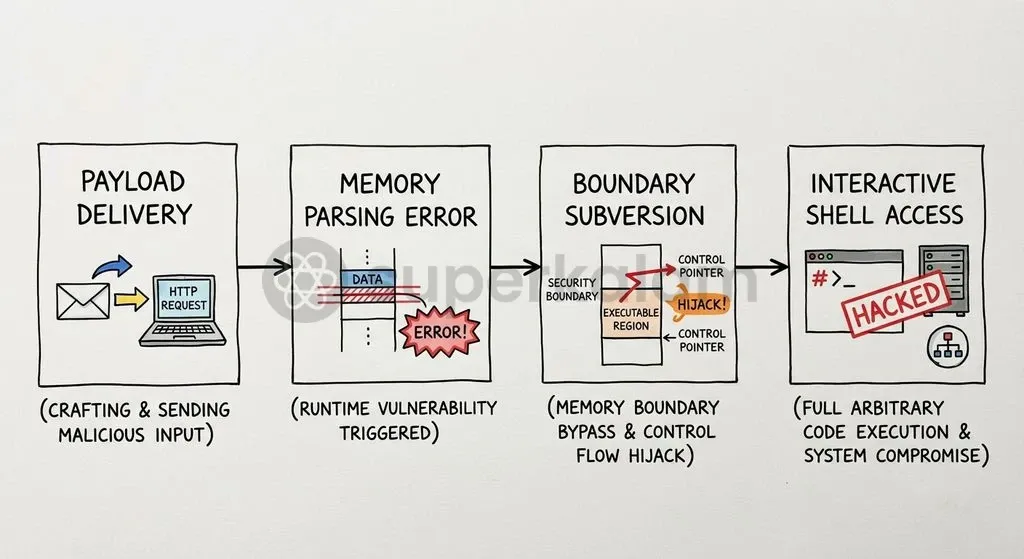
Web application runtimes routinely process untrusted incoming inputs from external users across the internet. When an application accepts data, the underlying interpreter allocates memory, parses variables, and executes functional logic. If an unauthenticated actor sends crafted requests that deliberately trigger unhandled runtime failures, the underlying process deviates from its intended execution flow.
- Attacker Payload: An unauthenticated user delivers crafted network requests across the internet.
- Web Server Process: The runtime interpreter parses variables and allocates memory buffers.
- Memory Corruption: Unhandled runtime aborts trigger unsafe state recovery.
- Interactive Shell: The adversary attains arbitrary command execution as the active process user.
Once attackers secure command execution through an interactive shell, the web server becomes a staging ground. Perpetrators can run low-privilege system instructions, survey internal directories, and read configuration files containing credentials. Attackers then attempt privilege escalation to gain root control, pivot laterally across adjacent corporate networks, and deploy destructive ransomware payloads.
Discuss with Superkalam
Which statutory provisions of the IT Act, 2000 govern the creation and operational mandate of CERT-In and NCIIPC respectively?
Ask NowAnatomy of the Exploit: Understanding CVE-2026-109618 and CVE-2026-109619
Both vulnerabilities within the PHP2Shell suite hold a Common Vulnerability Scoring System base score of 9.2, denoting critical severity. According to the CVE Program Record, each flaw carries the standardised vector string CVSS:4.0/AV:N/AC:H/AT:P/PR:N/UI:N/VC:H/VI:H/VA:H/SC:N/SI:N/SA:N. This score reflects network accessibility without prior authentication, high complexity, and total loss of confidentiality, integrity, and availability on the vulnerable system.
| Metric / Dimension | CVE-2026-109618 | CVE-2026-109619 |
|---|---|---|
| Primary Root Cause | Out-of-memory handling failure | Fatal-error state handling flaw |
| Trigger Mechanism | Memory allocation exhaustion | Unhandled fatal execution abort |
| Internal Mechanism | Uninitialised memory left by longjmp() |
Dangling pointers to freed request memory |
| Impact Phase | Exploited during engine cleanup routines | Exploited by subsequent worker requests |
| Exploitation Prerequisite | Unauthenticated remote network delivery | Reused worker process handling multiple requests |
| Impact Severity | Arbitrary code execution (CVSS 9.2) | Arbitrary code execution (CVSS 9.2) |
The GitHub Advisory Database explains that CVE-2026-109618 originates from out-of-memory handling routines. The PHP engine uses the standard C library function longjmp() to abort request processing when system memory is exhausted. This abrupt jump bypasses normal resource allocation, leaving critical memory structures uninitialised. Attackers can leverage these uninitialised buffers during cleanup routines to gain arbitrary code execution.
The second vulnerability, CVE-2026-109619, involves improper pointer lifecycle management after fatal execution aborts. The GitHub Advisory Database notes that when longjmp() handles a fatal error, the engine fails to reset its global state. This failure leaves pointers pointing to freed request memory. Subsequent incoming requests handled by the same worker process read or branch on these dangling memory pointers, producing reliable code execution.
Discuss with Superkalam
How does an unauthenticated remote code execution vulnerability in a web runtime enable an attacker to pivot into internal state databases?
Ask NowWhy Underlying Web Infrastructure Remains Globally Vulnerable
Internet infrastructure relies heavily on open-source scripting engines that power the modern web ecosystem. According to survey data from W3Techs, PHP powers 69.3% of all websites whose server-side programming language is known as of October 2026. This immense market footprint creates an asymmetrical attack surface, where a single engine flaw jeopardises millions of deployments.
| Platform Category | Market Share Percentage |
|---|---|
| PHP Engine Deployments | 69.3% |
| All Other Server-side Languages Combined | 30.7% |
(Data source: W3Techs Web Technology Surveys, October 2026)
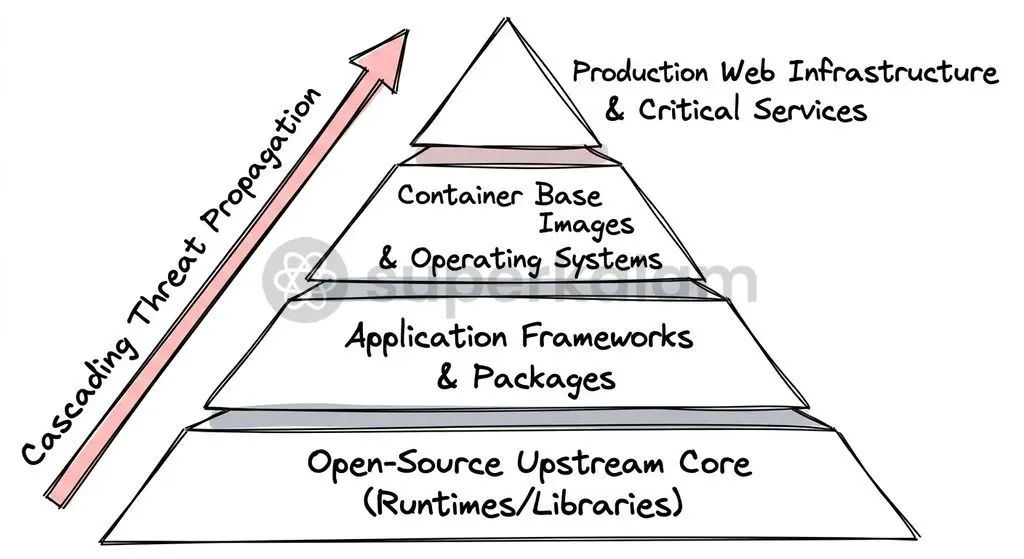
Modern digital services feature extensive software supply chains with deep interdependencies. Web frameworks, content management platforms, and enterprise portals sit on top of underlying C-based runtime interpreters. When security vulnerabilities emerge in core interpreters, patches must travel through multiple intermediaries, including distributions, package managers, and container base images.
Upstream developers responded swiftly by releasing patched engine updates across four supported release branches: PHP 8.2.35, PHP 8.3.36, PHP 8.4.27, and PHP 8.5.12. However, real-world deployment of updates remains slow. System administrators often delay upgrades because legacy software applications may conflict with newer runtime versions, leaving servers exposed to automated reconnaissance scans.
Threat Landscape for India: Impact on Critical Information Infrastructure
Indian digital infrastructure faces significant exposure from runtime flaws due to the widespread use of common web platforms in e-governance initiatives. Public service utilities, commercial banking backends, transport booking systems, and citizen portals frequently run on modular open-source architectures. When foundational runtimes exhibit vulnerabilities, systems handling sensitive financial and citizen records risk unauthorised access and data extraction.
Section 70(1) of the Information Technology Act, 2000 empowers the Central or State Government to declare essential computer systems as a Protected System. The statute applies to any facility whose incapacitation would cripple national security, the economy, public health, or safety. Unauthorised access to a Protected System carries serious statutory penalties under Section 70(3), including imprisonment for up to ten years and fines.
- Threat Vector: Exploitation of remote code execution flaws (PHP2Shell).
- Vulnerable Assets: Public portals, State Data Centres, and e-governance servers.
- Statutory Protection: Declaration of critical nodes under Section 70 of the IT Act, 2000.
- Downstream Harm: Potential disruption of public health, defence, or financial transaction networks.
Exploitation of web server flaws on state infrastructure threatens continuity of service across citizen networks. Beyond website defacement, malicious actors can exploit RCE flaws to establish persistent command-and-control access within State Data Centres. Attackers can then pivot across internal networks to compromise core databases, disrupting municipal management, utility billing, and identity verification services.
Discuss with Superkalam
Why does a vast deployment footprint, such as PHP powering 69.3% of known web server engines, create an asymmetrical security advantage for threat actors?
Ask NowInstitutional Safeguards: The Roles of CERT-In, NCIIPC, and the IT Act
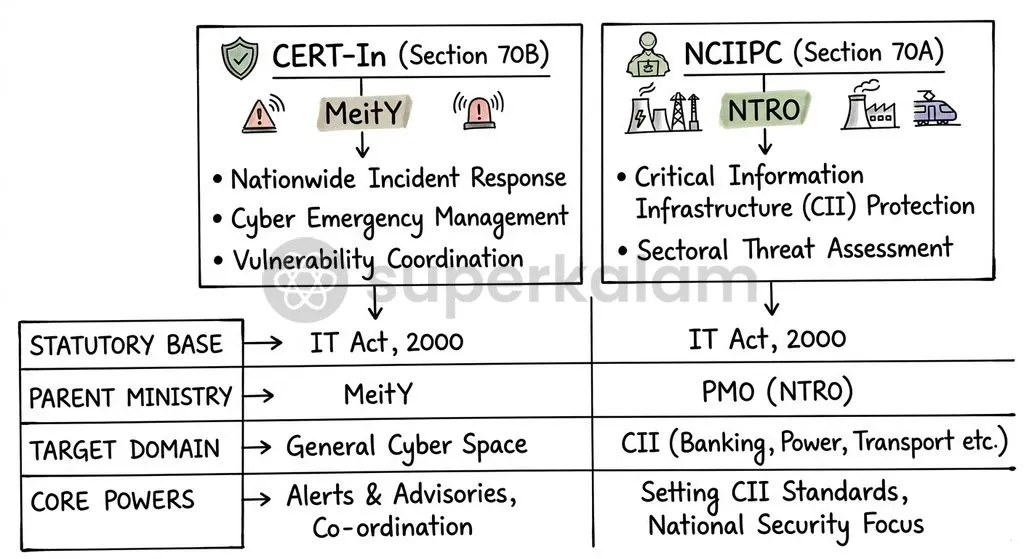
The Information Technology Act, 2000 establishes a dual institutional framework to protect general cyberspace alongside specialised critical infrastructure. Section 70B(1) designates the Indian Computer Emergency Response Team, known as CERT-In, as the national nodal agency for cybersecurity incident response. Operating under the Ministry of Electronics and Information Technology, CERT-In handles emergency coordination, threat forecasting, and advisory issuance.
The National Critical Information Infrastructure Protection Centre, or NCIIPC, was established under Section 70A of the IT Act, 2000 under the National Technical Research Organisation. While CERT-In monitors public and private computer networks across India, NCIIPC focuses entirely on defending designated critical sectors. NCIIPC advises designated entities on vulnerability management, audits, and strategic defence planning.
| Institutional Dimension | CERT-In | NCIIPC |
|---|---|---|
| Statutory Provision | Section 70B of the IT Act, 2000 | Section 70A of the IT Act, 2000 |
| Parent Organisation | Ministry of Electronics and IT (MeitY) | National Technical Research Organisation (NTRO) |
| Operational Domain | All Indian cyberspace and networks | Designated Critical Information Infrastructure (CII) |
| Core Functions | Incident response, alerts, advisories, coordination | Hardening, vulnerability alerts, sector defence |
| Key Mandate | 6-hour incident reporting, 180-day log rules | Overseeing security controls in Protected Systems |
Section 70B(4) of the Information Technology Act, 2000 charges CERT-In with forecasting threats, issuing advisories, and coordinating emergency response measures across India. Under the Cyber Security Directions issued on 28 April 2022, regulated entities must report specified cyber incidents to CERT-In within six hours of detection. These directions also require organisations to retain ICT system logs securely within Indian jurisdiction for 180 days. Non-compliance carries statutory penalties under Section 70B(7), including up to one year of imprisonment, fines up to one lakh rupees, or both.
For declared Protected Systems, security governance involves dedicated oversight roles. The Information Technology Rules, 2018 require every protected organisation to designate a Chief Information Security Officer and form an Information Security Steering Committee. This governance structure ensures that critical agencies respond systematically to runtime advisories through mandatory security audits and operational compliance.
Key Challenges in Patching Legacy Systems and Open-Source Code
System administrators face substantial operational hurdles when remediating legacy deployments that depend on deprecated libraries. Many enterprise services run on legacy application code developed years ago, making teams hesitant to apply major runtime upgrades. Upgrading from older configurations to modern branches like PHP 8.2 or 8.4 often introduces backward compatibility issues that can break core operational workflows.
- Legacy Dependencies: Legacy application code breaks on modern runtime upgrades.
- Unmonitored Shadow IT: Uninventoried public web servers remain unpatched across distributed departments.
- Asymmetric Exploitation: Automated bot scans discover targets faster than manual patching cycles.
- Supply-Chain Delays: Upstream patches take days or weeks to propagate through distribution downstream repositories.
(Author's synthesis of enterprise patch deployment hurdles)
Mitigation strategies can temporarily reduce risk when immediate patching is not possible. The PHP Group noted in its advisory that disabling session upload progress and fatal error backtraces, combined with strict memory and post limits, offers partial mitigation. However, upstream maintainers stress that configuration adjustments are temporary measures and cannot substitute for deploying verified software builds.
Maintaining open-source infrastructure also involves an imbalance between global reliance and available development resources. Core server backends used by millions of public and commercial entities are frequently maintained by volunteer communities with limited funding. This resource constraint slows systematic source code audits, allowing subtle memory corruption flaws to persist undetected in codebases for years.
Discuss with Superkalam
How should government cybersecurity policies balance the legal deterrence of Section 70 of the IT Act against the practical technical difficulties of patching legacy e-governance systems?
Ask NowWay Forward: Building Resilient Cyber Defences and Secure Coding Standards
Securing public and commercial digital backends requires adopting modern architectural standards alongside defensive coding practices. Organisations must implement a Software Bill of Materials, known as an SBOM. NIST Special Publication 800-161 Revision 1 defines an SBOM as a formal, machine-readable inventory of software components, third-party libraries, and dependencies, which accelerates vulnerability tracking across complex applications.
- Component Tracking (SBOM): Maintain comprehensive machine-readable inventories to locate vulnerable dependencies immediately.
- Secure Pipelines (SSDLC): Integrate automated static analysis and dynamic memory profiling into continuous testing.
- Zero Trust Architecture (NIST SP 800-207): Enforce micro-segmentation and continuous least-privilege verification across network boundaries.
Engineering teams must incorporate the Secure Software Development Lifecycle into organisational workflows. Guided by the NIST Secure Software Development Framework SP 800-218, SSDLC embeds threat modelling, automated static analysis, and dynamic memory analysis directly into continuous integration pipelines. These security checks identify uninitialised memory buffers before code is deployed to production servers.
Network design should transition to Zero Trust Architecture, as defined in NIST Special Publication 800-207. Operating on the guiding principle of "never trust, always verify," Zero Trust enforces strict micro-segmentation, continuous authentication, and least-privilege policies. Under this model, an attacker who achieves command execution on a web server cannot traverse the internal network to compromise core enterprise systems.
Key Takeaways
- The PHP Group patched two critical vulnerabilities, CVE-2026-109618 and CVE-2026-109619, known together as PHP2Shell, on 21 October 2026 across versions 8.2.35, 8.3.36, 8.4.27, and 8.5.12.
- Both vulnerabilities hold a CVSS v4.0 score of 9.2, allowing unauthenticated remote code execution via unsafe
longjmp()error recovery and uninitialised memory routines. - Telemetry from Amazon Threat Intelligence detected zero-day exploitation attempts against the vulnerabilities on 17 October 2026, four days before official patches were published.
- The IT Act, 2000 governs India's institutional defence through CERT-In under Section 70B for incident response and NCIIPC under Section 70A for Protected Systems.
- Comprehensive mitigation requires systemic defences, including Software Bills of Materials (SP 800-161 Rev. 1), Secure Software Development Lifecycles (SP 800-218), and Zero Trust Architecture (SP 800-207).
Mains Question
'Section 70 of the Information Technology Act, 2000 provides statutory protection for Critical Information Infrastructure, yet vulnerabilities in open-source server runtimes expose deep structural vulnerabilities in e-governance systems.' Examine. (10 Marks)
Evaluate NowMains Question
'The structural dependence of modern digital governance on open-source libraries maintained by small upstream communities creates an asymmetrical threat surface.' In this context, critically analyse the institutional and technical challenges in securing critical information infrastructure against zero-day runtime flaws. (15 Marks)
Evaluate NowPractice MCQs
QUESTION 1
With reference to the statutory and institutional framework governing cybersecurity in India under the Information Technology Act, 2000, consider the following statements:
- The Indian Computer Emergency Response Team (CERT-In) is designated as the national nodal agency for incident response under Section 70B of the Act.
- The National Critical Information Infrastructure Protection Centre (NCIIPC) operates under the National Technical Research Organisation pursuant to Section 70A of the Act.
- NCIIPC is mandated to monitor general public and private computer networks across India, whereas CERT-In deals exclusively with designated critical sectors. Which of the statements given above are correct?
QUESTION 2
Regarding the provisions of Section 70 of the Information Technology Act, 2000, consider the following statements:
- The Central or State Government is empowered to declare any computer system affecting national security, economy, or public health as a 'Protected System'.
- Any person who secures unauthorized access or attempts to secure access to a protected system is liable to punishment with imprisonment for a term which may extend to ten years and fine. Which of the statements given above is/are correct?
QUESTION 3
Consider the following statements regarding the 'PHP2Shell' vulnerabilities (CVE-2026-109618 and CVE-2026-109619):
- Both vulnerabilities are classified as critical remote code execution (RCE) flaws with a Common Vulnerability Scoring System (CVSS) base score of 9.2.
- CVE-2026-109618 arises from the runtime using longjmp() during out-of-memory handling, which bypasses normal resource allocation and leaves memory uninitialised.
- Exploitation of CVE-2026-109619 relies on dangling pointers to freed request memory when reused worker processes handle subsequent requests. Which of the statements given above are correct?
QUESTION 4
In the context of computer network security, which of the following best describes the immediate consequence of a successful 'Remote Code Execution' (RCE) exploit on a web server?
QUESTION 5
Consider the following statements regarding the global web infrastructure and runtime environments:
- As of October 2026, survey data from W3Techs indicates that PHP powers over 65% of all websites with known server-side programming languages.
- In the PHP2Shell incident, telemetry detected in-the-wild exploitation attempts in honeypot networks prior to the public release of official patches. Which of the statements given above is/are correct?