Personal Guarantors Under IBC: Subhash Chandra Case and Key Legal Issues
As the NCLT halts an extreme haircut on Essel Group debt, personal guarantor insolvency highlights the tension between promoter liability and credit recovery.
Sep, 2026
•8 min read

Overview
Insolvency proceedings against Zee Group promoter Dr. Subhash Chandra highlight a growing friction point in Indian corporate recovery. India's personal guarantor regime under the Insolvency and Bankruptcy Code, 2016 tests whether promoter wealth can be recovered when businesses fail. The Supreme Court has firmly affirmed co-extensive promoter liability, yet recovery remains slow. With state-backed lenders contesting severe haircuts, the Chandra case serves as a real-time stress test for personal insolvency.
Why in the News?
The National Company Law Tribunal stepped in to freeze a controversial debt settlement involving Dr. Subhash Chandra. As of September 2026, a five-member larger Bench of the tribunal stayed the approval of his personal repayment plan under Section 95 of the Insolvency and Bankruptcy Code, 2016.
The dispute centres on an extreme divergence between debt owed and money offered:
- Admitted Creditor Claims: Total financial debt stood at ₹22,006.57 crore.
- Proposed Promoter Settlement: Dr. Chandra offered ₹6.25 crore to settle all liabilities.
- Creditor Recovery Rate: The offer represented recovery below 0.03%, forcing a staggering 99.97% haircut on institutional lenders.
The larger Bench restrained Dr. Chandra from transferring personal assets while it investigates procedural flaws in the voting process.
Discuss with Superkalam
Which Ministry notification formally enforced Part III of the IBC against personal guarantors to corporate debtors, and in which year?
Ask NowThe Essel Debt Web: How Personal Guarantees Backed Corporate Loans
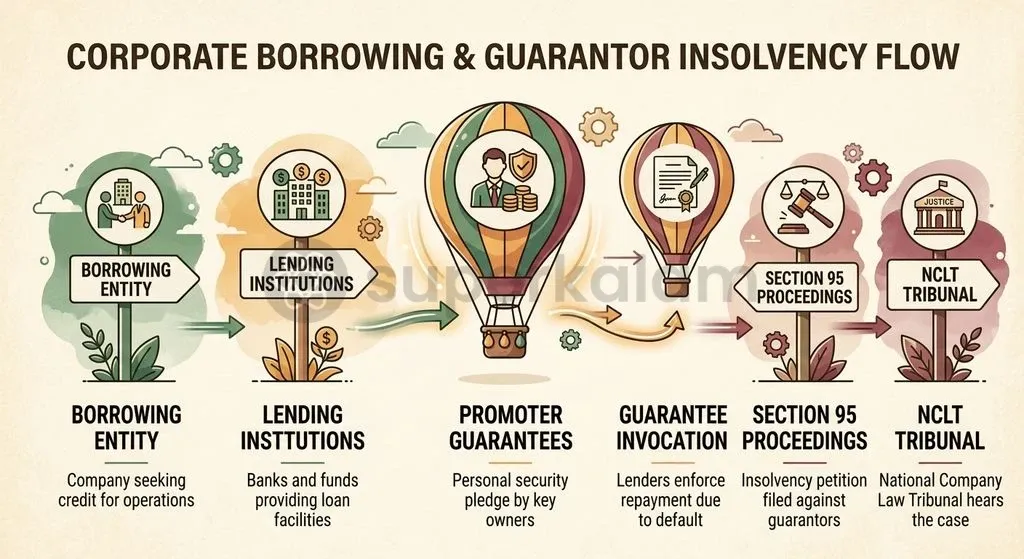
Personal guarantees from Dr. Chandra drove aggressive borrowing across Essel Group operating firms for over a decade. He pledged individual wealth to secure credit lines from banks and non-banking financial companies. When operating cash flows dried up, non-performing loans accumulated across group entities.
Lenders quickly invoked these guarantees to attach the promoter's private estate:
- Action Under Section 95: Indiabulls Housing Finance Limited moved against Dr. Chandra in case CP(IB)-97/ND/2022.
- Voting Skew: The repayment plan cleared the threshold with 80.814% creditor approval by value.
- Associate Control: Five alleged associate entities held roughly 61.78% of the voting share, effectively overriding public lenders.
State-backed lenders including Axis Bank, Canara Bank, and Union Bank of India dissented immediately, challenging the settlement as collusive.
The Legal Backbone: How Part III of IBC Brought Promoters to Book
Executive notifications opened personal guarantors to direct insolvency actions. On 15 November 2019, the Ministry of Corporate Affairs issued Notification S.O. 4126(E), enforcing Part III of the Code specifically for personal guarantors to corporate debtors.
Sections 60(1) and 60(2) assign personal guarantor cases to the National Company Law Tribunal rather than Debt Recovery Tribunals. This statutory consolidation keeps proceedings for corporate borrowers and individual guarantors under one judicial roof.
Part III establishes a clear sequential process:
- Application Filing (Sections 94–95): Either the debtor or a financial creditor submits an insolvency application before the designated tribunal bench.
- Interim Moratorium (Section 96): An immediate statutory freeze takes effect on the date of application, halting independent debt recovery actions.
- Resolution Professional Examination (Section 99): The tribunal appoints a Resolution Professional to examine application eligibility and submit a recommendation report.
- Repayment Plan Formulation (Section 105): The personal guarantor prepares a structured repayment plan detailing debt restructuring, asset liquidation, and creditor distribution.
- Discharge Order (Section 115): The tribunal issues a formal discharge order upon the complete implementation of the repayment plan, releasing the guarantor from residual liabilities.
Discuss with Superkalam
How does the role and operational authority of a Resolution Professional differ between Part II (corporate debtor) and Part III (personal guarantor) of the IBC?
Ask NowCorporate Debtor vs Personal Guarantor: How Resolution Differs in Practice
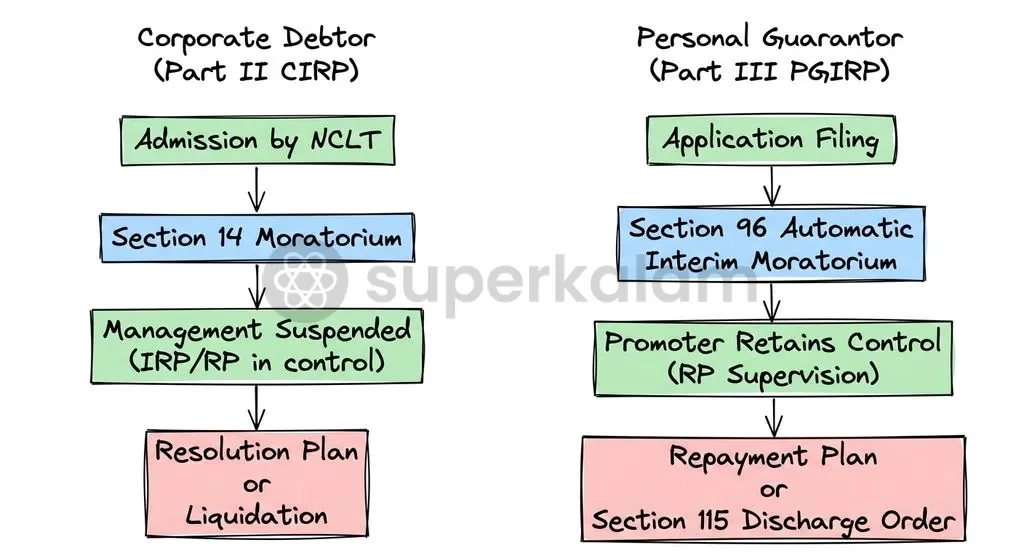
The Code applies distinct operational rules for corporate entities under Part II and individual guarantors under Part III. Corporate insolvency aims at enterprise revival and management substitution. Personal insolvency restructures individual debt without dissolving the underlying corporate entity.
| Dimension | Corporate Debtor (Part II CIRP) | Personal Guarantor (Part III) |
|---|---|---|
| Governing Provisions | Sections 4 to 32 of the Code | Sections 94 to 120 of the Code |
| Moratorium Commencement | Imposed under Section 14 upon formal admission by the tribunal | Imposed under Section 96 automatically on filing of the application |
| Management Control | Board of Directors suspended; Resolution Professional assumes operations | Individual retains personal liberty; Resolution Professional acts in a facilitative role |
| Resolution Instrument | Resolution Plan submitted by prospective third-party Resolution Applicants | Repayment Plan submitted directly by the individual personal guarantor |
| Outcome on Failure | Corporate liquidation and asset distribution under Section 53 waterfall | Bankruptcy order and individual asset realisation under Section 121 |
| Final Relief | Clean-slate transfer to new successful bidder | Discharge Order under Section 115 on plan completion |
The Promoter Playbook: Legal Maneuvers, Interim Moratoriums, and Delay Tactics
Promoters often exploit procedural clauses to shield private estates from swift attachment. Under Section 96, an automatic interim moratorium begins immediately when an application is filed under Section 94 or Section 95. This immediately stalls pending civil recovery actions.
Strategic delays emerge across several fronts:
- Cross-Forum Stays: Promoters use Section 96 to halt ongoing recovery actions under the SARFAESI Act and the Recovery of Debts and Bankruptcy Act across High Courts and DRTs.
- Debtor-Triggered Protection: Filing under Section 94 secures an instant nationwide shield against asset attachment without needing prior judicial admission.
- Tribunal Bottlenecks: Of 5,186 personal guarantor applications filed by mid-2026, Resolution Professionals were appointed in only 2,137 cases, showing an appointment rate of approximately 41%.
- Low Realisation: Cumulative recovery across 64 concluded personal guarantor cases reached just ₹234.56 crore, delivering a meagre 1% recovery rate on admitted claims.
Discuss with Superkalam
If a promoter files under Section 94 while facing parallel debt recovery proceedings under SARFAESI before a DRT, what immediate legal protection do they obtain?
Ask NowKey Judicial Milestones: From Lalit Kumar Jain to Chandra's Petitions
The Supreme Court has systematically upheld the legal architecture governing personal guarantors. In Lalit Kumar Jain v. Union of India (2021), the apex court upheld the 15 November 2019 notification]. The bench held that approving a corporate resolution plan does not discharge the personal guarantor, as liability remains strictly co-extensive under Section 128 of the Indian Contract Act, 1872.
Procedural challenges were later dismissed in Dilip B. Jiwrajka v. Union of India (2023). The court affirmed Sections 95 to 100, holding that the Resolution Professional's role under Section 99 is purely facilitative and non-adjudicatory]. Appointing a professional before a formal hearing does not violate natural justice.
Four principles steer personal guarantor jurisprudence today:
- Notification Validity: The Lalit Kumar Jain (2021) verdict sanctioned phased enforcement targeting corporate promoters before expanding to individual partnerships.
- Co-Extensive Liability: Creditors retain full legal entitlement to pursue simultaneous resolution proceedings against both the corporate borrower and the individual guarantor.
- Facilitative Verification: The Dilip B. Jiwrajka (2023) judgment established that the Section 99 inquiry functions as an objective data-gathering stage rather than a judicial trial.
- Scrutiny of Voting Composition: The NCLT's intervention in the Subhash Chandra case signals growing judicial intolerance toward associate-entity dominance in repayment plan voting.
Discuss with Superkalam
Why does the dominance of related-party or associate entities in creditor voting undermine the core objectives of the IBC personal insolvency framework?
Ask NowEthical and Governance Lens: Breaking the Shield of Limited Liability
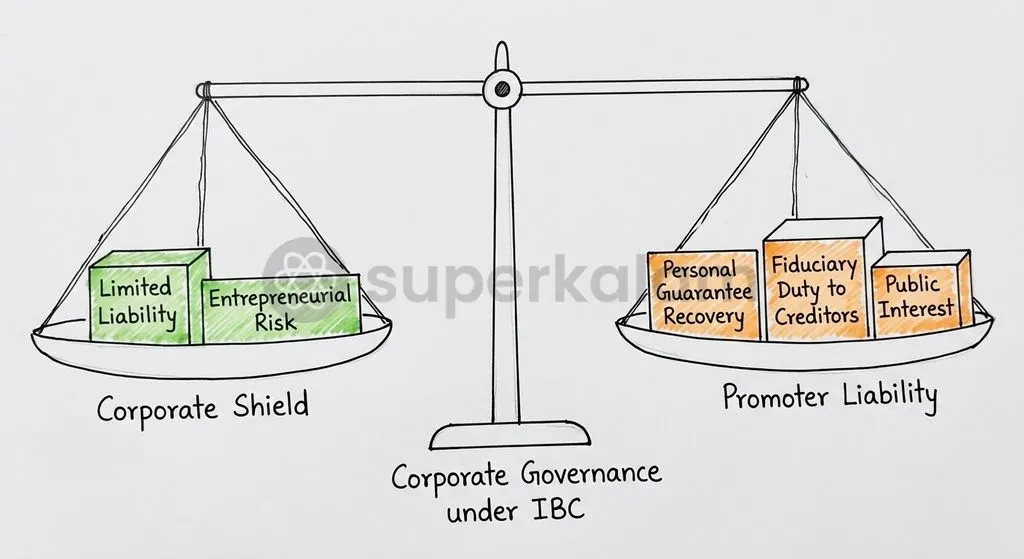
Personal guarantee defaults expose deep flaws in promoter accountability. Limited liability protects operational enterprise risk, but personal guarantees explicitly commit private promoter wealth to secure public funds. When business owners run up corporate debt while shielding individual assets, they compromise credit discipline.
Promoter moral hazard deepens when corporate borrowings are moved into complex cross-holdings, family trusts, and overseas entities to block asset recovery. Demanding a 99.97% haircut while maintaining personal luxury assets breaks the basic ethical compact of borrowing.
Promoter accountability demands transparency between corporate risk and individual wealth:
- Moral Hazard: Promoters internalise commercial profits through corporate structures while socialising bad loans onto public sector banking balance sheets.
- Fiduciary Responsibility: Corporate directors owe a duty of fairness to public depositors whose savings fund bank credit lines.
- Related-Party Collusion: Deploying affiliated entities to outvote genuine institutional lenders undermines procedural justice during repayment plan negotiations.
The Road Ahead: Fixing Bottlenecks in India's Personal Insolvency Framework
Regulatory updates are essential to turn legal liability into genuine financial recovery. In September 2026, the Insolvency and Bankruptcy Board of India proposed mandatory rules requiring Resolution Professionals to conduct comprehensive avoidance transaction audits on undervalued, preferential, and extortionate credit transactions.
Key structural reforms include:
- Independent Valuation: Valuations by registered valuers must precede any creditor vote on personal repayment plans.
- Dedicated Benches: Specialised tribunal benches for personal insolvency can clear backlogs where fewer than half of cases have assigned Resolution Professionals.
- Digital Asset Registries: Centralised registries will allow rapid tracking of personal assets across states.
- Cross-Border Law: Adopting the UNCITRAL Model Law on Cross-Border Insolvency, as recommended by the Insolvency Law Committee, will allow Resolution Professionals to freeze and repatriate offshore assets.
Discuss with Superkalam
Should personal guarantee repayment plans mandate a minimum statutory recovery threshold to prevent disproportionately steep haircuts on public sector lenders?
Ask NowKey Takeaways
- The National Company Law Tribunal stayed Dr. Subhash Chandra's personal repayment plan, which offered ₹6.25 crore against ₹22,006.57 crore in admitted financial claims (a 99.97% haircut).
- Section 95 and Section 96 of the Insolvency and Bankruptcy Code provide for creditor-initiated personal insolvency and impose an automatic interim moratorium on the date of application filing.
- The Supreme Court upheld the constitutional validity of personal guarantor provisions in Lalit Kumar Jain (2021) and affirmed co-extensive liability under Section 128 of the Indian Contract Act, 1872.
- The Dilip B. Jiwrajka (2023) ruling affirmed that a Resolution Professional's role under Section 99 is purely facilitative and does not breach natural justice.
- As of mid-2026, IBBI data shows Resolution Professional appointments occurred in only 41% of filed personal guarantor cases, yielding a low 1% cumulative recovery rate across concluded resolutions.
- Reforming personal insolvency requires mandatory avoidance audits, registered valuer assessments, and enacting the UNCITRAL Model Law for cross-border asset tracing.
Mains Question
"The enforcement of Part III of the Insolvency and Bankruptcy Code, 2016 sought to enforce co-extensive promoter liability, yet procedural delays and low recovery rates continue to hinder effective resolution." Critically examine. (15 Marks)
Evaluate NowMains Question
Highlighting the ruling in Dilip B. Jiwrajka v. Union of India (2023), elucidate the statutory procedure and institutional role of the Resolution Professional in personal guarantor insolvency proceedings under the IBC. (10 Marks)
Evaluate NowPractice MCQs
QUESTION 1
With reference to the insolvency framework for personal guarantors under the Insolvency and Bankruptcy Code (IBC), 2016, consider the following statements:
- Under Section 60 of the Code, insolvency resolution proceedings of personal guarantors to corporate debtors are adjudicated by Debt Recovery Tribunals (DRTs).
- An interim moratorium under Section 96 comes into effect automatically on the date of filing the application, prior to its formal judicial admission.
- The approval of a corporate resolution plan under Part II automatically discharges the personal guarantor from their liabilities.
Which of the statements given above is/are correct?
QUESTION 2
Consider the following statements regarding the Supreme Court's ruling in Dilip B. Jiwrajka v. Union of India (2023):
- It held that the role of the Resolution Professional under Section 99 of the IBC is purely facilitative and non-adjudicatory.
- It struck down the appointment of Resolution Professionals prior to a formal judicial hearing as a violation of natural justice.
- It upheld the procedural validity of Sections 95 to 100 under Part III of the Insolvency and Bankruptcy Code.
Which of the statements given above are correct?
QUESTION 3
Consider the following comparative statements between Corporate Insolvency Resolution Process (CIRP under Part II) and Personal Guarantor Insolvency Resolution (under Part III) of the IBC, 2016:
- While CIRP aims at enterprise revival and suspension of the corporate debtor's board, personal guarantor resolution restructures individual debt without dissolving the corporate entity.
- If resolution fails, CIRP leads to corporate liquidation under Section 53, whereas personal guarantor resolution leads to a bankruptcy order under Section 121.
- Both CIRP and personal guarantor processes impose a moratorium only upon formal admission of the petition by the Adjudicating Authority.
Which of the statements given above are correct?
QUESTION 4
Under Part III of the Insolvency and Bankruptcy Code, 2016, which statutory instrument marks the formal release of a personal guarantor from residual liabilities upon the complete implementation of a repayment plan?
QUESTION 5
Consider the following statements regarding the enforcement of Part III of the Insolvency and Bankruptcy Code, 2016:
- Ministry of Corporate Affairs Notification S.O. 4126(E) in November 2019 enforced Part III specifically for personal guarantors to corporate debtors.
- The Supreme Court in Lalit Kumar Jain v. Union of India (2021) upheld phased enforcement targeting corporate promoters before individual partnerships.
Which of the statements given above is/are correct?