Performance-Linked Incentives in PSBs: Governance Reforms and Union Friction
As the government freezes variable pay for senior bank executives, examine how market-linked incentives clash with public banking mandates and collective bargaining.
Sep, 2026
•8 min read

Overview
Performance-Linked Incentives in Public Sector Banks represent an evolving administrative reform. The initiative seeks to align state-run banking compensation with commercial efficiency, profitability, and prudent risk governance.
Under frameworks negotiated by the Indian Banks' Association and notified by the Department of Financial Services, variable pay links remuneration directly to operating milestones. While intended to drive meritocracy and support financial turnaround, the mechanism introduces friction over collective bargaining, geographic disparities, and potential mission drift away from core public-welfare mandates.
Why Performance-Linked Pay in PSBs is Making Headlines
As of September 2026, the Department of Financial Services directed Public Sector Banks to keep individual performance-linked incentives for senior executives in abeyance for FY 2025-26 following widespread union pushback. The directive temporarily halted an ambitious variable compensation matrix introduced on November 19, 2024, which offered Scale IV to VIII executives and Whole-Time Directors performance bonuses ranging from 70% to 100% of annual basic pay.
This administrative freeze highlights the tension between commercial incentive structures and traditional public banking models. State-run lenders have recorded strong financial turnarounds, with Department of Financial Services data for FY 2025-26 reporting key milestones:
- Gross NPA: Reduced to 2.30%.
- Net NPA: Contained at 0.45%.
- Cumulative Earnings: First-half net profits touching ₹0.94 lakh crore.
Despite these headline gains, harmonising market-oriented executive incentives with branch-level public duties remains a major policy challenge.
Discuss with Superkalam
What are the four prudential criteria established by the Department of Financial Services for state-run bank executive incentive payouts?
Ask NowWhat is the Performance-Linked Incentive Scheme in State-Run Banks?
The Indian Banks' Association instituted the Performance-Linked Incentive scheme across Public Sector Banks to provide annual variable remuneration tied directly to institutional financial health. Formally introduced under the 11th Bipartite Settlement and 8th Joint Note on November 11, 2020, the matrix established a bank-wide bonus pool calculated on annual operating profit growth.
The 12th Bipartite Settlement and 9th Joint Note, signed on March 8, 2024, retained this institutional architecture while union negotiations agreed in principle to a five-day banking week subject to government notification. To qualify for executive-level payouts under the Department of Financial Services framework, a state-run bank must satisfy at least three of four prudential criteria:
- Return on Assets (RoA): Maintaining a positive net return across the financial year.
- Asset Quality: Keeping Net NPA at or below 1.5%, or achieving a minimum annual reduction of 25 basis points.
- Cost Efficiency: Maintaining a Cost-to-Income ratio at or below 50%.
- Capital Adequacy: Ensuring the Capital to Risk-Weighted Assets Ratio (CRAR) remains at least 200 basis points above the regulatory minimum.
The Genesis: P.J. Nayak Committee and Human Resource Reform
The P.J. Nayak Committee recommended granting comprehensive human resource autonomy and variable compensation powers to Public Sector Bank boards in May 2014. Constituted by the Reserve Bank of India to review board governance, the committee observed that rigid bureaucratic pay scales impaired the state-run banking sector's ability to attract, motivate, and retain specialist talent.
The committee advocated fundamental structural changes to dismantle dual regulation by the Ministry of Finance and the central bank. Key institutional recommendations included:
- Repeal of Governing Statutes: Repealing the Bank Nationalisation Acts of 1969 and 1980 alongside the State Bank of India Act to reconstitute lenders under the Companies Act.
- Board Autonomy: Transferring executive appointment, remuneration design, and performance evaluation powers entirely to independent bank boards.
- Market-Linked Incentives: Instituting variable compensation schemes, performance bonuses, and Employee Stock Ownership Plans (ESOPs) to align managerial incentives with long-term bank value.
Comparing Pay Mechanisms: PSB Bipartite Settlements vs Private Bank Models
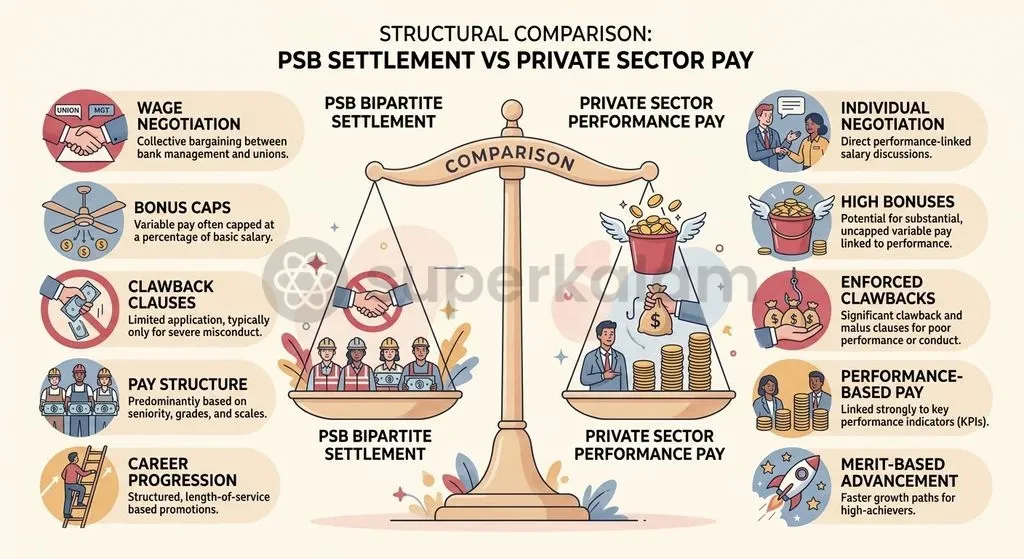
Public Sector Bank compensation operates under uniform industry-wide Bipartite Settlements negotiated by the Indian Banks' Association, whereas private banks utilise dynamic, individualised incentive scorecards. This structural divergence shapes institutional culture, risk appetite, and employee retention across both sectors.
| Parameter | Public Sector Banks (PLI Framework) | Private Sector Commercial Banks |
|---|---|---|
| Wage Determination Mechanism | Industry-wide Bipartite Settlements negotiated via the Indian Banks' Association | Bilateral contractual negotiations aligned with competitive market benchmarks |
| Variable Pay Base | Bank-level operating profit growth and institutional financial hurdles | Individual Key Result Areas, division profitability, and board evaluation |
| Executive Variable Proportion | Variable pay for senior management was capped between 70% and 100% of basic pay before being placed in abeyance | Significant variable component, often exceeding fixed remuneration |
| Risk Governance Integration | Broad prudential hurdles including CRAR and Net NPA thresholds | Mandatory RBI-directed deferral of at least 50% variable pay with malus and clawback clauses |
| Lower-Tier Participation | Uniform institutional bonus capped at 15 days' salary for junior and clerical staff | Discretionary, performance-differentiated annual bonuses |
The Case for Variable Pay: Accountability, Profitability, and EASE Reforms
The Department of Financial Services integrates performance incentives with the Enhanced Access and Service Excellence framework to strengthen institutional accountability and commercial sustainability. The EASE reform agenda evaluates state-run lenders across four weighted pillars:
- Business and Profitability: Enhancing operational margins and balance sheet efficiency.
- Asset Quality: Sustaining disciplined credit appraisal and aggressive loan recovery.
- Digital and Customer Experience: Modernising public banking access and transaction channels.
- Financial Inclusion and Governance: Preserving baseline social commitments while enforcing ethical standards.
Proponents of performance pay argue that variable remuneration reinforces these administrative targets. Grounding executive bonuses in balance-sheet health ensures that management focuses on recovering bad loans and containing operational costs.
Linking remuneration to audited financial achievements replaces tenure-based seniority with measurable commercial delivery. This shift supports the capital preservation requirements of state lenders.
Discuss with Superkalam
How does the bank-wide bonus pool established under the 11th Bipartite Settlement differ from the individual executive incentives notified for Scale IV to VIII officers?
Ask NowWhy Bank Unions Oppose PLI: Collective Bargaining and Structural Grievances
The United Forum of Bank Unions opposes individual executive incentives because asymmetric compensation structures undermine collective bargaining and penalise branch-level operational realities. Representing nine major officer and employee associations, the forum highlighted several structural deficiencies in the Department of Financial Services guidelines:
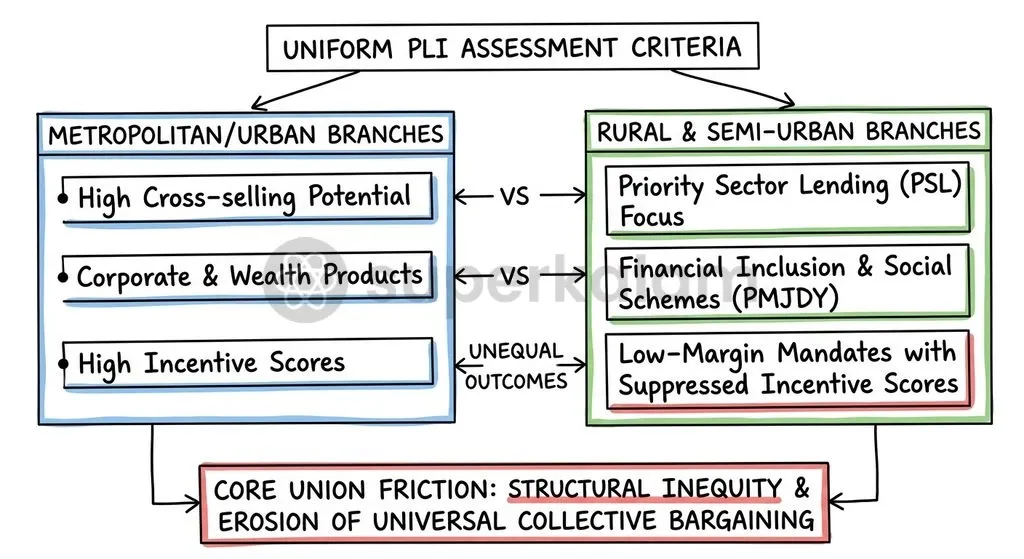
- Remuneration Hierarchy: Junior officers in Scales I to III and clerical cadres receive variable payouts capped at 15 days' basic salary, while senior executives were slated to receive up to 100% of annual basic pay.
- Geographic Asymmetry: Bank branches in rural, semi-urban, and economically backward regions manage unremunerative social schemes with negligible scope for fee-based cross-selling.
- Staffing Deficits: Understaffed rural and semi-urban branches face systemic capacity constraints, making uniform performance scorecards structurally unfair to ground-level staff.
Ethical and Policy Risks: Mis-Selling Pressures and Priority Sector Neglect
Aggressive commercial incentive targets documented by the Reserve Bank of India risk triggering widespread financial mis-selling and compromising social banking mandates like PMJDY. Systemic distortions arise across two major operational fronts:
- Aggressive Cross-Selling: Branch staff facing rigid non-interest income and third-party fee targets often push unsuitable insurance or investment products.
- Mission Drift: Unremunerative financial inclusion programmes, government social security distributions, and Priority Sector Lending risk operational neglect when career progression rewards only short-term commercial returns.
This dynamic disincentivises personnel from dedicating time to complex rural credit appraisal and low-margin developmental banking.
Discuss with Superkalam
If you are managing a rural bank branch focusing on priority sector loans, how would uniform commercial scorecards affect your branch's performance rating compared to an urban branch?
Ask NowWay Forward: Building a Balanced Incentive Matrix for Public Banking
The Reserve Bank of India and governance experts recommend replacing raw accounting profit benchmarks with risk-adjusted performance metrics and branch-normalised evaluation scorecards. To prevent reckless short-term balance sheet expansion, financial sector experts advise transitioning incentive calculations to Risk-Adjusted Return on Capital (RAROC) and Economic Value Added (EVA).
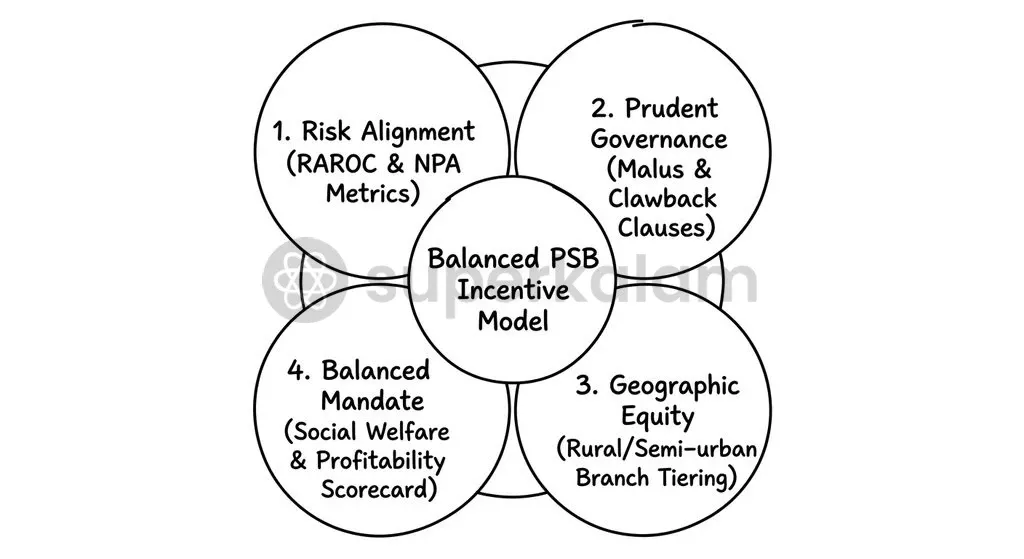
A sustainable incentive framework for state-owned lenders requires four structural reforms:
- Risk-Weighted Deferrals: Implementing RBI compensation guidelines that mandate deferring at least 50% of variable pay over three or more years for material risk-takers, backed by explicit malus and clawback provisions to penalise subsequent asset deterioration.
- Branch-Tier Normalisation: Establishing differentiated evaluation benchmarks for rural and semi-urban branches based on regional demographic baselines, as suggested in governance frameworks, to prevent geographical bias.
- Balanced Scorecard Integration: Incorporating non-financial parameters, such as statutory compliance, grievance redressal turnaround times, cyber resilience, and priority sector asset quality, alongside profitability metrics.
- Equitable Staff Participation: Calibrating incentive tiers across junior operational officers and clerical cadres to maintain organisational cohesion while rewarding collective branch performance.
Discuss with Superkalam
Analyze the potential operational trade-offs between aggressive fee-based cross-selling targets and the core social banking mandates of Public Sector Banks.
Ask NowKey Takeaways
- The Performance-Linked Incentive scheme was established under the 11th Bipartite Settlement in November 2020 to link bank bonuses to operating profit growth.
- The Department of Financial Services introduced individual executive variable pay in November 2024 but placed the scheme in abeyance in September 2026 following union opposition.
- The P.J. Nayak Committee (2014) laid the conceptual groundwork for market-linked compensation and human resource autonomy in state-run banks.
- Bank unions resist uniform PLI metrics due to internal pay disparities and systemic disadvantages faced by rural and semi-urban branches.
- Long-term banking stability requires adopting Risk-Adjusted Return on Capital (RAROC) and malus-clawback provisions to mitigate mis-selling and mission drift.
Mains Question
"The P.J. Nayak Committee emphasized granting operational autonomy and market-linked compensation to Public Sector Bank boards to dismantle bureaucratic rigidities." Critically examine the structural and ethical challenges in implementing variable pay models within state-run banking institutions. (15 Marks)
Evaluate NowMains Question
Linking executive compensation directly to balance-sheet metrics under the EASE reform agenda aims to enhance commercial efficiency, yet it faces resistance from employee unions. Discuss the primary grievances raised by bank unions against individual performance-linked incentives in PSBs. (10 Marks)
Evaluate NowPractice MCQs
QUESTION 1
With reference to the recommendations of the P.J. Nayak Committee (2014) on bank governance, consider the following statements:
- It recommended repealing the Bank Nationalisation Acts of 1969 and 1980 and the State Bank of India Act to reconstitute lenders under the Companies Act.
- It proposed transferring executive appointment, remuneration design, and performance evaluation powers entirely to independent bank boards.
- It recommended discontinuing all market-linked variable compensation schemes and Employee Stock Ownership Plans (ESOPs) to insulate public banks from market risks.
Which of the statements given above are correct?
QUESTION 2
Under the Department of Financial Services (DFS) framework, a Public Sector Bank must satisfy at least three out of four prudential criteria to qualify for executive-level Performance-Linked Incentive payouts. Which of the following are among these four criteria?
- Maintaining a positive Return on Assets (RoA) across the financial year.
- Keeping Net NPA at or below 1.5%, or achieving an annual reduction of at least 25 basis points.
- Maintaining a Cost-to-Income ratio at or below 50%.
- Ensuring Capital to Risk-Weighted Assets Ratio (CRAR) remains at least 200 basis points above the regulatory minimum.
Select the correct answer using the code given below:
QUESTION 3
Consider the following statements regarding the compensation and risk governance models of Public Sector Banks (PSBs) versus Private Sector Commercial Banks:
- PSB wage determination is governed by industry-wide Bipartite Settlements negotiated through the Indian Banks' Association, unlike private banks which use bilateral contractual negotiations.
- Private sector commercial banks are subject to mandatory Reserve Bank of India guidelines requiring the deferral of at least 50% of variable pay with malus and clawback provisions.
Which of the statements given above is/are correct?
QUESTION 4
Under the Enhanced Access and Service Excellence (EASE) reform agenda evaluated by the Department of Financial Services, state-run lenders are evaluated across four weighted pillars. Which of the following is NOT one of these four pillars?
QUESTION 5
Consider the following statements regarding the Performance-Linked Incentive (PLI) architecture in Public Sector Banks:
- The bank-wide PLI matrix tied to annual operating profit growth was formally introduced under the 11th Bipartite Settlement.
- The 12th Bipartite Settlement retained the institutional architecture of PLI while agreeing in principle to a five-day banking week subject to government notification.
- Junior officers in Scales I to III receive variable payouts identical in percentage terms to senior management in Scales IV to VIII.
Which of the statements given above is/are correct?