Pension Sakhis: How the New Rural Pension Initiative Works
Pension Sakhis will use women's self-help groups to expand pension awareness, enrolment and access across rural India.
Sep, 2026
•8 min read

Overview
The Department of Rural Development and the Pension Fund Regulatory and Development Authority entered into a nationwide partnership in September 2026 to mobilise rural self-help group members as Pension Sakhis. This initiative expands voluntary pension enrolment and financial security across India's informal agricultural and unorganised workforce.
The collaboration embeds formal retirement savings instruments within the established network of Deendayal Antyodaya Yojana-National Rural Livelihoods Mission. By turning trained community cadres into doorstep educators and enrolment agents, the programme tackles the distribution deficit in rural pension markets. This shifts public social security from distress relief toward self-sustaining contributory pensions.
Why is the DoRD–PFRDA Partnership in the News?
The Department of Rural Development signed a formal Memorandum of Understanding with the Pension Fund Regulatory and Development Authority on 14 September 2026 to expand rural pension coverage. As of September 2026, this pact operationalises a dedicated cadre of Pension Sakhis drawn from women self-help groups.
Key institutional elements of this partnership include:
- Community-Led Delivery: Cadres lead grassroots financial literacy, voluntary onboarding, and long-term subscriber servicing across rural districts, according to PIB Release ID: 2310300, Department of Rural Development and PFRDA Sign MoU to Expand Pension Coverage in Rural India Through 'Pension Sakhis'.
- Statutory Mandate: The initiative draws authority from the Pension Fund Regulatory and Development Authority Act, 2013 (Act No. 23 of 2013).
- Promotional Function: The Act charges the authority with promoting old-age income security by establishing, developing, and regulating pension funds across both formal and informal employment sectors.
Who Are Pension Sakhis and How Will They Operate?
Pension Sakhis operate as specialised community resource persons under the Deendayal Antyodaya Yojana-National Rural Livelihoods Mission to deliver doorstep retirement planning. The initiative integrates Banking Correspondent (BC) Sakhis and trained Community Resource Persons as trusted grassroots facilitators.
This deployment helps overcome the psychological and physical barriers rural households face when dealing with formal financial institutions, as stated by the Ministry of Rural Development.
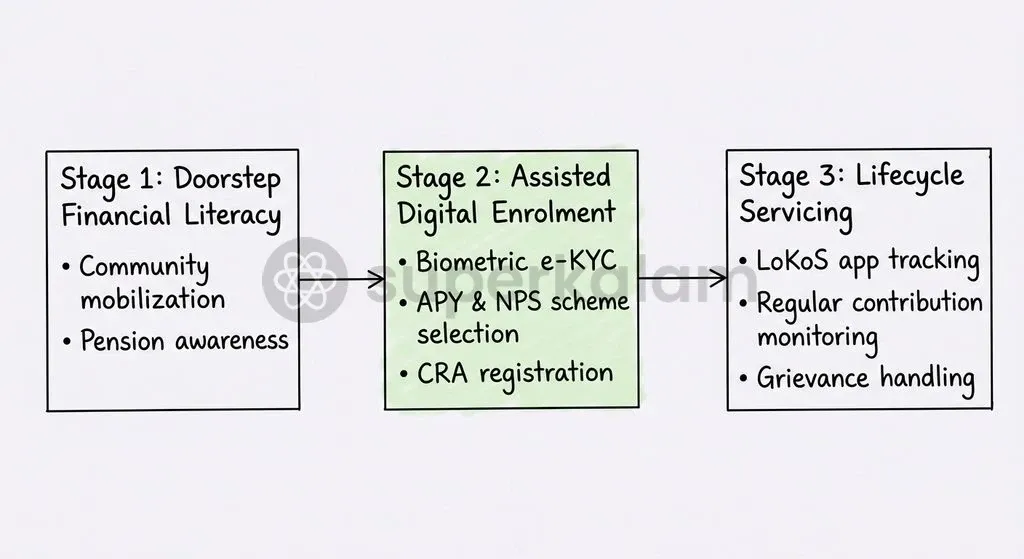
The core operational mandate of a Pension Sakhi follows three distinct phases:
- Doorstep Financial Education: Conducting village-level awareness campaigns on post-retirement income needs and long-term inflation risk.
- Voluntary Onboarding: Assisting rural workers in selecting and enrolling in suitable schemes, primarily the Atal Pension Yojana (APY) and voluntary citizen models under the National Pension System (NPS).
- Post-Enrolment Servicing: Providing ongoing operational help, including updating subscriber details, resolving transaction rejections, and assisting grievance redressal.
Outreach and performance monitoring deploy dedicated digital dashboards and mobile platforms. The system coordinates with the National Rural Livelihoods Mission's LoKoS application and maintains unique identifier-based subscriber tracking through Central Recordkeeping Agencies registered with the pension regulator.
Discuss with Superkalam
Which statutory body regulates voluntary pension products like APY and NPS in India, and under which Act was it established?
Ask NowUnderstanding the Rural Pension Gap: Why Voluntary Retirement Savings Stalled
India's rural pension gap stems from structural informality. Irregular seasonal earnings often prevent unorganised workers from committing to rigid monthly contribution schedules.
Key structural factors shaping this shortfall include:
- High Informal Workforce Concentration: Unorganised and informal workers comprise over 80% of the total labour force, earning volatile daily or seasonal wages from agriculture and allied activities, according to data from the Periodic Labour Force Survey and the Economic Survey.
- Skewed Geographic Enrolment: Non-metro and rural areas account for less than 4% of voluntary individual accounts under the All Citizen Model, while metropolitan centres hold more than 21% of the total subscriber base.
- Low Pension Slabs: Cumulative enrolments under the flagship Atal Pension Yojana crossed 8.11 crore subscribers by August 2025 and surpassed 9.0 crore gross enrolments in 2026, as reported by the Pension Fund Regulatory and Development Authority.
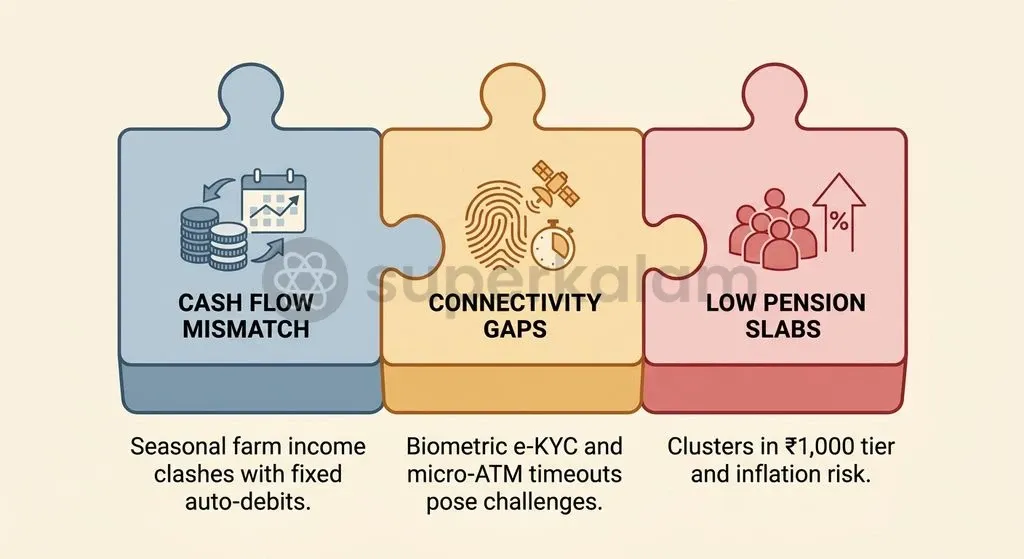
- Concentration at Minimum Tier: Scheme statistics and financial inclusion reports indicate that nearly 86.9% of subscribers remain concentrated in the lowest guaranteed tier of ₹1,000 per month, leaving rural households exposed to severe under-insurance against inflation.
Discuss with Superkalam
Explain why fixed monthly auto-debit schedules create operational hurdles for agricultural and unorganised workers enrolling in contributory pension schemes.
Ask NowHow the DAY-NRLM Self-Help Group Network Unlocks Last-Mile Financial Inclusion
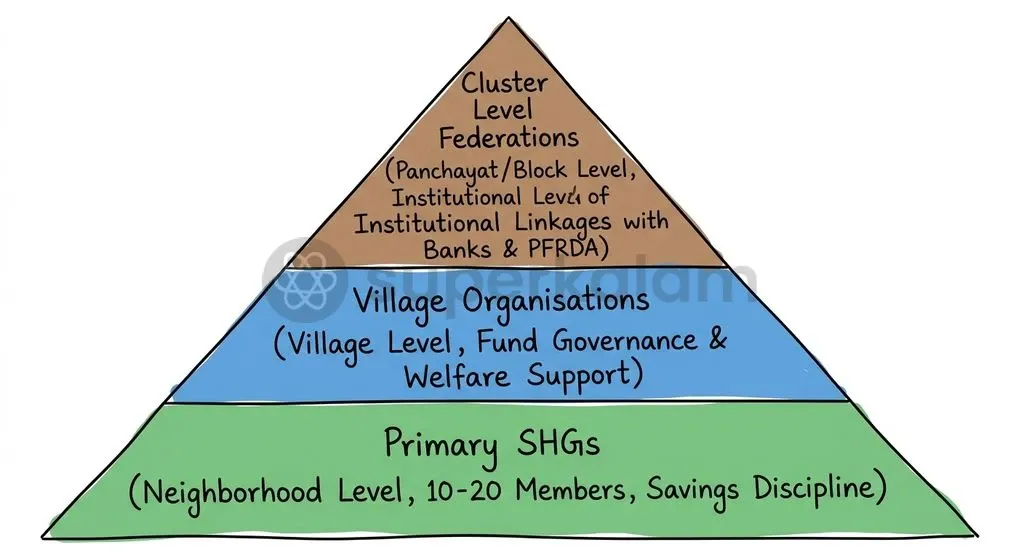
The Deendayal Antyodaya Yojana-National Rural Livelihoods Mission provides a three-tiered institutional architecture that builds deep social capital and trust across rural India. This community structure mobilises over 8.7 crore rural women across more than 81 lakh self-help groups, federated progressively into village-level and cluster-level organisations, according to the Economic Survey.
The operational tiers of the mission include:
- Primary Self-Help Groups (SHGs): Neighbourhood affinity groups of 10 to 20 women that build credit discipline and peer-monitored micro-savings.
- Village Organisations (VOs): Village federations that aggregate primary groups, manage community investment funds, and coordinate social welfare delivery.
- Cluster Level Federations (CLFs): Large secondary federations covering several villages that interface with commercial banks, administrative departments, and regulatory bodies.
The strategy builds directly upon the operational success of the One Gram Panchayat, One BC Sakhi model. That initiative deployed over 100,000 trained women banking agents across rural gram panchayats, proving that community-embedded female intermediaries achieve higher transaction reliability and client trust than traditional commercial bank branches, as noted in Ministry of Rural Development reports.
Comparing Financial Intermediaries: Bank Sakhis vs. Pension Sakhis
Community cadres under the Ministry of Rural Development perform distinct operational roles depending on their institutional alignment and financial service mandates. While Bank Sakhis focus on immediate liquidity and everyday banking transactions, Pension Sakhis specialise in long-horizon asset accumulation and multi-decade social security planning.
| Dimension | Bank Sakhi / BC Sakhi | Pension Sakhi |
|---|---|---|
| Primary Mandate | Last-mile banking, cash deposits, withdrawals, and direct benefit transfers. | Doorstep pension literacy, subscriber onboarding, and long-term account servicing. |
| Target Products | Basic Savings Bank Deposit Accounts (BSBDA), micro-insurance, and remittances. | Atal Pension Yojana (APY) and National Pension System (NPS) voluntary tiers. |
| Transaction Horizon | Immediate, short-term liquidity and daily transactional support. | Multi-decade wealth accumulation and retirement annuities. |
| Regulatory Interface | Reserve Bank of India (RBI) and commercial sponsor banks. | Pension Fund Regulatory and Development Authority (PFRDA) and Central Recordkeeping Agencies. |
| Core Operational Tool | Micro-ATMs and biometric Point-of-Sale (PoS) devices. | Digital enrolment dashboards, LoKoS platform, and Central Recordkeeping Agency portals. |
Discuss with Superkalam
Analyse the institutional advantages of using a three-tiered SHG federation (SHG-VO-CLF) over commercial bank branches for promoting multi-decade pension products.
Ask NowKey Challenges in Extending NPS and APY to the Rural Informal Workforce
Implementing contributory pension schemes in rural regions faces operational friction around incentive structures, biometric authentication, and micro-contribution sustainability. Financial inclusion evaluations indicate that maintaining sustainable commission models is critical to prevent cadre attrition in sparsely populated rural geographies, as reported in evaluation studies on rural livelihoods programmes.
Technical and financial bottlenecks include:
- Biometric Authentication Failures: Aadhaar-seeded electronic Know Your Customer verification and micro-ATM operations remain vulnerable to rural connectivity disruptions, leading to elevated transaction failure rates, according to Reserve Bank of India Financial Inclusion Advisory Committee Reports.
- Rigid Auto-Debit Mechanisms: Unorganised workers with volatile seasonal cash flows often incur banking penalties when fixed monthly auto-debit dates clash with lean agricultural periods.
- Financial Literacy Asymmetry: Complexities regarding annuity compounding, tier selection, and nominee operational rules require continuous community engagement rather than one-time enrolment drives.
Ethical Dimension: Old-Age Vulnerability, Dignity, and the Care Deficit in Rural India
Article 41 of the Constitution of India directs the State to secure public assistance in cases of old age within its economic capacity. As a Directive Principle of State Policy under Part IV, this provision is non-justiciable in court, yet it remains fundamental in governance by placing a constitutional responsibility on the state to protect vulnerable ageing citizens, as specified in The Constitution of India.
Key demographic and fiscal pressures include:
- Demographic Acceleration: India's elderly population will expand rapidly, rising from 158 million individuals in 2026 (11% of the population) to over 340 million by 2050 (more than 20%), according to the India Ageing Report by the United Nations Population Fund and the International Institute for Population Sciences.
- Limited Non-Contributory Assistance: The National Social Assistance Programme provides basic social protection through the Indira Gandhi National Old Age Pension Scheme to 3.09 crore Below Poverty Line beneficiaries, but central assistance remains capped at ₹200 to ₹500 per month.
- Erosion of Kinship Safety Nets: Because nuclear family transitions in rural areas erode traditional kinship care networks, expanding contributory micro-pensions is vital to ensure human dignity and financial autonomy for ageing agrarian workers.
Discuss with Superkalam
Evaluate whether expanding contributory micro-pensions (like APY) is more sustainable for fiscal management than enhancing non-contributory welfare transfers (like NSAP).
Ask NowThe Way Forward: Building Long-Term Financial Resilience for Rural Communities
Building durable rural retirement security requires flexible contribution structures, reliable cadre remuneration, and integrated grievance redressal mechanisms. Aligning financial products with rural economic realities will determine whether the initiative scales beyond initial enrolment targets.
- Flexible Micro-Contribution Schedules: Regulators should permit flexi-frequency deposits (quarterly, seasonal, or harvest-linked) within the Atal Pension Yojana to accommodate agricultural income cycles without triggering auto-debit default penalties.
- Tiered Cadre Remuneration: Establishing a hybrid compensation model—combining upfront onboarding incentives with annual retention trailing commissions—will incentivise Pension Sakhis to maintain subscriber accounts and lower default rates.
- Offline-Capable Biometric Infrastructure: Deploying store-and-forward transaction capabilities on digital dashboards will mitigate biometric authentication failures during intermittent rural connectivity outages.
- Inflation-Indexed Pension Tiers: Expanding the guaranteed minimum pension slabs under Atal Pension Yojana beyond the current baseline will protect purchasing power against long-term inflationary erosion.
Key Takeaways
- Institutional Convergence: The DoRD–PFRDA Memorandum of Understanding leverages the self-help group infrastructure of Deendayal Antyodaya Yojana-National Rural Livelihoods Mission to create a dedicated Pension Sakhi cadre.
- Targeted Products: Pension Sakhis facilitate doorstep awareness, onboarding, and servicing for the Atal Pension Yojana (APY) and National Pension System (NPS).
- Coverage Asymmetry: While gross APY enrolments exceeded 9.0 crore in 2026, voluntary NPS rural adoption remains under 4%, requiring community-embedded intermediaries to bridge the gap.
- Constitutional Anchor: The initiative operationalises the welfare objectives of Article 41 (Directive Principles of State Policy) to ensure income security for informal workers.
- Implementation Imperatives: Long-term success requires flexible contribution cycles matching harvest periods, reliable remuneration for community cadres, and inflation-indexed pension tiers.
Mains Question
'The deployment of community-embedded intermediaries under DAY-NRLM transforms rural financial inclusion from mere account opening to long-term social security.' In light of the Pension Sakhi initiative, evaluate the efficacy of leveraging Self-Help Group networks to bridge the rural old-age security deficit. (15 Marks)
Evaluate NowMains Question
With unorganised workers comprising over 80% of India's labour force and non-contributory pensions offering limited financial support, critically analyse the challenges in expanding voluntary contributory pension schemes in rural India. (10 Marks)
Evaluate NowPractice MCQs
QUESTION 1
With reference to the 'Pension Sakhi' initiative and rural pension mobilization, consider the following statements:
- It is a joint initiative operationalised through an MoU between the Department of Rural Development and the Pension Fund Regulatory and Development Authority (PFRDA).
- Pension Sakhis are mobilised from the community cadre of the Deendayal Antyodaya Yojana-National Rural Livelihoods Mission (DAY-NRLM).
- The statutory authority for PFRDA to promote old-age income security is derived from the Pension Fund Regulatory and Development Authority Act, 2013.
Which of the statements given above are correct?
QUESTION 2
Regarding the structural patterns of pension coverage in India's informal and rural sector, consider the following statements:
- Non-metro and rural areas account for the vast majority of voluntary individual accounts under the NPS All Citizen Model.
- In the Atal Pension Yojana (APY), a significant majority of subscribers are concentrated in the minimum guaranteed pension tier of ₹1,000 per month.
- Informal and unorganised workers constitute over 80% of India's total labour force.
Which of the statements given above is/are correct?
QUESTION 3
Consider the following comparisons between Bank Sakhis (BC Sakhis) and Pension Sakhis under rural financial inclusion models:
- While Bank Sakhis focus on immediate liquidity and everyday banking transactions, Pension Sakhis specialize in multi-decade asset accumulation and retirement planning.
- Bank Sakhis operate under the regulatory framework of the RBI and sponsor banks, whereas Pension Sakhis interface with PFRDA and Central Recordkeeping Agencies.
Which of the statements given above is/are correct?
QUESTION 4
Which of the following provisions of the Constitution of India explicitly directs the State to secure public assistance in cases of old age within the limits of its economic capacity and development?
QUESTION 5
According to demographic projections cited in the India Ageing Report by UNFPA and IIPS, what is the expected trajectory of India's elderly population between 2026 and 2050?