Operation Trident: Dismantling Narco-Hawala Networks
Beyond seizing border contraband, dismantling shadow hawala corridors tests India's multi-agency intelligence architecture and asset-freezing framework.
Oct, 2026
•10 min read

Overview
Operation Trident marks a structural turning point in Indian counter-narcotics enforcement. The strategy changed. Rather than intercepting physical border consignments alone, investigators now target shadow banking conduits, money mules, and commercial trade fronts financing transnational syndicates.
The multi-agency sweep spanned Assam, Mizoram, and Manipur. During the operation, enforcement bodies uncovered ₹100 crore in illicit transactions. Officers promptly froze bank accounts and attached criminal assets under anti-money laundering statutes. The goal was direct. This strategic realignment strikes at the financial lifeblood of cartels rather than low-level logistics carriers.
As of October 2026, Indian enforcement bodies are integrating real-time financial intelligence with ongoing criminal probes. This joined-up approach aims to neutralise cross-border syndicates exploiting transit corridors between India, Myanmar, and Bangladesh.
Why Operation Trident Signalled a Shift in Counter-Narcotics Policing
The Narcotics Control Bureau initiated Operation Trident to enforce a structural shift from seizing drug shipments to targeting illicit balance sheets. The focus moved to ledgers. On 23 October 2026, the bureau coordinated with the Enforcement Directorate and Mizoram Police to search 38 locations across Assam, Mizoram, and Manipur, according to a press release by the Press Information Bureau.
This joint enforcement action dismantled key nodes across what agencies designate the Death Triangle Corridor. The corridor connects trafficking flows across India, Myanmar, and Bangladesh.
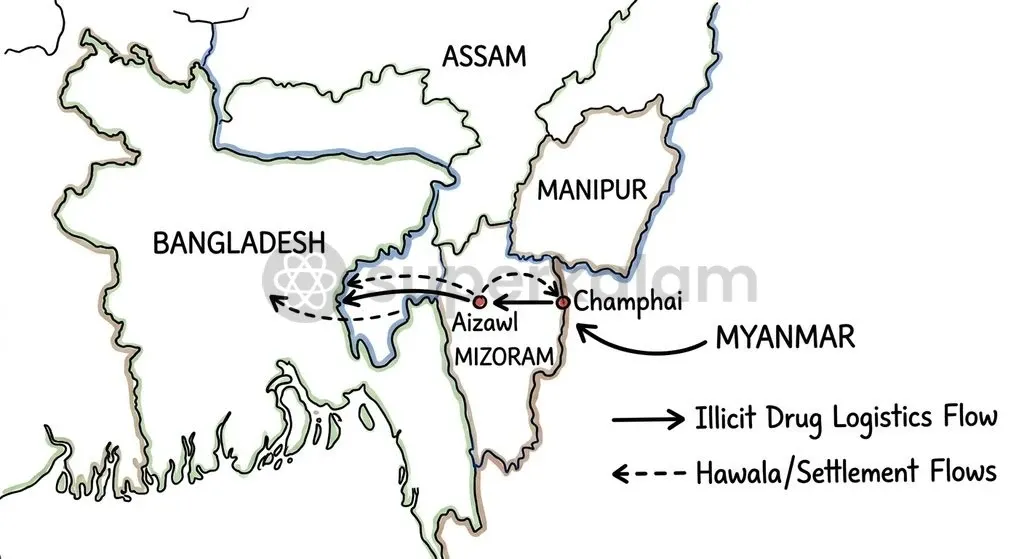
The coordinated sweep targeted methamphetamine and heroin routes cutting through northeastern transit hubs like Champhai, Aizawl, and Churachandpur. Enforcers uncovered extensive financial and material networks. Key operational outcomes detailed by the Press Information Bureau included:
- Illicit Hawala Flows: Enforcers identified ₹100 crore routed through shadow hawala transactions.
- Frozen Accounts: The sweep led to 1,424 frozen bank accounts across the region.
- Property Attachments: Authorities secured the provisional attachment of properties valued at ₹17.82 crore under anti-laundering provisions.
- Arrests and Arms: Ground teams executed 18 arrests and recovered 500 detonators.
The operation translates the Union Government's Vision Document on Narcotics Control (2026–2029) into operational practice. Checkpoint seizures were never enough. Historically, counter-narcotics policing concentrated on interdicting couriers and impounding consignments at checkpoints. Operation Trident operationalised a dual strategy pairing backward and forward linkage tracing with 360-degree financial profiling, striking physical border nodes and financial pipelines simultaneously.
Discuss with Superkalam
What are the four administrative tiers comprising the Narco-Coordination Centre (NCORD) mechanism?
Ask NowTracing the Web: How Shadow Hawala Channels Financed Maritime Drug Routes
The narco-hawala syndicate funnelled illicit proceeds through distributed border commercial fronts rather than standard corporate channels. In settlements such as Champhai and Zokhawthar, syndicates layered money through retail pharmacies and mini-ATMs, alongside local money-transfer outlets, as reported by The Hindu on 25 October 2026. These informal hubs disbursed payments to local carriers, masking trafficking funds within high-frequency, low-value retail cash flows.
The technique was deliberate. A central mechanism in cross-border narco-financing is trade-based money laundering. Illicit account balances are settled by misinvoicing legitimate cargo passing through border transit points. The Financial Action Task Force noted in its 2024 Mutual Evaluation Report of India that syndicates systematically exploit false documentation, under-invoicing, and over-invoicing of goods to balance hawala ledgers without direct bank transfers.
The syndicate's financial architecture relied on three distinct operational layers:
- Retail Placement Nodes: Local commercial fronts, including pharmacies and grocery outlets, received cash from drug consignments and mingled it with daily merchant deposits.
- Layering via Mule Networks: Syndicates distributed funds across 1,424 disposable bank accounts, transferring fragmented balances across state jurisdictions to prevent systemic monitoring.
- Informal Ledger Settlement: Hawala operators balanced transnational ledgers by manipulating commercial cargo invoices across the Myanmar and Bangladesh borders, avoiding formal foreign exchange systems.
Discuss with Superkalam
How does trade-based money laundering allow transnational cartels to balance hawala ledgers across borders without moving cash through regular banks?
Ask NowThe Investigation Playbook: Following the Money Trail Across Multiple Agencies
The Enforcement Directorate executed searches and asset freezes under Section 17 of the Prevention of Money Laundering Act, 2002. Arrests followed swiftly. Investigators arrested key operators under Section 19 of the statute to dismantle the financial network. This multi-agency enforcement model integrates intelligence streams from state police, central drug authorities, and financial regulators.
The statutory architecture balances administrative freezing powers with formal judicial confirmation processes. Predicate offences under the Narcotic Drugs and Psychotropic Substances Act, 1985, sit under Part A of the Schedule to the Prevention of Money Laundering Act, 2002. No monetary minimum applies. This classification allows the Enforcement Directorate to initiate investigations without monetary thresholds, while Section 4 prescribes an enhanced penalty of up to 10 years imprisonment for drug-linked money laundering.
| Statutory Dimension | Narcotic Drugs and Psychotropic Substances Act, 1985 (Chapter VA) | Prevention of Money Laundering Act, 2002 |
|---|---|---|
| Primary Statutory Mandate | Sections 68A to 68Z govern identification, freezing, and forfeiture of drug-derived assets. | Sections 5, 8, 17, and 19 govern search, seizure, attachment, and prosecution of proceeds of crime. |
| Immediate Freezing Powers | Section 68F empowers investigating officers to freeze illegally acquired assets with recorded reasons. | Section 17 permits immediate search and property seizure or account freezing. |
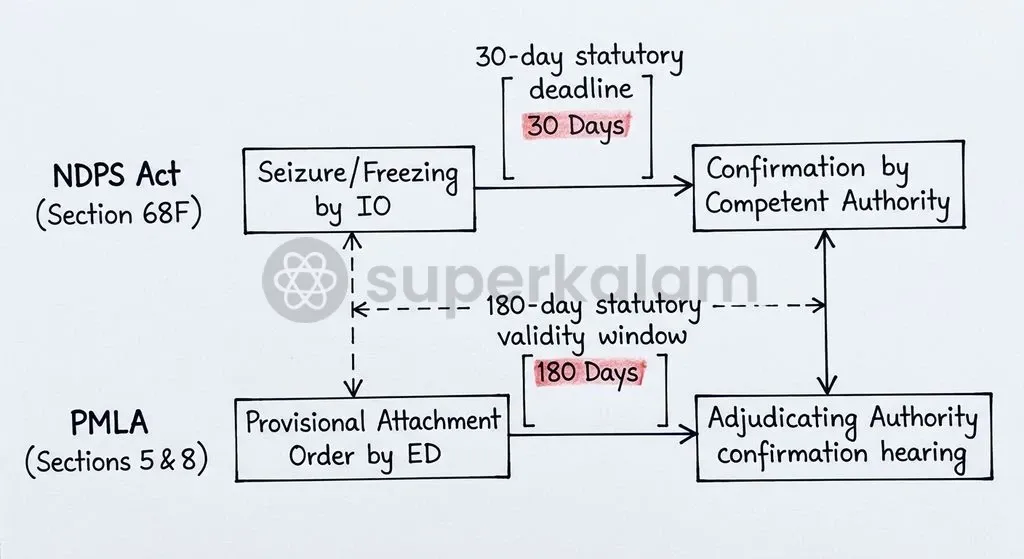
| Confirmation Timeline | Section 68F mandates confirmation by the statutory Competent Authority within 30 days. | Section 5 provisional attachments run for 180 days, requiring confirmation by the Adjudicating Authority under Section 8. |
| Burden of Proof | Section 68J explicitly shifts the burden of proof onto the accused to show lawful acquisition. | Section 24 places the legal burden on the accused to establish untainted property status. |
| Monetary Threshold | Nil; applies directly to all covered illicit trafficking properties. | Nil for Part A Scheduled Offences, including all drug trafficking violations under the NDPS Act. |
Chapter VA of the Narcotic Drugs and Psychotropic Substances Act, 1985, establishes explicit statutory mechanisms for tracing tainted wealth. Time limits are strict. Section 68F allows an investigating officer to freeze trafficking assets, provided the statutory Competent Authority confirms the order within 30 days. Section 68J reinforces this mechanism by placing a reverse burden of proof on the accused to demonstrate that seized properties were acquired lawfully.
Financial intelligence processing relies heavily on the Financial Intelligence Unit-India. Established in 2004 under the Department of Revenue, the agency is the central national clearinghouse for receiving, analysing, and disseminating Suspicious Transaction Reports filed under Section 12 of the Prevention of Money Laundering Act, 2002. Global linkages matter. The unit has been an active member of the Egmont Group of Financial Intelligence Units since 2007, exchanging operational intelligence with over 170 international counterparts via the Egmont Secure Web.
The impact of this intelligence infrastructure showed in July 2026. During that month, the Financial Intelligence Unit-India became global runner-up at the Best Egmont Case Award. The recognised case untangled ₹868 crore in laundered proceeds routed across 5,000 mule accounts, relying on cross-border intelligence shared through the secure international network, as documented by the Ministry of Finance.
Discuss with Superkalam
Compare the freezing powers and confirmation timelines provided under Section 68F of the NDPS Act with those under Section 5 of the PMLA.
Ask NowBottlenecks on the Ground: Inter-Agency Friction and Legal Hurdles in Asset Freezing
Split ministerial oversight creates institutional friction between home affairs and finance portfolios. The Narcotics Control Bureau reports to the Ministry of Home Affairs, whereas the Enforcement Directorate and the Financial Intelligence Unit-India answer to the Department of Revenue within the Ministry of Finance. Handoffs take time. The Financial Action Task Force noted in its 2024 Mutual Evaluation Report that divergent reporting lines cause procedural handoff delays between predicate investigations and secondary money-laundering prosecutions.
The inter-agency framework operates through the four-tier Narco-Coordination Centre mechanism established by the Ministry of Home Affairs. This mechanism synchronises counter-narcotics enforcement nationwide across Apex, Executive, State/Union Territory, and District committees. Dedicated Anti-Narcotics Task Forces headed by officers of Additional Director General or Inspector General of Police rank serve as executive arms across all States and Union Territories to execute joint ground operations.
Despite structured coordination platforms, significant operational and legal hurdles persist during financial asset interdiction:
- Short-Lived Mule Accounts: Syndicates use disposable accounts emptied before statutory attachment orders are finalised, complicating the evidentiary threshold required for provisional freezing under Section 5 of the Prevention of Money Laundering Act, 2002.
- Documentation Standards: Satisfying the strict 'reason to believe' standard under the anti-laundering statute demands forensic accounting data that border police stations struggle to assemble quickly.
- Predicative Prosecutorial Imbalance: The 2024 Financial Action Task Force evaluation noted that while India vigorously prosecutes money laundering tied to economic fraud, authorities initiate fewer laundering prosecutions for predicate drug trafficking and trade-based money laundering.
- Information Sharing Gaps: Under Financial Action Task Force Recommendation 40 on international cooperation, evaluators noted delays in circulating cross-border financial intelligence feedback between central intelligence hubs and frontline field units.
Discuss with Superkalam
Given the split oversight between the Ministry of Home Affairs and Ministry of Finance, evaluate whether structural delays in asset freezing undermine counter-narcotics enforcement.
Ask NowThe Cross-Border Impasse: Why Shell Companies and Digital Ledger Trails Evade Seizure
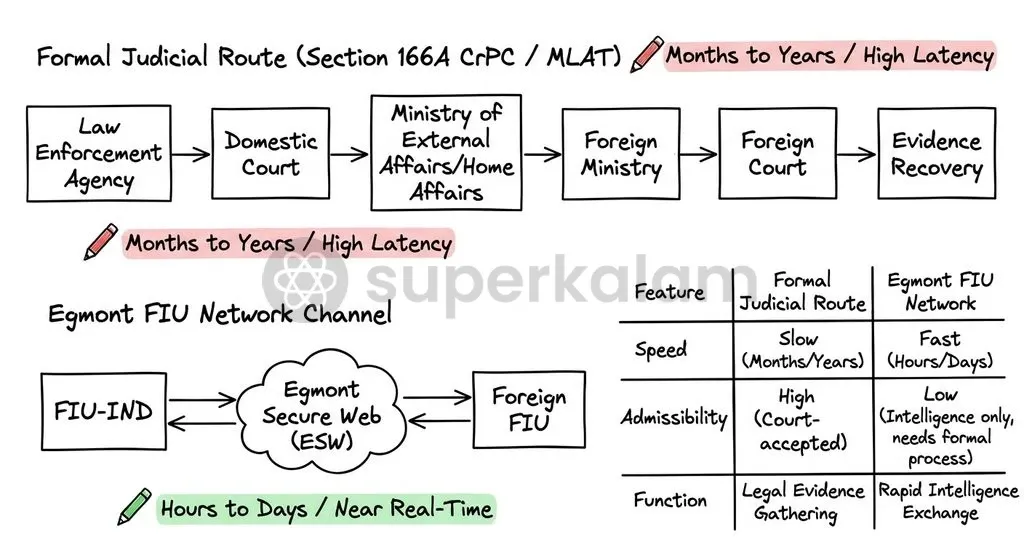
Cross-border evidentiary procedures encounter severe jurisdictional constraints when tracking offshore drug kingpins and informal settlement systems. Borders stall investigations. Establishing a verifiable audit trail across international borders requires formal Mutual Legal Assistance Treaties or Letters Rogatory issued under Section 166A of the Code of Criminal Procedure, 1973. A policy analysis by the Manohar Parrikar Institute for Defence Studies and Analyses noted that diplomatic processing backlogs, coupled with prevailing political instability inside Myanmar, routinely stall cross-border judicial assistance.
Enforcement teams face three structural barriers when attempting cross-border asset recovery:
- Evidentiary Delays: Letters Rogatory under Section 166A face prolonged diplomatic vetting, while political instability inside Myanmar limits cooperation on the ground.
- Corporate Veils: The Financial Action Task Force sets explicit global benchmarks under Recommendations 24 and 25 to counter corporate opacity. These rules mandate that member jurisdictions maintain transparent, accurate, and up-to-date beneficial ownership registers for legal persons and arrangements, preventing syndicates from concealing drug profits behind anonymous shell structures.
- Intelligence Gaps: Bilateral intelligence pacts partially bridge formal treaty delays. The Financial Intelligence Unit-India maintains operational Memoranda of Understanding with regional counterpart agencies, including the Myanmar Financial Intelligence Unit, the Bangladesh Financial Intelligence Unit, and Thailand's Anti-Money Laundering Office. These pacts enable secure preliminary intelligence exchanges, helping investigators map offshore holding structures before pursuing formal judicial mutual assistance.
Institutional Lessons: What Operation Trident Means for Future Financial Interdiction
Operation Trident demonstrated that multi-agency financial crackdowns disrupt illicit supply lines far more effectively than isolated transit seizures. Seizures alone fail. By pairing financial profiling with territorial sweeps, enforcement teams disabled both physical smuggling routes and supporting retail banking nodes.
Future operational success depends on deepening statutory and technological linkages across agencies:
- Beneficial Ownership Verification: Stricter corporate registries aligned with international standards are necessary to identify ultimate beneficial owners of domestic firms operating near sensitive border trade corridors.
- Automated Information Workflows: Policy recommendations outlined on the National Narcotics Coordination Portal suggest integrating financial transaction monitoring systems with bank core banking platforms and central narcotics databases to speed up suspicious transaction flags.
- Focused Predicate Prosecutions: Aligning domestic prosecutorial priorities with Financial Action Task Force guidance requires launching parallel money-laundering investigations alongside primary narcotics cases as standard operating procedure.
- Regional Intelligence Networks: Expanding bilateral operational agreements with Southeast Asian enforcement partners helps bypass diplomatic treaty bottlenecks, providing actionable asset intelligence before funds disappear into informal networks.
Key Takeaways
- Strategic Transformation: Operation Trident operationalised the Union Government's Vision Document on Narcotics Control (2026–2029), shifting counter-narcotics enforcement from border contraband seizures to financial profiling and structural network dismantling.
- Scale of Disruption: The operation targeted the cross-border Death Triangle Corridor spanning India, Myanmar, and Bangladesh, freezing 1,424 bank accounts, attaching ₹17.82 crore in assets under the Prevention of Money Laundering Act, 2002, and identifying ₹100 crore in hawala money flows.
- Statutory Alignment: Narcotics offences constitute Part A Scheduled Offences under the Prevention of Money Laundering Act, 2002, removing any monetary threshold for Enforcement Directorate action and carrying enhanced penalties up to 10 years imprisonment under Section 4.
- Procedural Disconnects: Inter-ministerial division between the Narcotics Control Bureau under the Ministry of Home Affairs and the Enforcement Directorate under the Ministry of Finance creates operational friction, echoing concerns raised in India's 2024 Financial Action Task Force evaluation regarding drug-related laundering prosecutions.
- Cross-Border Constraints: Letters Rogatory under Section 166A of the Code of Criminal Procedure, 1973, and formal mutual assistance treaties suffer diplomatic delays, underscoring the importance of informal intelligence sharing through the Egmont Group and regional Memoranda of Understanding.
Mains Question
"Counter-narcotics enforcement in India is transitioning from seizure-centric interdiction to dismantling illicit balance sheets." In light of Operation Trident and the Vision Document on Narcotics Control (2026–2029), examine how the integration of financial intelligence has reshaped the investigation of cross-border trafficking syndicates. (10 Marks)
Evaluate NowMains Question
Despite a robust statutory and multi-tiered coordination framework, procedural and institutional frictions continue to impair the swift interdiction of narco-financial flows. Critically analyse in the context of inter-agency coordination mechanisms and the Financial Action Task Force (FATF) 2024 findings. (15 Marks)
Evaluate NowPractice MCQs
QUESTION 1
With reference to the statutory framework governing asset freezing and forfeiture in India, consider the following statements:
- Under Chapter VA of the Narcotic Drugs and Psychotropic Substances Act, 1985, an asset freeze order issued by an investigating officer requires confirmation by the statutory Competent Authority within 30 days.
- Under the Prevention of Money Laundering Act, 2002, provisional attachment orders run for 180 days and require confirmation by the Adjudicating Authority.
- Offences under the NDPS Act are classified under Part B of the Schedule to the PMLA, 2002, requiring a minimum monetary threshold before the Enforcement Directorate can initiate an investigation.
Which of the statements given above are correct?
QUESTION 2
Consider the following statements regarding institutional mechanisms for counter-narcotics and financial intelligence in India:
- The Financial Intelligence Unit-India (FIU-IND) functions under the administrative control of the Ministry of Home Affairs.
- The Narco-Coordination Centre (NCORD) operates through a four-tier structure encompassing Apex, Executive, State/UT, and District committees.
- The Financial Intelligence Unit-India has been a member of the Egmont Group of Financial Intelligence Units since 2007.
Which of the statements given above is/are correct?
QUESTION 3
Regarding the legal provisions on the burden of proof under anti-narcotics and anti-money laundering statutes in India, consider the following statements:
- Section 68J of the Narcotic Drugs and Psychotropic Substances Act, 1985, explicitly shifts the burden of proof onto the accused to establish the lawful acquisition of seized property.
- Section 24 of the Prevention of Money Laundering Act, 2002, places the legal burden on the accused to establish that property is untainted.
Which of the statements given above is/are correct?
QUESTION 4
In the context of transnational drug trafficking networks, the term 'Trade-Based Money Laundering' primarily refers to which of the following techniques?
QUESTION 5
Consider the following statements regarding the findings of the Financial Action Task Force (FATF) 2024 Mutual Evaluation Report of India mentioned in the context of counter-narcotics policing:
- Procedural handoff delays occur between predicate investigations and secondary money-laundering prosecutions due to divergent ministerial oversight.
- India initiates significantly more money-laundering prosecutions for predicate drug trafficking than for economic fraud.
- Delays exist in sharing cross-border financial intelligence feedback between central hubs and frontline field units under FATF Recommendation 40.
Which of the statements given above are correct?