One Nation One Ration Card: Portability and NFSA Benefits
Decoupling food security from local Fair Price Shop monopolies empowers mobile citizens, reshaping targeted public delivery and welfare rights across India.
Oct, 2026
•13 min read
Overview
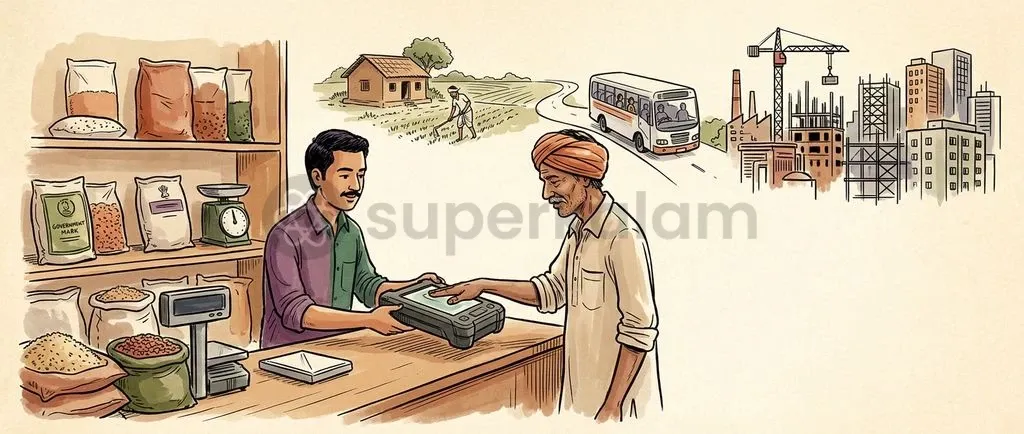
Food security in India is no longer chained to a single neighbourhood shop. The One Nation One Ration Card initiative establishes nationwide portability and family-level divisibility for subsidised foodgrains. This policy shift turns a geographically locked entitlement into an automated, citizen-centric right across all thirty-six States and Union Territories.
Historically, the National Food Security Act, 2013 bound vulnerable families to one licensed dealer. That spatial lock-in generated dealer rent-seeking, hurt migrant welfare, and allowed quota diversion into the open market. Modern digital delivery breaks that trap.
Electronic Point of Sale devices, biometric verification, and central portals now shift systemic bargaining power directly to the citizen. As of March 2024, the platform operates alongside the Pradhan Mantri Garib Kalyan Anna Yojana, serving 81.35 crore individuals across the country.
Why in the News: The Expansion of Nationwide Food Portability
Food distribution in India achieved full statutory portability following three major administrative and statutory milestones:
- Universal Pan-India Coverage: The One Nation One Ration Card platform achieved complete pan-India implementation across all thirty-six States and Union Territories after Assam operationalised the reform in June 2022. This milestone realised full statutory portability under the National Food Security Act, 2013.
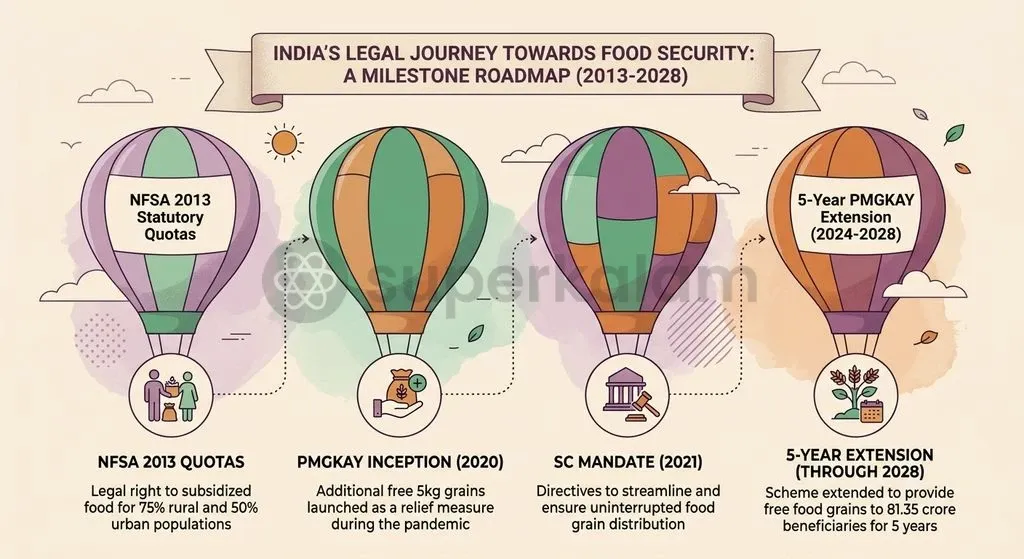
- Statutory Coverage Base: According to Section 3(2) of the National Food Security Act, 2013, the statute legally entitles up to 75% of the rural population and 50% of the urban population to subsidised foodgrains. This statutory coverage ceiling is capped at 81.35 crore individuals based on the 2011 Census.
- Subsidy Outlay Consolidation: The Union Cabinet subsumed existing central food subsidy schemes into the Pradhan Mantri Garib Kalyan Anna Yojana on 1 January 2023. Under this unified framework, the Central Government supplies entitled foodgrains completely free of cost to eligible households. As of December 2023, the Central Government extended free grain distribution under this scheme for five years through 31 December 2028, committing an estimated central subsidy outlay of Rs 11.80 lakh crore.
How Food Subsidies Worked Before ONORC: The Dealer Lock-In
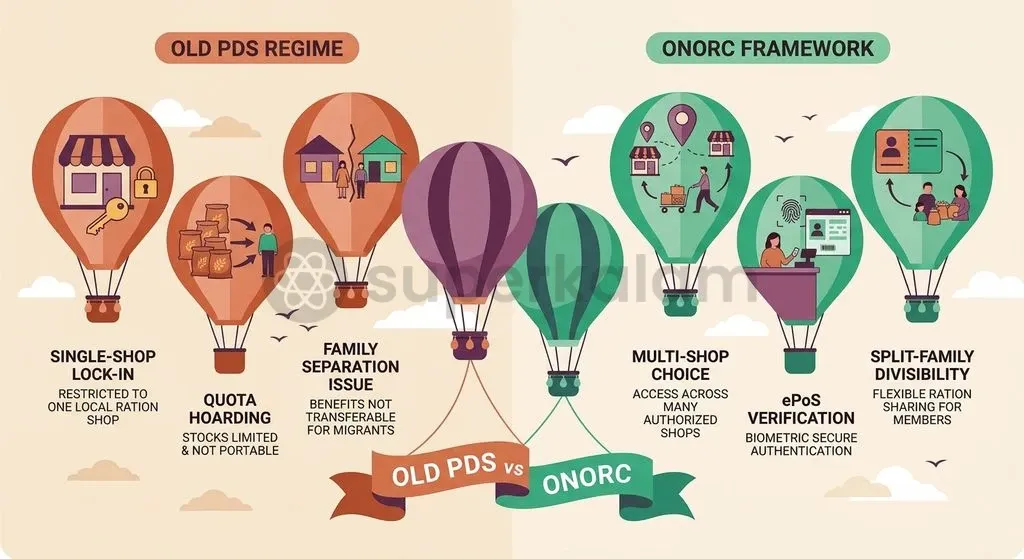
The Targeted Public Distribution System historically tied households to a single Fair Price Shop in their registered village or municipal ward. Beneficiaries had to present physical ration cards and paper coupons at that specific shop to receive their monthly grain quota.
This geographic lock-in produced three severe systemic distortions:
- Monopolistic Rent-Seeking: Dealers operated with guaranteed customer bases, leaving cardholders with zero exit options if a dealer under-weighed grains, diverted stocks, or demanded illicit top-up charges.
- Migrant Destitution: When construction workers, brick-kiln labourers, or domestic staff relocated across administrative borders for work, their statutory entitlements remained trapped in home villages.
- Quota Diversion: Unlifted foodgrain balances allowed corrupt dealers to engage in artificial quota hoarding, diverting valuable public grains into local black markets.
Administrative grievance systems offered little practical relief. According to an official-secondary survey by researchers from the International Food Policy Research Institute published in Ideas for India, 64% of public distribution beneficiaries in Bihar who lodged formal complaints with statutory Grievance Redressal Mechanisms reported their grievances remained entirely unaddressed. The structural inability to switch vendors converted administrative capture into perpetual beneficiary vulnerability.
Discuss with Superkalam
Recall the two statutory household categories defined under Schedule I of the NFSA, 2013 and their exact foodgrain entitlement quotas.
Ask NowWhat is One Nation One Ration Card (ONORC)?
The One Nation One Ration Card initiative is an inter-state welfare reform administered by the Ministry of Consumer Affairs, Food and Public Distribution to eliminate geographic constraints on food entitlements. It decouples legal entitlements from physical retail locations. Beneficiaries can now lift foodgrains from any operational, automated retail outlet nationwide.
Statutory entitlements under the National Food Security Act, 2013 remain divided into two legal categories under Schedule I:
- Antyodaya Anna Yojana (AAY): Poorest-of-the-poor households receive a fixed legal quota of 35 kg of foodgrains per family per month.
- Priority Households (PHH): Eligible vulnerable households receive 5 kg of foodgrains per person per month.
Portability operates across two administrative tiers. Intra-district and intra-state portability allows an individual to visit any automated Fair Price Shop within their home state or district. Inter-state portability permits a worker residing in destination states like Maharashtra or Gujarat to claim their grain quota using an existing ration card issued in origin states like Bihar or Odisha.
The architecture avoids bureaucratic expansion. Instead of issuing a new, centralised card, the system networks existing state databases and verifies beneficiaries through real-time biometric authentication.
The Mechanism: Aadhaar Seeding, ePoS Devices, and IM-PDS
The Integrated Management of Public Distribution System is the central technological backbone enabling inter-state ration portability across all automated Fair Price Shops in India. This platform links state-level civil supplies servers through a central repository of national ration card records.
The operational architecture relies on five interconnected components:
- Central IM-PDS Repository: Maintains a consolidated deduplication database of all nationwide ration cards to prevent individuals from registering fraudulent cards in multiple states.
- Annavitran Portal: Tracks granular transaction data across intra-state distribution channels, recording electronic allocations and real-time off-take at individual Fair Price Shops.
- Electronic Point of Sale (ePoS) Automation: Over 99.8% of shops among India's 5.44 lakh Fair Price Shops have been automated with biometric ePoS devices to execute real-time identity authentication.
- Universal Aadhaar Seeding: Nationwide Aadhaar seeding across ration cards has reached 99.8% coverage, enabling more than 97% of monthly public distribution transactions to occur via biometric authentication.
- Mera Ration Mobile Application: Developed by the Department of Food and Public Distribution in thirteen languages, this mobile interface enables migrant beneficiaries to locate nearby shops, check balance grain quotas, and register temporary migration movements.
Transaction flows are straightforward. When a citizen visits a shop, the dealer keys the ration card or Aadhaar number into the terminal. The device queries the central IM-PDS clearinghouse to verify remaining quotas. Once biometric scan verification succeeds, the transaction completes, and the central ledger updates immediately to prevent double-dipping.
Discuss with Superkalam
Explain how quota divisibility prevents intra-household gendered nutritional penalties during circular migration.
Ask Now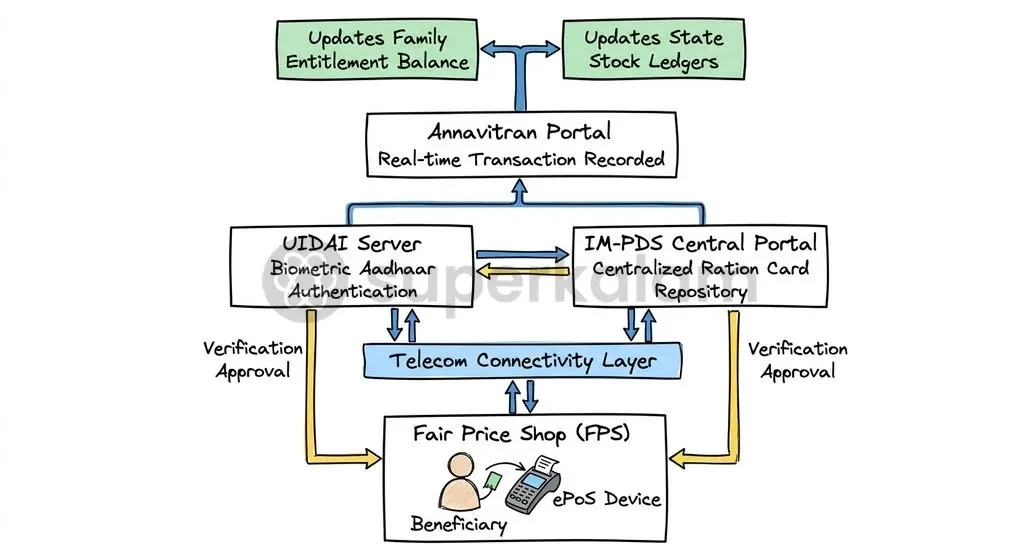
Portability and Divisibility: Empowering Migrants and Split Families
The Department of Food and Public Distribution designed quota divisibility to support circular migrant workers who leave portions of their families behind in home villages. This architectural distinction between full portability and divisibility forms the central social protection innovation of the scheme.
Full portability permits an entire household to lift its cumulative monthly grain quota in single or multiple transactions from any automated shop in India. This mechanism serves families that migrate together to urban industrial clusters.
Divisibility addresses the far more common phenomenon of split-household circular migration:
- An individual migrant working at an urban construction site can withdraw their individual entitlement, such as 5 kg of grain, at a destination shop.
- Remaining family members staying in the rural village retain the legal right to collect the balance family quota at their local Fair Price Shop.
This structural divisibility resolves a painful gendered trade-off within low-income households. Previously, when a migrant took the physical ration card to an urban workplace, family members left in the village lost their subsidised grain. Divisibility safeguards village nutrition while ensuring mobile workers receive individual food protection.
Breaking the Fair Price Shop Monopoly: Shifting Power to the Citizen
The Fair Price Shop network long operated as a captive local monopoly. By introducing portability, the policy replaces administrative captive patronage with citizen-led consumer choice.
Beneficiary choice directly curtails black-market diversion. Under the pre-reform regime, dealers frequently claimed that absent migrants had failed to collect their grain, allowing dealers to retain the balance and sell it into the open market. The operational blueprint of the scheme prevents this practice because uncollected balances remain digitally visible on the IM-PDS ledger, completely eliminating artificial quota hoarding.
Empirical transaction data highlights that portability operates primarily as an accountability mechanism within local neighbourhoods. According to an empirical study of 891 million transactions from Bihar's electronic public distribution system portal, beneficiaries used portability far more often to abandon abusive local dealers than to support long-distance interstate migration [per The Indian Express (as reported, October 2026)]. The bargaining-power effect proved decisive: 62 out of every 100 portability transactions occurred at an alternative retail shop located proximate to the consumer's registered shop rather than across state boundaries [per The Indian Express (as reported, October 2026)].
Beneficiary demand for this exit option is exceptionally high:
- Survey data from Bihar, Odisha, and Eastern Uttar Pradesh documented that 57% of surveyed recipients were initially unaware of official portability procedures.
- Yet 80% of respondents stated an explicit willingness to pay to obtain portability rights.
The credible threat of customer exit forces local dealers to improve weighing accuracy, curb verbal harassment, and maintain reliable opening hours.
Discuss with Superkalam
How can destination urban local bodies apply real-time IM-PDS off-take data to plan grain buffer stock allocations for sudden seasonal migrant influxes?
Ask NowBefore vs After: Public Distribution Delivery Compared
The National Food Security Act framework underwent a profound operational transformation when digital identity authentication replaced manual dealer-controlled grain registers across India. The systemic differences across operational dimensions illustrate how citizen autonomy replaced dealer capture.
| Delivery Dimension | Pre-ONORC Framework | Post-ONORC Implementation |
|---|---|---|
| Entitlement Mobility | Strictly location-bound to one designated Fair Price Shop. | Nationwide portability across all 36 States and Union Territories. |
| Family Quota Structure | Indivisible; entire family quota had to be claimed simultaneously. | Family divisibility, allowing split transactions across locations. |
| Dealer Market Power | Captive local monopoly; zero risk of customer exit. | Competitive pressure; beneficiaries can switch to neighbouring shops. |
| Unclaimed Migrant Stock | Retained by local dealers, driving black-market grain diversion. | Digitally tracked via IM-PDS, eliminating artificial quota hoarding. |
| Authentication Standard | Manual paper registers and physical card inspections. | Real-time biometric ePoS authentication across 99.8% of shops. |
| Redress Mechanism | Rigid administrative grievance mechanisms with documented high pendency. | Direct market exit to alternative shops alongside administrative redress. |
Key Operational Bottlenecks: Biometrics, Connectivity, and Stock Forecasting
The Food Corporation of India and state food departments face significant logistical hurdles in synchronising dynamic foodgrain inventories across seasonal interstate migration corridors. Shifting grain entitlements across state borders requires continuous operational adjustment.
Key technical and operational bottlenecks include:
- Biometric Authentication Failures: Heavy manual physical labour, skin abrasion, and advancing age frequently degrade fingerprint clarity among migrant construction workers, causing repeated biometric scan failures on ePoS terminals [per Centre for Labour Research and Action / Dalberg Study (as reported, May 2022)].
- Last-Mile Telecommunication Disruptions: Periodic cellular and broadband outages in rural or topographically shadowed pockets render ePoS terminals offline, interrupting real-time IM-PDS clearinghouse verification.
- Interstate Stock Reconciliation: Influxes of seasonal migrants into specific urban industrial pockets require rapid adjustments in central grain allocations and financial clearing mechanisms between origin and destination states.
- Exclusion Driven by Outdated Population Baselines: Statutory National Food Security Act coverage remains anchored to the 2011 Census. Because national coverage is legally pegged to historic population figures, natural demographic growth and rural-to-urban migrations have left over 100 million individuals excluded from ration cards entirely.
Maintaining adequate food stocks during seasonal migration surges relies on the Food Corporation of India. Established under the Food Corporations Act, 1964, the corporation maintains strategic reserves and operational buffer stocks to supply the central pool and stabilise grain flows across dynamic deficit zones.
Discuss with Superkalam
Analyse the structural factors that enabled Fair Price Shop dealers to monopolise food subsidies and divert grain under the pre-ONORC regime.
Ask NowJudicial Push: Supreme Court Mandates on Migrant Welfare
The Supreme Court of India delivered decisive constitutional backing for interstate food portability in its landmark June 2021 migrant labourers judgment. In Suo Motu Writ Petition (Civil) No. 6 of 2020 (In Re Problems and Miseries of Migrant Labourers), the court intervened to alleviate severe pandemic disruptions faced by unorganised workers.
The Court issued three major directives that reshaped welfare administration:
- Mandatory Portability Deadline: The bench directed all non-compliant state governments and Union Territory administrations to operationalise the One Nation One Ration Card scheme by 31 July 2021.
- National Unorganised Worker Database: The Court ordered the Ministry of Labour and Employment, in consultation with the National Informatics Centre, to launch a nationwide registry to capture unorganised and migrant workers, leading directly to the establishment of the e-Shram portal.
- Updating Statutory Beneficiary Caps: The bench explicitly urged the Central Government to exercise its statutory powers under Section 9 of the National Food Security Act, 2013 to recalculate rural and urban coverage caps to reflect contemporary population numbers rather than obsolete census records.
This judicial intervention affirmed that the right to food security constitutes an integral component of the right to life under Article 21 of the Constitution. The Court established that interstate administrative friction cannot be permitted to extinguish statutory food entitlements.
Way Forward: Deepening Nutrition Security Beyond Basic Grains
The Central Government must modernise the public distribution architecture by addressing exclusion errors and integrating dietary diversity beyond standard grain quotas. While procedural portability is complete, structural food security requires institutional refinement.
To build on the gains of nationwide portability, policy implementation should focus on four priorities:
- Updating Statutory Coverage Ceilings: Parliament and the Central Government should invoke Section 9 of the National Food Security Act, 2013 to recalibrate state-wise population coverage, incorporating the estimated 100 million individuals currently excluded due to the delayed census enumeration.
- Institutionalising Non-Biometric Fallback Mechanisms: To prevent manual labourers from facing exclusion when fingerprints fail, state administrations must standardise dependable exception-handling protocols, including iris scanners, registered mobile one-time passwords, and authorised nominee provisions.
- Expanding the Nutritional Basket: Food assistance under the Pradhan Mantri Garib Kalyan Anna Yojana must expand beyond rice and wheat to incorporate coarse grains, millets, and pulses, addressing chronic micronutrient deficiencies and hidden hunger among low-income households.
- Dynamic Supply-Chain Forecasting: The Food Corporation of India and state logistics departments must use Annavitran and IM-PDS transaction data to build predictive artificial intelligence models that pre-position grain buffers in urban migrant corridors before peak seasonal migration waves begin.
Discuss with Superkalam
Evaluate whether transitioning from physical spatial lock-ins to biometric digital infrastructure trades dealer rent-seeking for digital exclusion risks.
Ask NowKey Takeaways
- Universal Geographic Coverage: As of June 2022, all thirty-six States and Union Territories operationalised the One Nation One Ration Card scheme, completing nationwide implementation.
- Empowerment Through Divisibility: The operational architecture decouples entitlements, allowing circular migrants to claim their per-capita share at destination shops while leaving remaining family rations for rural relatives.
- Dismantling Retail Monopolies: Beneficiaries exercise consumer choice to abandon rent-seeking dealers, with empirical data showing that 62% of portability transactions happen locally to bypass abusive shopkeepers [per The Indian Express (as reported, October 2026)].
- Technological Backbone: Automated delivery relies on 99.8% ePoS shop coverage, 99.8% Aadhaar seeding, and real-time transaction clearing through the IM-PDS and Annavitran portals.
- Judicial Directives: In its June 2021 judgment, the Supreme Court enforced a nationwide implementation deadline for portability and urged the expansion of coverage caps under Section 9 of the NFSA.
- Structural Coverage Gap: Because NFSA statutory limits remain anchored to the 2011 Census, over 100 million citizens from natural population growth remain excluded from ration cards and portability benefits.
Mains Question
'Decoupling food security entitlements from geographic retail lock-in under the One Nation One Ration Card (ONORC) scheme fundamentally alters dealer-beneficiary power dynamics.' Elucidate. (10 Marks)
Evaluate NowMains Question
The integration of technology into the Public Distribution System through IM-PDS and biometric ePoS devices addresses structural leakages, yet operational bottlenecks continue to challenge inclusive delivery. Critically analyse. (15 Marks)
Evaluate NowPractice MCQs
QUESTION 1
With reference to the National Food Security Act, 2013 and the One Nation One Ration Card (ONORC) platform, consider the following statements:
- The NFSA, 2013 legally entitles up to 75% of the rural population and 50% of the urban population to subsidised foodgrains, with statutory coverage capped at 81.35 crore individuals based on the 2011 Census.
- Under Schedule I of the NFSA, 2013, Antyodaya Anna Yojana (AAY) households are legally entitled to 5 kg of foodgrains per person per month, while Priority Households (PHH) receive a fixed quota of 35 kg per family per month.
- The ONORC architecture replaced existing state ration cards by issuing a single, centralised national digital smart card to all beneficiaries. Which of the statements given above is/are correct?
QUESTION 2
Consider the following statements regarding the technological architecture of the One Nation One Ration Card (ONORC) system:
- The Integrated Management of Public Distribution System (IM-PDS) acts as the central clearinghouse and repository for deduplication of ration cards across states.
- The Annavitran portal is designed specifically to track intra-state transaction data and electronic off-take at individual Fair Price Shops.
- Complete nationwide coverage under ONORC across all 36 States and Union Territories was achieved when Assam operationalised the reform in June 2022. Which of the statements given above are correct?
QUESTION 3
Regarding the portability mechanism under the One Nation One Ration Card (ONORC) initiative, consider the following statements:
- Full portability allows an entire migrant family to lift its cumulative monthly entitlement at an automated Fair Price Shop outside their home state.
- Quota divisibility permits an individual circular migrant worker to claim their proportionate individual entitlement at a destination Fair Price Shop while family members in the native village collect the remaining balance.
- Intra-state portability requires a beneficiary to obtain prior administrative re-registration from the destination district's Civil Supplies Department. Which of the statements given above is/are correct?
QUESTION 4
In the context of public food distribution reforms in India, the 'Mera Ration' mobile application was launched primarily to:
QUESTION 5
Consider the following statements regarding the Pradhan Mantri Garib Kalyan Anna Yojana (PMGKAY):
- Existing central food subsidy schemes were subsumed under the PMGKAY unified framework on 1 January 2023, providing foodgrains free of cost to eligible NFSA households.
- The Central Government has extended free foodgrain distribution under PMGKAY for five years through 31 December 2028 with an estimated subsidy outlay of Rs 11.80 lakh crore. Which of the statements given above is/are correct?