Off-Budget Borrowing and KIIFB: Kerala's Fiscal Federalism Dispute
As Kerala tests Article 293 in the Supreme Court over KIIFB debt deductions, federal oversight collides with sub-sovereign developmental spending priorities.
Nov, 2026
•11 min read
Context
The constitutional showdown between the Union Government and Kerala over the Kerala Infrastructure Investment Fund Board proves that off-budget financing has limits. In March 2022, the Union Ministry of Finance revised its federal borrowing rules. It decided to classify state-guaranteed liabilities as direct sovereign state debt.
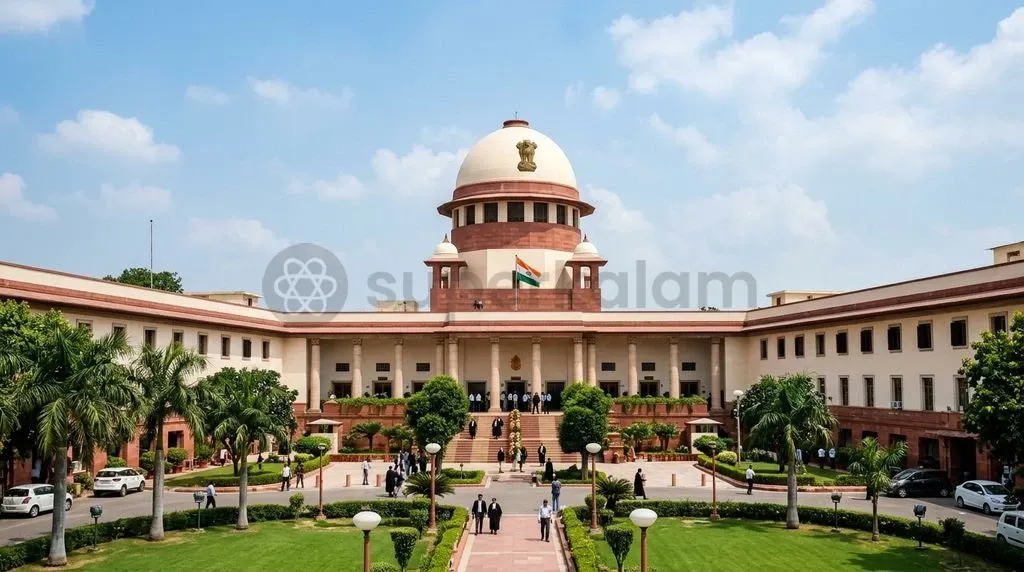
The dispute escalated to the Supreme Court under Article 131. Kerala challenged the Union's power to deduct parastatal obligations from its statutory Net Borrowing Ceiling.
- State position: Financing vehicles provide essential capital for socio-economic development under state legislative autonomy.
- Union position: Watchdogs treat unmonitored off-budget debt as balance-sheet camouflaging that imperils macroeconomic stability under Article 293.
Why in the News: The Centre-State Showdown over Borrowing Space
Kerala took the Union Government to the Supreme Court by filing Original Suit No. 1 of 2024 under Article 131. The suit directly contested the Union Ministry of Finance's choice to deduct state-guaranteed, off-budget debt from Kerala's annual Net Borrowing Ceiling.
Key developments defining the dispute include:
- March 2022 policy shift: The Department of Expenditure ruled that borrowings by state-level Special Purpose Vehicles (SPVs) and public sector enterprises—serviced through budgetary allocations or assigned tax revenues—must be treated as direct state debt under Article 293(3).
- Litigation under Article 131: Kerala contested these deductions in the Supreme Court, arguing that the curbs abruptly restricted open market borrowings and constrained state liquidity.
- Interim order: As of April 2024, the dispute reached a constitutional crossroads when the Supreme Court declined interim relief to the State while framing substantive constitutional questions on fiscal federalism.
Discuss with Superkalam
Recall the two statutory state revenue streams dedicated by executive notification to service KIIFB debt obligations.
Ask NowWhat is KIIFB and How Does It Fund Infrastructure?
The Kerala Infrastructure Investment Fund Board is a statutory body corporate tasked with financing public works. Reconstituted under the Kerala Infrastructure Investment Fund (Amendment) Act, 2016, the agency mobilises off-budget finance outside the traditional state budget.
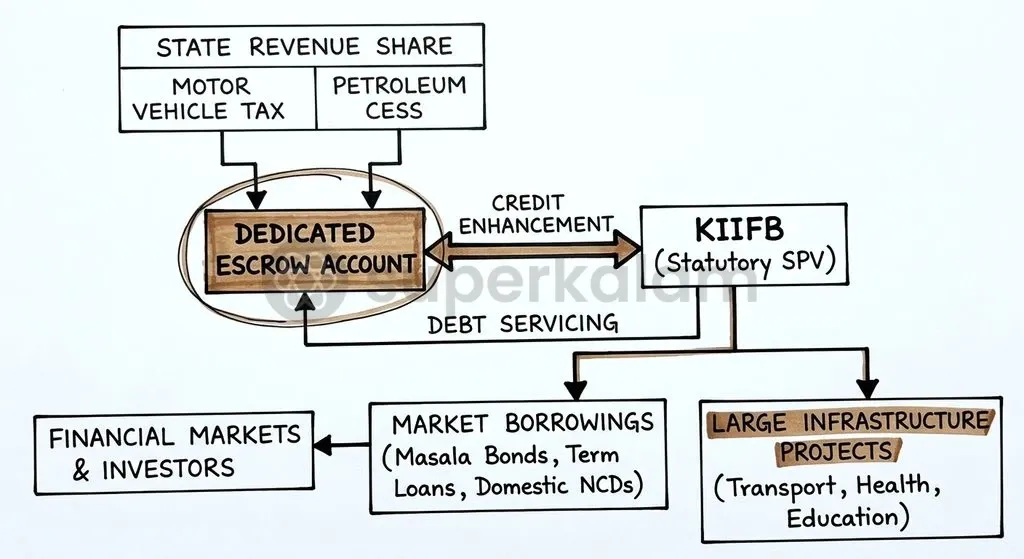
The funding architecture relies on dedicated statutory revenue transfers governed by executive notifications. Under Section 7 of the amended Act, the Kerala government channels a designated share of its revenue directly to an escrow account:
- Motor Vehicle Tax: The State statutory framework transfers a prescribed portion of the Motor Vehicle Tax, stepping up from 10% in 2016-17 to 50% in subsequent years.
- Petroleum Cess: The entirety of the state cess collected on petroleum products goes directly into the escrow mechanism to service debt obligations.
- Capital Market Debt: The entity issues commercial bonds and borrows from financial institutions using these dedicated revenue flows as collateral.
In March 2019, the board tapped international capital markets. It became the first sub-sovereign entity in India to issue offshore rupee-denominated bonds. These Masala Bonds raised ₹2,150 crore at an annual interest rate of 9.723%, listing on both the London Stock Exchange and the Singapore Exchange. The board redeemed this ₹2,150 crore debt in full upon scheduled maturity in March 2024, as confirmed on the floor of the Kerala Legislative Assembly.
Understanding Off-Budget Borrowings: Definitions and Disclosures
Off-budget borrowings are loans raised by government-owned public enterprises, autonomous boards, or Special Purpose Vehicles on behalf of the state. These liabilities do not appear in the headline fiscal deficit figures presented in the annual financial statement under Article 202.
Governments deploy these mechanisms to sustain public works without displaying immediate spikes in fiscal deficit ratios. When the entity lacks independent commercial earnings, the principal and interest repayments inevitably fall back on the public exchequer.
Key institutional findings and corrective measures regarding these liabilities include:
- Legislative oversight bypass: Comptroller and Auditor General audit reports highlighted that committing sovereign tax streams outside legislative appropriation circumvents legislative scrutiny.
- Finance Commission directives: The Fifteenth Finance Commission highlighted that extra-budgetary resources obscure fiscal risk across both Union and state tiers, recommending that governments eliminate existing off-budget liabilities in a time-bound manner.
- Union balance-sheet clean-up: The Union Government initiated corrective steps on its own balance sheet starting in FY 2020-21, bringing approximately ₹3.7 lakh crore—representing over 90% of its off-budget obligations, including Food Corporation of India borrowings from the National Small Savings Fund—directly onto the formal Union Budget.
Discuss with Superkalam
Explain how off-budget borrowing allows a government to sustain capital infrastructure spending without showing an immediate spike in headline fiscal deficit figures.
Ask NowThe Constitutional Core: Article 293 and State Borrowing Limits
Article 293 defines the constitutional boundaries governing sub-sovereign borrowing powers. It demarcates executive authority while instituting mandatory central oversight safeguards to maintain macroeconomic coherence.
| Constitutional Provision | Mandated Authority | Key Constitutional Requirement |
|---|---|---|
| Article 293(1) | State Executive | Borrowing permitted only within India upon the security of the Consolidated Fund of the State |
| Article 293(2) | Union Government | Authority to make central loans or provide guarantees to States within parliamentary limits |
| Article 293(3) | Central Consent | Mandatory prior consent required if any central loan or guarantee remains outstanding |
| Article 293(4) | Central Discretion | Union power to impose conditions when granting borrowing consent |
The Comptroller and Auditor General noted that sub-sovereign foreign debt issuance touches exclusive Union jurisdictions. Under Entry 37 of List I (Union List) in the Seventh Schedule, raising foreign loans falls under the exclusive legislative domain of Parliament. This makes offshore bond issuances a point of federal friction.
Why the Centre Clamped Down: The Net Borrowing Ceiling Explained
The Union Department of Expenditure enforces fiscal discipline among States via the Net Borrowing Ceiling. This mechanism operationalises the recommendations of the Finance Commission under the mandate of Article 293(3) and Article 293(4).
The ceiling framework combines strict baselines with reform-linked conditions:
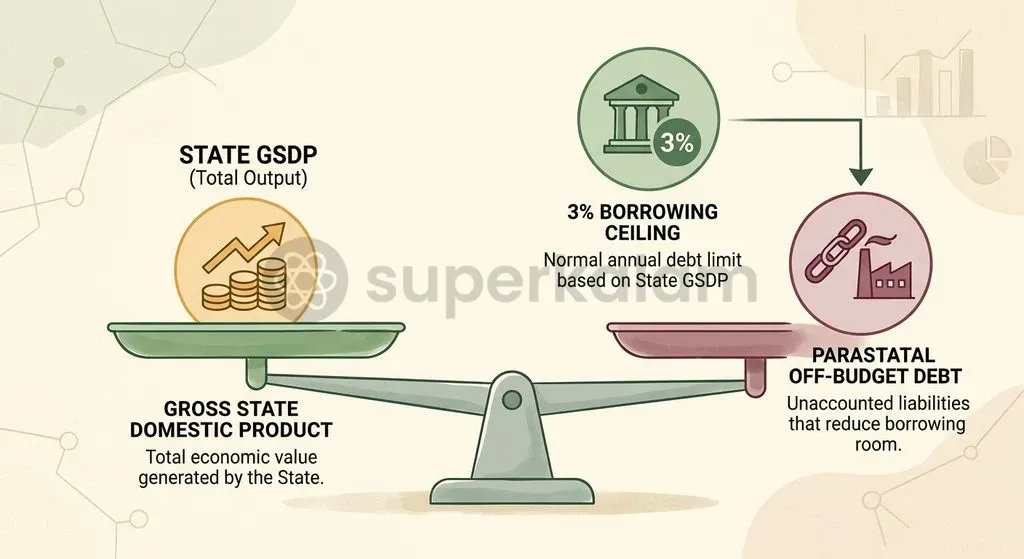
- Baseline borrowing ceiling: For the 2023-24 to 2025-26 cycle, the Fifteenth Finance Commission fixed the baseline Net Borrowing Ceiling for States at 3.0% of Gross State Domestic Product (GSDP).
- Reform-linked headroom: An additional borrowing space of 0.5% of GSDP remains accessible to States, provided they implement designated power sector reforms.
- Parastatal deductions: In March 2022, the Department of Expenditure adjusted state borrowing permissions downward by deducting off-budget borrowings mobilised by bodies like KIIFB and the Kerala Social Security Pension Limited.
- Macro-stability concerns: The Union noted that unmonitored SPV liabilities threaten economic stability, pointing out that Kerala's debt-to-GSDP ratio stood at 39.87% at the close of FY 2020-21, exceeding the 32.8% target prescribed under the amended Kerala Fiscal Responsibility Act.
Kerala's Counter-Arguments: Autonomy and Capital Creation
Kerala contends that expanded debt deductions undermine constitutional federalism. The State argues that central executive directives cannot subordinate state legislation enacted under List II of the Seventh Schedule.
Kerala's legal and economic defence rests on three core pillars:
- Corporate Entity Distinction: The State argues that KIIFB operates as an autonomous body corporate. Its borrowings do not constitute direct liabilities on the Consolidated Fund of the State under Article 293(1).
- Targeted Infrastructure Creation: Unlike borrowings deployed for revenue deficits, KIIFB capital funds tangible public assets such as hospitals, schools, and roads. These capital projects spur long-term economic growth and revenue generation.
- Statutory Legislative Authority: The Kerala Legislative Assembly established the funding model via democratic legislation. In January 2021, the Assembly passed a resolution under Rule 118 rejecting the Comptroller and Auditor General's audit conclusions regarding the unconstitutionality of the funding board's borrowings.
State representatives further pointed out that statutory corporations across India mobilise extra-budgetary capital. Imposing retrospective deductions without an adjustment transition restricts ongoing works and curtails sub-sovereign initiatives.
Discuss with Superkalam
Suppose a State creates a power sector SPV that raises market loans backed by state guarantees without independent revenue. How should the Union Department of Expenditure treat these borrowings under Article 293(3)?
Ask NowThe Supreme Court Stance on Centre-State Financial Disputes
The Supreme Court bench addressed the operational friction between state developmental demands and federal debt limits on April 1, 2024. A two-judge bench delivered an interim order in State of Kerala v. Union of India, refusing Kerala's plea to borrow an immediate ₹10,722 crore outside its assigned ceiling.
The order established two significant legal markers:
- Refusal of interim relief: The Court ruled that the State failed to satisfy the classic triple test required for interim injunctions: establishing a prima facie case, showing the balance of convenience, and proving irreparable injury.
- Five-judge referral: Recognising the constitutional stakes, the bench referred seven substantial legal questions to a five-judge Constitution Bench under Article 145(3).
These questions focus on defining the precise scope of Union power under Article 293(3) and Article 293(4). The forthcoming ruling will determine whether the Union can regulate parastatal debt or whether such oversight infringes state autonomy.
Comparative View: Budgetary Debt vs Off-Budget Liabilities
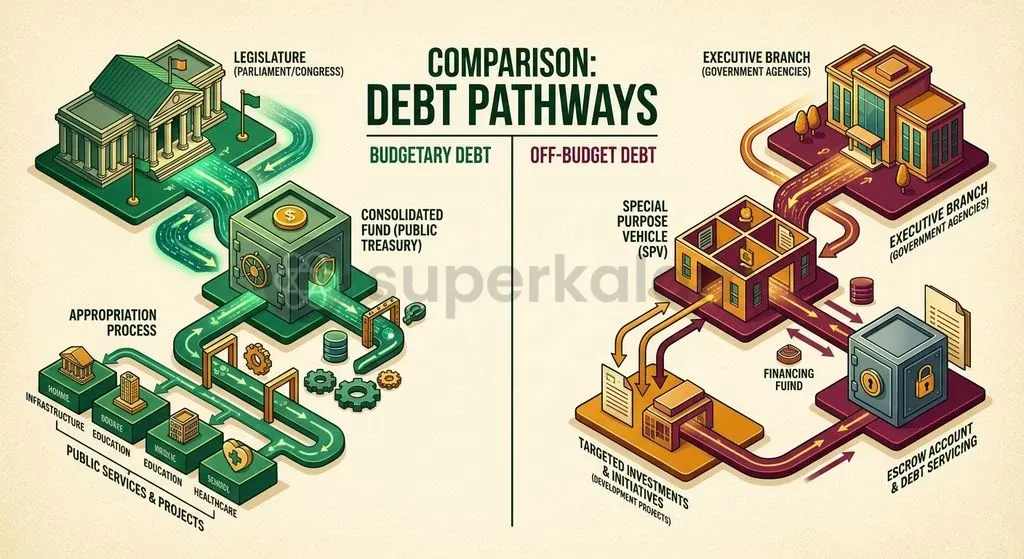
Comparing conventional budgetary borrowings with off-budget mechanisms reveals stark differences in disclosure, legislative oversight, and fiscal risk. The table below delineates how these two approaches function within the framework of Indian public finance:
| Parameter | Budgetary Debt | Off-Budget Parastatal Liabilities |
|---|---|---|
| Primary Borrower | State Government via Department of Finance | Special Purpose Vehicles or public corporations (e.g., KIIFB) |
| Constitutional Anchor | Article 293(1) backed by the Consolidated Fund of the State | Corporate charter under state statute; no direct constitutional mention |
| Legislative Oversight | Annual legislative vote and appropriation under Article 204 | Off-budget transfers authorised by parent Acts; circumvents annual vote |
| Debt Servicing Source | General revenues appropriated from the State Consolidated Fund | Assigned cesses, specific tax shares, or budgetary grants transferred to escrow |
| Ceiling Classification | Explicitly counted within the Net Borrowing Ceiling under Article 293(3) | Historically excluded; deducted post-March 2022 Department of Expenditure circular |
| Fiscal Deficit Disclosure | Reflected directly in the headline fiscal deficit presented under Article 202 | Kept off the state balance sheet, obscuring headline debt metrics |
Ethical and Governance Dimensions in Public Debt Management
Public debt management involves serious ethical considerations regarding transparency and intergenerational equity. Moving liabilities into autonomous entities weakens the democratic link between state institutions and voters.
These practices trigger distinct governance dilemmas:
- Fiscal agency problem: Incumbent governments can front-load capital spending to achieve short-term political visibility while pushing debt service burdens onto future administrations and taxpayers.
- Intergenerational debt burdens: Future generations inherit the legal obligation to service loans without participating in the political choices that incurred them.
- Compromised institutional integrity: A research paper by the International Monetary Fund highlighted that opaque sub-national fiscal structures generate distorted indicators that misinform citizens, domestic lenders, and sovereign rating agencies.
Fiduciary governance demands full, unambiguous disclosure across every category of public liability.
Discuss with Superkalam
Analyse the institutional conflict between the CAG's audit mandate, parliamentary jurisdiction under Entry 37 of List I, and state legislative autonomy under List II regarding offshore debt issuances.
Ask NowWay Forward: Balancing Fiscal Discipline with State Development
Resolving the conflict over off-budget borrowing requires a balanced framework that preserves national macroeconomic stability without choking sub-sovereign capital formation. By October 2026, an expert revamp committee appointed by the Kerala Government recommended winding down independent off-budget borrowings by KIIFB and restricting its mandate to executing ongoing works. A sustainable path forward encompasses several structural measures:
- Unified Balance-Sheet Disclosures: States should present a comprehensive statement of parastatal liabilities alongside the annual financial statement, mimicking the Union's disclosure of extra-budgetary resources since FY 2021-22.
- Transparent Ceiling Adjustments: The Union Department of Expenditure and the Finance Commission should establish a multi-year glide path for including off-budget debt into the Net Borrowing Ceiling, preventing sudden fiscal shocks to states executing vital capital works.
- Commercial Viability Benchmarks: Parastatals should mobilise debt only for projects with defined, direct user-fee recovery models. When debt servicing depends solely on allocated state taxes, the liability must be treated as direct sovereign debt from its inception.
- Strengthened Inter-State Dialogue: The Inter-State Council and the NITI Aayog governing council must provide forums for consensus-building on sub-sovereign borrowing rules, preventing protracted litigation under Article 131.
Key Takeaways
- Statutory SPV Framework: The Kerala Infrastructure Investment Fund Board raises capital outside the conventional state budget, relying on statutory transfers of Motor Vehicle Tax and fuel cess under the amended 2016 Act.
- The Union's 2022 Ruling: The Union Ministry of Finance determined in March 2022 that SPV borrowings serviced through state budget allocations or designated taxes must be counted within the state's Net Borrowing Ceiling under Article 293(3).
- Constitutional Review: The Supreme Court declined interim relief to Kerala for ₹10,722 crore of emergency borrowing and referred seven foundational constitutional questions on sub-sovereign debt regulation to a five-judge Constitution Bench under Article 145(3).
- Audit Objections: The Comptroller and Auditor General found that bypassing the Consolidated Fund of the State subverts legislative appropriation authority under Article 204 and compromises fiscal transparency.
- Institutional Governance: The Fifteenth Finance Commission and public finance standards require the elimination of extra-budgetary borrowings to preserve intergenerational equity and prevent distorted public debt indicators.
Mains Question
"The Union Ministry of Finance's decision to deduct state-guaranteed liabilities of Special Purpose Vehicles from the Net Borrowing Ceiling has brought the fault lines of Indian fiscal federalism to the fore." Critically examine the constitutional and economic implications of this move under Article 293. (15 Marks)
Evaluate NowMains Question
Differentiating between budgetary debt and off-budget liabilities, evaluate the role of the Kerala Infrastructure Investment Fund Board (KIIFB) model in capital infrastructure financing. (10 Marks)
Evaluate NowPractice MCQs
QUESTION 1
With reference to the constitutional provisions governing state borrowings in India under Article 293, consider the following statements:
- A State executive may raise loans outside the territory of India upon the security of the Consolidated Fund of the State.
- A State cannot raise any loan without the consent of the Government of India if there is still outstanding any part of a loan made to the State by the Government of India.
- The Government of India may impose conditions when granting consent to a State for raising a loan. Which of the statements given above are correct?
QUESTION 2
Consider the following statements regarding the Kerala Infrastructure Investment Fund Board (KIIFB):
- It was reconstituted under the Kerala Infrastructure Investment Fund (Amendment) Act, 2016 as a statutory body corporate.
- Its debt obligations are serviced via statutory transfers of a prescribed share of Motor Vehicle Tax and state petroleum cess to an escrow account.
- In 2019, it became the first sub-sovereign entity in India to issue offshore rupee-denominated Masala Bonds. Which of the statements given above is/are correct?
QUESTION 3
Regarding the Net Borrowing Ceiling (NBC) framework for States, consider the following statements:
- The baseline Net Borrowing Ceiling recommended by the Fifteenth Finance Commission for the 2023-24 to 2025-26 cycle is fixed at 3.0% of Gross State Domestic Product (GSDP).
- States are eligible for an additional borrowing space of 0.5% of GSDP linked to the implementation of designated power sector reforms.
- Deductions of borrowings raised by state-level Special Purpose Vehicles from the ceiling were introduced by the Department of Expenditure in March 2022. Which of the statements given above are correct?
QUESTION 4
Which of the following constitutional provisions confers original jurisdiction upon the Supreme Court of India to adjudicate disputes between the Government of India and one or more States?
QUESTION 5
With reference to public debt management and off-budget borrowings in India, consider the following statements:
- Under Entry 37 of List I (Union List) in the Seventh Schedule, raising foreign loans falls under the exclusive legislative domain of Parliament.
- Off-budget borrowings raised by state-owned Special Purpose Vehicles are automatically reflected in the headline fiscal deficit under Article 202. Which of the statements given above is/are correct?
Discuss with Superkalam
Evaluate whether the Union Ministry of Finance's imposition of Net Borrowing Ceiling deductions on statutory boards protects national macroeconomic stability or weakens cooperative federalism.
Ask Now