OCI Card Rules in India Explained: Rights, Restrictions and Revocation Powers
OCI card rules explained: the rights and restrictions of Overseas Citizens of India, Section 7D grounds, and whether the government can revoke OCI status and deport cardholders.
Oct, 2026
•12 min read

Overview
Under Indian nationality jurisprudence, the Central Government possesses the statutory authority to cancel an Overseas Citizen of India registration under Section 7D of the Citizenship Act, 1955. It can subsequently order expulsion under Section 3 of the Foreigners Act, 1946. However, executive discretion is strictly circumscribed by procedural due process under Articles 14 and 21 of the Constitution of India.
Overseas Citizen of India (OCI) status represents a statutory scheme rather than constitutional dual citizenship. Cardholders cannot invoke fundamental freedoms under Article 19. Even so, the state cannot exercise its revocation or deportation powers arbitrarily without establishing a concrete statutory ground and providing an effective hearing. This administrative framework balances sovereign border control with constitutional non-arbitrariness.
Why Executive Power Over OCI Cards Faces Intensifying Legal Scrutiny
The Ministry of Home Affairs exercises statutory oversight over Overseas Citizen of India registrations, facing mounting legal scrutiny from constitutional courts over its cancellation mechanisms. As of March 2026, repeated judicial interventions have established that executive power over diaspora status is neither unreviewable nor immune to natural justice.
| Constitutional Dimension | Legal Reality |
|---|---|
| Status Classification | Statutory privilege, not dual citizenship |
| Statutory Powers | Section 7D revocation paired with Foreigners Act expulsion |
| Constitutional Limits | Accountable to procedural fairness, reasoned orders, and proportionality under Articles 14 and 21 |
The underlying friction stems from the distinct legal architecture governing the Indian diaspora. Article 9 of the Constitution of India explicitly bars dual citizenship, dictating that any citizen who voluntarily acquires foreign nationality forfeits Indian citizenship. To maintain cultural and economic connections with foreign citizens of Indian origin, Parliament introduced the OCI framework through amendments to the Citizenship Act, 1955.
Recent controversies arise when executive authorities invoke national security or public interest grounds to revoke registration certificates. Many affected individuals are long-term residents with established families, businesses, and property in India. When the state combines cancellation under the Citizenship Act with summary expulsion notices under immigration statutes, executive action directly impacts personal liberty and livelihood.
The constitutional tension between sovereign state prerogatives in border management and individual protections against arbitrary governance forms the core of modern administrative litigation. High Courts across the country increasingly scrutinise whether the executive has met its statutory burden or merely deployed statutory phrases to bypass judicial review.
Statutory Privilege vs Fundamental Rights: What OCI Status Actually Means in Law
The Citizenship Act, 1955 defines Overseas Citizens of India as foreign nationals holding foreign passports who receive specific statutory benefits. Under Section 2(a) of the Foreigners Act, 1946, an OCI cardholder is legally classified as a foreigner, which denotes any person who is not an Indian citizen.
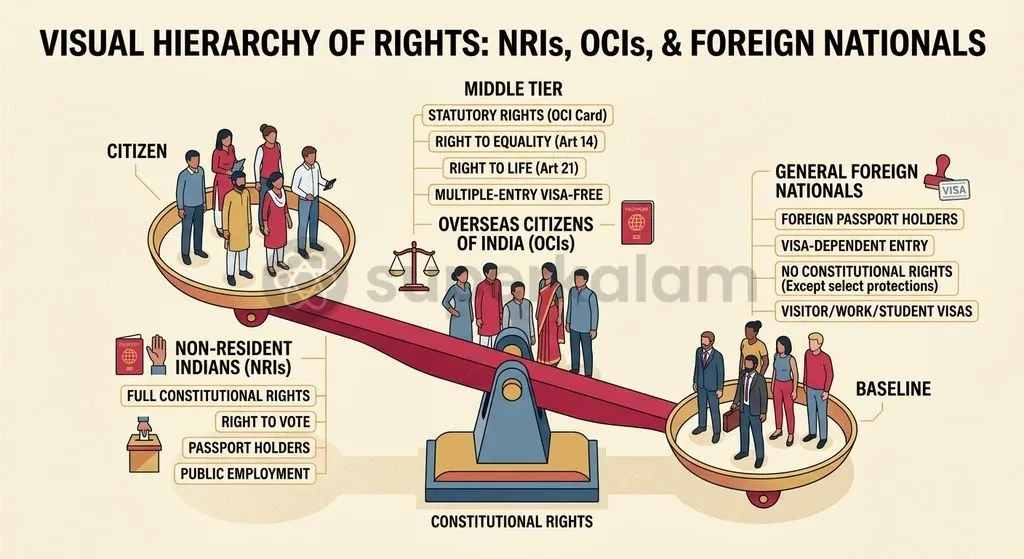
A common legal error conflates Non-Resident Indians (NRIs) with OCI cardholders. Non-Resident Indians are Indian passport holders residing overseas who retain uncompromised citizenship, voting privileges, and full Part III fundamental rights. Conversely, OCI cardholders hold foreign allegiances and possess no constitutional claim to Indian nationality.
Section 7B(2) of the Citizenship Act, 1955 explicitly withholds political entitlements from OCI cardholders. Overseas citizens cannot register as voters under Section 16 of the Representation of the People Act, 1950, nor can they seek election to either House of Parliament or state legislatures. The statute further debars them from occupying constitutional offices, including appointments to the Supreme Court, High Courts, or the office of the President and Vice-President.
| Dimension | Non-Resident Indian (NRI) | Overseas Citizen of India (OCI) | Foreign National (General) |
|---|---|---|---|
| Citizenship Status | Indian Citizen | Foreign Citizen (Statutory Cardholder) | Foreign Citizen |
| Passport Held | Republic of India | Foreign Sovereign State | Foreign Sovereign State |
| Constitutional Freedoms | Full Article 19 protections | Article 19 unavailable | Article 19 unavailable |
| Due Process Protections | Articles 14, 20, 21, and 22 | Articles 14, 20, 21, and 22 | Articles 14, 20, 21, and 22 |
| Political Franchise | Eligible to vote in Indian elections | Strictly barred under Section 7B(2) | Strictly barred |
| Statutory Grounding | Passports Act, 1967 | Citizenship Act, 1955 (Section 7A–7D) | Foreigners Act, 1946 |
| Travel Authorisation | Unrestricted constitutional entry | Multiple-entry lifelong statutory visa | Requires specific visa or permit |
Administrative orders further regulate this conditional legal status. According to Ministry of Home Affairs Gazette Notification S.O. 1050(E) dated March 4, 2021, cardholders must secure special permission from the Foreigners Regional Registration Officer (FRRO) to conduct research, engage in missionary or Tabligh activities, practise journalism, or undertake diplomatic internships.
Clause 2(5) of the same notification clarifies that for all unenumerated activities, cardholders remain equated with general foreign nationals. In addition, consular directives clarify that OCI status confers no diplomatic immunity, leaving holders entirely subject to domestic penal and regulatory codes.
Discuss with Superkalam
Identify the specific statutory grounds enumerated under Section 7D of the Citizenship Act, 1955 that empower the Central Government to revoke an OCI card.
Ask NowInside Section 7D: The Grounds and Thresholds for Cancelling OCI Registration
Section 7D of the Citizenship Act, 1955 enumerates the statutory grounds under which the Central Government can cancel an OCI registration. The executive cannot invent grounds outside these legislative parameters:
- Fraudulent Registration: The registration was obtained through means of fraud, false representation, or the concealment of any material fact under Section 7D(a).
- Disaffection to the Constitution: The cardholder has shown disaffection towards the Constitution of India as by law established under Section 7D(b).
- Trading with the Enemy: The cardholder unlawfully traded or communicated with an enemy during any war in which India was engaged under Section 7D(c).
- Sentenced to Imprisonment: The cardholder was sentenced to imprisonment for a term of not less than two years within five years after registration under Section 7D(d).
- Sovereignty, Security, and Public Interest: Cancellation is necessary in the interests of the sovereignty and integrity of India, state security, friendly relations with foreign states, or the general public interest under Section 7D(e).
- Violation of Notified Laws: The cardholder violated any provision of the Act or any other law specified by the Central Government by notification, under Section 7D(da).
Parliament introduced Section 7D(da) via Section 4 of the Citizenship (Amendment) Act, 2019, significantly broadening executive oversight. Critics initially argued this gave the government unchecked leeway to cancel cards for minor statutory infractions. Addressing these administrative concerns, Ministry of Home Affairs Notification S.O. 3662(E) established specific enforcement thresholds, requiring a formal chargesheet or conviction for serious criminal offences carrying a minimum penalty of seven years of imprisonment.
Section 4 of the Citizenship (Amendment) Act, 2019 enacted a mandatory statutory safeguard. The proviso following Section 7D mandates that no cancellation order can be issued without giving the cardholder a reasonable opportunity of being heard. This statutory clause embeds the principle of natural justice, preventing summary administrative revocation without notice.
Discuss with Superkalam
Explain why Non-Resident Indians (NRIs) and Overseas Citizens of India (OCIs) occupy distinctly different legal and constitutional positions in India.
Ask NowCancellation Versus Expulsion: How the Foreigners Act Interlocks with Revocation
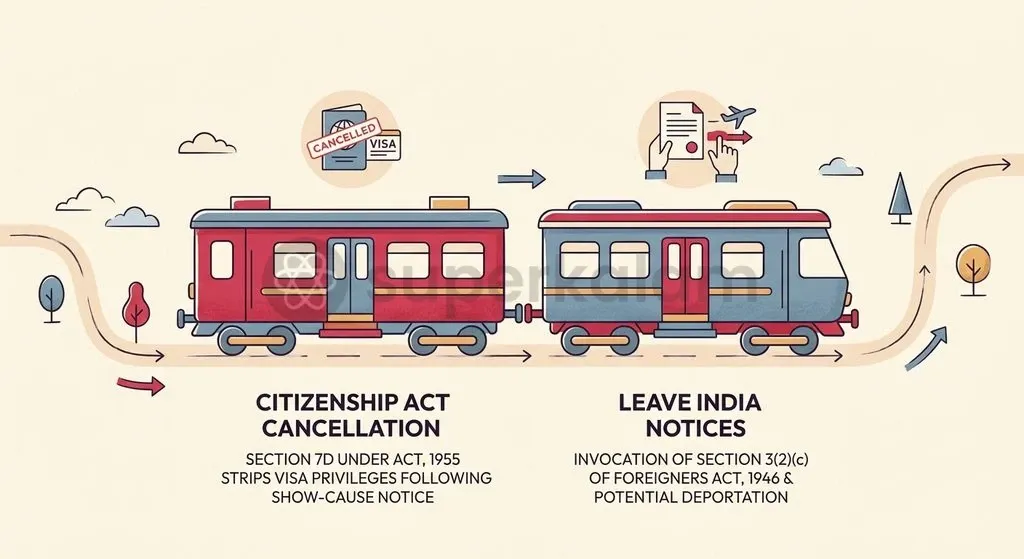
The Foreigners Act, 1946 provides the primary statutory mechanism for immigration enforcement once an OCI registration is revoked. Section 7D cancellation is an administrative condition precedent that immediately strips away the cardholder's statutory right to reside in India. Once the card is annulled, the individual loses their lifelong multi-entry visa privilege and reverts to the status of a standard foreign national.
Section 3(2)(c) of the Foreigners Act, 1946 authorises the Central Government to order that a foreigner shall not remain in India. This provision empowers executive authorities to issue summary Leave India notices, order deportations, or place the individual on entry blacklists.
The administrative procedure moves through defined statutory phases:
- Show-Cause Notice: The Ministry of Home Affairs issues a notice under the Section 7D proviso specifying alleged violations.
- Consideration of Representation: The affected party submits their defence to satisfy the statutory hearing requirement.
- Final Order of Cancellation: The Central Government issues a reasoned order cancelling the OCI registration certificate.
- Invocation of Expulsion Powers: Authorities deploy Section 3(2)(c) of the Foreigners Act, 1946 to mandate departure within a stipulated timeframe.
- Entry Blacklisting: The individual's travel profile is flagged across immigration checkpoints, barring re-entry.
Because the Citizenship Act, 1955 provides no independent statutory tribunal or ombudsman to adjudicate appeals against Section 7D cancellations, an aggrieved party's primary remedy lies in writ petitions filed before High Courts or the Supreme Court.
Discuss with Superkalam
Suppose an OCI cardholder residing in India is issued an expulsion notice under the Foreigners Act without a prior show-cause notice. How can Articles 14 and 21 be invoked to challenge this action?
Ask NowConstitutional Firewalls: Do Articles 14 and 21 Protect Foreign Citizens Facing Deportation?
The Constitution of India constructs an intentional textual dichotomy between rights reserved exclusively for citizens and rights guaranteed to any person. Fundamental freedoms under Article 19—including freedom of speech, assembly, and the right to reside anywhere in India—are textually confined to citizens alone. An OCI cardholder cannot maintain an Article 19 claim against deportation or registration cancellation.
In contrast, Articles 14 and 21 protect any person within Indian territory, irrespective of their nationality. Article 14 bars arbitrary state action and mandates equal protection under the law. Article 21 secures personal liberty, declaring that no person shall be deprived of life or liberty except according to procedure established by law.
| Constitutional Provision | Target Beneficiary | Application to OCI Cardholders |
|---|---|---|
| Article 19 Freedoms | Confined strictly to Indian citizens | Unavailable; cardholders cannot contest cancellation or deportation on speech or residence grounds |
| Articles 14 and 21 Guarantees | Extends to any person within Indian territory | Fully protected against arbitrary state action, procedural unfairness, and unlawful detention |
Judicial doctrine subjects executive deportation and cancellation decisions to distinct constitutional standards:
- Protection Against Arbitrariness: Under Maneka Gandhi v. Union of India (1978), procedures depriving personal liberty under Article 21 must remain non-arbitrary, just, and fair under Article 14.
- Proportionality and Review: As held by the Delhi High Court in Jayantkumar Chandubhai Patel v. Union of India & Anr., deportation powers exercised against long-term OCI residents without proximate national security justifications remain subject to judicial review.
- Direct Evidentiary Connection: The executive cannot rely on broad assertions; it must establish a direct connection between the cardholder's conduct and the statutory harm invoked.
Discuss with Superkalam
Analyse how the introduction of Section 7D(da) via the Citizenship (Amendment) Act, 2019 expanded executive discretion, and how administrative notifications later tempered this power.
Ask NowJudicial Precedents: Where Courts Have Checked or Upheld Arbitrary Revocations
Indian judicial doctrine governing deportation powers has evolved from broad executive deference to meticulous administrative scrutiny. In Hans Muller of Nurenburg v. Superintendent, Presidency Jail, Calcutta (1955), the Supreme Court ruled that executive power to expel foreigners under Section 3(2)(c) of the Foreigners Act is absolute and unfettered by constitutional limitations beyond basic procedural compliance.
This doctrine was clarified in Louis De Raedt v. Union of India (1991). The Supreme Court affirmed that foreign nationals hold Article 21 protections against unlawful deprivation of life and personal liberty, but pointedly possess no Article 19(1)(e) right to reside or settle in India, leaving entry and stay subject to state permission.
Modern constitutional jurisprudence, however, has added strict checks against arbitrary OCI revocations:
- Dr. Christo Thomas Philip v. Union of India (2019): The Delhi High Court quashed the cancellation of a medical doctor's OCI card and the accompanying travel ban. The court held that the Central Government cannot mechanically invoke Section 7D(e) on vague allegations of missionary work without demonstrating an objective threat to sovereignty, security, or public interest.
- Ashok Swain v. Union of India (2023 and 2025): The Delhi High Court twice invalidated executive orders revoking an academic's OCI status under Section 7D(e). The court held that merely quoting statutory terminology as a ritual formula violates the mandatory hearing requirement under the Section 7D proviso when authorities fail to disclose the primary materials, evidence, or specific reasons behind the decision.
These rulings confirm that while the sovereign state retains immigration authority, executive decisions to cancel OCI cards must be backed by tangible evidence and transparent reasoning.

Reconciling National Security, Due Process, and Diaspora Diplomacy
National security considerations require that sovereign nations preserve the power to expel foreign individuals who threaten domestic peace or engage in hostile conduct. Nevertheless, treating OCI cardholders like transient foreign tourists overlooks their structural ties to India. Over four million diaspora members have structured their familial lives, property ownership, and investments around statutory OCI guarantees.
Administrative overreach undermines diaspora trust and degrades India's soft power abroad. Arbitrary cancellations based on dissenting scholarship, political commentary, or unsubstantiated allegations generate reputational costs across international forums. The absence of an independent administrative tribunal leaves foreign nationals burdened by protracted writ litigation under Article 226 of the Constitution.
A sustainable balance requires administrative reforms that reconcile security prerogatives with institutional fairness:
- Internal Appellate Mechanisms: Introducing a statutory appellate tribunal within the Ministry of Home Affairs framework would allow independent judicial minds to examine intelligence reports and evaluate proportionality before cards are revoked.
- Standardised Show-Cause Frameworks: Show-cause notices issued under the Section 7D proviso must supply non-confidential factual summaries of the allegations rather than bare statutory citations.
- Differentiated Security Thresholds: Administrative guidelines should formalise higher evidential thresholds for revoking the status of long-settled OCI residents compared to temporary visa holders.
- Proportional Penalties for Minor Breaches: Implementing graded fines or temporary permit suspensions for technical infractions under Section 7D(da) would prevent disproportionate invocations of full card cancellation.
Anchoring OCI administration in constitutional non-arbitrariness protects national security while preserving the legal and institutional credibility of India's diaspora policy.
Discuss with Superkalam
Evaluate whether the absence of an independent appellate tribunal under the Citizenship Act leaves diaspora members excessively vulnerable to administrative overreach.
Ask NowKey Takeaways
- Statutory Status Over Constitutional Citizenship: OCI status is an administrative scheme under the Citizenship Act, 1955 and does not constitute dual citizenship, which is prohibited under Article 9 of the Constitution.
- Classification under Immigration Law: Under Section 2(a) of the Foreigners Act, 1946, an OCI cardholder is legally classified as a foreigner and lacks political franchise under Section 7B(2) of the Citizenship Act, 1955.
- Statutory Revocation Framework: Section 7D governs OCI cancellations across defined grounds, including fraud, disaffection toward the Constitution, national security, and criminal thresholds notified under Section 7D(da).
- Interlocking Deportation Machinery: Cancelling an OCI card removes the holder's lifelong visa privilege, permitting the state to order expulsion under Section 3(2)(c) of the Foreigners Act, 1946.
- Constitutional Protections Apply: While Article 19 protections are restricted to Indian citizens, Articles 14 and 21 extend to OCI cardholders, mandating reasoned administrative orders, procedural natural justice, and proportionality.
- Judicial Review Safeguards: High Court rulings in Christo Thomas Philip and Ashok Swain establish that executive orders merely reciting statutory clauses without disclosing concrete justifications will be struck down.
Mains Question
"Overseas Citizen of India (OCI) status is a statutory privilege rather than constitutional dual citizenship, yet executive discretion in revoking it remains tethered to constitutional firewalls." Examine the grounds of revocation under Section 7D of the Citizenship Act, 1955, and the procedural constraints imposed on executive power. (10 Marks)
Evaluate NowMains Question
'The interlocking application of Section 7D of the Citizenship Act, 1955 and Section 3 of the Foreigners Act, 1946 illustrates the delicate friction between sovereign border control and constitutional non-arbitrariness.' Critically analyse. (15 Marks)
Evaluate NowPractice MCQs
QUESTION 1
With reference to the legal status of an Overseas Citizen of India (OCI) cardholder, consider the following statements:
- An OCI cardholder is legally classified as a foreigner under Section 2(a) of the Foreigners Act, 1946.
- OCI cardholders enjoy fundamental freedoms guaranteed under Article 19 of the Constitution on par with Non-Resident Indians (NRIs).
- Under Section 7B(2) of the Citizenship Act, 1955, OCI cardholders are ineligible to register as voters under the Representation of the People Act, 1950.
Which of the statements given above are correct?
QUESTION 2
Consider the following statements regarding the statutory grounds for cancellation of an OCI registration under Section 7D of the Citizenship Act, 1955:
- An OCI registration can be cancelled if the cardholder is sentenced to imprisonment for not less than two years within five years of registration.
- The proviso following Section 7D allows summary cancellation of OCI registration without a hearing in matters concerning state security.
- Section 7D(da), introduced via the Citizenship (Amendment) Act, 2019, permits cancellation for violating any law notified by the Central Government.
Which of the statements given above is/are correct?
QUESTION 3
Regarding the regulatory regime governing Overseas Citizen of India (OCI) cardholders under Ministry of Home Affairs Notification S.O. 1050(E), consider the following statements:
- Prior permission from the Foreigners Regional Registration Officer (FRRO) is mandatory for an OCI cardholder to engage in journalistic or missionary activities.
- Cardholders enjoy diplomatic immunity against domestic penal prosecution in India.
- For activities not explicitly enumerated in the notification, cardholders are treated on par with general foreign nationals.
Which of the statements given above is/are correct?
QUESTION 4
Which of the following provisions of the Foreigners Act, 1946 empowers the Central Government to issue summary 'Leave India' notices or expulsion orders against foreign nationals, including former OCI cardholders following revocation?
QUESTION 5
Consider the following statements regarding the constitutional protections available to OCI cardholders facing expulsion:
- OCI cardholders are protected against arbitrary state action under Article 14 of the Constitution.
- The procedural protections of Article 21 do not extend to foreigners residing in India.
- The Citizenship Act, 1955 establishes an independent statutory tribunal to hear appeals against Section 7D cancellation orders.
Which of the statements given above is/are correct?