Data Centres in India: Why NITI Aayog Green Norms Matter for AI Growth
NITI Aayog green norms for data centres explained: the energy and water demands of AI compute, green metrics, and India climate pledges.
Oct, 2026
•10 min read
Context
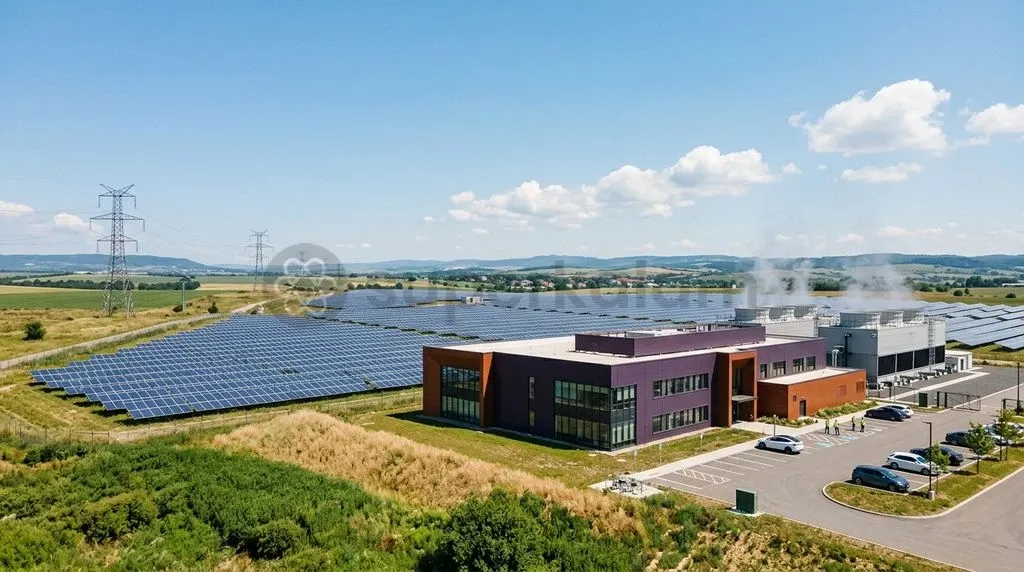
India's push to scale sovereign artificial intelligence compute infrastructure risks deepening localised water distress. Expanding server clusters also destabilises regional power grids unless states replace uncoordinated fiscal subsidies with enforceable environmental operating standards.
High-density server clusters draw unprecedented baseload electricity and cooling volumes across major metropolitan hubs. To resolve this friction between digital industrial targets and national decarbonisation goals, NITI Aayog released a five-pillar evaluation model designed to align sub-national industrial incentives with long-term ecological limits.
Why in the News?
The Union Government faces an escalating operational contradiction between expanding sovereign artificial intelligence capacity and meeting statutory climate commitments.
Key policy milestones highlight this collision between digital infrastructure and green energy targets:
- Compute Expansion: The Union Cabinet approved the comprehensive IndiaAI Mission in March 2024 with a financial outlay of ₹10,372 crore over five years to onboard more than 10,000 GPUs.
- Thermal and Energy Draw: This build-out demands round-the-clock baseload power drawing 40 kW to over 120 kW per AI rack. This draw collides with India's updated Panchamrit pledges to install 500 GW of non-fossil capacity by 2030 and achieve Net-Zero emissions by 2070.
- Standardised State Guidance: As of October 2026, NITI Aayog stepped into this policy vacuum. The think tank published the Data Centre Evaluation Framework to Help States Plan for Sustainable Growth on 14 October 2026, establishing standardised operating guidelines for state industrial departments.
Discuss with Superkalam
What are the five core operational pillars outlined in NITI Aayog's evaluation model for green data centres?
Ask NowHow Compute Growth Threatens Power Grids and Water Tables
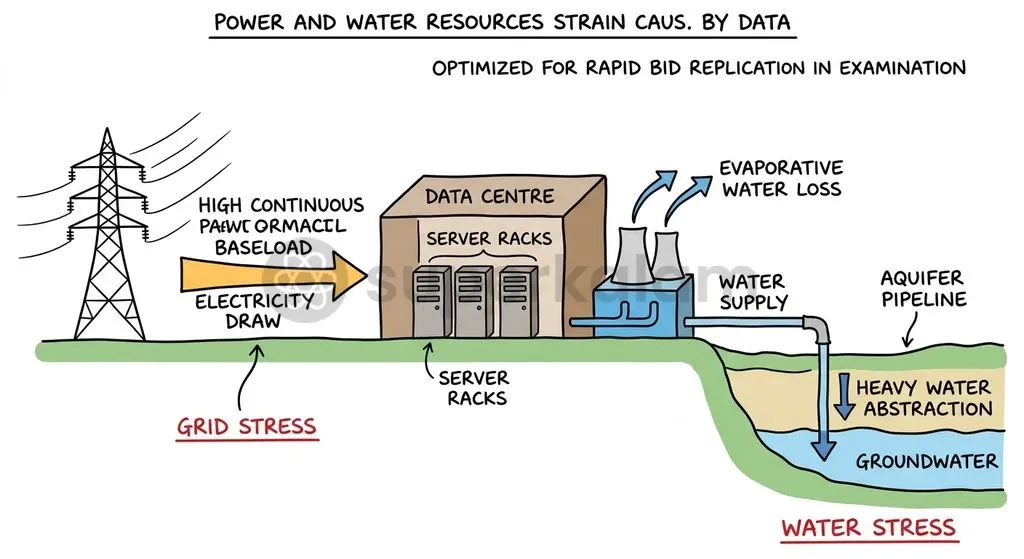
The Central Electricity Authority and energy planners face severe localised strain because compute infrastructure concentrates geographically rather than dispersing evenly across India.
Three primary structural bottlenecks define this physical resource crunch:
- Rapid Capacity Growth: According to a PIB release on NITI Aayog's Frontier Tech Hub Data Centre Evaluation Framework (PRID 2323840), India's installed data centre capacity grew from approximately 375 MW in 2020 to roughly 1.5 GW by late 2026. Projections indicate the sector will reach between 4.5 GW and 6.5 GW by 2030.
- Geographic Transmission Bottlenecks: Greater Mumbai hosts over 50% of total national operational capacity, driven by international undersea fibre-optic cable landing points. When gigawatt-scale loads tether to coastal urban nodes, transmission networks experience severe peak congestion.
- Aquifer Depletion: Data centres utilising evaporative cooling towers are reported to withdraw between 1 million and 5 million litres of potable water daily, according to findings cited in the NITI Aayog launch proceedings (reported October 2026). In semi-arid corridors and over-extracted urban aquifers, continuous industrial withdrawals deplete municipal groundwater reserves that local populations rely on.
Why Regional Tech Competition Bypasses Climate Goals
Sub-national industrial policy in India has triggered a fiscal race to the bottom that systematically overlooks environmental costs. State governments offer aggressive incentives to secure capital investments after the Department of Economic Affairs granted data centres Infrastructure Status in October 2022 for facilities exceeding 5 MW total capacity or 3 MW IT load.
Leading industrial states compete by trading away utility revenues and power stability:
- Maharashtra: The state's IT and ITES Policy provides a power tariff subsidy of ₹1 per kWh for five years alongside permanent electricity duty exemptions for facilities operating outside Zone-I.
- Uttar Pradesh: The state's Data Centre Policy grants a 7% capital subsidy up to ₹20 crore, a 100% electricity duty exemption for 10 years, and state-funded dual-grid transmission feed support.
- Tamil Nadu: Under its sector-specific policy, the state delivers a 100% electricity tax waiver for five years and offers a 50% concession on conventional open access charges.
These incentive architectures lack binding ecological riders. States reward land uptake and capital deployment while ignoring cooling efficiency, water source sustainability, or peak-load stress. Public distribution utilities ultimately absorb the balance-sheet risks of dedicated infrastructure.
Discuss with Superkalam
Why do standard evaporative cooling systems pose an acute ecological challenge in semi-arid Indian urban hubs?
Ask NowStandardizing Green Metrics for Compute
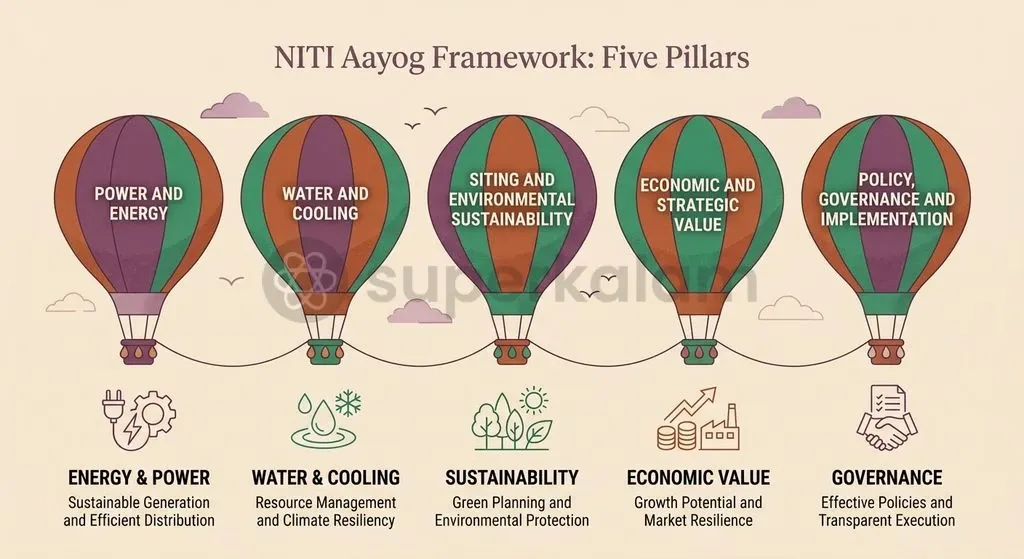
NITI Aayog's Frontier Tech Hub structured its framework around five operational pillars to replace fragmented state-level rules with objective technical thresholds.
| Evaluation Pillar | Operational Focus & Compliance Requirement |
|---|---|
| 1. Power & Energy | Calibrated operating PUE baselines, demand-response capability, and telemetry |
| 2. Water & Cooling | Water Usage Effectiveness (WUE) metrics and non-potable closed-loop chilling |
| 3. Siting & Environment | Siting in renewable-rich zones, zero freshwater draw in stressed basins, and emissions roadmaps |
| 4. Economic & Strategic | Sovereign compute prioritization and deployment of indigenous server architectures |
| 5. Policy & Governance | Milestone-based fiscal incentives replacing unconditional tax and tariff exemptions |
The framework reframes efficiency assessment across key technical operational areas:
- Climate-Calibrated PUE: Instead of enforcing rigid Western metrics, the framework mandates modelled design Power Usage Effectiveness (PUE) and guaranteed operating PUE calibrated against Indian ambient conditions, including dry summer temperatures touching 40°C.
- Catchment Water Balances: Approvals require assessing Water Usage Effectiveness (WUE) alongside a comprehensive 20-to-30-year seasonal catchment water balance covering municipal supplies, groundwater basins, and surrounding agricultural requirements.
- Basin-Level Freshwater Prohibitions: In river basins experiencing critical water stress, the framework prohibits any additional freshwater abstraction, obliging facilities to deploy desalinated water or recycled grey wastewater.
- Grid Telemetry Integration: For facilities demanding loads above 20 MW, states must require automated demand-response capability and real-time telemetry linked directly to State Load Despatch Centres (SLDCs).
- Pollution and Lifecycle Mandates: Developers must submit time-bound diesel generator replacement roadmaps using Battery Energy Storage Systems (BESS), biofuels, or green hydrogen, backed by formal decommissioning mechanisms for e-waste and battery storage.
Current State Subsidies vs NITI Aayog's Green Norms
The operational divergence between current regional policies and NITI Aayog's evaluation approach marks a shift from unconditional state concessions to enforceable technical accountability.
| Policy Dimension | Uncoordinated State Policies (Current Practice) | NITI Aayog Green Evaluation Framework |
|---|---|---|
| Incentive Structure | Upfront capital expenditure subsidies, stamp duty waivers, and unconditional tax cuts | Milestone-based disbursements conditioned on audited PUE, verified WUE, and domestic hardware use |
| Power Support | Concessional tariffs (e.g., ₹1/kWh discount) and prolonged electricity duty exemptions | Developers fund 100% of dedicated substations; mandatory automated demand response for loads >20 MW |
| Water Scrutiny | Unmonitored municipal allocation or unmetered local borewell abstraction | Mandatory 20-30 year catchment water balance; zero freshwater abstraction in stressed basins |
| Cooling Standards | Left to developer preference; heavy deployment of evaporative cooling towers | Measured operating WUE targets; deployment of closed-loop systems, recycled water, or desalination |
| Emissions Strategy | Unrestricted reliance on multi-megawatt backup diesel generator banks | Mandatory lifecycle carbon accounting and scheduled phase-out roadmaps using BESS or clean fuels |
| Grid Integration | Passive baseload off-take placing strain on public distribution licensees | Real-time telemetry linked to SLDCs to enable frequency stabilization and peak clipping |
Discuss with Superkalam
How does heavy data centre concentration in coastal cities like Mumbai impact regional transmission networks and municipal resources?
Ask NowBaseload Renewable Power, Circular Cooling, and Water Audits
The Bureau of Energy Efficiency faces complex implementation hurdles when translating these evaluation guidelines into binding operational realities. The Energy Conservation (Amendment) Act, 2022 provides statutory authority to establish the Indian Carbon Market (CCTS) and mandate non-fossil energy consumption quotas for designated energy-intensive consumers.
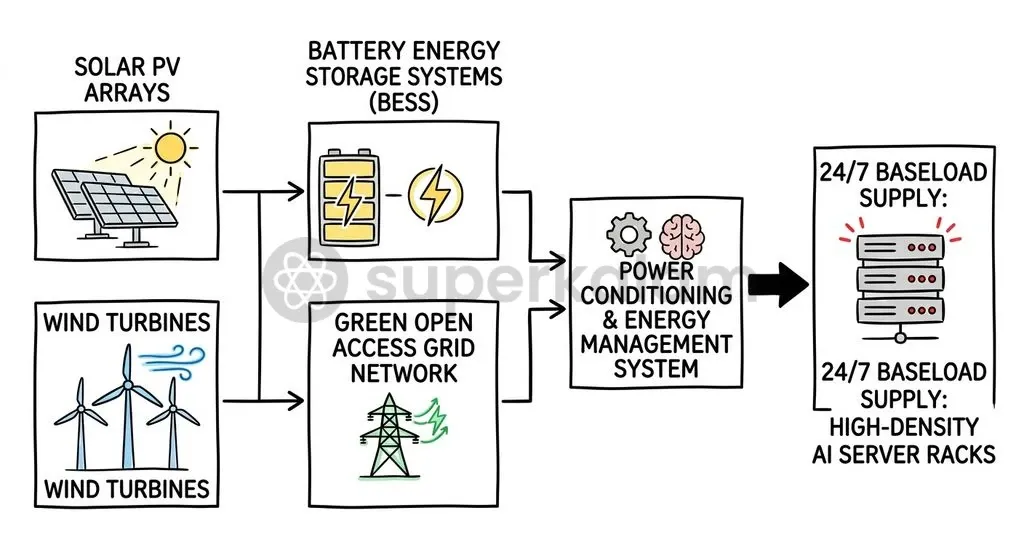
Intermittent clean generation cannot easily sustain round-the-clock server racks. Solar and wind generation profiles leave steep gaps during non-generating hours. Facilities lean heavily on thermal grid power during evening peaks unless they procure dedicated storage or firm clean energy.
| Hyperscale Supply Layer | Operational Role & Power Delivery Channel |
|---|---|
| Renewable Generation | Dedicated solar and wind off-take procured via open access agreements |
| Storage Balancing | Battery Energy Storage Systems (BESS) discharging during peak renewable deficits |
| Grid Telemetry | Real-time coordination with State Load Despatch Centres to preserve frequency |
| Continuous Power Draw | Round-the-clock baseload delivered to high-density racks drawing 40 kW to 120 kW |
Water audits present similar structural frictions. While dry cooling avoids massive water evaporation, it incurs an efficiency penalty by driving up auxiliary electricity consumption when ambient temperatures exceed 40°C.
To break this operational deadlock, NITI Aayog advises state governments to establish planned data-centre-ready zones pre-assessed for power and water availability. Siting clusters inside renewable-rich energy corridors eliminates long-distance transmission wheeling losses and avoids straining metropolitan aquifers.
Resource Diversion and Regional Equity
NITI Aayog Member Prof. Abhay Karandikar warned of acute economic distortions if multinational corporations consume subsidized Indian resources to export raw compute overseas. Domestic value capture remains negligible when global cloud operators build server farms purely for cheap water, subsidised power, and tax holidays without developing local intellectual property.
The ethical dimensions of this allocation model directly engage administrative fairness under public resource management. When regional utilities guarantee uninterruptible 24/7 grid stability and water access to private server campuses, drought-prone agricultural regions and underserved urban households face heightened load-shedding and supply curbs.
To protect public funds, the framework recommends that developers pay the full capital cost of dedicated electricity substations and transmission links rather than passing grid upgrade costs onto domestic rate-payers.
Furthermore, state industrial bodies are urged to separate passive real-estate models from active compute services:
- Passive Models: Colocation spaces and powered shells create minimal permanent employment and limited domestic software integration, warranting strict regulatory oversight rather than heavy fiscal hand-outs.
- Active Services: Cloud services supporting sovereign machine-learning workloads, GPU-as-a-Service deployments, and facilities adopting domestic hardware—such as C-DAC's indigenously developed Rudra server under the National Supercomputing Mission—merit targeted, milestone-governed support.
Discuss with Superkalam
Should state governments replace all upfront fiscal incentives for technology parks with mandatory environmental milestone audits?
Ask NowBlending Green Open Access with Mandatory Energy Efficiency Standards
The Ministry of Power established a legal pathway for industrial decarbonisation by notifying the Green Energy Open Access Rules in June 2022, lowering the minimum transaction limit from 1 MW to 100 kW. This threshold allows mid-sized server operators to contract off-site solar and wind power directly without negotiating high utility surcharges.
To institutionalize NITI Aayog's five-pillar model, statutory bodies must coordinate across three administrative priorities:
- Bureau of Energy Efficiency (BEE) Mandates: The Ministry of Power should notify data centres as designated consumers under the Energy Conservation Act, setting mandatory operating PUE caps adjusted for regional climatic zones.
- Statutory Water Footprint Audits: State Pollution Control Boards must mandate seasonal water audits, requiring facilities in semi-arid districts to install circular, closed-loop chilling loops or tap tertiary-treated urban effluent.
- Milestone-Based Fiscal Disbursements: State industrial departments must restructure concession agreements, releasing fiscal incentives only after third-party audits verify operating PUE benchmarks and documented domestic compute utilisation.
Coordinating industrial policy across state lines ensures that India's digital computing expansion strengthens national economic resilience without undermining local environmental security.
Key Takeaways
- India's installed data centre capacity reached approximately 1.5 GW by late 2026 and is projected to expand to 4.5–6.5 GW by 2030, driven by the ₹10,372 crore IndiaAI Mission.
- The high thermal density of artificial intelligence workloads (40 kW to over 120 kW per rack) creates an operational clash with India's target of 500 GW non-fossil capacity by 2030 and Net-Zero by 2070.
- Unregulated sub-national competition has led states like Maharashtra, Uttar Pradesh, and Tamil Nadu into a subsidy race, offering long-term tax waivers without binding ecological conditions.
- NITI Aayog's five-pillar framework introduces climate-calibrated operating PUE baselines, 20-to-30-year seasonal catchment water balances, and complete bans on additional freshwater extraction in stressed river basins.
- Decarbonisation enforcement relies on integrating the Green Energy Open Access Rules 2022 (100 kW threshold) with consumption mandates under the Energy Conservation (Amendment) Act, 2022.
Mains Question
'Uncoordinated sub-national fiscal competition to attract AI compute infrastructure risks severe local ecological degradation and grid instability.' In the light of NITI Aayog's Data Centre Evaluation Framework, critically examine the shift needed from unconditional state subsidies to enforceable operational standards. (15 Marks)
Evaluate NowMains Question
Explain how NITI Aayog's Frontier Tech Hub framework addresses the operational contradictions between expanding sovereign artificial intelligence compute capacity and ensuring regional ecological sustainability. (10 Marks)
Evaluate NowPractice MCQs
QUESTION 1
With reference to the 'Data Centre Evaluation Framework to Help States Plan for Sustainable Growth' released by NITI Aayog, consider the following statements:
- It mandates real-time telemetry linked directly to State Load Despatch Centres (SLDCs) for facilities demanding loads above 20 MW.
- In river basins experiencing critical water stress, the framework allows unrestricted freshwater abstraction provided a 10% water tax is remitted to state utilities.
- It replaces rigid Western Power Usage Effectiveness (PUE) baselines with modelled design and operating PUE calibrated against Indian ambient conditions. Which of the statements given above is/are correct?
QUESTION 2
Regarding the digital and energy infrastructure landscape in India, consider the following statements:
- Under the Department of Economic Affairs notification of October 2022, data centres were granted Infrastructure Status for facilities exceeding 5 MW total capacity or 3 MW IT load.
- Greater Mumbai accounts for less than 15% of India's total national operational data centre capacity due to coastal inland restrictions.
- The IndiaAI Mission approved by the Union Cabinet in March 2024 aims to onboard more than 10,000 GPUs over five years. Which of the statements given above is/are correct?
QUESTION 3
Consider the following statements regarding sub-national data centre policies in India:
- Maharashtra's IT and ITES Policy offers a power tariff subsidy of ₹1 per kWh for five years alongside permanent electricity duty exemptions outside Zone-I.
- Uttar Pradesh's Data Centre Policy provides a 7% capital subsidy capped at ₹20 crore and a 100% electricity duty exemption for 10 years.
- Tamil Nadu offers a 100% electricity tax waiver for five years along with a 50% concession on conventional open access charges. Which of the statements given above are correct?
QUESTION 4
The five evaluation pillars formulated by NITI Aayog's Frontier Tech Hub for sustainable data centres explicitly incorporate which of the following requirements?
- Water Usage Effectiveness (WUE) metrics and non-potable closed-loop chilling
- Mandatory deployment of dedicated coal-fired captive plants to ensure uninterrupted baseload
- Scheduled diesel generator replacement roadmaps using Battery Energy Storage Systems (BESS) or clean fuels
- Milestone-based disbursements conditioned on audited technical metrics replacing unconditional upfront subsidies Select the correct answer using the code given below:
QUESTION 5
Which statutory enactment empowers the Central Government to establish the Indian Carbon Market (CCTS) and mandate non-fossil energy consumption quotas for designated energy-intensive consumers?
Related Blogs

PMFBY and WINDS: Why the Stalled Weather Station Rollout Matters for Crop Insurance
Oct, 2026
•9 min read

National Strategic Trade Command Centre (NSTCC): What It Is, Functions and SCOMET Link
Oct, 2026
•9 min read

Women-Led Development in India: Meaning, Constitutional Basis and the Asset Gap
Oct, 2026
•9 min read


