National Strategic Trade Command Centre (NSTCC): What It Is, Functions and SCOMET Link
National Strategic Trade Command Centre (NSTCC) explained: what it is, its functions, DGFT role, and what it means for SCOMET dual-use export controls.
Oct, 2026
•9 min read
Overview
On 15 October 2026, the Ministry of Commerce and Industry launched the National Strategic Trade Command Centre to unify India's fragmented dual-use export oversight, bridging the structural divide between domestic high-tech manufacturing ambitions and rigorous international non-proliferation enforcement. This command architecture establishes a centralised, data-driven intelligence node designed to streamline compliance, enforce strategic export restrictions, and secure supply-chain trust with global technology partners. As India expands high-technology commerce under bilateral initiatives like the US-India Initiative on Critical and Emerging Technologies, balancing stringent regulatory oversight with industrial agility has emerged as the definitive test of India's contemporary economic diplomacy and strategic autonomy.
Why in the News? The Push for a Unified Strategic Trade Watchdog
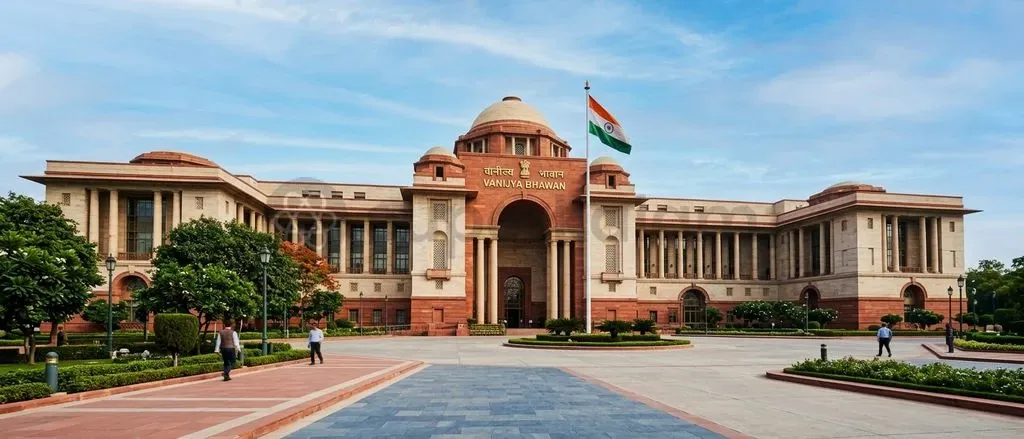
The Ministry of Commerce and Industry launched the National Strategic Trade Command Centre (NSTCC) on 15 October 2026 at Vanijya Bhawan, New Delhi. This institutional initiative operates as a consolidated, data-driven intelligence and monitoring hub according to a PIB Delhi release. Prior to this establishment, strategic trade governance was distributed unevenly across multiple departmental desks, creating protracted clearance delays for domestic manufacturers.
During the launch review of the strategic trade dashboard, Union Minister Piyush Goyal directed the Inter-Ministerial Committee to convene weekly meetings to eliminate application backlogs expeditiously. The regulatory architecture anchors itself legally in Chapter IVA of the Foreign Trade (Development and Regulation) Act, 1992, alongside the Weapons of Mass Destruction and their Delivery Systems (Prohibition of Unlawful Activities) Act, 2005. As of October 2026, the command centre marks India's transition toward institutionalised, real-time export surveillance to reconcile domestic industrial growth with binding international non-proliferation commitments.
The Central Dilemma: Expanding Tech Exports Without Spreading Weapons Risks
India's manufacturing strategy under the Make in India initiative encounters an inherent structural friction between rapid export growth and non-proliferation risk management. Civilian technological capabilities in aerospace, telecommunications, and advanced chemicals frequently mirror the inputs required for conventional armaments and weapons of mass destruction. Expanding high-tech commercial exports without robust end-use monitoring risks diversion to illicit programmes, which would invite punitive sanctions from multilateral technology cartels.
This dynamic creates an acute diplomatic trade-off for Indian foreign policy. Deeper alignment with Western export architectures, particularly through bilateral frameworks with the United States, requires accepting intrusive supply-chain audits and stringent third-party transfer limits. While access to cutting-edge components unlocks commercial scaling, it simultaneously tests India's strategic autonomy by conditioning domestic industrial workflows on external non-proliferation standards. Resolving this tension demands an enforcement mechanism that guarantees leakage-proof end-user verification while insulating compliant domestic enterprises from administrative paralysis.
Discuss with Superkalam
Which three multilateral export control regimes has India successfully acceded to, and which one remains pending?
Ask NowWhat is SCOMET and How Does India Track Dual-Use Technology?
The Directorate General of Foreign Trade regulates dual-use items through the SCOMET list, which classifies dual-use goods, software, and technologies under Indian trade law. Codified as Appendix 3 to Schedule 2 of the ITC (HS) Classification, SCOMET governs items possessing both civilian industrial utility and potential weaponised applications according to the DGFT Strategic Trade Control System Handbook.
Statutory control over dual-use commerce relies on two primary legislative pillars:
- Foreign Trade (Development and Regulation) Act, 1992: Chapter IVA, inserted via the 2010 amendment, empowers the Union government to regulate or prohibit goods, technologies, or services related to weapons of mass destruction.
- Weapons of Mass Destruction Act, 2005: Act No. 21 of 2005 criminalises the unauthorised export, transfer, brokering, or transit of nuclear, chemical, and biological materials and their delivery systems.
- Catch-All Provisions: Under Para 10.05 of the Foreign Trade Policy 2023, exporters must obtain licences even for unlisted items if notified that goods may serve illicit military or proliferation end-uses.
- Intangible Technology Transfers (ITT): Regulatory controls extend beyond physical cargo to encompass software codes, engineering blueprints, and electronic transmissions over digital networks.
India's enforcement framework directly upholds United Nations Security Council Resolution 1540 (2004), which mandates all United Nations member states to prevent non-state actors from securing mass-destruction technologies.
| Dimension | SCOMET Dual-Use Regime | General Commercial Trade |
|---|---|---|
| Statutory Mandate | FTDR Act 1992 (Chapter IVA) and WMD Act 2005 | FTDR Act 1992 (General Provisions) |
| Licensing Default | Restricted; mandatory inter-ministerial licence | Free, unless placed under restricted or prohibited import-export lists |
| Standard Authorisation Validity | 24 months (with revalidation up to 12 months) | Linked to shipment terms or Foreign Trade Policy schemes |
| Transfer Scope | Governs physical shipments and Intangible Technology Transfers | Primarily physical goods and standard services |
| Penal Liabilities | IEC revocation, heavy fines, and criminal imprisonment | Civil fines, fiscal penalties, or customs confiscation |
Inside the NSTCC: How the New Command Centre Operates
The National Strategic Trade Command Centre establishes a unified operational architecture to monitor dual-use transactions across India's foreign trade ecosystem. Operating from Vanijya Bhawan, the facility integrates fragmented operational streams from core Directorate General of Foreign Trade (DGFT) domains, as detailed in reports from the Ministry of Commerce and Industry.
The NSTCC architecture plans progressive integration across external regulatory and security nodes, based on Akashvani News reporting on the launch:
- Trade Platform Synthesis: The centre synthesises data across Importer-Exporter Codes (IEC), Advance Authorisations, Export Promotion Capital Goods (EPCG) licences, and Certificates of Origin.
- Inter-Agency Intelligence Sharing: Operational pipelines link DGFT databases with Customs (ICEGATE) and national security agencies to identify shell trading entities and suspicious shipping routings.
- Weekly Inter-Ministerial Review: The Inter-Ministerial Working Group processes technical assessments on a weekly cycle to reduce the historical licensing bottleneck.
- End-Use Verification: Advanced analytics cross-reference physical export declarations against verified consignee registries and international sanction watchlists.
Discuss with Superkalam
How does an Intangible Technology Transfer (ITT) complicate the monitoring of dual-use controls compared to physical customs clearance?
Ask NowThe Geopolitical Stakes: Unlocking Western Tech and the US iCET Deal
The United States and European allies treat robust export control enforcement as an absolute prerequisite for advanced technology transfer. Sensitive bilateral engagements, including the US-India Initiative on Critical and Emerging Technologies (iCET) launched in 2023, require recipient nations to maintain verifiable safeguards against unauthorized third-party leakage, as affirmed by the US Bureau of Industry and Security.
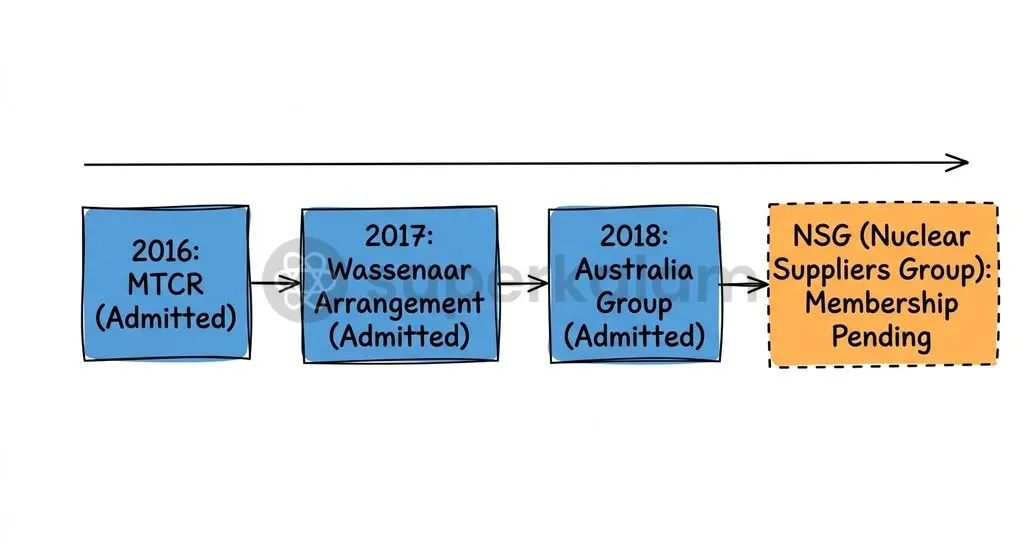
India's integration into global non-proliferation regimes has advanced substantially across three major non-proliferation bodies:
- Missile Technology Control Regime (MTCR): India gained admission as the 35th member on 27 June 2016, facilitating access to high-end unmanned aerial systems and cryogenic technology.
- Wassenaar Arrangement: On 8 December 2017, India joined as the 42nd participating state, aligning its conventional arms and dual-use classification lists with global non-proliferation baselines.
- Australia Group: Admitted as the 43rd member on 19 January 2018, India harmonised chemical and biological export controls with international counter-proliferation benchmarks.
Despite its accession to three regimes, India's entry into the Nuclear Suppliers Group (NSG) remains blocked by China due to Beijing's insistence on Non-Proliferation Treaty (NPT) signatory status. Through the India-US Strategic Trade Dialogue (IUSSTD) under iCET, India uses the NSTCC to prove its strategic export controls match Western standards. Demonstrating airtight export enforcement allows India to negotiate exemptions from restrictive licensing regimes in strategic areas like semiconductors, artificial intelligence, quantum computing, and defence aerospace.
Roadblocks: Compliance Burdens on Indian Startups and MSMEs
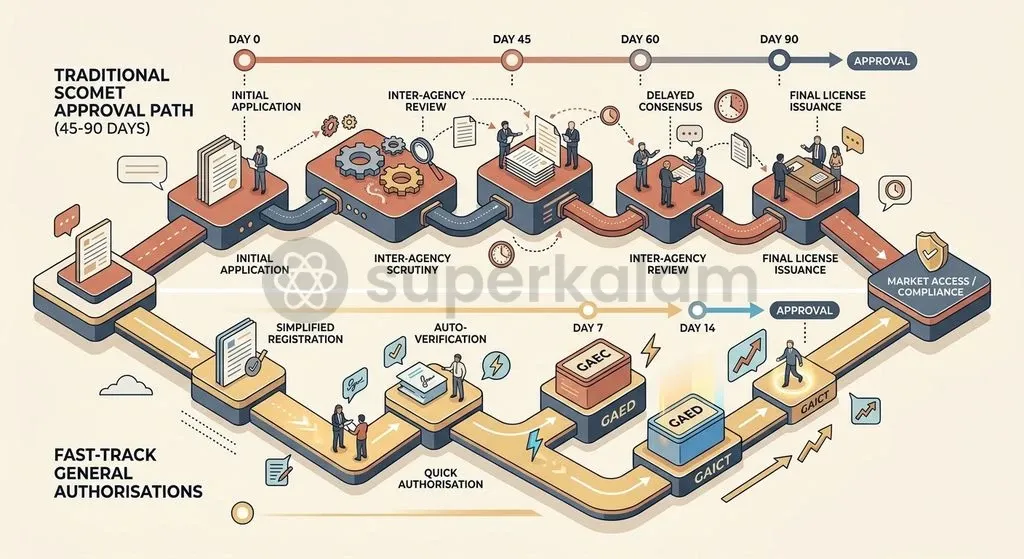
Indian private defence startups and micro, small, and medium enterprises face steep operational friction under rigorous dual-use licensing procedures. Complex documentation and extensive inter-ministerial screening historically lengthened SCOMET approval timelines to between 45 and 90 days according to industry compliance analyses presented at DGFT strategic trade conferences.
To balance regulatory enforcement with commercial efficiency, the Directorate General of Foreign Trade maintains specialised general authorization mechanisms:
- Chemicals Authorisation (GAEC): A five-year blanket export authorisation for chemicals and related equipment granted to pre-approved destination nations.
- Drones Authorisation (GAED): A three-year multi-shipment licence covering civilian uncrewed aerial vehicles under SCOMET Category 5B.
- Intra-Company Authorisation (GAICT): A three-year approval mechanism facilitating software and design technology transfers between Indian firms and overseas parent entities.
Small manufacturing enterprises frequently struggle to utilise these tiered authorisations. Securing GAED or GAICT clearance requires companies to maintain a certified Internal Compliance Programme (ICP) or Authorised Economic Operator (AEO) status. The substantial technical and legal overhead needed to implement corporate compliance programmes discourages smaller engineering firms, creating an entry barrier that risks centralising dual-use manufacturing within established industrial conglomerates.
Discuss with Superkalam
Analyse the trade-off between accepting intrusive Western supply-chain audits under iCET and preserving domestic strategic autonomy.
Ask NowWay Forward: Creating a Credible Yet Business-Friendly Export Regime
Building a credible export control regime requires lowering administrative overheads for domestic technology innovators while maintaining stringent proliferation safeguards. The Directorate General of Foreign Trade should broaden general authorisations to cover emergent categories like quantum computing and microelectronics to prevent compliance backlogs.
+-----------------------------------------------------------------------------+
|                     POLICY ROADMAP FOR REFORMED SCOMET                      |
+-----------------------------------------------------------------------------+
|  1. Broaden Authorisations: Extend GAED models to AI and quantum sectors.   |
|  2. Digitize Screening: Use algorithmic verification for low-risk exports.  |
|  3. Subsidise ICP: Provide compliance toolkits to defence MSMEs.            |
|  4. Deepen Partnerships: Standardise end-user agreements via IUSSTD.        |
+-----------------------------------------------------------------------------+
Institutional reforms must focus on several practical administrative measures:
- Algorithmic Clearance Pipelines: Deploy automated risk profiling within the NSTCC dashboard to process low-risk component shipments, reserving manual screening for sensitive destinations.
- Subsidised Compliance Toolkits: Develop standardised internal compliance templates and training programmes tailored for defence startups and academic research institutions.
- Harmonised Inter-Agency Workflows: Maintain the weekly meeting mandate for the Inter-Ministerial Committee to prevent inter-agency referrals from stalling commercial delivery schedules.
- Bilateral Verification Protocols: Leverage the India-US Strategic Trade Dialogue to establish mutually recognised end-user certificates, reducing duplicated technical reviews across partnering jurisdictions.
Discuss with Superkalam
How should India design its strategic export control policies to safeguard national security without stifling private MSMEs and tech startups?
Ask NowKey Takeaways
- The Ministry of Commerce and Industry established the National Strategic Trade Command Centre (NSTCC) on 15 October 2026 to consolidate trade intelligence and dual-use export monitoring at Vanijya Bhawan.
- SCOMET items, codified under Appendix 3 to Schedule 2 of the ITC (HS) Classification, derive their statutory authority from Chapter IVA of the Foreign Trade (Development and Regulation) Act, 1992, and the WMD Act, 2005.
- Strategic trade controls govern both tangible material shipments and Intangible Technology Transfers (ITT), including technical blueprints, software codes, and digital network transmissions.
- India maintains membership in three key multilateral export control cartels (MTCR, Wassenaar Arrangement, and Australia Group), while its Nuclear Suppliers Group membership remains stalled by China.
- General authorisations like GAEC, GAED, and GAICT mitigate operational compliance friction, but mandatory Internal Compliance Programmes present financial hurdles for domestic MSMEs and deep-tech startups.
Mains Question
"Balancing stringent regulatory oversight with industrial agility has emerged as the definitive test of India's contemporary economic diplomacy and strategic autonomy." In the light of the establishment of the National Strategic Trade Command Centre (NSTCC), critically analyse how India can reconcile its high-tech export ambitions with international non-proliferation obligations. (15 Marks)
Evaluate NowMains Question
Examine the statutory and operational architecture of the SCOMET regime in India. To what extent does the newly operationalised National Strategic Trade Command Centre address the structural bottlenecks faced by domestic manufacturers? (10 Marks)
Evaluate NowPractice MCQs
QUESTION 1
Regarding the statutory and institutional framework governing strategic dual-use trade in India, consider the following statements:
- Chapter IVA of the Foreign Trade (Development and Regulation) Act, 1992 explicitly empowers the Union Government to regulate or prohibit goods, technologies, or services related to weapons of mass destruction.
- Under the SCOMET architecture, Category 0 items relating to nuclear materials fall under the administrative jurisdiction of the Department of Defence Production.
- Intangible Technology Transfers (ITT) are excluded from SCOMET controls, limiting the Directorate General of Foreign Trade's regulatory mandate strictly to physical cargo. Which of the statements given above is/are correct?
QUESTION 2
With reference to India's participation in multilateral export control regimes and bilateral technology partnerships, consider the following statements:
- India joined the Missile Technology Control Regime (MTCR) as its 35th member and the Wassenaar Arrangement as its 42nd participating state.
- India is currently a full participating member of all four major multilateral export control regimes, including the Nuclear Suppliers Group.
- The India-US Strategic Trade Dialogue functions under the Initiative on Critical and Emerging Technologies (iCET) framework to facilitate licensing exemptions in strategic domains. Which of the statements given above are correct?
QUESTION 3
Consider the following statements regarding the regulatory instruments under India's strategic trade control mechanism:
- The 'Catch-All' principle under Para 10.05 of the Foreign Trade Policy mandates export licences even for unlisted goods if notified of potential proliferation or military end-uses.
- The standard licensing authorisation validity for dual-use items under SCOMET is 24 months, with an option of revalidation up to 12 months.
- Global Authorisation for Intra-Company Transfers (GAICT) is restricted exclusively to public sector undertakings. Which of the statements given above is/are correct?
QUESTION 4
The National Strategic Trade Command Centre (NSTCC), recently launched at Vanijya Bhawan, operates under the aegis of which Union Ministry?
QUESTION 5
Consider the following pairs of SCOMET categories and their controlling authorities in India:
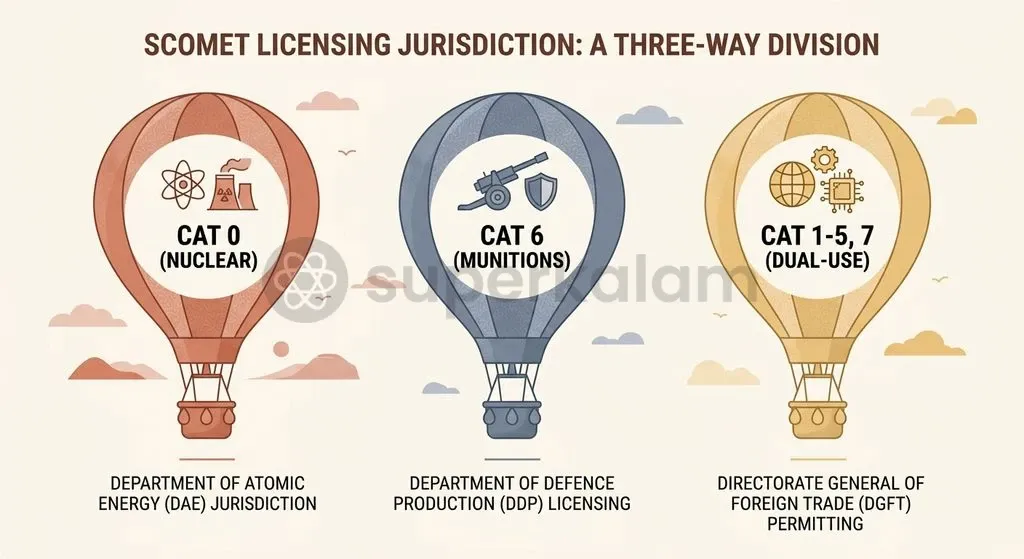
- Category 0 (Nuclear Materials): Department of Atomic Energy
- Category 6 (Munitions List): Department of Defence Production
- Categories 1-5, 7 (Dual-Use Items): Directorate General of Foreign Trade How many of the above pairs are correctly matched?
Related Blogs

Women-Led Development in India: Meaning, Constitutional Basis and the Asset Gap
Oct, 2026
•9 min read

Reservation After Religious Conversion: What the Supreme Court Has Ruled and the Article 341 Debate
Oct, 2026
•10 min read

Lancet Commission on Global Health Threats 2026: What It Is and the 17 Threats It Identifies
Oct, 2026
•8 min read


