GSAT-7C and Varunastra Explained: Military Satellites and the Sensor-to-Shooter Loop
GSAT-7C and Varunastra explained: India military communication satellites, the indigenous anti-submarine torpedo, and the sensor-to-shooter network.
Oct, 2026
•10 min read
Overview
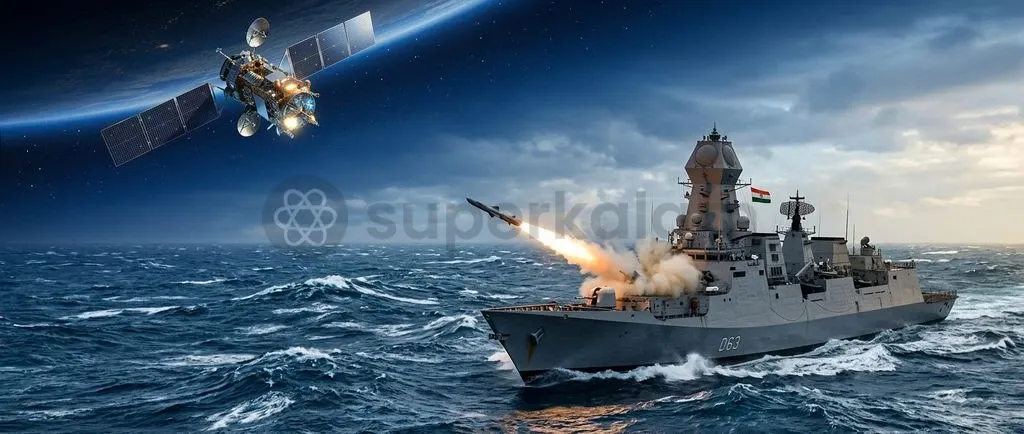
India's concurrent acquisition of the GSAT-7C communication satellite and the Varunastra heavyweight torpedo marks a decisive operational transition toward multi-domain network-centric warfare. The procurement connects orbital surveillance assets directly to undersea strike platforms to drastically compress the military's sensor-to-shooter timeline.
This dual procurement shifts Indian defence planning away from isolated platform acquisitions. It builds an interoperable architecture where space-based communications guide tactical responses across maritime operating environments. Armed forces can detect and neutralise sub-surface threats rapidly. To do so, they rely on dedicated beyond-line-of-sight data links for aerial forces and indigenously manufactured heavyweight munitions on naval warships. Modern C4ISR systems convert disparate military platforms into a unified operational kill web.
Why in the News: Breakthrough Approvals in Aerospace and Undersea Indigenisation
The Ministry of Defence approved two landmark procurement contracts worth a combined ₹4,106 crore on October 15, 2026, accelerating India's military modernisation and self-reliance drives. As of October 2026, these capital acquisitions target critical operational gaps in aerial tactical networking and sub-surface anti-submarine warfare.
The procurement breaks down into two targeted industrial allocations, as detailed in the official PIB release on GSAT-7C and Varunastra contracts (PRID: 2323814):
- A ₹2,563 crore contract awarded to NewSpace India Limited (NSIL) to develop, manufacture, and deliver the dedicated GSAT-7C military communication satellite for the Indian Air Force.
- A ₹1,543 crore contract signed with Bharat Dynamics Limited (BDL), Hyderabad, for the serial production and supply of indigenous Varunastra heavyweight torpedoes for the Indian Navy.
Both platforms fall under the Ministry of Defence Positive Indigenisation Lists, which legally prohibit foreign procurement whenever domestic technical alternatives exist, according to Department of Military Affairs notifications.
Beyond Isolated Platforms: The Doctrine of Multi-Domain Network-Centric Warfare
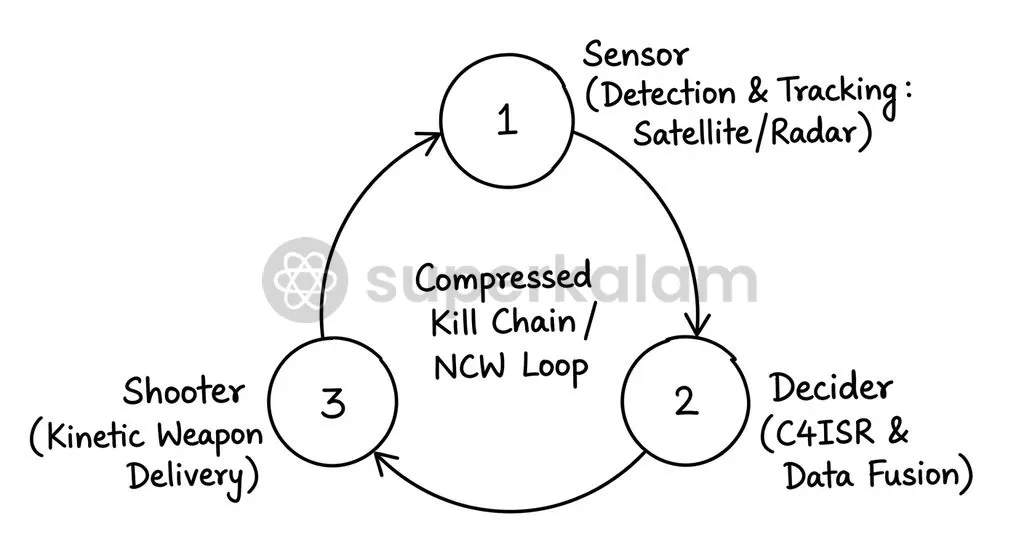
Network-centric warfare shifts operational focus from individual weapon platforms to interconnected tactical grids. These grids link distributed sensors, decision-makers, and weapons across geographic domains. According to the Ministry of Defence Integrated C4ISR and Anti-Submarine Warfare Doctrine, modern combat requires closing the sensor-to-shooter loop rapidly to neutralise hostile assets before they can reposition or deploy countermeasures.
The doctrine highlights two starkly contrasting approaches to maritime procurement:
- Legacy Platform Procurement: Focuses on standalone assets, such as procuring a surface frigate or a fighter squadron without synchronised data links. This approach falters when quiet diesel-electric submarines exploit ocean thermal layers to evade basic sonar suites.
- Network-Centric Warfare: Integrates space-based orbital relay nodes with precision sub-surface munitions to forge a resilient kill web. Sensor data gathered by airborne patrols guides anti-submarine strikes delivered by distant surface vessels.
Discuss with Superkalam
Recall the maximum operational depth, firing range, and speed of the indigenous Varunastra heavyweight torpedo.
Ask NowGSAT-7C: Securing the Indian Air Force's Tactical Network and Datalink Backbone
The GSAT-7C communication satellite is a dedicated orbital communications node engineered to expand the command and control architecture of the Indian Air Force. According to reporting by The Times of India, the platform delivers two primary operational capabilities:
- Tactical Hub Connectivity: Provides secure hub links for tactical Software-Defined Radios (SDRs) fitted across frontline aircraft and command posts.
- Extended Reach: Establishes real-time beyond-line-of-sight communication channels across the entire operational flight theatre.
This dedicated satellite deployment resolves acute operational bandwidth shortfalls that have built up across air operations. GSAT-7C is engineered to supplement and eventually replace the aging GSAT-7A satellite, which was launched in 2018 with an eight-year design life, as documented by The Times of India. Operational strain on GSAT-7A has intensified because the Indian Air Force shares approximately 30 percent of bandwidth with the Indian Army for border communications. This shared load highlights the strategic urgency for dedicated aerospace infrastructure.
Varunastra: Enhancing Sub-Surface Lethality with Indigenous Anti-Submarine Firepower
The Varunastra anti-submarine torpedo provides the Indian Navy with an indigenous, high-speed weapon system capable of hunting modern quiet submarines in deep and shallow waters. Developed by the Naval Science and Technological Laboratory (NSTL) of DRDO and manufactured by Bharat Dynamics Limited, the weapon is an advanced 533mm heavyweight torpedo equipped with wire guidance and active-passive acoustic homing systems, as detailed in NSTL technical bulletins.
Technical specifications from the Naval Science and Technological Laboratory outline the weapon's operational capabilities:
- Operating Speed: Achieves a maximum velocity of 40 knots, translating to approximately 74 km/h during target interception.
- Engagement Range: Delivers an effective firing envelope of up to 40 kilometres against submerged targets.
- Dive Envelope: Operates reliably down to depths of 600 metres, matching the diving thresholds of modern combat submarines.
- Combat Payload: Packs a devastating 250-kilogram high-explosive warhead designed to crack reinforced double-hulled vessels.
Naval armament inspection reports confirm that the Indian Navy has integrated Varunastra onto its frontline surface fleet, including Kolkata-class, Delhi-class, and Rajput-class destroyers, Kamorta-class anti-submarine corvettes, and Talwar-class stealth frigates.
Discuss with Superkalam
Explain how ocean thermal layers limit the effectiveness of traditional surface sonars and why airborne sensors are needed.
Ask NowConnecting the Nodes: How C4ISR Networks Bridge Space Sensors to Undersea Shooters
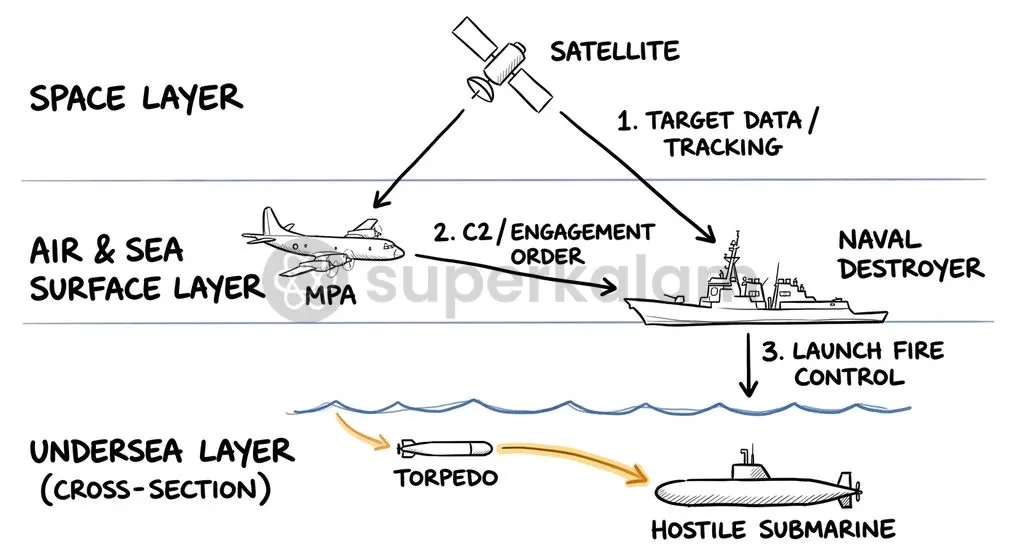
The operational integration between GSAT-7C and Varunastra demonstrates how space-based C4ISR architectures guide weapon delivery against elusive sub-surface adversaries. Anti-submarine warfare depends on hunting targets that surface combatant sonars cannot easily detect at long ranges due to salinity and temperature boundaries in tropical waters. Long-range maritime patrol aircraft bridge this gap by patrolling vast maritime corridors and tracking submerged acoustic signatures.
Under the Indian Navy's anti-submarine concept of operations, the joint sensor-to-shooter loop operates in four sequential stages:
- Airborne Detection: Boeing P-8I maritime patrol aircraft detect hostile sub-surface acoustic signatures across vast maritime corridors.
- Encrypted Space Uplink: Sensor tracks are immediately transmitted via secure datalinks to the GSAT-7C satellite node.
- Surface Downlink: GSAT-7C downlinks real-time target vectors directly to surface combatants, such as Kolkata-class destroyers or Talwar-class frigates.
- Coordinated Strike: The surface vessel launches the wire-guided Varunastra heavyweight torpedo toward target coordinates, shrinking the tactical reaction timeline without needing organic sonar contact.
Regional underwater developments underline the strategic urgency of this joint sensor-to-shooter loop:
- Regional Fleet Expansion: The Pakistan Navy commissioned PNS Hangor on April 30, 2026, marking the lead boat of eight Hangor-class diesel-electric attack submarines equipped with Chinese-supplied Air Independent Propulsion (AIP), as reported by Naval News.
- Bilateral Co-Production: The Hangor programme divides eight Type 039B Yuan-variant boats between direct construction in China (four hulls) and domestic assembly at Karachi Shipyard & Engineering Works (four hulls), with fleet deliveries spanning 2028–2030 per National Maritime Foundation assessments.
- Demonstrated Undersea Firepower: PNS Hangor carried out its maiden live weapon firing in the North Arabian Sea on September 26, 2026, launching an extended-range anti-ship cruise missile, as confirmed by Pakistan Navy official releases.
- Indian Ocean Hydrographic Mapping: The People's Liberation Army Navy routinely deploys conventional Yuan-class submarines, nuclear boats, and dual-use oceanographic vessels to map deep-sea acoustic channels along the Ninety East Ridge, according to Indian Navy maritime domain briefings reported in the press.
India is expanding its sub-surface detection perimeter to counter these regional deployments. In June 2026, the Naval Physical and Oceanographic Laboratory (NPOL) in Kochi issued an Expression of Interest to develop the Underwater Fibre Optic Sensing System (UFOSS) under the Navy's Deep Ocean Watch programme, creating a permanent seabed acoustic surveillance network across strategic chokepoints.
Cross-Domain Capabilities: How Indigenous Platforms Compare Across Strategic Domains
Evaluating GSAT-7C and Varunastra side by side illustrates how modern defence indigenisation creates cross-domain deterrence across space and maritime environments.
| Strategic Dimension | GSAT-7C Aerospace Communication Node | Varunastra Undersea Munition System |
|---|---|---|
| Operational Domain | Space / Orbital Domain (C4ISR Relay) | Undersea / Maritime Strike Domain |
| Primary End-User | Indian Air Force (tactical networks) | Indian Navy (surface combatant fleet) |
| Development Agency | NewSpace India Limited (ISRO commercial arm) | Naval Science and Technological Laboratory (DRDO) |
| Production Partner | Indian aerospace manufacturing ecosystem | Bharat Dynamics Limited (BDL), Hyderabad |
| Core Technical Role | Real-time beyond-line-of-sight SDR datalinks | Wire-guided active-passive acoustic kill vehicle |
| Operational Range / Reach | Full Indian operational flight theatre coverage | Extended engagement range up to 40 kilometres |
| Doctrinal Alignment | Air Force C4ISR communication backbone | Hard-kill maritime anti-submarine weapon |
Discuss with Superkalam
How can the four-stage sensor-to-shooter loop demonstrated here be applied to neutralise threats in distant maritime chokepoints?
Ask NowPersistent Bottlenecks: Critical Component Import Dependency and Inter-Service Integration
Industrial vulnerabilities in upstream component manufacturing continue to hamper domestic defence supply chains despite substantial platform-level indigenisation breakthroughs. According to data from the Department of Defence Production's Srijan monitoring portal and DRDO reviews, two primary supply chain constraints persist:
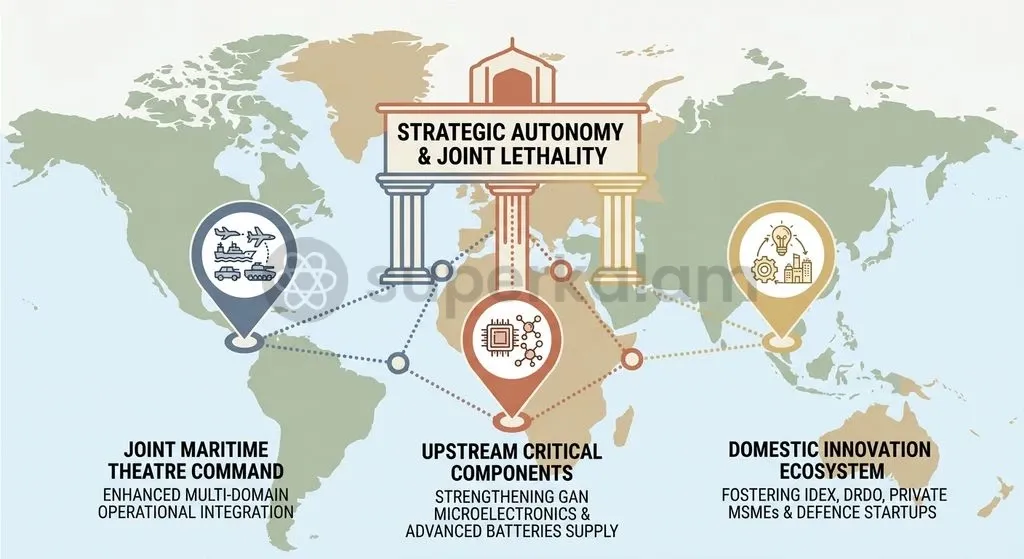
- Upstream Microelectronics: Torpedo and missile production achieves over 75 percent local content in structural components, yet remains reliant on foreign suppliers for critical gallium nitride (GaN) monolithic microwave integrated circuits and advanced microcontrollers.
- Propulsion Minerals and Battery Cells: Domestic manufacturing of high-energy silver-zinc and advanced lithium battery cells remains dependent on imported refined raw minerals, requiring substantial domestic investments in refining and testing infrastructure.
Beyond raw hardware manufacturing, organisational barriers between the military services complicate complete network-centric integration. The Department of Military Affairs and the Chief of Defence Staff are currently establishing three joint theatre commands, including an integrated Maritime Theatre Command, to dismantle single-service operational stovepipes and unify cross-domain data networks.
Way Forward: Consolidating Theatre Commands and Scaling Domestic Defence Technology
Consolidating joint operational structures forms the baseline requirement for fully exploiting cross-domain assets like GSAT-7C and Varunastra. Establishing the Maritime Theatre Command will unify air, naval, and space sensor streams into a unified battle-management picture, preventing stovepiped data links from stalling engagement decisions during crises.
Deepening indigenous component manufacturing is equally vital for safeguarding operational autonomy during extended conflicts. The Ministry of Defence is targeting upstream sub-tier dependencies through the Innovations for Defence Excellence (iDEX) framework and Defence India Startup Challenges (DISC), which fund private industry and defence startups to develop:
- Autonomous underwater vehicles (AUVs) to extend forward ocean surveillance.
- Next-generation sonar signal processing algorithms to detect ultra-quiet submarines.
- Specialised tactical Software-Defined Radio components for uninterrupted beyond-line-of-sight communications.
Sustained domestic research funding and streamlined private-sector integration will ensure India pairs its physical weapon systems with sovereign digital hardware and secure datalinks.
Discuss with Superkalam
Compare the strategic impact of standalone platform acquisitions versus network-centric C4ISR integration on naval combat readiness.
Ask NowKey Takeaways
- The Ministry of Defence signed contracts worth ₹4,106 crore on October 15, 2026, commissioning NSIL for the GSAT-7C satellite (₹2,563 crore) and BDL for Varunastra torpedoes (₹1,543 crore).
- GSAT-7C provides dedicated beyond-line-of-sight communication channels and ground hub links for Indian Air Force Software-Defined Radios, replacing GSAT-7A which shared roughly 30 percent of its bandwidth with the Army.
- Varunastra is an indigenous 533mm heavyweight anti-submarine torpedo with wire guidance, active-passive acoustic homing, a 40-knot speed, a 40-kilometre range, and a 600-metre operational depth.
- The operational synergy between GSAT satellites and Varunastra compresses the sensor-to-shooter loop, allowing aerial platforms like the P-8I to relay target tracks directly to surface warships deploying torpedoes.
- Despite reaching over 75 percent domestic content in mechanical assemblies, Indian high-technology munitions remain reliant on imported gallium nitride microelectronics, specialised microcontrollers, and refined battery minerals.
- Tri-service theatre commands and the Maritime Theatre Command are critical organisational reforms required to eliminate single-service C4ISR stovepipes and achieve unified multi-domain warfare capabilities.
Mains Question
"Network-centric warfare shifts operational focus from individual weapon platforms to interconnected tactical grids, transforming isolated assets into a unified kill web." In the context of the recent procurement of GSAT-7C and the Varunastra torpedo, examine how space-based C4ISR networks bridge domain gaps in anti-submarine warfare. (10 Marks)
Evaluate NowMains Question
"The transition toward self-reliance under Positive Indigenisation Lists addresses platform assembly but exposes severe vulnerabilities in upstream component manufacturing." Critically analyse this statement with reference to India's aerospace and sub-surface defence manufacturing. (15 Marks)
Evaluate NowPractice MCQs
QUESTION 1
With reference to the Varunastra torpedo, consider the following statements:
- It is an indigenous 533mm heavyweight torpedo equipped with active-passive acoustic homing and wire guidance.
- It has an operational dive envelope capable of operating down to depths of 600 metres.
- It was designed and developed by Bharat Dynamics Limited (BDL) without inter-agency collaboration.
Which of the statements given above is/are correct?
QUESTION 2
Consider the following statements regarding the GSAT-7C communication satellite:
- It is designed to provide dedicated beyond-line-of-sight communication channels and tactical Software-Defined Radio links for the Indian Air Force.
- It is developed and delivered under a contract awarded to NewSpace India Limited (NSIL).
- It is intended to supplement and eventually replace the GSAT-7A satellite launched in 2018.
Which of the statements given above are correct?
QUESTION 3
With reference to India's maritime and undersea surveillance systems mentioned in recent developments, consider the following statements:
- The Underwater Fibre Optic Sensing System (UFOSS) is being developed under the Deep Ocean Watch programme.
- UFOSS is designed to establish a permanent seabed acoustic surveillance network across strategic chokepoints.
- The procurement of Varunastra was undertaken under an emergency import route outside the Positive Indigenisation Lists.
Which of the statements given above is/are correct?
QUESTION 4
In the context of modern naval doctrine, which of the following best describes the sequential operation of the 'sensor-to-shooter loop' bridging GSAT-7C and Varunastra?
QUESTION 5
Consider the following pairs of surface combatants and naval systems:
- Varunastra : Kamorta-class anti-submarine corvettes
- Hangor-class submarine : Air Independent Propulsion (AIP)
- GSAT-7A : Dedicated exclusively to Indian Navy undersea links
Which of the pairs given above is/are correctly matched?
Related Blogs

Data Centres in India: Why NITI Aayog Green Norms Matter for AI Growth
Oct, 2026
•10 min read

PMFBY and WINDS: Why the Stalled Weather Station Rollout Matters for Crop Insurance
Oct, 2026
•9 min read

National Strategic Trade Command Centre (NSTCC): What It Is, Functions and SCOMET Link
Oct, 2026
•9 min read


