NSE IPO and Market Infrastructure Institutions: Public Utility vs Profit Debate
As SEBI clears the NSE IPO, Indian capital markets confront the fragile balance between commercial shareholder returns and frontline regulatory vigilance.
Sep, 2026
•9 min read

Overview
The planned initial public offering of the National Stock Exchange of India highlights a core policy tension. Market Infrastructure Institutions face an ongoing balance between public utility obligations and shareholder profit maximisation.
These systemically vital bodies handle essential trading, clearing, and depository functions. Concurrently, they enforce statutory compliance across capital markets.
Permitting public listing offers market-determined valuation, liquidity, and strict governance scrutiny. Even so, it introduces short-term quarterly pressures. Such commercial demands can compromise regulatory independence, operational resilience, and fair access across the market.
Why is the NSE IPO and MII Listing in the News?
The Securities and Exchange Board of India (SEBI) granted a No-Objection Certificate to the National Stock Exchange (NSE) to initiate its public float. This clearance from SEBI's Market Regulation Department followed material progress on outstanding regulatory proceedings and settlement applications.
As of January 2026, the clearance revives the debate over how a frontline regulator balances statutory mandates with commercial returns.
Market Infrastructure Institutions (MIIs) face distinct listing criteria compared to standard commercial firms. Under the regulatory code, an MII cannot file a Draft Red Herring Prospectus (DRHP) without explicit regulatory clearance from SEBI. This gatekeeping mechanism ensures that pending enforcement matters, technology lapses, or governance deficits reach resolution before public capital mobilisation.
Discuss with Superkalam
Which three categories of entities constitute the core architecture of Market Infrastructure Institutions (MIIs) in India?
Ask NowWhat are Market Infrastructure Institutions (MIIs) and Their Core Functions?
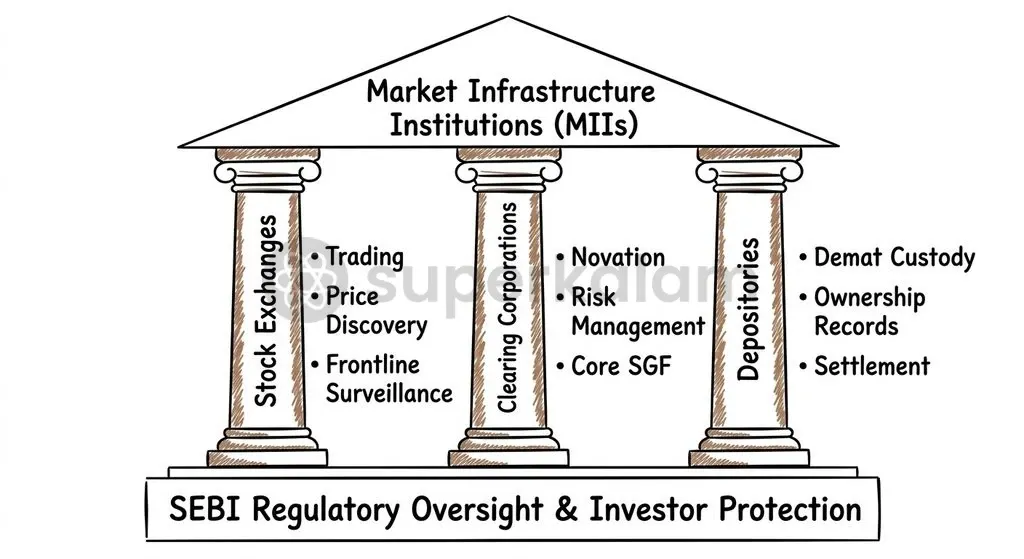
Market Infrastructure Institutions (MIIs) comprise stock exchanges, clearing corporations, and depositories. According to the Report of the Bimal Jalan Committee on Review of Ownership and Governance of Market Infrastructure Institutions (MIIs), these bodies constitute the institutional backbone for capital formation, liquidity allocation, and settlement safety.
The operational architecture of Indian capital markets rests on three interconnected pillars:
- Stock Exchanges: Trading platforms, such as the National Stock Exchange (NSE) and the Bombay Stock Exchange (BSE), that enable transparent price discovery and market liquidity across securities.
- Clearing Corporations: Central counterparties that guarantee trade settlement, manage counterparty exposure, and maintain the Core Settlement Guarantee Fund (Core SGF).
- Depositories: Custodial institutions that hold securities in dematerialised form and manage electronic book-entry ownership transfers.
| Institution Type | Primary Statutory Role | Systemic Risk Profile | Core Revenue Source |
|---|---|---|---|
| Stock Exchange | Trade execution and first-line market surveillance | Market disruption and operational outages | Transaction charges and listing fees |
| Clearing Corporation | Trade novation, settlement, and counterparty guarantee | Systemic insolvency and settlement defaults | Clearing charges and treasury management |
| Depository | Dematerialisation, custodial safety, and ownership records | Record-keeping failure and custodial fraud | Custody and depository participant fees |
The Structural Conflict: First-Line Regulator vs For-Profit Corporation
A dual mandate sits at the centre of stock exchange governance. As highlighted by the Report of the Committee on Strengthening Governance of Market Infrastructure Institutions (G. Mahalingam Committee), MIIs act simultaneously as first-line market regulators and commercial corporate entities.
| Regulatory Mandate (Public Good) | Commercial Driver (For-Profit) |
|---|---|
| First-line trade oversight and surveillance | Maximising dividend yield and investor returns |
| Member audit and disciplinary enforcement | Transaction volume growth and client acquisition |
| Capital ring-fencing via Core SGF | Shareholder valuation and return on equity |
| Technology resilience investment | Cost and margin optimisation |
This structural dualism creates distinct operational friction points:
- Member Oversight vs Client Acquisition: Exchanges supervise brokers while competing for their trading turnover to expand fee revenues.
- Surveillance Spending vs Margin Expansion: Capital allocated to trade surveillance systems and forensic audit functions as a cost centre with no direct commercial yield.
- Equitable Access vs Premium Monetisation: Commercial incentives push bourses to build tiered, high-fee latency services that can disadvantage retail market participants.
Discuss with Superkalam
How does an exchange's role as a first-line regulator structurally conflict with its commercial drive to maximise transaction turnover?
Ask NowEvolution of MII Regulations: From Bimal Jalan to Gandhi Committee
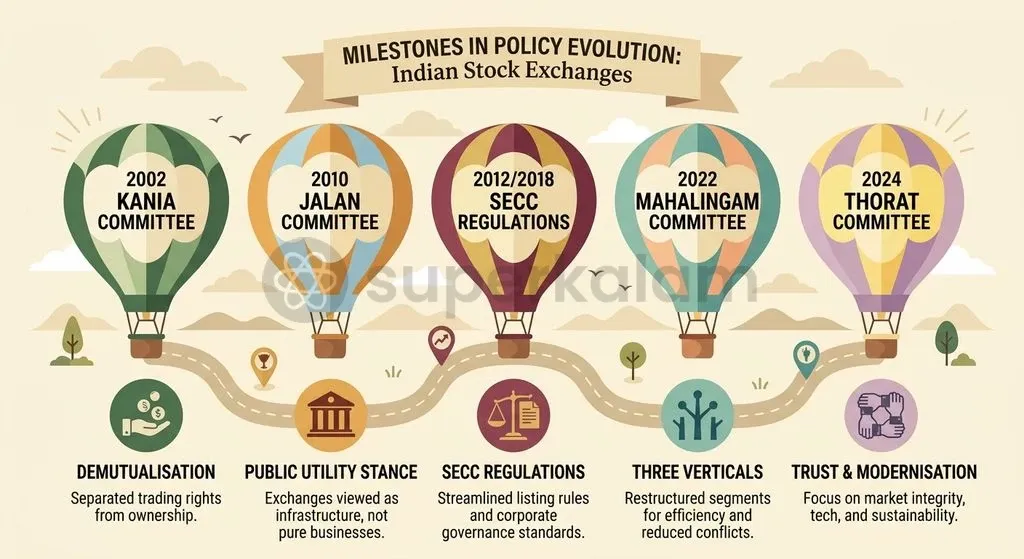
Indian exchange regulations shifted gradually from mutual broker associations toward strictly supervised listed entities. The Justice M.H. Kania Committee in 2002 initiated this trajectory by recommending the mandatory demutualisation of bourses. This reform legally separated exchange ownership, management, and trading rights.
| Year & Committee | Key Regulatory Milestone |
|---|---|
| 2002 (Justice M.H. Kania Committee) | Mandated demutualisation to separate broker-trading rights from exchange ownership. |
| 2010 (Dr. Bimal Jalan Committee) | Defined MIIs as public utilities, opposed public listing, and recommended capping profits. |
| 2012 & 2018 (SECC Regs & R. Gandhi Committee) | Permitted exchange listing with ownership caps (5% individual, 15% institutional); kept clearing corporations unlisted. |
| 2022 (G. Mahalingam Committee) | Mandated three distinct functional verticals, two-thirds Public Interest Directors, and executive pay caps. |
| 2024 (Usha Thorat Committee) | Appointed to evaluate ownership norms and CCP risk independence in clearing corporations. |
The regulatory paradigm evolved across several formal reviews:
- Bimal Jalan Committee (2010): Recommended against public listing. It concluded that MIIs function as public utilities whose governance must stay insulated from profit maximisation.
- SECC Regulations, 2012: SEBI opened the door under the Securities Contracts (Regulation) (Stock Exchanges and Clearing Corporations) Regulations, allowing exchanges to list under ownership dispersion norms.
- R. Gandhi Committee (2018): Endorsed public listing for bourses and depositories. However, it advised keeping clearing corporations unlisted due to central counterparty risk concentration.
- SECC Regulations, 2018: Capped shareholding in a recognised bourse at 5% for individual investors and up to 15% for specified entities, including banks, insurance firms, and foreign bourses.
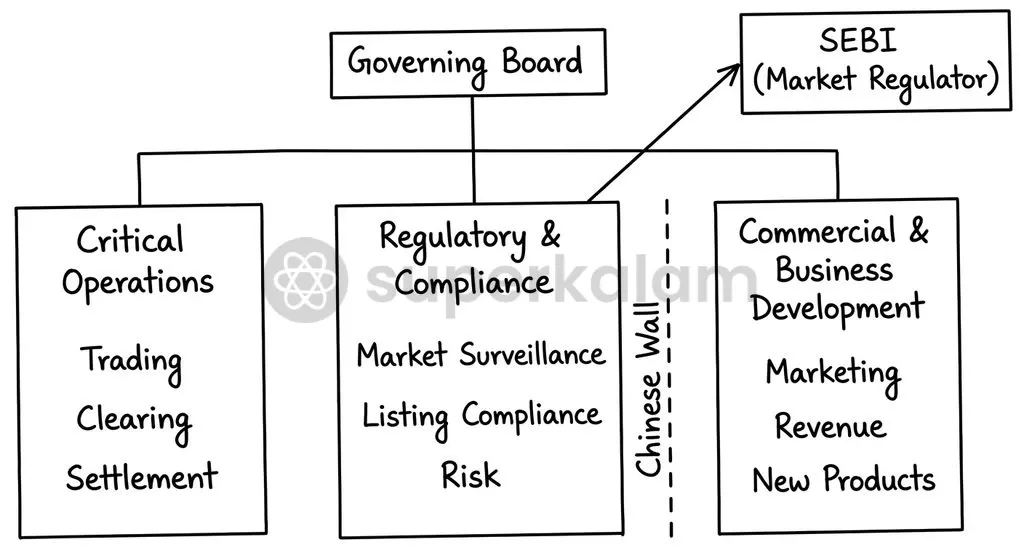
- G. Mahalingam Committee (2022): Formulated governance protections. It mandated three distinct functional verticals (Critical Operations, Regulatory/Risk Management, Business Development) and required two-thirds Public Interest Directors (PIDs).
- Usha Thorat Committee (2024): Constituted by SEBI in June 2024 to review the ownership, governance, and economic independence of central counterparties.
Arguments For Listing: Capital Efficiency, Liquidity, and Transparency
Proponents of exchange listing argue that public markets enforce operational discipline. Listing mandates continuous disclosure under market regulations, subjecting exchange administration to open institutional scrutiny.
Key rationales advanced for public listing include:
- Fair Price Discovery for Existing Shareholders: Institutional investors, sovereign funds, and domestic lenders that backed early infrastructure secure an orderly, market-priced exit mechanism.
- Dispersed Public Ownership: Wide shareholding dilutes concentrated institutional control, reinforcing the democratic holding model required by SEBI.
- Capital Mobilisation for Upgrades: Public equity markets facilitate capital raising for extensive technological overhauls and cross-border expansion.
Discuss with Superkalam
If a listed stock exchange faces falling quarterly margins, how might commercial pressures influence its decisions regarding technological maintenance and surveillance spending?
Ask NowKey Governance Risks: Misaligned Incentives, Tech Underinvestment, and Regulatory Capture
Commercialising market infrastructure creates risks when short-term earnings take precedence over resilience. According to the SEBI Consultation Paper on Strengthening Governance and Technology Resilience at MIIs, quarterly earnings pressures generate distinct operational hazards.
| Governance Vulnerability | Operational Manifestation | Systemic Impact |
|---|---|---|
| Technology Deficit | Deferred software and hardware upgrades to boost EBITDA | Higher risk of trading glitches and outages |
| Surveillance Gap | Compliance units treated as cost centres | Diluted oversight of high-turnover brokers |
| Preferential Bias | Co-location and high-speed data monetisation | Informational disparity for retail participants |
Core governance hazards include:
- Technology Under-Investment: Infrastructure budgets may face cuts to protect operating margins, increasing the likelihood of trading glitches, outages, and cyber vulnerabilities.
- Surveillance Dilution: Exchange executives may soften supervision over high-volume market intermediaries who contribute large transaction fees.
- Historical Access Disparities: The co-location and tick-by-tick data matters illustrated how structural preferences can undermine fair and equitable access for broad market participants.
- Executive Compensation Distortion: Tying executive compensation directly to commercial turnover disincentivises conservative risk management.
Ethical Dimensions: Public Trust and Fiduciary Duty in Capital Markets
Market Infrastructure Institutions carry a fiduciary duty to preserve fairness, transparency, and procedural integrity. The G. Mahalingam Committee observed that exchange credibility relies on procedural justice and equal opportunity of execution for all participants.
Ethical governance requires balancing competing institutional duties:
- Fiduciary Duty to the Public vs Shareholders: MII boards must place systemic stability and investor protection as paramount, superseding dividend targets.
- Integrity of Market Data Feeds: Distributing price data without speed distortion safeguards informational parity across market tiers.
- Ring-Fencing Settlement Reserves: Committing mandatory revenue allocations to the Core Settlement Guarantee Fund (Core SGF) secures trade settlement, even if it trims distributable profits.
Global Precedents: How International Stock Exchanges Handle Self-Listing
Global financial jurisdictions use structural firewalls to manage the conflict of interest in listed exchanges. Under Regulation 45 of SEBI's SECC Regulations, 2018, India bars a stock exchange from self-listing on its own exchange floor. It mandates cross-listing on competitor bourses to maintain independent market oversight during price discovery.
To prevent regulatory capture, domestic regulations mandate structural division. SEBI requires public interest directors to lead board oversight and establishes direct reporting channels from chief regulatory officers to the statutory regulator.
Discuss with Superkalam
Compare the perspective of the Bimal Jalan Committee (2010) on MII listing with the reforms introduced under the SECC Regulations and the R. Gandhi Committee (2018).
Ask NowWay Forward: Balancing Commercial Autonomy with Public Good Imperatives
Aligning public utility duties with corporate autonomy requires structural reforms in regulatory design. Policy frameworks must embed operational firewalls to protect core regulatory priorities and technical resilience.
Key policy measures include:
- Statutory Ring-Fencing of Regulatory Verticals: Ensure complete operational, administrative, and financial independence of the Regulatory and Risk Management vertical from commercial units.
- Mandatory Technology Capital Expenditure Floor: Set a binding revenue percentage dedicated entirely to cybersecurity, disaster recovery, and infrastructure redundancy.
- Public Interest Director Empowerment: Enforce the G. Mahalingam Committee mandate for a two-thirds majority of Public Interest Directors (PIDs) on exchange boards.
- Executive Pay Alignment: Cap variable pay for Key Management Personnel (KMPs) at between 25% and 50% of total compensation, indexing bonuses to regulatory compliance instead of trading turnover.
- Central Counterparty Independence: Execute the structural reforms of the Usha Thorat Committee to safeguard the financial and risk independence of clearing corporations.
Key Takeaways
- Systemic Role: Market Infrastructure Institutions (MIIs) encompass stock exchanges, clearing corporations, and depositories, providing the foundational infrastructure for India's capital markets.
- Dual Mandate Conflict: MIIs function simultaneously as first-line market regulators and commercial corporate entities, generating structural conflicts between profit motives and public interest.
- Regulatory Shift: The Bimal Jalan Committee (2010) opposed public listing, but SEBI subsequently permitted listing under strict ownership caps (5% for individuals, 15% for institutions).
- Governance Safeguards: The G. Mahalingam Committee (2022) recommended vertical operational segregation, two-thirds Public Interest Director representation, and executive pay caps.
- Cross-Listing Mandate: Indian regulations prohibit self-listing, requiring stock exchanges to cross-list on competitor platforms to maintain market surveillance integrity.
Mains Question
"Market Infrastructure Institutions (MIIs) act simultaneously as first-line market regulators and commercial corporate entities." In light of the G. Mahalingam Committee recommendations, critically examine the structural conflict arising from the public listing of stock exchanges. (15 Marks)
Evaluate NowMains Question
Trace the evolution of the regulatory framework governing the ownership and listing of Market Infrastructure Institutions in India from the Bimal Jalan Committee to the Usha Thorat Committee. Discuss. (10 Marks)
Evaluate NowPractice MCQs
QUESTION 1
With reference to Market Infrastructure Institutions (MIIs) in India, consider the following statements:
- Under the SECC Regulations, 2018, shareholding in a recognised stock exchange is capped at 5% for individual investors.
- The Dr. Bimal Jalan Committee (2010) recommended the mandatory public listing of stock exchanges to enhance market liquidity.
- Market Infrastructure Institutions cannot file a Draft Red Herring Prospectus (DRHP) without explicit regulatory clearance from SEBI.
Which of the statements given above are correct?
QUESTION 2
Which of the following committees on the governance of Indian stock exchanges recommended the mandatory demutualisation of bourses to legally separate ownership, management, and trading rights?
QUESTION 3
Consider the following statements regarding the governance framework of Market Infrastructure Institutions (MIIs):
- The G. Mahalingam Committee (2022) mandated three distinct functional verticals: Critical Operations, Regulatory/Risk Management, and Business Development.
- The G. Mahalingam Committee recommended that Public Interest Directors (PIDs) constitute at least two-thirds of the board of an MII.
- The R. Gandhi Committee (2018) recommended that clearing corporations should be publicly listed to diversify central counterparty risk.
Which of the statements given above is/are correct?
QUESTION 4
Consider the following pairs of institutions and their core statutory roles as Market Infrastructure Institutions:
- Stock Exchange — Trade execution and first-line market surveillance
- Clearing Corporation — Trade novation, settlement, and maintenance of the Core Settlement Guarantee Fund
- Depository — Dematerialisation, custodial safety, and electronic ownership records
How many of the pairs given above are correctly matched?
QUESTION 5
Consider the following statements regarding the governance risks of listing Market Infrastructure Institutions (MIIs):
- Quarterly earnings pressure can lead to technology under-investment, increasing the risk of operational outages.
- Ring-fencing capital into the Core Settlement Guarantee Fund (Core SGF) increases the distributable profits of an exchange.
- Treating compliance and trade surveillance units as commercial profit centres softens oversight on high-turnover intermediaries.
Which of the statements given above is/are correct?