Nobel Prize in Medicine 2026: Winners and Optogenetics
The 2026 Medicine Nobel recognises discoveries in optogenetics. Read who won, how light controls neurons and why it matters for UPSC.
Oct, 2026
•8 min read
Nobel Prize in Medicine 2026: Winners and Discovery
The 2026 Nobel Prize in Physiology or Medicine was awarded jointly to Karl Deisseroth, Peter Hegemann and Georg Nagel "for their discoveries concerning light-gated ion channels and optogenetics". The Nobel Assembly at Karolinska Institutet announced the award on 5 October 2026.
Hegemann and Nagel discovered channelrhodopsin, a light-sensitive protein in a single-celled alga. When exposed to blue light, it opens an ion channel, allowing charged particles to enter the cell and generate an electrical signal. Deisseroth adapted this mechanism to control nerve cells with light, first demonstrating it in rat neurons and later in living mice.
Optogenetics helps researchers identify how specific neural circuits influence memories, feelings and behaviour. It is a research method with emerging clinical applications, not an established cure for neurological disorders.
Source: Nobel Assembly official press release.
Overview
Optogenetics is a breakthrough neuromodulation technique combining optical technology and genetic engineering to selectively stimulate or inhibit genetically targeted neurons with millisecond temporal precision and single-cell spatial resolution. By inserting microbial opsin genes into specific brain cells using viral vectors, researchers can activate or silence distinct neural circuits using targeted pulses of light. This approach bridges the gap between invasive electrical stimulation and diffuse pharmacological treatments. It offers unprecedented control over neural circuitry, transforming experimental neuroscience and paving the path for next-generation gene-based neurotherapeutics.
Why in the News?
Optogenetic neurotechnologies are transitioning rapidly from basic laboratory models to clinical applications, highlighted by successful human trials that partially restored visual function in blind patients. The technique represents a paradigm shift in how clinicians could treat intractable central nervous system disorders like Parkinson's disease, drug-resistant epilepsy, and retinal dystrophies. As of July 2026, premier Indian research institutions are accelerating pre-clinical neural circuit mapping to build domestic translational neuroscience capacity, as highlighted by research briefings from the Indian Institute of Science.
Discuss with Superkalam
Which specific microbial opsin and activating light wavelength are responsible for depolarizing and exciting neurons?
Ask NowWhat Is Optogenetics and How Does It Work?
Optogenetics is a biomedical method that integrates genetic modification and targeted illumination to control the electrical activity of individual living neurons in real time. Traditional neurological tools often lack spatial or temporal accuracy, but optogenetics achieves sub-millisecond kinetic control that closely matches native action potential firing patterns.
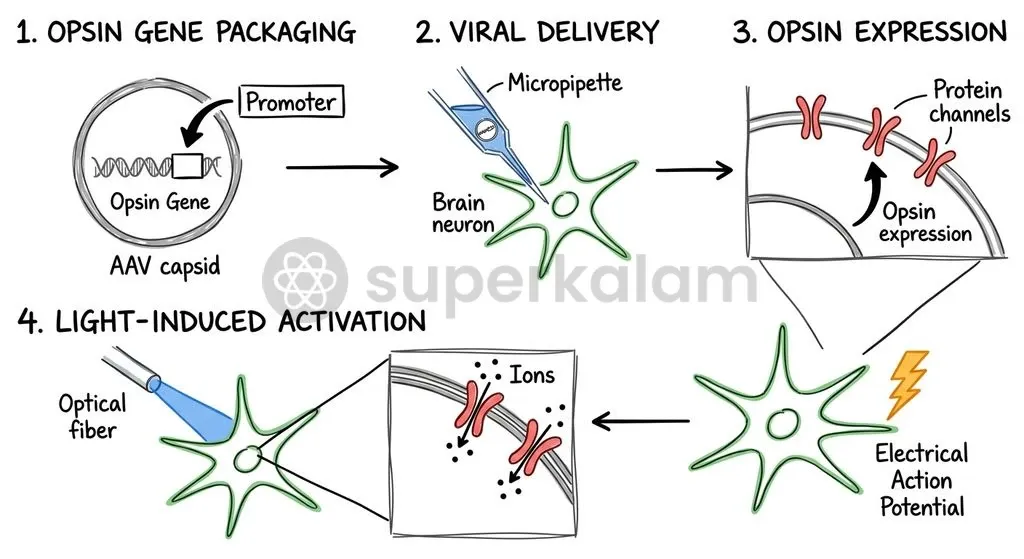
The standard operational workflow relies on a systematic five-step framework:
- Gene Identification: Isolating light-sensitive opsin genes from microbial or algal organisms.
- Viral Vector Packaging: Inserting opsin cDNA into Adeno-Associated Virus (AAV) or Lentivirus vectors known for high transduction efficiency and low pathogenic risk.
- Targeted Delivery: Delivering vectors into specific brain regions where cell-type-specific promoters restrict expression exclusively to defined neuronal subtypes.
- Optical Illumination: Directing light of specific wavelengths into target tissue via implanted micro-LEDs or optical fibers.
- Circuit Modulation: Activating or silencing the targeted cell population without perturbing adjacent bystander neurons or passing axonal tracts.
The Biology of Light Control: Channelrhodopsin and Microbial Opsins
Microbial opsins are light-sensitive transmembrane proteins that alter cellular membrane potential by transporting ions across the lipid bilayer upon photon absorption. Different microbial opsins respond to distinct optical wavelengths, allowing bidirectional control over neuronal excitability.
| Opsin Protein | Biological Source | Mechanism of Action | Activating Wavelength | Functional Effect on Neurons |
|---|---|---|---|---|
| Channelrhodopsin-2 (ChR2) | Chlamydomonas reinhardtii (green alga) | Light-gated cation channel | Blue light (~470 nm) | Depolarisation and excitation |
| Halorhodopsin (NpHR) | Natronomonas pharaonis (archaeon) | Inward chloride pump | Yellow-to-orange light (~580 nm) | Hyperpolarisation and silencing |
| Archaerhodopsin-3 (Arch) | Halorubrum sodomense (archaeon) | Outward proton pump | Green-yellow light | Rapid optical hyperpolarisation |
Channelrhodopsin-2 allows positively charged ions like sodium and calcium to enter the cell when illuminated with blue light. This influx depolarises the membrane and triggers an action potential. Conversely, Halorhodopsin pumps chloride ions inward and Archaerhodopsin pumps protons outward, driving the membrane potential below its resting threshold to silence neuronal firing instantly.
Discuss with Superkalam
Explain how viral vectors and cell-type-specific promoters work together to ensure that only targeted neural circuits respond to light.
Ask NowHow Optogenetics Compares to Traditional Brain Treatments
Conventional modalities for treating central nervous system disorders rely primarily on systemic pharmacology or electrical neuromodulation. While effective in several clinical contexts, both methods suffer from significant mechanistic trade-offs regarding precision, speed, and side-effect profiles.
| Dimension | Pharmacological Drugs | Deep Brain Stimulation (DBS) | Optogenetic Neuromodulation |
|---|---|---|---|
| Spatial Precision | Low (diffuse systemic distribution) | Moderate (anatomical region limited by electric field) | High (single-cell and circuit-specific) |
| Temporal Precision | Poor (minutes to hours; slow clearance) | Moderate (continuous or pulsatile electrical delivery) | Sub-millisecond precision matching action potentials |
| Cellular Selectivity | Poor (acts across all cells bearing target receptors) | Indiscriminate (activates cell bodies and passing axons) | Cell-type-specific promoters isolate exact targets |
| Invasiveness | Non-invasive to minimally invasive | Highly invasive (implanted electrode hardware) | Highly invasive (requires gene delivery and optical hardware) |
| Systemic Toxicity | High potential for off-target organ effects | Low systemic toxicity; risk of local tissue damage | Minimal systemic toxicity; foreign protein risks |
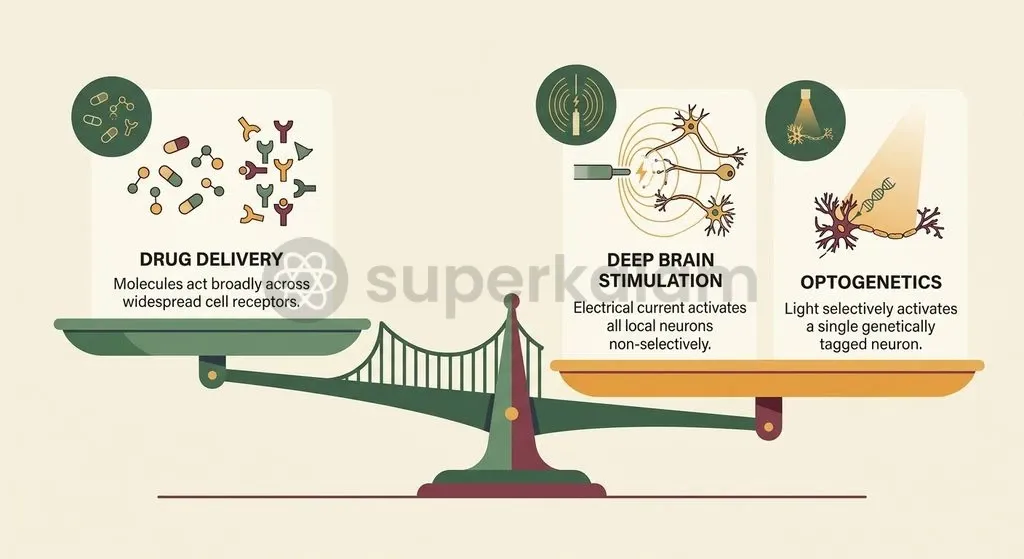
Deep Brain Stimulation indiscriminately excites all neuronal soma and passing axonal fibres caught within its electrical perimeter. In contrast, optogenetics isolates defined neuronal circuits, ensuring that neighboring non-target cells remain entirely unperturbed.
Key Medical and Neurological Applications
Optogenetics has emerged as an indispensable discovery engine in basic neurobiology and is actively expanding into therapeutic avenues across multiple medical domains.
Neurodegenerative and Motor Disorders
In experimental models of Parkinson's disease, selective optical excitation of subthalamic nucleus afferents and direct-pathway striatal projection neurons successfully reverses motor deficits, alleviating symptoms like akinesia and bradykinesia.
Epilepsy and Seizure Suppression
Optogenetic silencing using inhibitory pumps like NpHR and Arch offers an effective mechanism to abort epileptiform activity. By activating these opsins at seizure foci, closed-loop systems terminate behavioral seizures rapidly upon detecting abnormal neural synchrony.
Clinical Vision Restoration
The landmark Phase 1/2a PIONEER clinical trial demonstrated the first functional recovery in end-stage retinitis pigmentosa. Researchers delivered the channelrhodopsin ChrimsonR to retinal ganglion cells using an AAV vector, enabling a blind patient to perceive and locate objects using light-stimulating goggles.
Neuropsychiatric Research and Cardiology
In psychiatric neuroscience, optogenetic dissection of ventral tegmental area (VTA) dopaminergic pathways and medial prefrontal cortex circuits has established causal links to depressive behaviors and anhedonia. Beyond the brain, researchers have expressed light-sensitive channels in cardiac myocytes to build optical biological pacemakers, resynchronising arrhythmias without painful electrical shocks.
Discuss with Superkalam
Compare the mechanistic trade-offs of optogenetic neuromodulation against traditional pharmacological drugs and Deep Brain Stimulation.
Ask NowCurrent Technical Hurdles and Ethical Concerns
Translating optogenetics into broad clinical adoption requires addressing significant biophysical, immunological, and ethical roadblocks.
Biophysical and Delivery Constraints
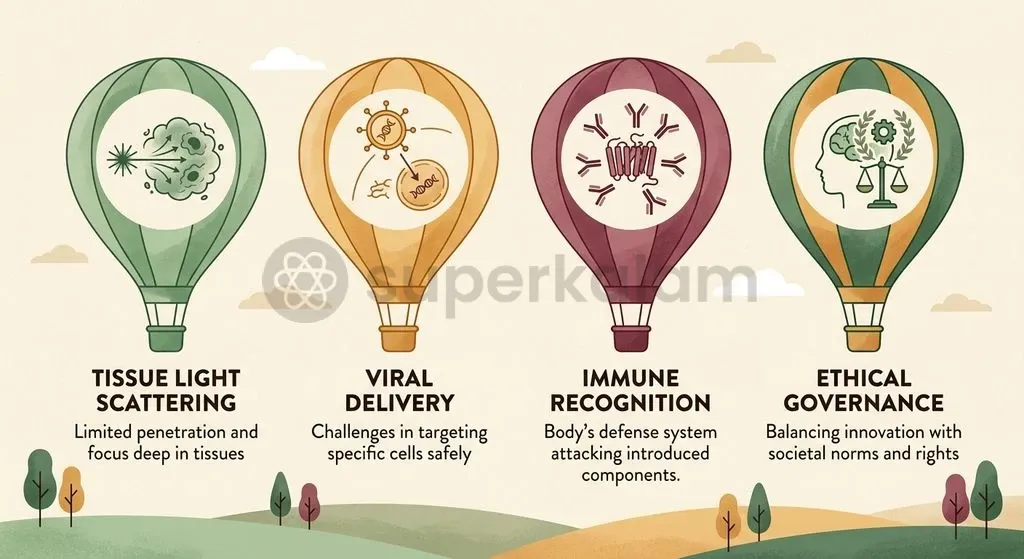
Mammalian brain tissue scatters and absorbs light rapidly, making non-invasive deep-brain illumination extremely difficult. Delivering light to deep structures currently requires invasive craniotomies and implanted fiber optics, which can cause localized tissue damage, inflammation, and gliosis. Furthermore, sustained high-intensity light can cause thermal heating and photodamage, perturbing baseline neuronal function.
Immunogenicity and Long-term Expression
Because opsins like ChR2 and NpHR originate from non-mammalian algae and archaea, their long-term presence in human tissue can provoke host immune recognition and neutralizing antibodies. Ensuring stable, non-toxic transgene expression over decades remains a major prerequisite for routine clinical gene therapy.
Neuroethical Considerations
Modulating human neural circuits touches fundamental ethical questions regarding cognitive liberty, personal identity, and behavioral agency. Targeted stimulation of circuits governing mood, motivation, and decision-making raises profound neuroethical dilemmas around consent and potential off-target behavioural alterations.
Regulatory Landscape and Indian Initiatives
India regulates optogenetic platforms under its comprehensive biotechnology and advanced-therapy regulatory framework.
Under the New Drugs and Clinical Trials Rules (2019) notified by the Central Drugs Standard Control Organisation (CDSCO), all Gene Therapy Products (GTPs) are legally classified as New Drugs. They require mandatory evaluation and clearance from the Gene Therapy Advisory and Evaluation Committee (GTAEC) housed at the Indian Council of Medical Research (ICMR).
Furthermore, the Indian Council of Medical Research and the Department of Biotechnology (DBT) formulated the National Guidelines for Gene Therapy Product Development and Clinical Trials (2019) to enforce strict biosafety standards, vector quality controls, and pre-clinical testing protocols. On the academic front, premier research centres including the Indian Institute of Science (IISc Bangalore), the National Centre for Biological Sciences (NCBS-TIFR), and the National Brain Research Centre (NBRC Manesar) actively employ optogenetic tools to dissect neural circuits governing pain, sensory processing, and neurodegenerative disorders.
Discuss with Superkalam
Considering the risks of tissue light scattering and foreign protein immunogenicity, evaluate the feasibility of optogenetics replacing Deep Brain Stimulation in standard clinical practice.
Ask NowWay Forward: The Future of Light-Based Neurotherapeutics
Advancing optogenetics toward safe clinical deployment requires coordinated progress across molecular engineering, material science, and bioethics. Developing red-shifted and near-infrared opsins will enable deeper optical penetration through intact skull tissue, reducing the need for invasive hardware implants.
Simultaneously, engineering humanised opsins will minimise foreign immunogenicity while enhancing light sensitivity. Establishing robust, transparent neuroethical frameworks within clinical governance bodies will be vital to safeguard cognitive autonomy as optical neuromodulation moves from experimental laboratories into clinical neurosurgery.
Key Takeaways
- Definition & Principle: Optogenetics merges optical engineering with genetic modification to excite or inhibit specific neurons with millisecond temporal precision and single-cell resolution.
- Core Molecular Tools: Key opsin tools include Channelrhodopsin-2 (blue light-gated cation channel for excitation), Halorhodopsin (yellow light-driven inward chloride pump for silencing), and Archaerhodopsin-3 (proton pump for hyperpolarisation).
- Delivery Mechanisms: Standard workflows utilise Adeno-Associated Virus (AAV) or Lentivirus vectors combined with cell-type-specific promoters to achieve targeted opsin expression.
- Clinical Milestones: The Phase 1/2a PIONEER trial achieved partial visual recovery in retinitis pigmentosa, proving the viability of human optogenetic therapy.
- Indian Regulatory Architecture: In India, Gene Therapy Products are regulated as 'New Drugs' under the New Drugs and Clinical Trials Rules (2019) and overseen by the ICMR-DBT GTAEC mechanism.
Mains Question
"Optogenetic neuromodulation bridges the gap between invasive electrical stimulation and diffuse pharmacological treatments by offering cellular selectivity and millisecond precision." Elucidate the biophysical mechanism of optogenetics and examine the hurdles in translating it from laboratory models to clinical practice. (15 Marks)
Evaluate NowMains Question
Highlighting the outcomes of the landmark PIONEER clinical trial, discuss the therapeutic potential of optogenetics in managing intractable central nervous system and sensory disorders. (10 Marks)
Evaluate NowPractice MCQs
QUESTION 1
With reference to microbial opsins used in optogenetics, consider the following statements:
- Channelrhodopsin-2 (ChR2) is a light-gated cation channel isolated from the green alga Chlamydomonas reinhardtii.
- Halorhodopsin (NpHR) functions as an inward chloride pump activated by blue light to cause neuronal depolarization.
- Archaerhodopsin-3 (Arch) drives optical hyperpolarisation by acting as an outward proton pump.
Which of the statements given above are correct?
QUESTION 2
Consider the following statements comparing Optogenetic Neuromodulation with Deep Brain Stimulation (DBS):
- Optogenetics achieves sub-millisecond temporal control matching native action potentials.
- DBS activates neural circuits with higher cellular selectivity than optogenetics.
- Optogenetics uses cell-type-specific promoters to restrict opsin expression to defined neuronal subtypes.
Which of the statements given above is/are correct?
QUESTION 3
Consider the following statements regarding the clinical applications of optogenetics:
- The Phase 1/2a PIONEER clinical trial demonstrated partial recovery of visual function in retinitis pigmentosa patients using the channelrhodopsin ChrimsonR.
- In experimental Parkinson's disease models, selective optical excitation of subthalamic nucleus afferents helps alleviate akinesia and bradykinesia.
- Optogenetic inhibition via chloride or proton pumps cannot be integrated into closed-loop systems for seizure suppression.
Which of the statements given above is/are correct?
QUESTION 4
In the standard optogenetic workflow, which of the following viral vectors are predominantly utilized for packaging opsin cDNA due to their high transduction efficiency and low pathogenic risk?
QUESTION 5
Which of the following are recognized technical and biophysical hurdles in translating optogenetics to clinical human neurotherapeutics?
- Rapid light scattering and absorption in mammalian brain tissue.
- Potential immunogenicity arising from foreign microbial or algal opsin proteins.
- Implantation of optical hardware causing localized tissue inflammation and gliosis.
Select the correct answer using the code given below: