Nobel Prize in Chemistry 2026: Winners and Chiral Molecules
Henri Kagan and Kenso Soai won the 2026 Chemistry Nobel for non-linear effects and asymmetric autocatalysis. Read the science of chiral molecules.
Oct, 2026
•9 min read
Overview
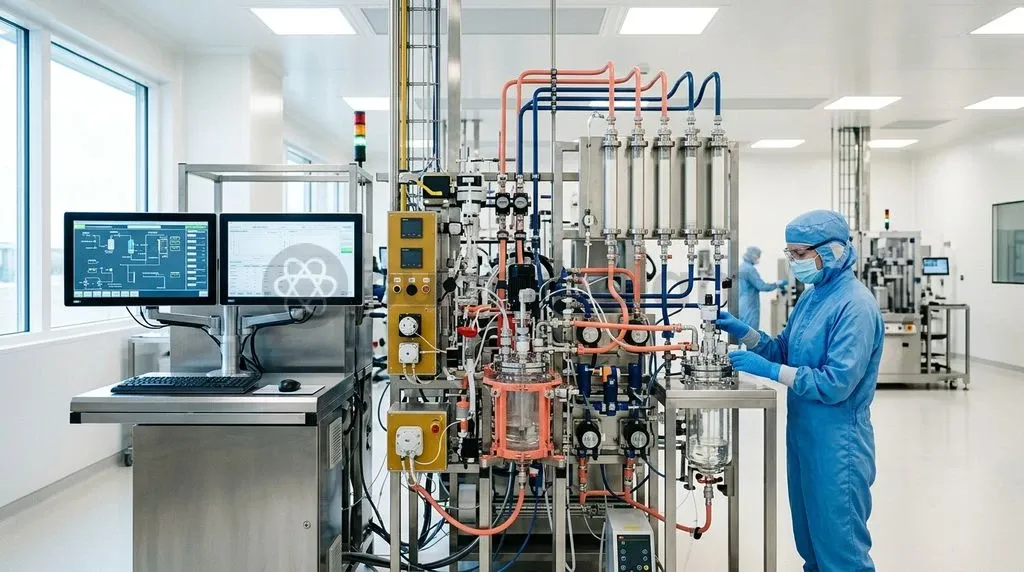
Mastering asymmetric catalysis enables the chemical synthesis of pure single-enantiomer drug molecules. This gives the Indian pharmaceutical manufacturing sector a clear scientific pathway to transition from commoditised generic bulk drugs into high-value, patent-protected active pharmaceutical ingredients.
By exploiting non-linear effects and autocatalytic reactions, chemical manufacturers can convert inexpensive prochiral substrates into enantiopure drugs. They no longer need to discard half of every batch as toxic effluent. This technological shift directly supports national manufacturing priorities under the Bulk Drug Parks Scheme and the Production Linked Incentive framework to secure raw material autonomy.
Why Chiral Symmetry Breaking Is Dominating Scientific Debate
The Royal Swedish Academy of Sciences awarded the 2026 Nobel Prize in Chemistry to Henri B. Kagan and Kenso Soai for discovering non-linear effects and asymmetric autocatalysis. According to the Nobel Foundation, their foundational research resolved how minute stereochemical biases amplify into uniform molecular handedness without requiring pre-existing biological templates.
Two landmark discoveries underpin this scientific milestone:
- Non-linear aggregation equilibria (1986): Henri Kagan demonstrated that an enantiomerically impure catalyst can yield reaction products displaying significantly higher optical purity than the catalyst itself.
- Self-amplifying autocatalysis (1995): Kenso Soai discovered that the chiral alkylation of pyrimidine-5-carbaldehyde produces an alcohol that catalyses its own formation, driving exponential self-multiplication of chiral purity.
These discoveries provide a practical engineering blueprint for industrial chemistry. India's bulk drug sector operates under intense pressure to decarbonise synthetic routes and minimise solvent consumption while climbing the value chain. Adopting self-amplifying catalytic cascades offers domestic manufacturers a viable method to synthesise complex chiral active pharmaceutical ingredients (APIs) at scale.
Discuss with Superkalam
Recall the biochemical reason why human cellular receptors and enzymes interact differently with mirror-image enantiomers.
Ask NowLeft Hand, Right Hand: What Makes Molecules Chiral
According to NCERT Chemistry curricula, chiral molecules lack an internal plane of symmetry. They exist as pairs of non-superimposable mirror images termed enantiomers. Enantiomers share identical scalar physical properties, including melting points, boiling points, solubilities, and densities, but rotate plane-polarised light in opposite directions.
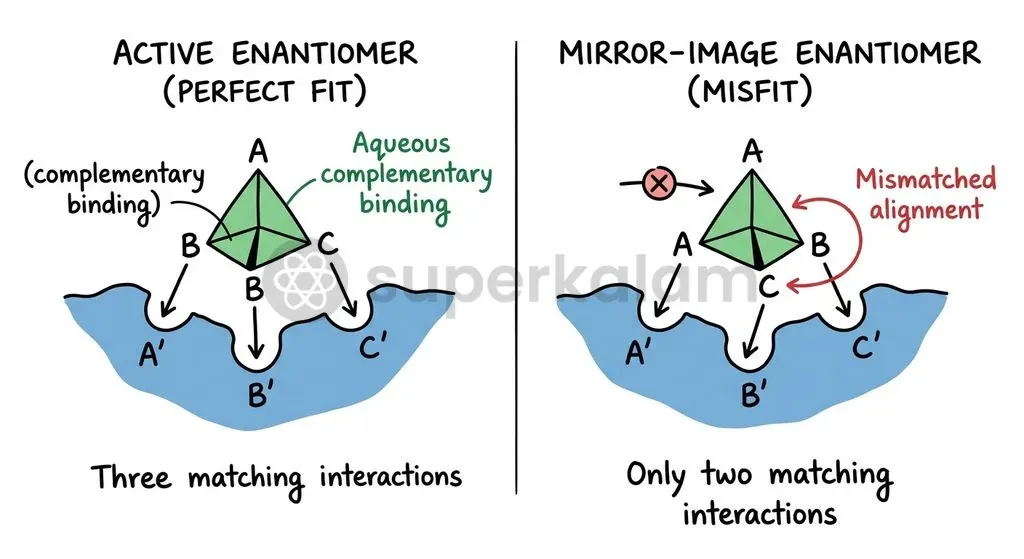
Biological environments interact stereospecifically with mirror isomers because human cellular receptors, enzymes, and transport proteins are chiral biopolymers composed exclusively of L-amino acids. The pharmacological differentiation between enantiomers is governed by the Easson-Stedman three-point interaction model. This model establishes that high-affinity binding requires complementary spatial alignment across at least three distinct pharmacophore sites. When an opposing enantiomer presents an inverted geometry, docking affinity diminishes or triggers adverse physiological responses.
| Molecular Dimension | Achiral Compounds | Enantiomeric Pairs |
|---|---|---|
| Symmetry Properties | Possesses internal plane or centre of symmetry | Lacks internal plane and inversion centre |
| Superimposability | Superimposable on mirror image | Non-superimposable mirror image |
| Optical Activity | Optically inactive (no net rotation of polarised light) | Rotates plane-polarised light in equal magnitude, opposite directions |
| Biological Receptor Fit | Identical docking across binding sites | Differential binding affinity via three-point docking |
The Cost of Getting It Wrong: From Thalidomide to Drug Side Effects
The World Health Organization documents that the thalidomide tragedy of 1957–1961 exposed catastrophic therapeutic risks from administering unresolved enantiomeric mixtures to patients. Prescribed widely as a sedative for pregnancy-induced morning sickness, the drug was marketed as a 50:50 racemic mixture. Clinical trials later demonstrated that while the (R)-enantiomer provided safe sedation, the mirror (S)-enantiomer caused severe teratogenic limb malformations, termed phocomelia, in thousands of newborns. Post-market investigations also revealed that spontaneous in vivo interconversion between the isomers undermined simple physical separation of the dose.
Regulatory agencies overhauled approval standards in response to stereoisomeric toxicities. The United States Food and Drug Administration issued binding guidance in May 1992 under policy statement 57 FR 22249, mandating that drug sponsors evaluate the pharmacokinetic, toxicological, and clinical activity of each individual enantiomer. Over 80% of small-molecule active pharmaceutical ingredients cleared by modern regulators contain chiral centres. Approximately 75% are commercialised as single enantiomers rather than racemates.
Commercial "chiral switches"—reformulating an established racemic medication into its active enantiomer—deliver marked therapeutic and clinical gains:
- Esomeprazole versus Omeprazole: The pure (S)-enantiomer of omeprazole avoids rapid metabolic clearance by hepatic cytochrome CYP2C19, generating higher systemic drug concentrations and superior gastric acid suppression at identical doses.
- Levocetirizine versus Cetirizine: Levocetirizine, the isolated (R)-enantiomer of cetirizine, provides a two-fold higher binding affinity for human H1 histamine receptors, enabling an effective clinical dose of 5 mg instead of 10 mg while mitigating central nervous system sedation.
- Ethambutol in Tuberculosis Control: In antimycobacterial therapy, (S,S)-ethambutol provides potent bacteriostatic action against Mycobacterium tuberculosis, whereas the mirror isomer (R,R)-ethambutol causes toxic retrobulbar optic neuritis that can induce irreversible blindness.
Discuss with Superkalam
Explain how Henri Kagan's discovery of non-linear aggregation equilibria allows chemical plants to bypass the requirement for 100% pure catalysts.
Ask NowWhy Traditional Chemical Separation Wastes Half of Every Batch
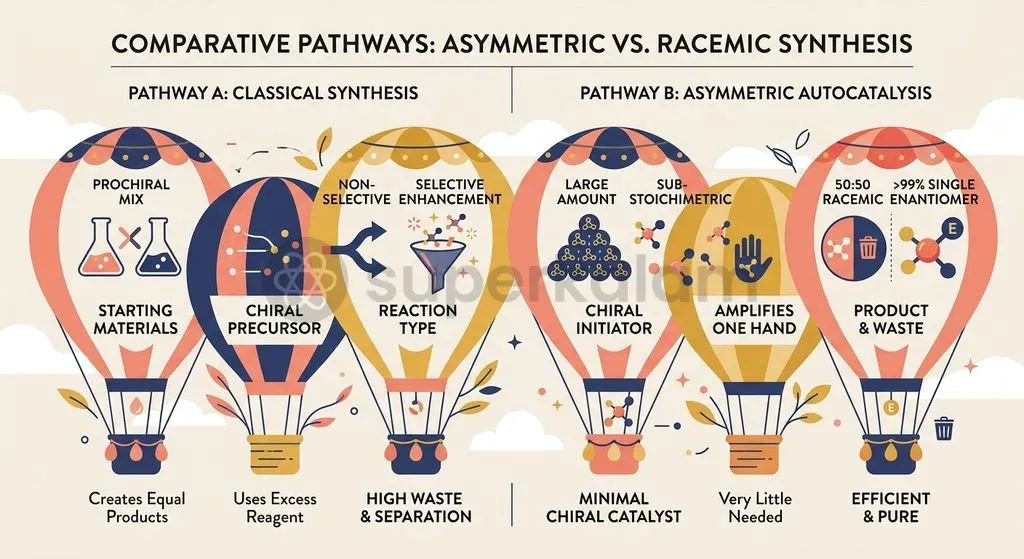
Standard chemical synthesis without chiral control produces an equimolar 50:50 racemic mixture, inherently wasting half of the synthesised intermediate. Classical chiral resolution relies on reacting a racemic mixture with an optically pure resolving agent to form temporary diastereomeric salts. Because diastereomers possess distinct physical solubilities, the targeted salt crystallises out while the unwanted enantiomeric salt remains dissolved in the mother liquor.
This separation approach introduces severe operational penalties:
- Direct material loss: Optical resolution discards up to 50% of the synthesized intermediate directly into chemical waste streams.
- Elevated E-factors: Material loss inflates the Environmental factor (E-factor), defined as the mass of waste generated per unit mass of final product. Complex active ingredient synthesis routinely exhibits an E-factor between 25 and over 100 kilograms of chemical and solvent waste per kilogram of API produced.
- Eroded margins: Incinerating or neutralising tonnes of discarded enantiomers generates heavy operating expenses, elevated energy footprints, and chronic compliance liabilities.
For Indian bulk drug manufacturers operating on thin operating margins, disposing of half their chemical inputs undermines international price competitiveness. Developing synthetic processes that generate only the desired isomer from the outset is an urgent economic imperative.
How Asymmetric Amplification Multiplies a Tiny Spark into Pure Output
Kenso Soai demonstrated in 1995 that asymmetric autocatalysis allows a chiral product to catalyse its own formation with exponential amplification. In the classic Soai reaction, the enantioselective addition of diisopropylzinc to pyrimidine-5-carbaldehyde produces a zinc alkoxide that catalyses the same transformation. An initial enantiomeric excess of less than 0.00005% rapidly self-amplifies to greater than 99.5% optical purity through auto-inductive reaction kinetics.
Henri Kagan established that non-linear effects emerge from aggregation states between enantiomeric catalyst species. When heterochiral complexes form preferentially over homochiral complexes, the minor enantiomer is trapped in an inactive reservoir. This reservoir frees the remaining homochiral catalyst pool to direct substrate conversion with high stereochemical fidelity.
The breakthroughs of Kagan and Soai remove the requirement for 100% enantiomerically pure catalysts in commercial plants. Chemical engineers can run continuous-flow synthesis using inexpensive, partially resolved catalysts or trace chiral initiators. This achieves near-perfect enantiomeric purity while slashing catalyst replenishment costs.
| Processing Parameter | Classical Racemic Resolution | Catalytic Asymmetric Amplification |
|---|---|---|
| Theoretical Atom Yield | Capped at 50% (unwanted enantiomer discarded) | Up to 100% conversion of prochiral substrate |
| Auxiliary Consumption | Stoichiometric resolving agents required | Sub-stoichiometric chiral catalyst inputs |
| Environmental E-Factor | High (25 to >100 kg waste per kg API) | Low (minimal chemical waste and solvent cycles) |
| Catalyst Purity Threshold | Requires 100% pure resolving agents | Tolerates partially pure catalysts via non-linear amplification |
| Scale-up Economics | High solvent recovery and disposal costs | Streamlined continuous-flow manufacturing |
Discuss with Superkalam
Compare the commercial and environmental penalties of classical racemic resolution against continuous-flow asymmetric catalysis using the concept of the E-factor.
Ask NowThe Commercial Stakes: Why India Must Shift from Generics to Pure Enantiomers
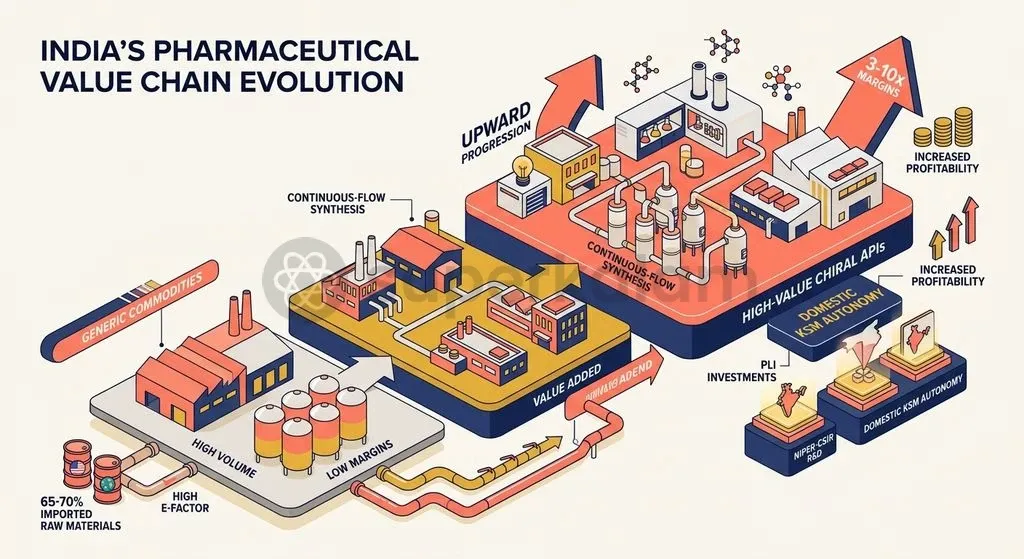
The Economic Survey 2023-24 highlights that India provides over 20% of global generic exports by volume while remaining concentrated in low-margin bulk commodities. Domestic formulators satisfy over 60% of international vaccine demand, yet Indian bulk drug operations remain historically vulnerable to upstream supply chain disruptions. Prior to 2020, India imported between 65% and 70% of its critical Key Starting Materials (KSMs), Drug Intermediates, and bulk APIs from China.
Moving up the value chain alters these manufacturing economics:
- Margin expansion: Commoditised generic APIs face chronic global price deflation and aggressive market competition. Conversely, complex chiral APIs and specialty chemical intermediates generate 3 to 10 times higher price margins per kilogram compared to commoditised racemic or achiral molecules.
- Defensible intellectual property: Mastering asymmetric synthesis allows Indian contract development and manufacturing organisations (CDMOs) to build proprietary chiral catalyst designs and non-infringing synthetic routes.
Capturing market share in patent-protected, single-enantiomer pharmaceuticals shields domestic manufacturers from global pricing volatility. Investing in advanced catalysis positions Indian firms to win innovator supply contracts as patent cliffs retire first-generation chiral drugs across Europe and North America.
Breaking the Generic Trap: Building Domestic Catalysis Capability
The Department of Pharmaceuticals is implementing the Scheme for Promotion of Bulk Drug Parks with ₹3,000 crore to construct shared infrastructure across three states. Strategic parks located in Andhra Pradesh, Gujarat, and Himachal Pradesh centralise critical utilities to compress capital expenditure for chemical manufacturers. Shared installations include Common Solvent Storage and Distillation Plants, advanced API testing laboratories, stability chambers, and Central Effluent Treatment Plants (CETPs) engineered to process high-COD pharmaceutical waste streams.
Government programmes and institutional initiatives reinforce this industrial pivot:
- Production Linked Incentive Scheme: Funded with an approved outlay of ₹6,940 crore across 41 critical Key Starting Materials, Drug Intermediates, and APIs. As of June 2026, cumulative actual investment reached ₹5,210.74 crore, exceeding the committed milestone of ₹4,330 crore, with 39 manufacturing projects commissioned across 28 critical APIs and intermediates.
- CSIR Laboratory Research: Laboratories at CSIR-IICT in Hyderabad and CSIR-NCL in Pune conduct applied research in continuous-flow asymmetric hydrogenation, organocatalysis, and biocatalytic transformations to eliminate reliance on imported noble-metal catalysts.
- Human Capital Legislation: Parliament passed the National Institute of Pharmaceutical Education and Research (Amendment) Act, 2021, designating all seven NIPER campuses as Institutes of National Importance to structure joint R&D pipelines for complex drug synthesis.
Discuss with Superkalam
Evaluate whether transitioning to pure enantiomers through asymmetric catalysis is sufficient for Indian bulk drug manufacturers to achieve raw material autonomy under the Bulk Drug Parks Scheme.
Ask NowKey Takeaways
- Foundational Chemistry: Chiral molecules lack internal symmetry and exist as non-superimposable mirror image enantiomers, which interact stereospecifically with chiral cellular receptors via three-point binding.
- Historical and Clinical Imperative: The 1957–1961 thalidomide tragedy demonstrated that opposing enantiomers can cause severe teratogenic toxicity, leading modern regulators to mandate single-enantiomer profiling for over 80% of chiral active ingredients.
- Overcoming Synthetic Waste: Traditional non-asymmetric synthesis produces 50:50 racemic mixtures that waste half of all intermediate chemicals, generating high environmental E-factors between 25 and over 100 kg of waste per kg of API.
- Nobel-Recognised Catalysis: The 2026 Nobel Prize in Chemistry awarded to Henri B. Kagan and Kenso Soai validates non-linear amplification and asymmetric autocatalysis, enabling quantitative single-enantiomer synthesis without requiring 100% pure catalysts.
- Strategic Industrial Transition: Transitioning from low-margin bulk generics to chiral APIs allows Indian manufacturers to access 3 to 10 times higher profit margins, backed by ₹5,210.74 crore in realised PLI investments as of June 2026 and dedicated infrastructure under the ₹3,000 crore Bulk Drug Parks Scheme.
Mains Question
'The structural shift from classical racemic resolution to catalytic asymmetric amplification is not merely a scientific upgrade, but an ecological and economic imperative for bulk drug manufacturing.' Elucidate. (10 Marks)
Evaluate NowMains Question
"Securing raw material autonomy in the pharmaceutical sector under the Bulk Drug Parks Scheme requires transitioning from commoditised generic bulk drugs to stereochemically pure active ingredients." In this context, examine the therapeutic, regulatory, and industrial significance of asymmetric catalysis for India. (15 Marks)
Evaluate NowPractice MCQs
QUESTION 1
With reference to chiral molecules and stereochemistry, consider the following statements:
- Enantiomers possess identical scalar physical properties such as melting point, boiling point, and density.
- The biological differentiation between enantiomers is explained by the Easson-Stedman three-point interaction model.
- A classical racemic resolution of an equimolar mixture can theoretically yield up to 100% of the single desired enantiomer without discarding chemical intermediates. Which of the statements given above are correct?
QUESTION 2
Consider the following statements regarding discoveries in asymmetric catalysis:
- Henri Kagan demonstrated that an enantiomerically impure catalyst can yield products displaying significantly higher optical purity than the catalyst itself through non-linear aggregation equilibria.
- In the Soai reaction, the chiral alkylation of pyrimidine-5-carbaldehyde produces an alcohol that catalyses its own formation.
- Asymmetric autocatalysis requires catalysts of 100% initial enantiomeric purity to achieve high optical output. Which of the statements given above is/are correct?
QUESTION 3
With reference to chiral pharmaceuticals and their clinical effects, consider the following pairs:
- Thalidomide: (R)-enantiomer caused phocomelia, while (S)-enantiomer acted as a sedative
- Ethambutol: (S,S)-enantiomer treats tuberculosis, while (R,R)-enantiomer causes retrobulbar optic neuritis
- Omeprazole: Pure (S)-enantiomer (esomeprazole) avoids rapid hepatic clearance compared to the racemate Which of the pairs given above is/are correctly matched?
QUESTION 4
In the context of industrial chemical manufacturing and green chemistry, the term 'Environmental factor' (E-factor) is defined as the:
QUESTION 5
Consider the following statements regarding regulatory and technological trends in drug development:
- United States FDA guidance issued under policy statement 57 FR 22249 mandated evaluation of the pharmacokinetic and toxicological activity of each individual enantiomer.
- Over 80% of small-molecule active pharmaceutical ingredients cleared by modern regulators contain chiral centres.
- The transformation of an established racemic drug into its isolated active enantiomer is termed a 'chiral switch'. Which of the statements given above are correct?