New Driving Licence Rules 2026: MoRTH's Proposed Changes Explained
MoRTH's draft amendments to the Central Motor Vehicles Rules propose a tougher learner's test, mandatory medical disclosures and a 30-minute safety tutorial. What changes for applicants.
Oct, 2026
•10 min read

Context
The Ministry of Road Transport and Highways has proposed sweeping draft amendments to the Central Motor Vehicles Rules, 1989. The proposal raises the learner's licence qualifying score to 75% and expands digital, automated driving assessments.
This regulatory shift targets informal tout networks across Regional Transport Offices by eliminating discretionary manual testing. However, technology alone cannot resolve systemic road trauma. Governance frameworks must separate testing authority from licensing administration while tackling deep state-level capacity constraints.
Why in the News: MoRTH Overhauls Driver Testing and Licensing Norms
The Ministry of Road Transport and Highways published draft amendments to the Central Motor Vehicles Rules, 1989 to overhaul candidate evaluation.
Key testing changes under the draft notification include:
- The statutory pass mark for the safe-driving tutorial preliminary learner's licence assessment will rise from 60% to 75%.
- The safe-driving tutorial must run for a minimum duration of 30 minutes.
- Candidates will receive an expanded testing window of 15 days, up from seven days, to complete their online learner's licence assessment.
Previous testing exemptions are being systematically removed to enforce uniform competency. According to reporting by The Hindu, holders of expired learner's licences and graduates of private driving schools must now mandatorily complete the tutorial and clear the preliminary assessment.
Streamlined administrative processing accompanies these testing standards. The Gazette notification introduces a unified Form 2A covering licence renewals, duplicate issues, vehicle class endorsements, and personal detail changes. Under proposed Rule 16A, licensing authorities must decide amendment applications within 15 days, and address updates remaining undecided after 30 days will be deemed approved.
Discuss with Superkalam
What specific percentage score must a candidate achieve to pass the learner's licence assessment under the proposed CMVR draft rules?
Ask NowHow India Gets Licences Today: The RTO Broker Economy and Crash Crisis
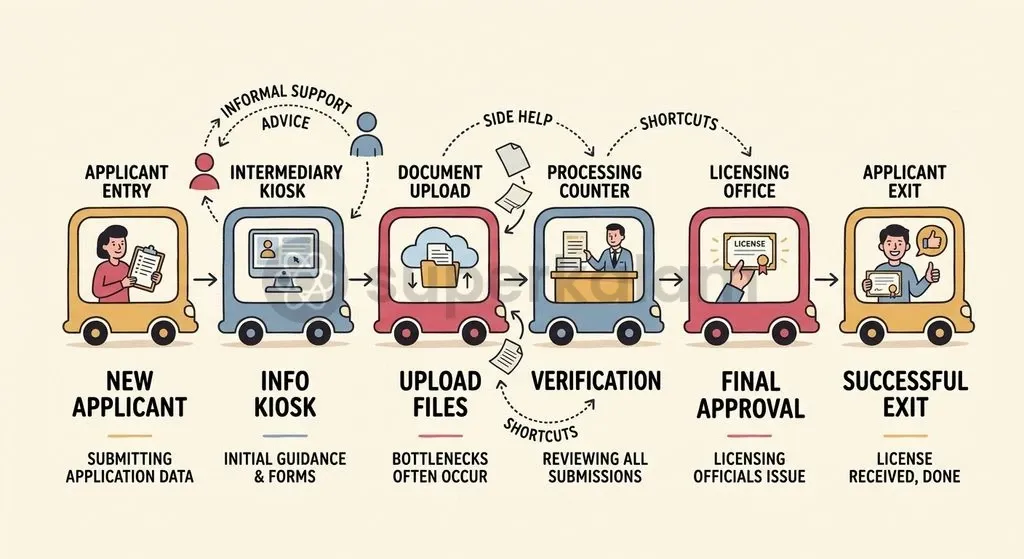
Regional Transport Offices operate as the primary administrative bottleneck in India's transport governance. Despite digitisation drives, structural discretion exercised by licensing officials has historically fostered an entrenched ecosystem of informal intermediaries.
A landmark randomised evaluation by Bertrand, Djankov, Hanna, and Mullainathan published in the Quarterly Journal of Economics revealed that 71% of individuals obtaining driving licences through private intermediaries bypassed the mandatory driving test. The experimental audit established that 62% of licence recipients who used agents failed an independent, surprise driving examination.
Informal tout networks have proved remarkably adaptable. According to a study by High Volume Transport Applied Research, physical intermediaries smoothly transitioned into digital service kiosks following the rollout of the Parivahan Sarathi 4.0 portal. These kiosks extract facilitation fees to navigate online booking slots and document uploads, leaving rent-seeking intact.
This governance failure directly fuels India's severe road safety crisis:
- The World Bank reports that India accounts for approximately 11% of global road deaths despite possessing only about 1% of the world's motor vehicles.
- Annual official statistics compiled in the Road Accidents in India 2023 report show that road crashes killed 1,73,000 lives across the country.
- Lax licensing directly impedes India's international commitments under the Brasilia Declaration on Road Safety, which pledges to halve traffic fatalities in line with United Nations Sustainable Development Goal Target 3.6.
What the New Draft Rules Change: Automation, Private Centres, and Aadhaar
Central Motor Vehicles Rules draft amendments seek to eradicate petty administrative graft by eliminating cash handling and in-person verification.
The proposed framework introduces major structural adjustments across administrative and training workflows:
- Fee waivers for digital updates: According to reporting by The Economic Times, the draft rules propose scrapping user fees for updating addresses, mobile numbers, and email details on driving licences. Charges will also be waived for select online services verified through Aadhaar e-KYC under Rule 32.
- Stricter identity verification: The draft notification eliminates informal affidavits sworn before executive magistrates or notaries. Applicants must instead provide UIDAI Aadhaar, passports, voter identity cards, or verified utility bills.
- Differentiated physical credentials: The draft rules introduce separate colour-coded Form 7 cards to visually distinguish driving licences issued to Indian citizens from those granted to foreign nationals.
Discuss with Superkalam
Why did the digital transition to the Parivahan Sarathi 4.0 portal fail to fully dismantle informal tout networks across RTOs?
Ask NowPrivate sector participation forms the second pillar of the Ministry's licensing overhaul. Under Rules 31B through 31J of the Central Motor Vehicles Rules, inserted via G.S.R. 394(E) in 2021, the government authorised Accredited Driver Training Centres to conduct comprehensive training. Candidates who pass training at an accredited centre receive a Form 5B training certificate, granting a statutory exemption from undergoing practical driving tests at government testing tracks.
Before and After: Manual Testing vs Automated Driving Test Tracks
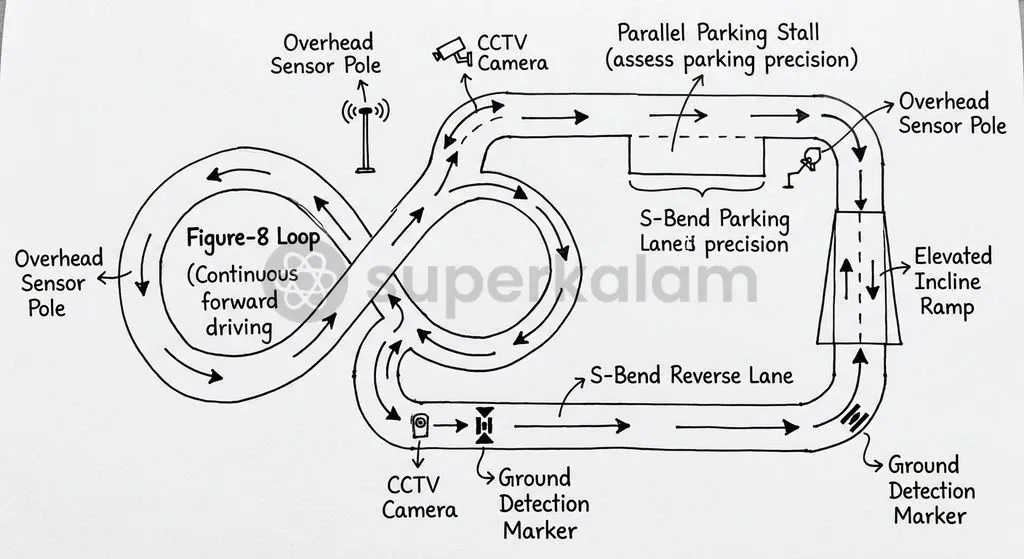
Automated Driving Test Tracks utilise sensor-embedded courses, high-definition video analytics, and radio-frequency identification to evaluate applicants without direct human intervention. Manual testing regimes at Regional Transport Offices relied entirely on the subjective discretion of motor vehicle inspectors.
| Parameter | Traditional Manual RTO Assessment | Automated Driving Test Track (ADTT) Assessment |
|---|---|---|
| Testing Environment | Unregulated public streets or basic open ground | Standardised closed circuit with embedded sensors |
| Evaluation Method | Subjective visual observation by motor vehicle inspectors | Overhead cameras, analytics software, and sensor triggers |
| Evaluated Maneuvers | Short linear driving, basic turning, brief verbal queries | Reverse parallel parking, figure-eight, gradient hill stop |
| Intermediary Vulnerability | High; pervasive reliance on touts to bypass evaluations | Lower for slot allocation; zero inspector scoring discretion |
| Cognitive Assessment | Minimal static theoretical queries | Standardised video tutorials and digital hazard modules |
| Operational Output | Hand-signed physical approval slips | Automated algorithmic scoring and real-time dashboard logs |
The operational contrast between manual inspection and automated scoring demonstrates clear administrative gains. Yet automated tracks present technical boundaries of their own.
Technical evaluations by the Transport Research Wing of MoRTH indicate that automated tracks assess basic low-speed vehicle manoeuvring on closed geometries, such as parallel parking and gradient stops. These tracks do not evaluate dynamic hazard perception, lane merging, or high-speed emergency braking in real-world traffic.
The Governance Dilemma: Can Algorithms Dismantle Grassroots Rent-Seeking?
Technocratic interventions often misdiagnose structural institutional corruption as a purely technological shortfall. Public administration literature emphasises that digitising a corrupt process without altering institutional incentives simply redistributes rent extraction.
Automation faces two persistent operational bottlenecks:
- Displacement of intermediaries: The transition to Parivahan Sarathi 4.0 proved that touts relocate to informal access barriers whenever procedural friction remains. Commercial intermediaries monetise digital illiteracy, managing portal appointments and document formatting for rural and unorganised transport workers. Algorithmic tracks remove inspector discretion on the circuit, but they do not eliminate corruption in antecedent requirements like medical certificates or private school attendance logs.
- Commercial conflicts of interest: Accredited Driver Training Centres introduce a secondary vector of regulatory risk. Granting private facilities the power to issue test-exempting Form 5B certificates creates an immediate conflict of interest. Private driving academies operate under commercial incentives to ensure high customer pass rates. Without rigorous, continuous independent inspections, regulatory capture could transform private training centres into commercial licence-vending outlets.
Ethical governance requires transparency, competence, and public accountability. When private entities assume statutory public functions, procedural integrity hinges on third-party oversight rather than unchecked automation.
Discuss with Superkalam
How might a state transport department balance its reliance on non-tax licensing revenue with central mandates that waive fees for Aadhaar e-KYC updates?
Ask NowFederal and Practical Roadblocks: Why States and Poor Drivers Face New Hurdles
Constitutional distribution of legislative authority creates structural friction in implementing national road safety policies. Under the Seventh Schedule of the Constitution of India, mechanically propelled vehicles fall under Entry 35 of the Concurrent List.
While Parliament enacts framework licensing legislation under Chapter II of the Motor Vehicles Act, 1988, State Governments possess statutory administrative authority over Regional Transport Offices, staff appointments, and fee collections. State transport departments rely heavily on motor vehicle registration and licensing fees for own-source non-tax revenues. Central rules that cap fees, mandate automated infrastructure, or bypass local offices frequently face state pushback.
Capital costs and real estate requirements further impede decentralised adoption:
- Developing automated test tracks and accredited centres demands extensive capital investment that strains state capital budgets.
- Statutory norms require a minimum of two acres of land for light motor vehicle training facilities.
- Urban transport authorities face acute land scarcity, while rural districts lack high-speed connectivity and power stability for sensor circuits.
Equity dimensions exacerbate these administrative roadblocks. Stringent digital portals, 30-minute safe-driving video tutorials, and online examinations present steep compliance hurdles for illiterate and semi-literate commercial drivers. Drivers from disadvantaged socio-economic backgrounds face heightened risks of administrative exclusion or forced reliance on exploitative digital cyber-kiosks.
Global Lessons: What Sweden and the UK Teach Us About Driver Competency
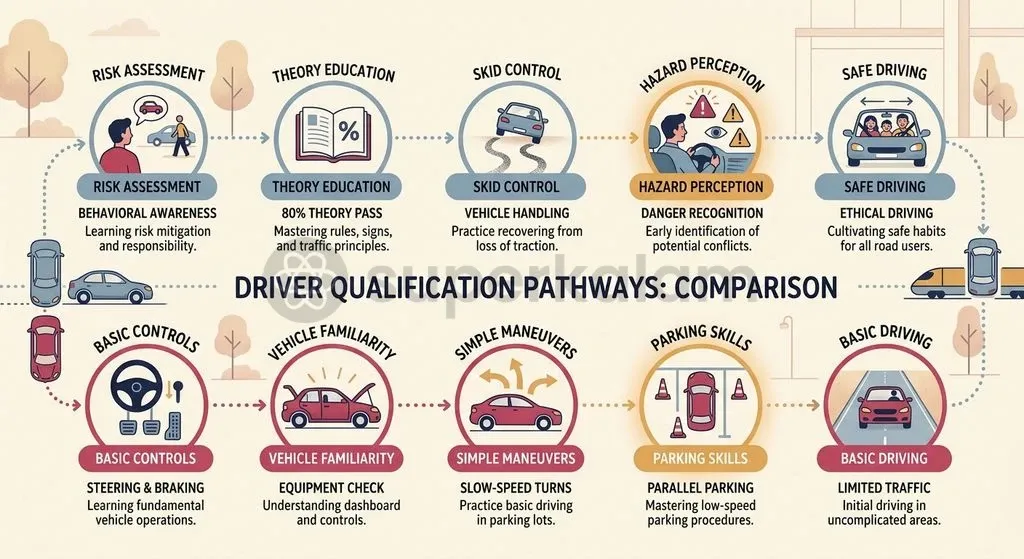
International best practices prove that durable road safety gains stem from comprehensive risk awareness rather than rudimentary mechanical testing. Advanced transport regimes treat driver licensing as an intensive cognitive qualification rather than an administrative formalities routine.
Two international models demonstrate how cognitive assessment shapes safety outcomes:
- Sweden's Vision Zero framework: The Swedish Transport Administration requires candidates to complete a mandatory two-stage Risk Training programme (Riskutbildning). Stage one addresses driver fatigue, narcotics, and alcohol impairment. Stage two (Halkbana) enforces practical skid and hazard management on low-friction tracks. Trafikverket's computerised theoretical test enforces a demanding 80% passing threshold, requiring candidates to answer 52 out of 65 questions correctly. First-time pass rates range between 45% and 50%, reflecting high testing stringency. Under Vision Zero, Sweden records approximately 2.1 to 2.2 road fatalities per 100,000 population.
Discuss with Superkalam
Compare the evaluation mechanisms of an Automated Driving Test Track with a traditional manual RTO test in assessing driver competence and curbing corruption.
Ask Now- The United Kingdom's two-tier assessment: The Driver and Vehicle Standards Agency manages a combined cognitive testing model. Candidates must pass a 50-question multiple-choice theory test with an 86% pass threshold alongside a 14-video hazard perception test in a single sitting. Official DVSA testing data indicates an overall pass rate of approximately 44.8%, eliminating unprepared applicants before practical on-road testing. Consequently, the United Kingdom records roughly 2.9 road deaths per 100,000 people, whereas India's road fatality rate exceeds 12 deaths per 100,000 population.
Discuss with Superkalam
Weigh the benefits of delegating driving examinations to Accredited Driver Training Centres against the regulatory risks of private commercial capture.
Ask NowWay Forward: Fixing Accountability Beyond Digital Dashboards
Sustainable licensing reform requires structural institutional restructuring alongside digital automation. Automated driving tracks resolve immediate scoring bias, but systemic integrity requires insulating regulatory enforcement from commercial and administrative conflicts of interest.
Key structural reforms recommended by expert bodies include:
- Separation of powers: The landmark Sundar Committee on Road Safety and Traffic Management recommended establishing a statutory national transport board and structurally separating driver testing from licensing bodies. An independent testing agency prevents licensing officials from exercising collusive gatekeeping.
- Dedicated road safety funding: The Supreme Court Committee on Road Safety, headed by former Supreme Court judge Justice K.S. Radhakrishnan, reinforced institutional capacity measures. The Committee directed state governments to establish dedicated, non-lapsable Road Safety Funds and create specialised state road safety authorities to oversee licensing compliance.
- Statutory oversight and audits: Operationalising central statutory bodies is essential for nationwide regulatory uniformity. The Union Government notified the constitution of the National Road Safety Board under Section 215B of the Motor Vehicles Act, 1988 through G.S.R. 614(E). This statutory board must set mandatory minimum curricula for private training centres and conduct random audits of automated testing tracks.
Finally, licensing evaluation must progress beyond static parking manoeuvres to test hazard perception and dynamic highway entry. Pairing objective digital testing with institutional oversight ensures that driving licences reflect genuine public safety competencies.
Key Takeaways
- Draft amendments to the Central Motor Vehicles Rules, 1989 raise the learner's licence qualifying score from 60% to 75% and mandate a 30-minute tutorial.
- Experimental research reveals that 71% of individuals obtaining driving licences through intermediaries bypassed practical examinations.
- Automated driving test tracks evaluate low-speed maneuvers but fail to measure dynamic hazard perception or live-traffic emergency responses.
- Transport falls under Entry 35 of the Concurrent List, generating fiscal and administrative friction between central mandates and state-level transport administration.
- Sustainable governance reform requires operationalising the National Road Safety Board under Section 215B of the Motor Vehicles Act, 1988 and separating testing bodies from licensing administration.
Mains Question
"Digitising a corrupt process without altering institutional incentives simply redistributes rent extraction." In the context of the proposed amendments to the Central Motor Vehicles Rules, 1989 and the roll-out of Automated Driving Test Tracks, critically examine whether technological interventions can eliminate structural corruption in Regional Transport Offices. (15 Marks)
Evaluate NowMains Question
India accounts for approximately 11% of global road fatalities despite possessing only 1% of the world's vehicles. Elucidate how administrative bottlenecks and federal friction in transport governance impede the realization of commitments under the Brasilia Declaration on Road Safety. (10 Marks)
Evaluate NowPractice MCQs
QUESTION 1
With reference to the draft amendments to the Central Motor Vehicles Rules, 1989 proposed by the Ministry of Road Transport and Highways (MoRTH), consider the following statements:
- The statutory pass mark for the safe-driving tutorial preliminary learner's licence assessment is proposed to be raised from 60% to 75%.
- Holders of expired learner's licences and graduates of private driving schools will be granted automatic exemptions from the online preliminary assessment.
- A unified Form 2A has been introduced to process renewals, duplicate issues, vehicle class endorsements, and personal detail changes. Which of the statements given above are correct?
QUESTION 2
Consider the following statements regarding the regulatory framework for driver licensing and vehicle regulation in India:
- Mechanically propelled vehicles fall under Entry 35 of the Concurrent List in the Seventh Schedule of the Constitution of India.
- Under Rules 31B through 31J of the Central Motor Vehicles Rules, candidates obtaining a Form 5B certificate from an Accredited Driver Training Centre are exempted from the practical driving test at government tracks.
- The Brasilia Declaration on Road Safety pledges to eliminate all traffic fatalities by 2030 in line with United Nations Sustainable Development Goal Target 3.6. Which of the statements given above is/are correct?
QUESTION 3
Consider the following statements regarding Automated Driving Test Tracks (ADTT) and transport governance:
- Technical evaluations by MoRTH indicate that ADTTs evaluate dynamic hazard perception and lane merging in real-world traffic.
- A randomised evaluation published in the Quarterly Journal of Economics revealed that over 70% of individuals obtaining driving licences through intermediaries bypassed mandatory driving tests.
- The draft amendments to the Central Motor Vehicles Rules propose the introduction of separate colour-coded Form 7 cards to distinguish licences of Indian citizens from foreign nationals. Which of the statements given above is/are correct?
QUESTION 4
Under the draft amendments to the Central Motor Vehicles Rules, 1989, what is the statutory status of an address update application submitted to a licensing authority if it remains undecided after 30 days under proposed Rule 16A?
QUESTION 5
With reference to the digital reforms in driver licensing under the Central Motor Vehicles Rules, consider the following statements:
- The draft rules propose waiving user fees for updating addresses, mobile numbers, and email details when verified via Aadhaar e-KYC under Rule 32.
- Following the introduction of the Parivahan Sarathi 4.0 portal, physical intermediaries were completely eliminated from the licensing ecosystem.
- Informal affidavits sworn before executive magistrates or notaries are proposed to be eliminated as valid proof of identity. Which of the statements given above is/are correct?