NdFeB Permanent Magnets: Bridging India's Supply Chain Gap
Despite vast monazite reserves, India's missing midstream refining and sintering capacity leaves clean energy and defence manufacturing acutely vulnerable.
Sep, 2026
•10 min read
Context
India faces a severe structural bottleneck in clean energy and national security manufacturing. While beach sands hold vast raw reserves, domestic industry remains fully dependent on imported Neodymium-Iron-Boron magnets.
The country lacks commercial facilities to convert crude chemical oxides into refined metals, special alloys, and sintered magnets. This midstream gap leaves electric mobility, wind turbines, robotics, and missile guidance assemblies vulnerable to external trade disruptions.
Why in the News?
The Ministry of Heavy Industries received 20 global bids on 12 August 2026 under the Request for Proposal to establish integrated manufacturing facilities for sintered Neodymium-Iron-Boron (NdFeB) permanent magnets. This bidding round follows the Union Cabinet's approval on 26 November 2025 of the ₹7,280 crore Scheme to Promote Manufacturing of Sintered Rare Earth Permanent Magnets (REPM).
As of August 2026, according to official trade statistics from the Ministry of Commerce and Industry, India imports virtually all of its sintered NdFeB magnet requirements, with over 90% of supplies originating from China.
Evolution of India's Rare Earth Ecosystem
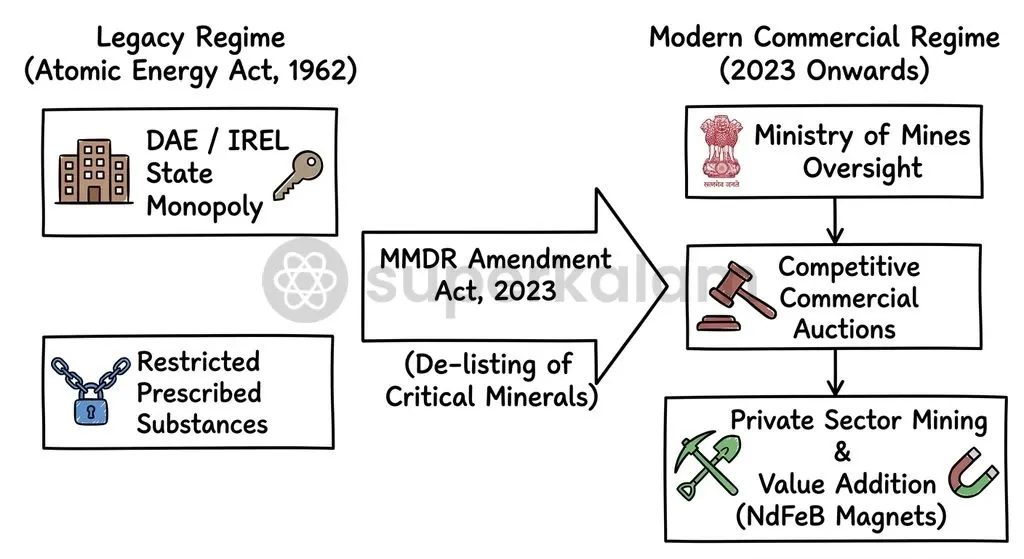
India's rare earth sector began under the administrative governance of the Department of Atomic Energy (DAE). Early policy treated beach sand minerals as strategic atomic resources rather than commercial commodities.
The historical trajectory spans two distinct regulatory eras:
- Monopoly Extraction Era: The Atomic Energy Act, 1962 placed coastal placer deposits under state control. State-owned IREL (India) Limited separated strategic heavy minerals from monazite sand under oversight from the Atomic Energy Regulatory Board (AERB).
- Crude Chemical Stagnation: Extraction remained confined to basic chemical cracking for decades. It yielded crude oxides rather than commercial downstream alloys.
- Commercial Market Opening: Parliament passed the MMDR Amendment Act, 2023, de-listing 24 critical minerals from Part B of the First Schedule and inserting Part D. This shift empowered the Central Government to auction commercial mining leases, transitioning the sector toward industrial scaling.
What Are NdFeB Magnets and Why Clean Energy Needs Them
Neodymium-Iron-Boron magnets are the strongest commercially available permanent magnets. They deliver an exceptional magnetic energy product alongside a superior power-to-weight ratio.
According to a PIB release on the Rare Earth Permanent Magnet Manufacturing Ecosystem, these magnets provide the high-torque density required for electric vehicle traction motors, wind turbine generators, industrial robotics, and aerospace actuators.
Magnetic performance depends directly on elemental composition. Heavy rare earth elements such as Dysprosium (Dy) and Terbium (Tb) serve as critical additives. A report by NITI Aayog notes that these additives prevent thermal demagnetisation when motors operate above 150°C.
| Feature | Standard Ferrite Magnets | Sintered NdFeB Permanent Magnets |
|---|---|---|
| Primary Composition | Iron oxide and Barium or Strontium carbonate | Neodymium, Iron, and Boron (alloyed with Dysprosium/Terbium) |
| Magnetic Energy Product ($BH_{max}$) | Low to moderate magnetic flux density | Extremely high magnetic energy density |
| Power-to-Weight Efficiency | Bulkier footprint; low torque density | Compact volume; high torque density |
| Temperature Resistance | Stable at moderate industrial temperatures | Requires Dysprosium/Terbium additives for temperatures above 150°C |
| Primary Industrial Use | Conventional consumer electronics and acoustic speakers | Electric vehicle traction motors, wind turbines, and defence guidance |
Discuss with Superkalam
Which specific heavy rare earth elements are added to NdFeB magnets to prevent thermal demagnetisation above 150°C?
Ask NowThe 5-Step Value Chain: From Monazite Ore to Sintered Magnet
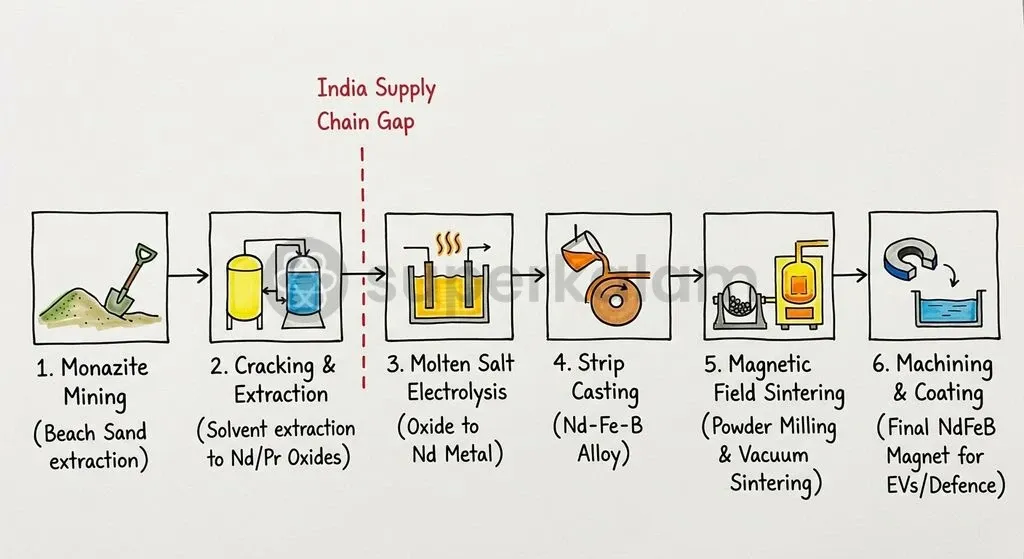
The transformation of raw mineral ore into precision-engineered NdFeB permanent magnets follows a rigorous six-stage metallurgical pathway, as detailed in the Critical Minerals & Rare Earth Magnets Roadmap by the Ministry of Mines.
- Mining and Physical Beneficiation: Beach sand deposits and placer ores undergo gravity and magnetic separation to isolate heavy minerals, yielding concentrated monazite sand.
- Cracking and Solvent Extraction: Monazite is chemically treated with caustic soda to remove thorium and uranium. Multi-stage liquid-liquid solvent extraction then separates individual high-purity rare earth oxides.
- Oxide-to-Metal Reduction: Separated Neodymium and Praseodymium oxides undergo high-temperature molten salt electrolysis to produce pure, unalloyed rare earth metals.
- Alloy Melting and Strip Casting: Pure Neodymium, Iron, and Boron are melted inside a vacuum induction furnace. The molten mixture is then strip-cast into thin flakes of NdFeB master alloy.
- Powder Metallurgy, Sintering, and Finishing: The master alloy is jet-milled into microscopic powder and aligned under a magnetic field. It is then compressed and fused in high-temperature vacuum sintering furnaces before final electroplating and pulse magnetisation.
Where the Chain Breaks: India's Key Midstream and Downstream Gaps
India's supply chain breaks at the transition between chemical oxide refining and metallurgical processing. According to an assessment published by the Ministry of Mines, domestic operations handle upstream mineral separation and crude extraction well. However, they lack commercial-scale molten salt electrolytic reduction facilities to convert refined oxides into pure Neodymium-Praseodymium metal.
State-owned IREL (India) Limited operates heavy mineral separation units at OSCOM in Odisha and a rare earth refining unit at Aluva, Kerala. These facilities produce chemical-grade rare earth oxides and crude concentrates rather than industrial master alloys. The absence of commercial strip casting, vacuum induction melting, and precision sintering infrastructure forces domestic motor makers to import finished magnets.
Industrial adoption of nascent domestic alternatives also faces strict qualification hurdles:
- Protracted Certification: Consultations conducted by the Ministry of Heavy Industries indicate that automotive and aerospace original equipment manufacturers typically require a 3-to-5-year qualification window before clearing new magnet formulations for mission-critical motors.
- High Switching Costs: Downstream motor designs rely on tight magnetic tolerances, making manufacturers reluctant to onboard unproven domestic alloys without extensive field validation.
Discuss with Superkalam
Why does crude chemical cracking of monazite sand fail to yield commercial-grade permanent magnets without midstream metallurgical reduction?
Ask NowGlobal Monopoly vs India's Upstream Reserves: A Comparative Look
Geological data confirms that India holds substantial raw mineral wealth. A PIB release on rare earth exploration documents that India possesses 13.15 million tonnes of monazite resources across 136 beach sand and inland placer deposits, representing approximately 7.23 million tonnes of in-situ Rare Earth Oxide equivalent.
Furthermore, the Geological Survey of India has identified cumulative resources of 767 million tonnes of rare earth element ores since the 2015 amendments to the mining statute.
| Global Segment | China's Market Share | India's Present Position |
|---|---|---|
| Oxide-to-Metal Refining | Over 90% capacity | Pilot scale; absent commercial reduction |
| Sintered Magnet Fabrication | Over 92% production | Near 0% commercial manufacturing |
| Raw Upstream Reserves | Dominant global bastnäsite/clays | 7.23 Mt in-situ REO equivalent |
The International Energy Agency notes that global supply remains highly concentrated. China controls over 90% of rare earth oxide-to-metal refining capacity and more than 92% of commercial sintered NdFeB permanent magnet production. This dominance creates a severe structural asymmetry, as India possesses vast raw resources but relies entirely on external refining infrastructure.
| Parameter | Domestic Landscape (India) | Dominant Global Producer (China) |
|---|---|---|
| Primary Resource Base | 13.15 million tonnes of monazite across 136 deposits | Massive inland bastnäsite and ionic clay deposits |
| Oxide-to-Metal Refining | Pilot-scale operations; absent commercial electrolytic reduction | Controls over 90% of global refining capacity |
| Sintered Magnet Fabrication | Developing under initial fiscal incentive schemes | Controls over 92% of commercial sintered NdFeB production |
| Downstream Market Role | Net importer of finished components and motors | Primary global exporter of finished permanent magnets |
Discuss with Superkalam
How might external export controls on heavy rare earths impact India's targeted rollout of electric vehicles by 2030?
Ask NowStrategic Risks: Clean Tech and Defence Vulnerabilities
India's clean energy transition creates massive demand for advanced magnetic components over the coming decade. Domestic demand for Rare Earth Permanent Magnets is projected to reach 8,220 metric tonnes per annum (MTPA) by 2030, driven primarily by electric vehicles (3,250 MTPA) and wind power installations (1,800 MTPA), according to data released by the Ministry of Mines.
External disruptions present immediate operational risks:
- Export Controls: In April 2025, China's Ministry of Commerce instituted export licensing restrictions on heavy rare earths, including Dysprosium and Terbium, as well as downstream permanent magnets.
- Downstream Slowdowns: Documentation from trade research institutions indicates that these trade controls triggered acute supply crunches and production slowdowns in global automotive and EV assembly lines, directly impacting domestic manufacturers dependent on imported sub-assemblies.
- Defence Dependencies: Guided missile actuators, radar transceivers, electronic warfare pods, and naval propulsion drives rely on high-coercivity magnets to maintain operational stability in harsh environments. Continued reliance on single-origin supply corridors compromises strategic autonomy during geopolitical crises.
Discuss with Superkalam
Compare the domestic availability of upstream monazite resources with India's current commercial sintered magnet fabrication capacity.
Ask Now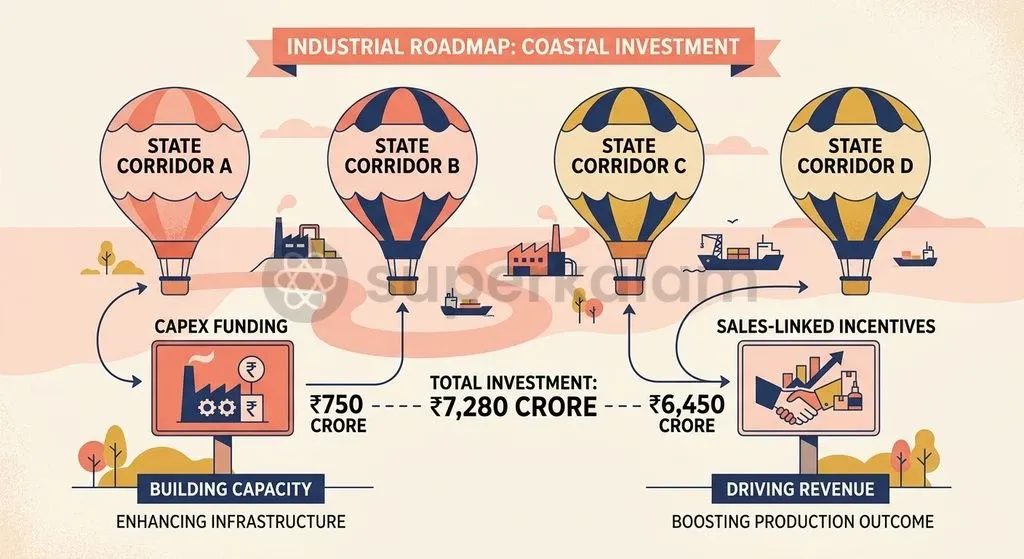
Policy Initiatives: Critical Minerals Strategy, IREL, and PLI Push
The Union Cabinet approved the National Critical Mineral Mission (NCMM) on 29 January 2025 to secure value chains across exploration, processing, recycling, and overseas asset acquisition through FY 2030-31. To support downstream value addition, the central government approved the ₹7,280 crore REPM scheme on 26 November 2025.
| Component | Outlay | Allocation Window |
|---|---|---|
| Capital Expenditure Subsidy | ₹750 crore | Initial facility construction phase |
| Sales-Linked Operational Incentive | ₹6,450 crore | Disbursed over 5 operational years |
| Total Financial Outlay | ₹7,280 crore | Cabinet-approved allocation |
The REPM scheme establishes specific operational criteria to ensure technological integration across the domestic manufacturing footprint:
- Target Manufacturing Capacity: Establishes 6,000 MTPA of domestic integrated sintered NdFeB magnet manufacturing capacity.
- Fiscal Distribution: Allocates ₹750 crore as capital expenditure subsidy and ₹6,450 crore as sales-linked production incentives disbursed over five operational years following a two-year construction period.
- Mandatory Value Chain Integration: Requires selected producers to execute full end-to-end processing in India, covering oxide-to-metal conversion, master alloy casting, and final sintered magnet fabrication.
- Beneficiary Scale: Selects up to five manufacturing entities via global competitive bidding, each delivering between 600 and 1,200 MTPA of capacity.
The Union Budget further reinforced this industrial push by announcing dedicated Rare Earth Elements industrial corridors across four coastal states: Kerala, Odisha, Andhra Pradesh, and Tamil Nadu. These integrated coastal hubs co-locate mineral separation, metallisation, and component manufacturing near major port ecosystems.
Discuss with Superkalam
How effective is the split between capex subsidies and sales-linked operational incentives in the ₹7,280 crore REPM Scheme for overcoming long OEM qualification cycles?
Ask NowWay Forward: Building an End-to-End Magnet Ecosystem
Sustainable industrial security requires deploying targeted fiscal and regulatory mechanisms across the critical mineral life cycle:
- Accelerate Project Clearances: Industrial execution under the REPM scheme must be accelerated by facilitating rapid environmental and atomic energy clearances for the 20 global bidders. State governments hosting coastal REE corridors in Kerala, Odisha, Andhra Pradesh, and Tamil Nadu must provide industrial land, effluent treatment infrastructure, and continuous power grids for high-temperature molten salt electrolysis.
- Secure Overseas Mineral Equity: International supply security must be anchored through multilateral frameworks. Khanij Bidesh India Limited (KABIL) and the Ministry of External Affairs should leverage the Quad Critical and Emerging Technology Working Group and the Minerals Security Partnership to acquire overseas equity stakes in heavy rare earth mining assets, ensuring reliable access to Dysprosium and Terbium feedstocks.
- Operationalise Closed-Loop Recycling: Circular economy frameworks must recover secondary materials from industrial waste streams. The Ministry of Environment, Forest and Climate Change estimates that magnet-to-magnet recycling under the Extended Producer Responsibility (EPR) framework could potentially supply 15-20% of domestic secondary rare earth feedstocks by 2035 from scrapped electric vehicles, appliances, and industrial electronics.
Key Takeaways
- Structural Vulnerability: India's critical mineral deficit is rooted in midstream oxide-to-metal reduction and precision sintering, not an absence of raw geological ore.
- Geological Potential: Domestic deposits contain 13.15 million tonnes of monazite resources, representing 7.23 million tonnes of in-situ Rare Earth Oxide equivalent.
- Import Dependency: As of August 2026, India imports virtually all of its sintered NdFeB magnet requirements, with over 90% sourced from China.
- Fiscal Intervention: The Union Cabinet approved the ₹7,280 crore REPM scheme to create 6,000 MTPA of domestic integrated sintered magnet manufacturing capacity.
- Legislative and Regional Reforms: The MMDR Amendment Act, 2023, enabled commercial mineral auctions, supported by dedicated coastal industrial corridors across Kerala, Odisha, Andhra Pradesh, and Tamil Nadu.
- Hedged Projections: Secondary recycling targets supplying 15-20% of feedstock by 2035 and 3-to-5-year OEM qualification windows remain policy-projected estimates rather than settled industrial baselines.
Mains Question
"Despite possessing substantial upstream monazite resources, India's clean energy and defence sectors remain vulnerable due to a pronounced midstream metallurgical gap." In light of this statement, examine the structural bottlenecks in domestic rare earth processing. (10 Marks)
Evaluate NowMains Question
Evaluate the efficacy of recent policy interventions, such as the MMDR Amendment Act, 2023 and the ₹7,280 crore REPM Scheme, in establishing an integrated domestic value chain for critical permanent magnets. (15 Marks)
Evaluate NowPractice MCQs
QUESTION 1
With reference to the value chain of Neodymium-Iron-Boron (NdFeB) permanent magnets, consider the following statements:
- The conversion of separated rare earth oxides into pure rare earth metals is carried out via molten salt electrolysis.
- Strip casting involves melting pure rare earth metals with iron and boron in a vacuum induction furnace.
- State-owned IREL (India) Limited's facilities at OSCOM and Aluva commercially produce finished NdFeB master alloys.
QUESTION 2
Regarding the regulatory and institutional evolution of India's rare earth sector, consider the following statements:
- The MMDR Amendment Act, 2023 de-listed 24 critical minerals from Part B of the First Schedule and placed them into Part D.
- The 2023 amendment empowered the Central Government to auction commercial mining leases for critical minerals.
- Historically, coastal placer deposits were governed under the Atomic Energy Act, 1962 under the administrative oversight of the AERB.
QUESTION 3
With reference to Neodymium-Iron-Boron (NdFeB) permanent magnets, consider the following statements:
- Heavy rare earth elements such as Dysprosium (Dy) and Terbium (Tb) are alloyed to prevent thermal demagnetisation above 150°C.
- Sintered NdFeB magnets possess a significantly lower magnetic energy product than standard ferrite magnets.
- Jet-milling of the master alloy into microscopic powder and magnetic alignment precede the vacuum sintering phase.
QUESTION 4
Consider the following statements regarding policy initiatives for critical minerals in India:
- The National Critical Mineral Mission (NCMM) was approved to secure value chains through FY 2030-31.
- Under the ₹7,280 crore REPM Scheme, the sales-linked operational incentive accounts for ₹6,450 crore disbursed over 5 operational years.
- The capital expenditure subsidy component under the REPM Scheme is allocated ₹1,500 crore.
QUESTION 5
According to official geological and trade assessments, which of the following accurately describes India's position in the rare earth sector?