National Single Window System (NSWS): Features, Portal and Significance
The National Single Window System (NSWS), run by DPIIT since 2021, puts business approvals from 32 central departments and 34 states/UTs on one portal.
Sep, 2026
•10 min read

Overview
The National Single Window System is India's central digital gateway for enterprise clearances. Yet its long-term efficacy depends on transitioning from a front-end portal aggregator into a statutory mechanism that enforces genuine business process re-engineering.
Developed by the Department for Promotion of Industry and Internal Trade in partnership with Invest India, the platform integrates dozens of central ministries and state governments under a common digital architecture. By utilising the Permanent Account Number as a primary identifier, the system reduces repetitive data entry across multiple regulatory touchpoints.
Digital consolidation provides transparency. However, structural ease of doing business still requires rationalising administrative discretion, harmonising departmental inspections, and securing statutory backing for time-bound deemed approvals.
Why in the News? The Push for Unified Clearance Mechanisms
The Department for Promotion of Industry and Internal Trade has accelerated the onboarding of ministries and states onto the National Single Window System to eliminate fragmented business clearances.
Key onboarding milestones highlight this rapid expansion:
- Central and State Footprint: As of September 2026, the National Single Window System hosts approvals across 32 Central Ministries and Departments alongside 34 States and Union Territories, according to data released by the Ministry of Commerce and Industry.
- User Onboarding and Volume: The platform has cumulatively onboarded over 5.69 lakh business entities and processed more than 8.29 lakh regulatory approvals.
Administrative scrutiny from parliamentary bodies has highlighted the gap between front-end portal integration and backend regulatory rationalisation. In its 201st Report, the Department-Related Parliamentary Standing Committee on Commerce noted that digital tracking interfaces cannot substitute for statutory deregulation.
Industrial governance now centres on whether digital aggregation alone can deliver a predictable investment climate without legislative overhauls of legacy bureaucratic procedures.
What Is the National Single Window System and How Does It Function?
The National Single Window System is an integrated regulatory interface designed by the Department for Promotion of Industry and Internal Trade to streamline pre-establishment and pre-operation government clearances. Officially launched on September 22, 2021, the system establishes a single electronic gateway for domestic and foreign investors navigating multi-tiered regulatory requirements.
The platform operates across five foundational digital modules:
- Know Your Approvals (KYA): An intelligent advisory questionnaire that maps the specific central and state licences required for a proposed industrial project based on sector, location, and scale. The system's guidance remains advisory and carries no statutory legal immunity against omitted filings, as noted in the NSWS Official FAQs & Guidance Portal.
- Common Registration Form (CRF): A unified data-entry sheet that auto-populates overlapping fields across multiple departmental application forms.
- Applicant Dashboard: A centralised digital console enabling investors to track clearance status, respond to departmental queries, and download final permits.
- Centralised Document Repository: A secure cloud-based vault that stores statutory certificates, eliminating the need to upload identical corporate documentation to separate departmental servers.
- E-Communication Module: A digital messaging protocol enabling time-stamped, official correspondence between regulatory authorities and applicants.
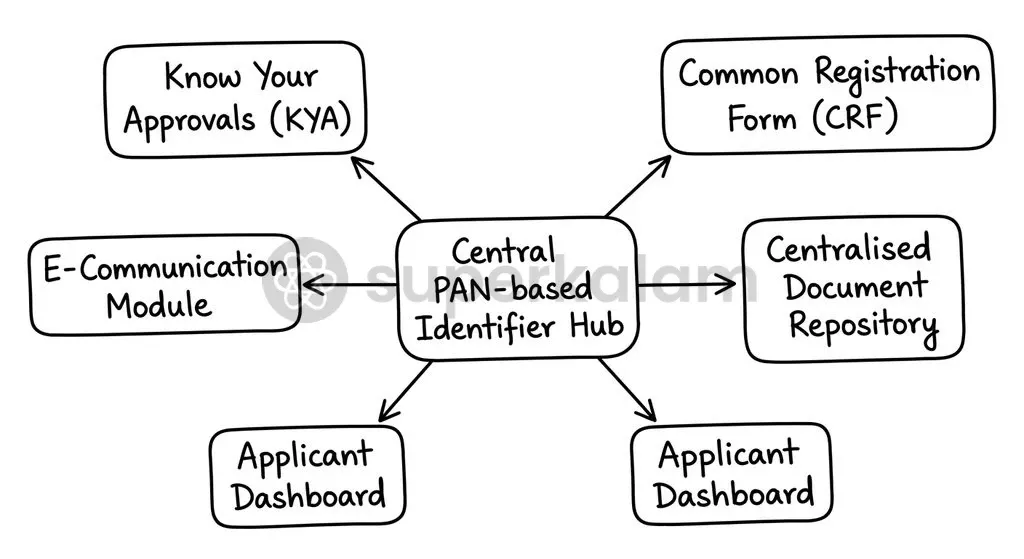
Authentication on the platform relies on the Permanent Account Number as universal identifier, integrating directly with Digital Signature Certificates and DigiLocker to maintain data integrity.
In foreign investment administration, the portal has become compulsory. All foreign direct investment proposals governed under the Government Route must route through the system following the formal integration of the Foreign Investment Facilitation Portal.
Discuss with Superkalam
Identify the primary universal identifier used by the National Single Window System to eliminate repetitive data entry across departmental portals.
Ask NowFrom Siloed Portals to Integrated Gateway: Evolution of the Clearance Architecture
Industrial clearance mechanisms in India historically evolved from isolated departmental desks into standalone departmental web applications. During initial administrative digitisation, line ministries created independent portals such as environmental clearance databases, labour registration portals, and municipal trade licensing nodes. This electronic sprawl forced entrepreneurs to navigate dozens of isolated login credentials and repetitive verification procedures.
State-level interventions under the Business Reforms Action Plan attempted to unify local permits through State Single Window Systems. However, interstate fragmentation persisted because state portals operated without standardised application programming interfaces (APIs) or links to central licensing databases.
The clearance architecture evolved across four distinct stages:
- Historic Silos: Physical desks managed separately at departmental levels.
- Fragmented Portals: Independent electronic portals launched across individual line ministries.
- State-Level Windows: State Single Window Systems established under initial Business Reforms Action Plan iterations.
- National Single Window System: Unified national interface operating on a shared central-state API architecture.
The Department for Promotion of Industry and Internal Trade addressed this inter-governmental division by configuring the National Single Window System to link existing state clearance architectures directly to central licensing systems.
To extend simplified compliance to grassroots administrative tiers, the Department formulated the District Business Reforms Action Plan (D-BRAP). This framework integrates municipal corporations, urban local bodies, and District Industries Centres into the single-window architecture, seeking to standardise clearance protocols across local jurisdictions.
Discuss with Superkalam
How does the District Business Reforms Action Plan (D-BRAP) expand the scope of ease of doing business beyond central and state levels?
Ask NowDigital Aggregation vs Process Re-engineering: The Core Operational Divide
Administrative evaluations reveal a sharp distinction between digital portal aggregation and structural business process re-engineering. The Parliamentary Standing Committee on Commerce observed in its 201st Report that the platform operates primarily as a digital front-end aggregator without automatically pruning underlying compliance burdens.
Digital aggregation provides a single sign-on interface over legacy procedures. In contrast, genuine business process re-engineering dismantles unnecessary clearances, merges redundant approvals, and replaces physical verification with risk-based digital audits.
| Governance Dimension | Digital Aggregation Model (Current Portal Paradigm) | Business Process Re-engineering (Structural Reform) |
|---|---|---|
| Core Function | Bundles existing clearance forms into a unified digital interface. | Eliminates redundant compliance layers and merges overlapping approvals. |
| Backend Workflow | Leaves legacy departmental inspection and verification steps intact. | Shifts low-risk approvals to self-certification and third-party audits. |
| Statutory Timelines | Tracks statutory timeframes without changing sectoral acts. | Codifies enforceable deemed approvals into parent legislation. |
| Site Inspections | Routes separate inspection dates through one electronic calendar. | Mandates automated joint site inspections across line departments. |
| Legal Status of Clearances | Operates as an administrative routing tool. | Backed by a dedicated single window statutory enactment. |
Targeted process integration demonstrates the potential of deep re-engineering. The Petroleum and Explosives Safety Organisation achieved complete transaction-level digital integration across all 74 licensing modules on the platform, fully removing offline touchpoints for industrial explosive permits.
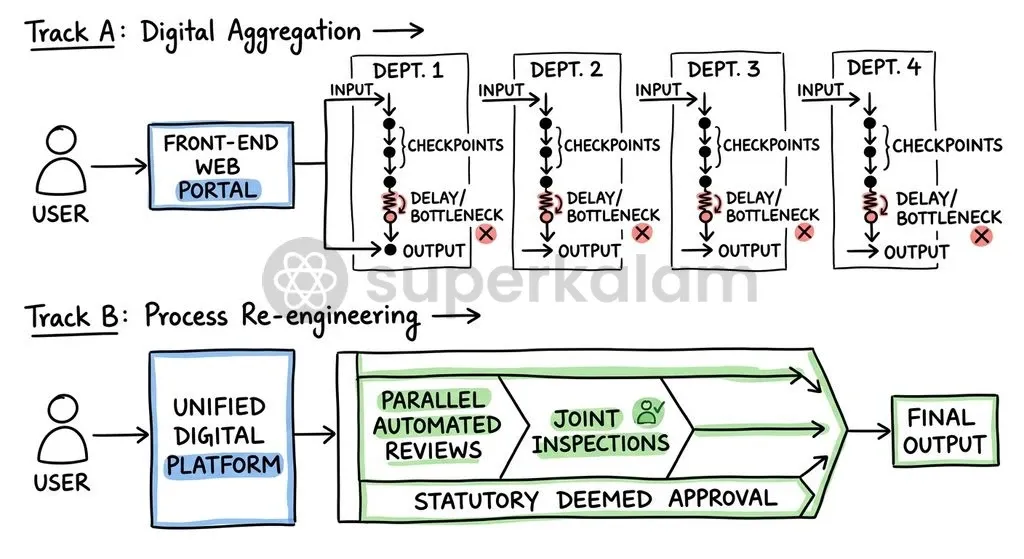
Complementary legislative efforts have targeted compliance reduction through statutory amendments. Parliament enacted the Jan Vishwas (Amendment of Provisions) Act, 2023, which decriminalised 183 regulatory provisions across 42 central statutes. Despite these legislative interventions, widespread process simplification across all line departments remains an ongoing administrative challenge.
Discuss with Superkalam
Analyse the structural differences between front-end digital aggregation and backend business process re-engineering in industrial licensing.
Ask NowFederal and Bureaucratic Hurdles: Why Backend Friction Persists Across States
Backend administrative friction continues across multiple jurisdictions due to legal, technical, and institutional constraints. A primary structural obstacle is shallow portal integration, where the national platform merely redirects applicants to external state websites through hyperlinks instead of executing two-way API data transfers. When transactions fail to synchronise seamlessly, business owners must re-enter corporate data on state-specific servers.
Departmental discretion represents another persistent operational hurdle. Licensing authorities retain broad administrative powers under independent sector-specific legislation to raise offline queries, issue objections, and require supplementary physical submissions outside standard digital workflows. These discretionary powers circumvent digital tracking and elongate approval cycles.
The structural breakdown in clearance workflows occurs in sequence:
- Initial Submission: Applicant files paperwork via the National Single Window System.
- Hyperlink Redirection: Shallow integration redirects the applicant to legacy state-level servers.
- Discretionary Queries: Independent sectoral statutes trigger offline departmental objections.
- Disjointed Inspections: Un-synchronised physical site visits are conducted across fire, labour, and environment agencies.
- Legal Vulnerability: Deemed approvals face judicial challenges due to absent sectoral statutory backing.
Physical pre-commissioning inspections remain largely un-synchronised across regulatory agencies. Environmental bodies, municipal town planning directorates, fire services, and factories inspectorates execute separate site visits due to disparate statutory mandates.
Furthermore, the legal status of deemed approvals remains vulnerable. If parent acts do not codify automatic clearance upon timeline expiry, courts and municipal authorities may treat software-generated deemed permits as legally invalid.
Discuss with Superkalam
Evaluate whether introducing a dedicated single-window statutory enactment is necessary to make time-bound deemed approvals legally enforceable.
Ask NowGlobal Benchmarks: How Leading Economies Decouple Approvals from Paperwork
Global investment promotion agencies decouple business establishment from complex administrative clearances by shifting from ex-ante approvals to ex-post regulatory compliance. Following the discontinuation of the 'Doing Business' report, international regulatory standards are assessed under the World Bank's Business Ready (B-READY) framework, which evaluates regulatory flexibility, public service transparency, and digital operational efficiency.
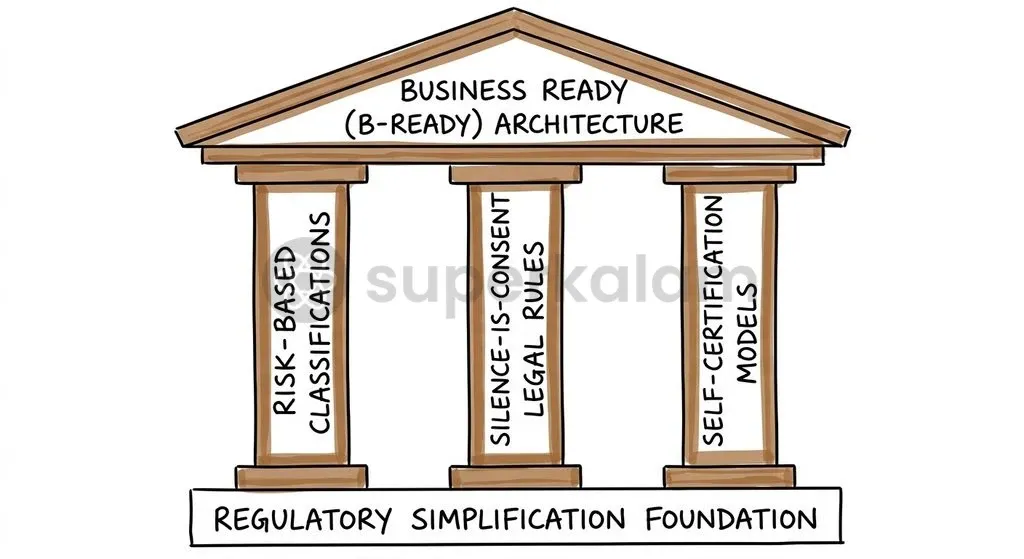
Leading regulatory regimes minimise pre-commissioning permits through targeted mechanisms:
- Risk-Based Prioritisation: Low-to-medium risk industrial activities commence operations immediately upon electronic notification, reserving detailed environmental and safety vetting exclusively for high-hazard units.
- Enforceable Silence-is-Consent Doctrines: Administrative frameworks embed strict statutory silence-is-consent rules across municipal, zoning, and corporate licensing bodies, giving deemed clearances full legal validity.
- Integrated Trusted-Trader Architecture: Regulated enterprises with established compliance track records receive expedited clearances, reduced inspection schedules, and expanded self-certification rights.
Elements of this trusted-trader model operate within India's domestic regulatory framework. Under Startup India guidelines operationalised through the national system, recognised startups obtain exemptions from routine physical inspections and may submit self-certifications under 6 labour laws and 3 environmental laws for up to five years. Expanding such models across general manufacturing represents a critical regulatory transition.
Way Forward: Shifting from Portal Aggregation to Statutory Simplification
Reforming India's regulatory environment requires transitioning from front-end digital routing toward comprehensive administrative deregulation and legal harmonisation.
- Enacting a Unified Single Window Act: Parliament and state legislatures should consider passing dedicated legislation conferring explicit statutory authority on single-window timelines, overriding inconsistent provisions in subordinate legislation.
- Institutionalising Joint Site Inspections: Industrial inspections must transition from individual departmental visits into an automated, computerised Joint Site Inspection framework to synchronise physical verifications across municipal, labour, and safety authorities, as recommended by the Parliamentary Standing Committee on Commerce.
- Expanding Self-Certification and Third-Party Audits: Low-risk enterprise categories should operate on self-declaration and empanelled third-party technical audits, reserving direct departmental licensing for high-risk environmental and hazardous industrial sectors.
- Deepening API Integrations under D-BRAP: The Department for Promotion of Industry and Internal Trade must phase out hyperlink redirects by mandating two-way API transactional connectivity across all state single-window systems and municipal licensing portals under the District Business Reforms Action Plan.
- Pruning Subordinate Compliance Mandates: Central and state departments should conduct systematic reviews of administrative notifications to eliminate obsolete registers, redundant logbooks, and discretionary renewal mandates.
Key Takeaways
- The National Single Window System, launched in September 2021 by the Department for Promotion of Industry and Internal Trade alongside Invest India, operates as a unified platform for pre-establishment and pre-operation clearances.
- As of September 2026, the platform hosts approvals across 32 Central Ministries and Departments and 34 States and Union Territories, onboarding over 5.69 lakh entities and issuing more than 8.29 lakh clearances.
- The system incorporates five primary digital modules: Know Your Approvals, the Common Registration Form, the Applicant Dashboard, the Centralised Document Repository, and the E-Communication Module.
- The Parliamentary Standing Committee on Commerce (201st Report) observed that the platform functions primarily as a digital front-end aggregator, highlighting the need for genuine backend business process re-engineering.
- Administrative friction persists due to shallow portal integrations, un-synchronised physical site inspections, offline departmental queries, and the statutory vulnerability of deemed approvals.
- Key policy recommendations include establishing a dedicated Single Window Clearance Act, institutionalising automated joint site inspections, and expanding risk-based self-certification frameworks.
Mains Question
"Digital tracking interfaces cannot substitute for statutory deregulation." In light of the Parliamentary Standing Committee on Commerce's observations on the National Single Window System, critically analyse the gap between digital portal aggregation and business process re-engineering. (15 Marks)
Evaluate NowMains Question
The National Single Window System (NSWS) aims to provide a unified electronic gateway for regulatory clearances. Elucidate how the platform addresses inter-governmental clearance fragmentation through its digital architecture. (10 Marks)
Evaluate NowPractice MCQs
QUESTION 1
Regarding the National Single Window System (NSWS), consider the following statements:
- It was developed by the Department for Promotion of Industry and Internal Trade (DPIIT) in partnership with Invest India.
- The system utilizes the Permanent Account Number (PAN) as the primary universal identifier for authentication.
- The guidance provided under the Know Your Approvals (KYA) module provides statutory legal immunity to businesses against omitted filings.
Which of the statements given above is/are correct?
QUESTION 2
With reference to the regulatory and operational features of the National Single Window System (NSWS), consider the following statements:
- All foreign direct investment proposals governed under the Government Route are required to be routed through the NSWS.
- The District Business Reforms Action Plan (D-BRAP) seeks to integrate municipal corporations and District Industries Centres into the single-window framework.
- The Petroleum and Explosives Safety Organisation (PESO) has integrated all 74 of its licensing modules on the platform.
Which of the statements given above are correct?
QUESTION 3
Consider the following statements regarding legislative and administrative reforms associated with the ease of doing business in India:
- The Jan Vishwas (Amendment of Provisions) Act, 2023 decriminalized 183 regulatory provisions across 42 central statutes.
- The Parliamentary Standing Committee on Commerce, in its 201st Report, observed that digital tracking interfaces on NSWS fully substitute for statutory deregulation.
Which of the statements given above is/are correct?
QUESTION 4
Which of the following is identified as a primary reason for backend administrative friction in state-level clearances on the National Single Window System?
QUESTION 5
Consider the following modules of the National Single Window System (NSWS):
- Common Registration Form (CRF)
- Centralised Document Repository
- Know Your Approvals (KYA)
Which of the modules mentioned above are functional components of the NSWS architecture?