Canal-Top Solar in India: 131 GW Potential, Benefits and Challenges
Canal-top solar (CTPV) saves land and cuts evaporation. India's first plant came up in Mehsana, Gujarat in 2012; potential is about 131 GW, but costs have held it back.
Sep, 2026
•9 min read
Overview
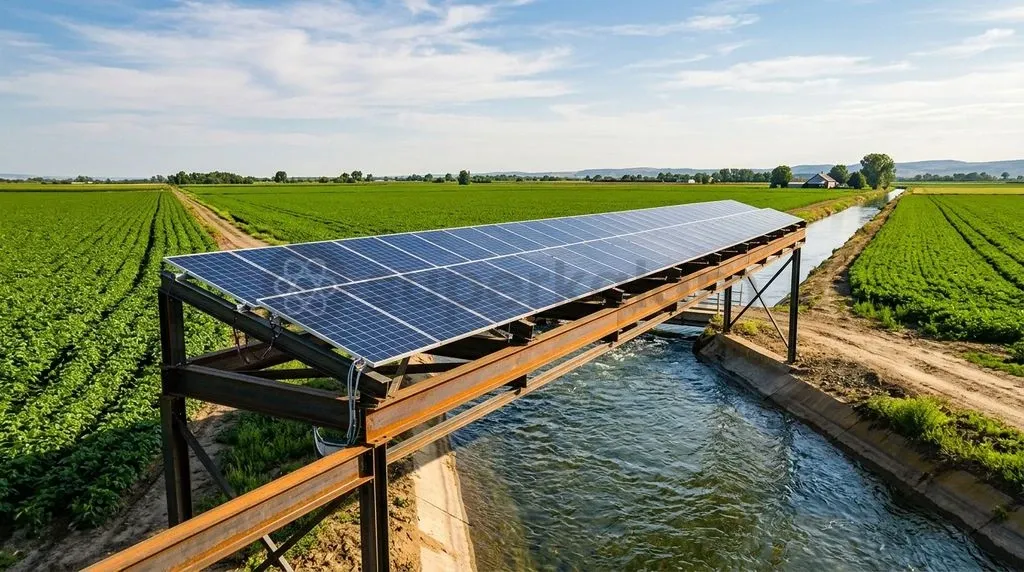
Canal-Top Photovoltaic (CTPV) systems mount solar panels directly over irrigation canals. This setup generates clean power without requiring extensive farmland or forest clearance.
According to a joint assessment by the Centre for Study of Science, Technology and Policy (CSTEP), GIZ, and Fraunhofer ISE, India possesses an estimated 131 GW of combined canal-top and canal-bank solar potential. Tapping this capacity generates electricity while cutting canal water evaporation.
High capital costs and maintenance hurdles still slow widespread adoption. Inter-departmental friction also determines whether canal solar moves beyond demonstration pilots into core decarbonisation plans.
Why Is Canal-Top Solar Back in the Spotlight?
Canal-top solar is back in national energy discussions as India accelerates renewable capacity under the National Solar Mission. As of March 2026, land acquisition remains one of the primary structural bottlenecks delaying utility-scale solar parks in densely populated agricultural states.
Irrigation corridors offer public right-of-way routes that bypass private land disputes entirely. The Ministry of New and Renewable Energy (MNRE) initially tested the concept through state demonstration schemes. Regional agencies are now exploring it to power agricultural water pumping at the local feeder level.
Covering open canals resolves competition between clean energy expansion and food production. Solar canopies effectively transform passive waterways into dual-purpose clean energy corridors.
How Canal-Top Solar Works: Harnessing the Water-Energy Nexus
Canal-Top Photovoltaic systems mount solar panels on elevated steel truss or cable-stayed substructures anchored directly to canal banks without disrupting water conveyance.
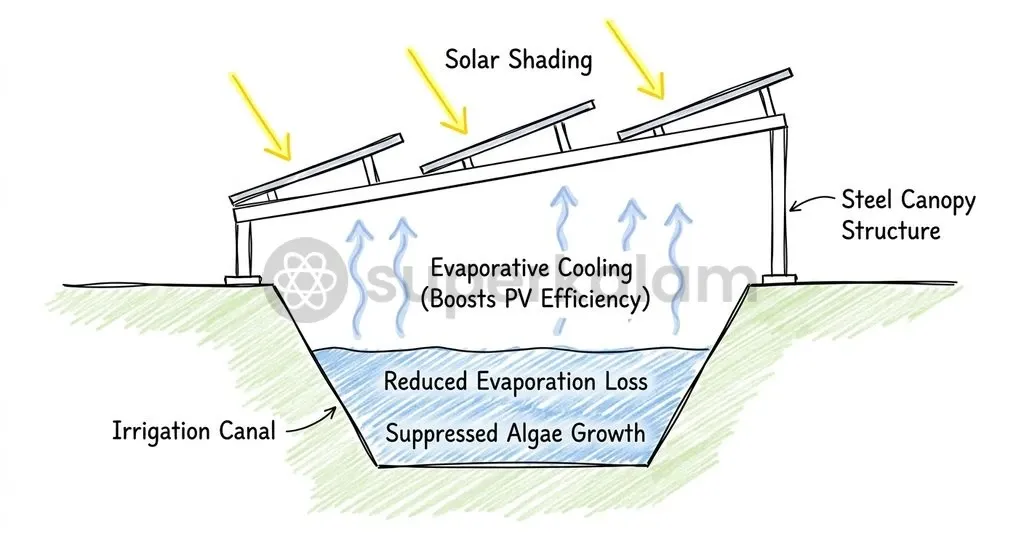
The operating model relies on a thermodynamic water-energy nexus:
- Structural Anchoring: Fabricated structural steel frames or tensioned cables span the canal width, securing solar modules above the maximum design flood level.
- Evaporative Cooling: Continuous water flow under the panels creates a humid microclimate that cools solar cells during peak daytime heat.
- Thermal Efficiency Gain: Technical proceedings documented by the Central Electricity Authority (CEA) and NTPC Green Energy Limited show that this evaporative cooling reduces module operating temperatures, boosting PV conversion efficiency by 2.5% to 8.8% compared to traditional ground-mounted arrays.
- Albedo and Aerodynamic Flow: Air movement along the water channel speeds up convective heat dissipation, preventing local hotspot degradation on panel surfaces.
Discuss with Superkalam
Which Indian state pioneered the world's first 1 MW canal-top solar pilot project at Chandrasan in 2012?
Ask NowThe Dual Advantage: Land-Neutral Power and Water Conservation
Canal-top photovoltaic installations address clean energy targets and water preservation without acquiring new land.
The core benefits span ecological, agricultural, and power generation priorities:
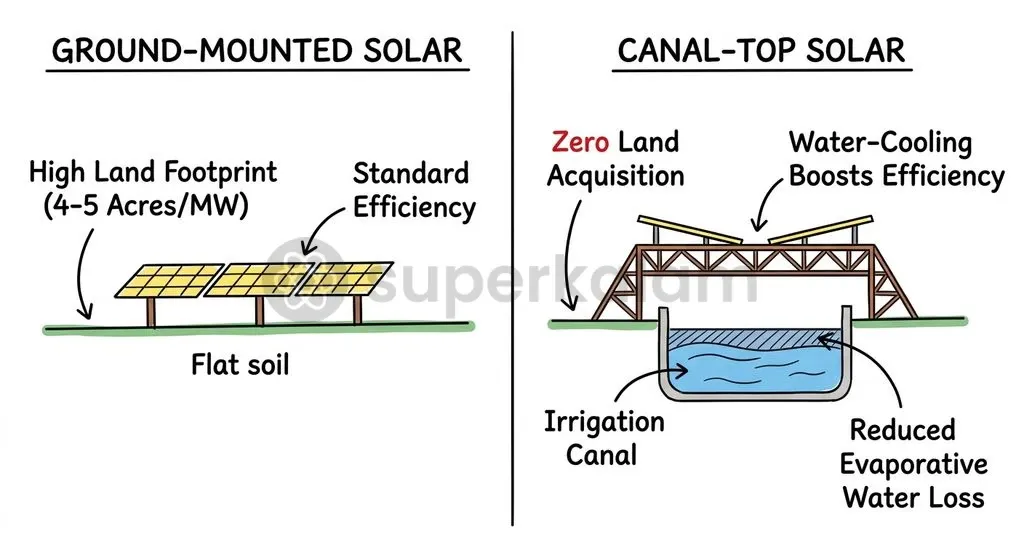
- Zero Land Footprint: Traditional utility-scale solar farms require approximately 4 to 5 acres of contiguous land per megawatt. Canal installations use existing irrigation waterways, avoiding land procurement expenses, environmental clearances, and resettlement issues.
- Evaporation Suppression: Solar panels act as a physical shield against direct sunlight. According to a technical brief by Sardar Sarovar Narmada Nigam Limited (SSNNL), the 1 MW pilot at Chandrasan prevents the evaporation of approximately 90 lakh litres of water annually.
- Suppression of Algae and Aquatic Weeds: Research from UC Merced and the Public Policy Institute of California (PPIC) indicates that solar canopies limit sunlight penetration into irrigation waterways. This shading reduces photosynthesis, curbing heavy algae blooms and weed growth that clog water pumps and inflate canal desilting costs.
- Enhanced Agricultural Grid Support: Canal networks run directly through farming belts. Generating power along these channels allows electricity distribution companies to supply daytime power to farm pumps with minimal transmission infrastructure.
Discuss with Superkalam
How does the microclimate created by flowing water in irrigation channels improve the thermal efficiency of solar panels?
Ask NowComparing Canal-Top Solar and Ground-Mounted Solar Installations
Canal-top solar systems differ significantly from standard ground-mounted utility solar farms in capital outlay, civil engineering complexity, and operational performance.
The structural comparison between both solar formats reflects fundamental engineering trade-offs:
| Parameter | Canal-Top Solar Systems | Ground-Mounted Solar Farms |
|---|---|---|
| Land Requirement | Zero dedicated land; deployed over existing canal infrastructure | Requires 4 to 5 acres of contiguous flat land per MW |
| Capital Expenditure (CAPEX) | ₹6.5 crore to ₹9 crore per MW | ₹3.5 crore to ₹4.5 crore per MW |
| Module Conversion Efficiency | 2.5% to 8.8% higher due to evaporative cooling | Standard baseline efficiency subject to ambient thermal degradation |
| Water Resource Impact | Prevents canal water evaporation and reduces weed growth | Neutral; requires external water for routine panel washing |
| Civil & Structural Design | High-grade galvanised steel trusses, long-span bridges, or cable-stayed anchors | Standard ground-rammed pile foundations or shallow concrete footings |
| Maintenance Complexity | Higher complexity due to linear geometry and water-safety access constraints | Standardised vehicle-assisted ground maintenance |
Why Has India's 131 GW Potential Remained Largely Untapped?
The Ministry of New and Renewable Energy identified substantial technical potential across India's canal network, yet widespread state-level commercial adoption has faced persistent economic and administrative barriers.
Key obstacles continue to constrain broader deployment:
- High Structural Capital Costs: Canal-top arrays require heavy structural steel framing to span channels without mid-canal piers. According to the Central Electricity Authority (CEA) and CSTEP, canal-top CAPEX ranges between ₹6.5 crore and ₹9 crore per MW, nearly double the ₹3.5 crore to ₹4.5 crore per MW required for ground-mounted solar parks.
- Unfavourable Tariff Disparity: Higher upfront civil engineering raises the Levelised Cost of Electricity (LCOE). As reported in State Electricity Regulatory Commission filings, canal-top solar has historically ranged from ₹3.50 to ₹6.00 per kWh, leaving it at a disadvantage against ground-mounted solar bids clearing below ₹2.60 per kWh.
- Inter-Departmental Administrative Friction: Project execution requires coordination between state energy agencies and irrigation departments. As reported by CSTEP in their policy assessments, historical projects faced delays over canal lease charges, maintenance jurisdictions, and emergency desilting protocols.
- Linear Maintenance Logistics: Unlike compact solar parks, canal-top plants stretch across kilometres of narrow channels. Deploying robotic panel cleaning systems and operating desilting machinery beneath live electrical canopies increase long-term operational costs.
- Corrosion Risks: High humidity over active irrigation channels accelerates galvanic corrosion of metal framing, demanding specialised galvanisation and frequent structural inspections.
Discuss with Superkalam
Compare the operational and maintenance challenges of a 10 km linear canal-top array with a 50 MW compact ground-mounted solar park.
Ask NowLessons from the Ground: Gujarat's Pilot and State Rollouts
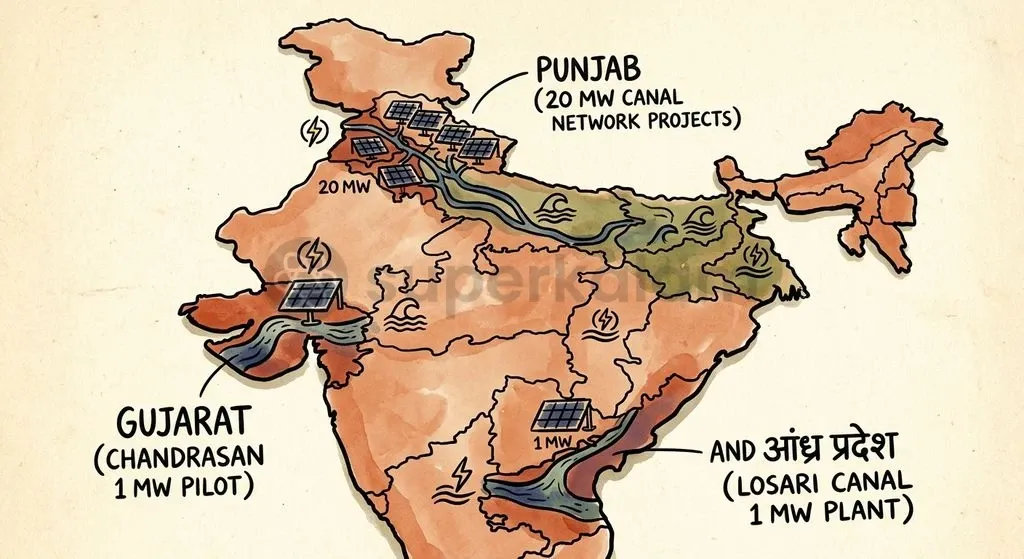
Gujarat State Electricity Corporation Limited pioneered canal solar engineering in April 2012 by commissioning the world's first 1 MW pilot plant on the Sanand Branch Canal at Chandrasan in Mehsana district.
Developed in partnership with Sardar Sarovar Narmada Nigam Limited (SSNNL), the 750-metre Chandrasan installation demonstrated that a 1 MW plant could generate 1.6 million units of electricity while saving 90 lakh litres of water from evaporation annually.
Encouraged by this initial success, the Ministry of New and Renewable Energy launched a nationwide 100 MW Pilot-cum-Demonstration Scheme in December 2014. The initiative allocated 50 MW for canal-top and 50 MW for canal-bank projects, offering Central Financial Assistance (CFA) of ₹3 crore per MW (up to 30% of project cost) for canal-top and ₹1.5 crore per MW for canal-bank installations.
Other states adapted the technology to local irrigation topographies:
- Andhra Pradesh: Commissioned a 1 MW canal-top plant featuring a seasonal tilting mechanism across a 1.2-km stretch of the Losari Main Canal at Gollavanitippa in West Godavari district, executed jointly by NREDCAP and BHEL at a cost of ₹7.9 crore.
- Punjab: Punjab Energy Development Agency (PEDA) developed 20 MW of canal-top solar across four sites on a Build, Operate and Own (BOO) basis, including the Ghaggar Link Canal (7.5 MW), Ghaggar Branch Canal (10 MW across two sections), and Sidhwan Branch Canal (2.5 MW). In 2025, PEDA floated tenders for an additional 40 MW canal-top capacity with an annual canal lease rent of ₹1.5 lakh per MW payable to the Water Resources Department and a tariff cap of ₹3.00 per kWh.
- Global Precedents: International water authorities have initiated similar adaptations. In the United States, California launched Project Nexus, investing $20 million over 1,680 linear feet of Turlock Irrigation District canals. Research published in Nature Sustainability by UC Merced indicated that covering California's 4,000 miles of canals could generate 13 GW of power and conserve 63 billion gallons of water each year.
A Roadmap to Make Canal Solar Economically and Structurally Viable
The Solar Energy Corporation of India (SECI) and state nodal agencies can scale canal-top solar by adopting modular engineering designs and targeted financial risk-mitigation frameworks.
Transitioning canal solar into a commercially viable asset requires specific structural and administrative steps:
- Adopting Cable-Stayed and Lightweight Structural Materials: Replacing heavy structural steel trusses with high-tensile steel cable-suspended canopies and structural aluminium alloys can reduce foundation dead-weight by up to 30%, lowering overall CAPEX per megawatt.
- Targeted Viability Gap Funding (VGF): Power distribution companies often avoid buying solar power priced above standard auction rates. Viability Gap Funding from central green energy schemes can absorb the structural CAPEX premium, bringing canal solar tariffs closer to grid parity.
- Integration with PM-KUSUM Feeder Solarisation: Coupling canal-top arrays directly with rural 11 kV agricultural feeders under Component-A of PM-KUSUM eliminates long-distance transmission losses. Generating power adjacent to irrigation lift pumps stabilizes local grid voltages during daytime agricultural pumping cycles.
- Standardised Institutional Frameworks: State governments should establish joint working mechanisms between irrigation and energy departments. Clear canal leasing rates and standard maintenance protocols ensure regular canal desilting occurs without disrupting power generation.
Discuss with Superkalam
Considering the higher CAPEX and tariff disparity, do the land-neutrality and water-saving benefits justify large-scale public investment in canal-top solar?
Ask NowKey Takeaways
- Canal-Top Photovoltaic (CTPV) systems mount solar panels over irrigation canals on elevated substructures, eliminating the need for dedicated land acquisition while generating clean power.
- India holds an estimated 131 GW of combined potential across canal-top and canal-bank installations according to technical assessments by CSTEP, GIZ, and Fraunhofer ISE.
- Evaporative cooling from underlying water channels reduces panel operating temperatures, boosting photovoltaic conversion efficiency by 2.5% to 8.8% compared to ground installations.
- Gujarat commissioned the world's first 1 MW canal-top pilot in 2012 on the Sanand Branch Canal, generating 1.6 million units of power and saving 90 lakh litres of water from evaporation annually.
- High capital costs of ₹6.5 crore to ₹9 crore per MW—driven by structural steel, long-span engineering, and corrosion protection—remain the primary bottleneck restricting wider commercial scaling.
- Integrating canal-top installations with rural agricultural feeders under schemes like PM-KUSUM Component-A provides a direct pathway to improve distribution efficiency and power local irrigation loads.
Mains Question
"Canal-Top Photovoltaic (CTPV) systems present an innovative water-energy nexus solution, yet high structural capital costs and operational friction impede commercial scaling." Critically examine. (15 Marks)
Evaluate NowMains Question
In the context of the Pilot-cum-Demonstration Scheme for Canal Top and Canal Bank Solar PV systems, evaluate the role of state-level rollouts in addressing the land-energy-water conflict in India. (10 Marks)
Evaluate NowPractice MCQs
QUESTION 1
With reference to Canal-Top Photovoltaic (CTPV) systems in India, consider the following statements:
- They eliminate the requirement for contiguous land procurement by utilizing existing irrigation waterways.
- The capital expenditure (CAPEX) per megawatt for canal-top solar is lower than that of conventional ground-mounted solar parks.
- The evaporative cooling effect from canal water flow can boost photovoltaic module conversion efficiency by 2.5% to 8.8%.
Which of the statements given above is/are correct?
QUESTION 2
Consider the following statements regarding the ecological and agricultural impacts of canal-top solar installations:
- Shading from solar canopies reduces photosynthesis in waterways, thereby suppressing algae blooms and weed growth.
- Canal-top solar plants increase the evaporation rate of irrigation channels due to heat trap under the panels.
- Proximity to agricultural networks enables daytime electricity supply to irrigation pumps with minimal additional transmission infrastructure.
Which of the statements given above is/are correct?
QUESTION 3
With reference to the rollout of canal solar projects in India, consider the following statements:
- The world's first 1 MW canal-top solar pilot was commissioned on the Sanand Branch Canal in Gujarat.
- Under the MNRE Pilot-cum-Demonstration Scheme launched in 2014, Central Financial Assistance for canal-top projects was ₹3 crore per MW.
- Andhra Pradesh deployed a canal-top solar plant featuring a seasonal tilting mechanism on the Losari Main Canal.
Which of the statements given above are correct?
QUESTION 4
Consider the following factors:
- Higher capital expenditure due to heavy structural steel framing
- High humidity leading to accelerated galvanic corrosion of structural mounts
- Linear geometry complicating maintenance and robotic cleaning logistics
- Inter-departmental coordination friction between irrigation and energy departments
Which of the factors given above act as constraints in tapping India's estimated 131 GW canal solar potential?
QUESTION 5
According to the joint assessment by CSTEP, GIZ, and Fraunhofer ISE, what is the estimated combined technical potential of canal-top and canal-bank solar power in India?