Greater One-Horned Rhino in India: Numbers, Conservation Strategy and Range
Greater one-horned rhino numbers in India rose from about 1,500 in the 1980s to over 4,000. The 2019 National Conservation Strategy, Phase I (2026-31) range expansion and grasslands.
Sep, 2026
•8 min read
Context
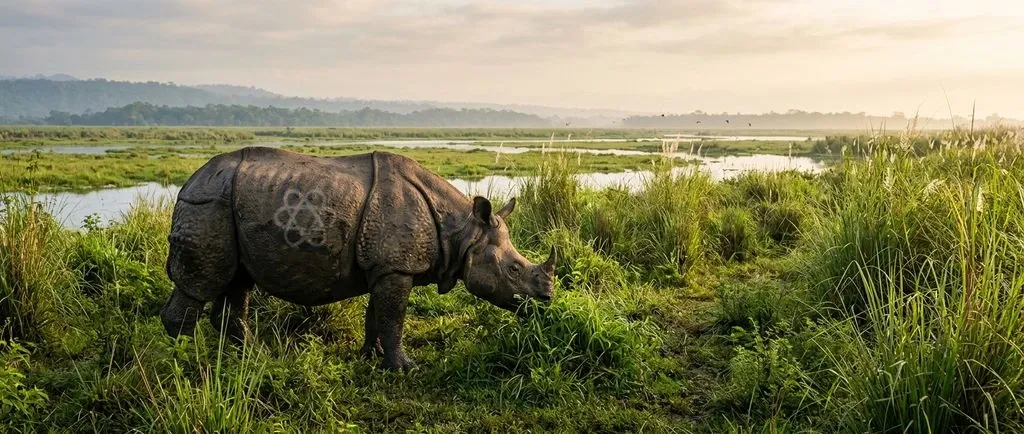
India's recovery of the Greater One-Horned Rhinoceros represents one of Asia's most notable wildlife conservation achievements. Sustaining this demographic success now requires moving beyond strict anti-poaching security toward active grassland management and corridor restoration.
The global population across India and Nepal has surpassed 4,000 individuals. However, invasive weed proliferation, natural ecological succession, and carrying capacity limits in core protected pockets show that headcounts alone cannot ensure long-term survival.
Why in the News: The Evolving Narrative of Rhino Conservation
Conservation policy in India is shifting from single-species anti-poaching enforcement toward systemic landscape ecology and grassland restoration. As of September 2026, the Ministry of Environment, Forest and Climate Change has stated that counting rhino heads is no longer sufficient to guarantee long-term species survival.
Key drivers shaping this policy transition include:
- Habitat saturation: High-density concentrations in protected pockets face escalating pressures from habitat degradation, invasive alien flora, and agricultural encroachment.
- Statutory protections: The Greater One-Horned Rhinoceros (Rhinoceros unicornis) is listed under Schedule I of the Wild Life (Protection) Act, 1972, granting it absolute protection against hunting and trade.
- International status: The species is classified as Vulnerable on the IUCN Red List and regulated under Appendix I of CITES, reflecting international consensus on its threatened status despite national population gains.
Discuss with Superkalam
Recall the structural material that constitutes a Greater One-Horned Rhino's horn and how it differs from bone.
Ask NowProfile of the Greater One-Horned Rhino: Habitat, Distribution, and Protection Status
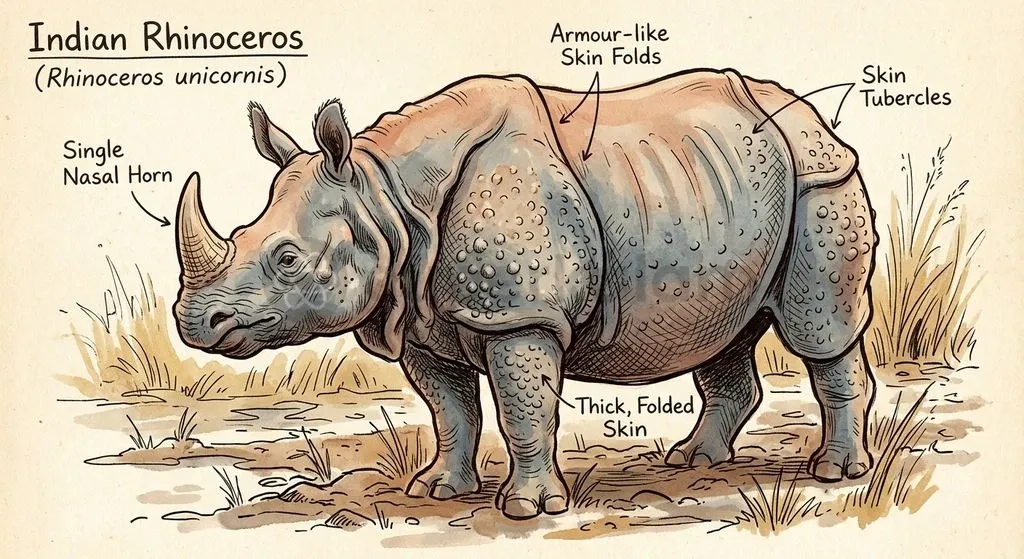
The Greater One-Horned Rhinoceros is the largest of the three Asian rhino species. It is distinguished by thick skin folds that resemble an armour-plated hide. Unlike two-horned African rhinos, the species possesses a single nasal horn composed of compressed keratin rather than bone, which grows continuously throughout the animal's lifespan.
Ecologically, the rhino functions as a specialised mega-herbivore adapted to alluvial floodplain systems. The species is predominantly a hindgut grazer, feeding on tall native grass species such as Saccharum spontaneum, Phragmites karka, and Imperata cylindrica. Beyond foraging lawns, rhinos depend on oxbow lakes, locally termed beels, and marshes for thermoregulation and wallowing.
| Dimension | Greater One-Horned Rhino Profile |
|---|---|
| Scientific Name | Rhinoceros unicornis |
| Physical Anatomy | Single keratin horn; thick, tuberculated skin folds |
| Ecological Niche | Hindgut grazer; landscape architect of alluvial grasslands |
| Primary Diet | Tall grasses (Saccharum spontaneum, Phragmites karka) |
| IUCN Red List Status | Vulnerable |
| CITES Listing | Appendix I |
| National Legal Status | Schedule I, Wild Life (Protection) Act, 1972 |
| Core Distribution | Assam, West Bengal, Uttar Pradesh (India); Terai lowlands (Nepal) |
Outside Assam, populations in India persist in the Terai and Dooars grasslands. Viable wild populations are sustained across West Bengal in Jaldapara National Park and Gorumara National Park, as well as in Uttar Pradesh within Dudhwa National Park.
The Success Story: How Assam and India Rebuilt Rhino Populations
Assam's conservation framework transformed a critically depleted species into a resilient population over the course of a century. In the early twentieth century, Kaziranga harboured fewer than 20 individuals due to uncontrolled colonial hunting and agricultural clearing. Focused state protection, armed forest protection forces, and rigorous monitoring expanded the Kaziranga National Park population to 2,613 individuals during the 14th Rhino Population Census in March 2022.
Assam currently anchors the vast majority of the global wild stock. The global wild population across India and Nepal stands at over 4,000 individuals, with Assam hosting approximately 80 percent of this total.
| Protected Area | State | Rhino Population (2022 Census) |
|---|---|---|
| Kaziranga National Park | Assam | 2,613 |
| Orang National Park | Assam | 125 |
| Pobitora Wildlife Sanctuary | Assam | 107 |
| Manas National Park | Assam | Over 45 (via IRV 2020 translocations) |
Data from the Assam Forest Department Census Notification confirms that Orang National Park shelters 125 rhinos, while Pobitora Wildlife Sanctuary supports 107 individuals. These figures establish the success of primary anti-poaching operations while setting the stage for modern ecological dilemmas.
Discuss with Superkalam
Explain how natural ecological succession and siltation alter the alluvial floodplain habitats essential for rhinos.
Ask NowNew Ecological Pressures: Carrying Capacity, Floods, and Genetic Bottlenecks
High population densities within restricted boundaries create acute ecological strains:
- Spatial Compression: Pobitora Wildlife Sanctuary has the highest ecological density of rhinos globally. It accommodates 107 individuals within approximately 16 square kilometres of effective grassland habitat inside a total notified area of 38.81 square kilometres. This compression forces rhinos into farm fields, causing human-wildlife conflict and exposing them to livestock pathogens.
- Hydrological Imbalances: Brahmaputra river floods provide an essential ecological pulse by replenishing alluvial soils. However, excessive siltation from upstream catchment degradation chokes water bodies and submerges artificial highland refugia.
- Meta-Population Risk: Concentrating roughly 80 percent of the species in a single state leaves it vulnerable to single-event catastrophes, such as disease outbreaks or extreme flooding.
Grassland Management: Tackling Invasive Weeds and Siltation
Sustaining floodplain grasslands requires active habitat intervention across three fronts:
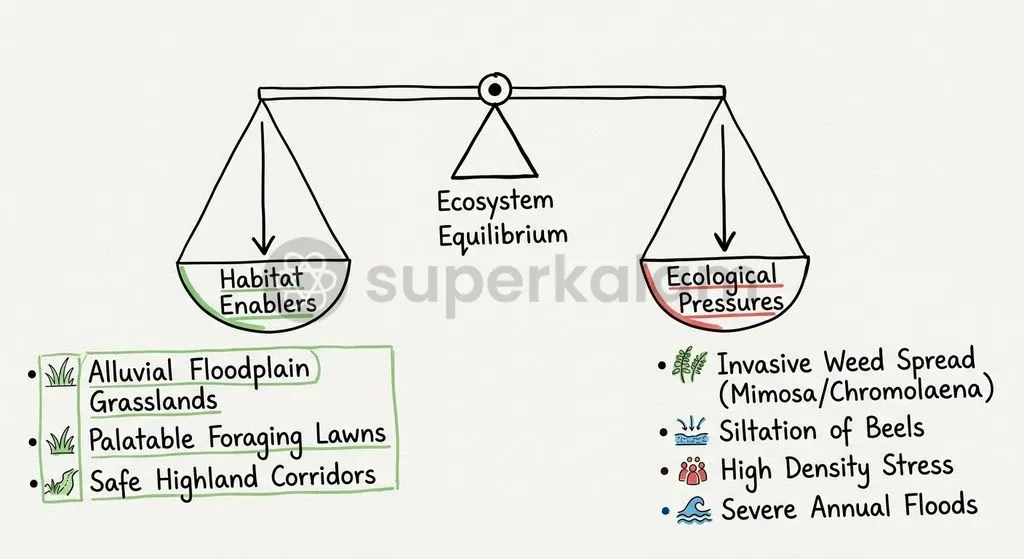
- Invasive Weed Spread: Proliferation of Mimosa diplotricha (giant sensitive plant), Chromolaena odorata (Siam weed), and Mikania micrantha suffocates native grazing species like Saccharum spontaneum. These unpalatable weeds form dense thickets that shrink viable grazing lawns.
- Ecological Succession: Open alluvial grasslands advance naturally toward closed-canopy woodland and dense scrub if unmanaged. Halting this transition requires controlled rotational burning and systematic weeding by park rangers.
- Wetland Siltation: Heavy silt deposits accelerate the shallowing of oxbow lakes (beels). When these channels fill with sediment, terrestrial plants replace aquatic forage, reducing wallowing grounds during peak summer heat.
Discuss with Superkalam
If high ecological density in a sanctuary like Pobitora triggers human-wildlife conflict, how can wild-to-wild translocations be applied as a management tool?
Ask NowKey Initiatives: Indian Rhino Vision 2020 and Expanded Translocation Programs
Wild-to-wild translocations have proven vital in creating secondary breeding hubs and dispersing high-density clusters across regional landscapes.
Key strategic initiatives include:
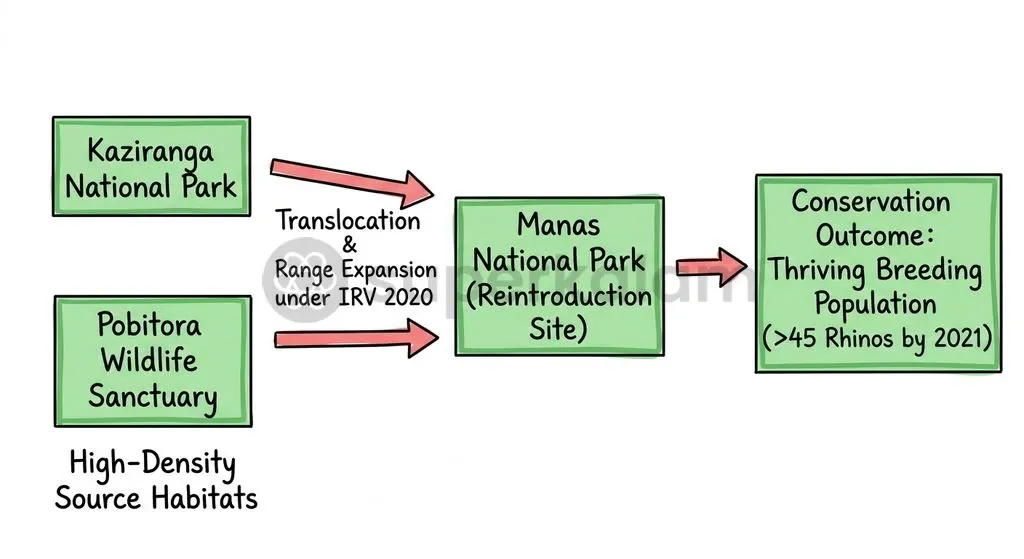
- Indian Rhino Vision 2020 (IRV 2020): Launched in 2005 as a joint collaborative effort, the initiative moved rhinos from donor sites in Kaziranga National Park and Pobitora Wildlife Sanctuary to Manas National Park. This sustained intervention successfully rebuilt Manas's depleted population to over 45 rhinos by 2021.
- National Conservation Strategy: In February 2019, the Union Government adopted the National Conservation Strategy for the Greater One-Horned Rhinoceros. Following the multilateral New Delhi Declaration on Asian Rhinos, this policy establishes a structured roadmap to boost gene flow and create meta-populations across historical range states.
- Satellite Group Expansion: National policy prioritises translocations to build genetically resilient groups across North Bengal, Uttar Pradesh, and adjoining sanctuaries in Assam.
GS-3 Analytical Framework: Balancing Anti-Poaching with Landscape Ecology
Conservation in protected floodplains requires balancing law enforcement with active habitat management. The historical model focused on armed patrols, drone surveillance, and strict anti-poaching infrastructure. While effective at curbing illegal trade, security alone cannot resolve underlying ecological constraints.
| Conservation Dimension | Security Paradigm (Historical) | Landscape Ecology Paradigm (Modern) |
|---|---|---|
| Primary Objective | Eliminating poaching; securing core zones | Maintaining habitat quality; expanding corridors |
| Key Indicator | Annual rhino mortality count from poaching | Carrying capacity; forage availability; gene flow |
| Spatial Focus | Isolated protected area boundaries | Connected riverine corridors and meta-populations |
| Threat Management | Armed forest staff; anti-poaching outposts | Invasive weed eradication; controlled burning |
| Community Role | Informant networks and perimeter defence | Eco-development committees; co-existence zones |
Expanding conservation beyond fenced parks relieves overcrowding in core zones. Connecting fragmented patches through functional corridors reduces territorial aggression, lowers pathogen transmission risks, and prevents genetic isolation across small resident groups.
Discuss with Superkalam
Compare the historical security-centric anti-poaching paradigm with the modern landscape ecology paradigm in rhino conservation.
Ask NowWay Forward: Securing Corridors and Restoring Alluvial Grasslands
Landscape-level connectivity is the primary structural solution for long-term rhino survival. Under the National Rhino Conservation Strategy, priority is assigned to expanding Orang National Park and establishing ecological links with Laokhowa and Burhachapori Wildlife Sanctuaries. Restoring these riverine stepping-stones allows surplus animals from central Assam to disperse safely across the Brahmaputra valley.
Achieving sustainable habitat health requires three institutional actions:
- Systematic Invasive Weed Eradication: Forest departments must deploy dedicated seasonal labour to uproot Mimosa diplotricha before its flowering phase, preventing seed bank establishment in prime grazing lawns.
- Desiltation of Oxbow Wetlands: Active restoration of silted beels during dry seasons preserves vital wallowing sites and sustains perennial aquatic vegetation.
- Community-Based Buffer Zone Management: Institutionalising eco-development committees around Pobitora and Central Kaziranga provides local communities with crop-loss compensation and alternative fodder resources, reducing fringe conflicts.
Key Takeaways
- Species & Protection: The Greater One-Horned Rhino (Rhinoceros unicornis) is a single-horned, hindgut grazer protected under Schedule I of the Wild Life (Protection) Act, 1972, Appendix I of CITES, and listed as Vulnerable on the IUCN Red List.
- Population Recovery: Global numbers across India and Nepal exceed 4,000, with Assam hosting approximately 80 percent, including 2,613 rhinos in Kaziranga National Park, 125 in Orang National Park, and 107 in Pobitora Wildlife Sanctuary.
- Carrying Capacity Pressure: Pobitora exhibits the world's highest rhino density with 107 individuals across approximately 16 square kilometres of effective grassland, driving human-wildlife conflict and pathogen risks.
- Habitat Degradation: Invasive alien weeds (Mimosa diplotricha, Chromolaena odorata, Mikania micrantha) and natural ecological succession threaten the alluvial grasslands that sustain mega-herbivores.
- Strategic Vision: Expanding initiatives from the Indian Rhino Vision 2020 into the National Conservation Strategy prioritizes corridor links, notably connecting Orang with Laokhowa and Burhachapori sanctuaries.
Mains Question
"Counting rhino heads is no longer sufficient to guarantee long-term species survival." In light of this statement, critically analyse the emerging ecological challenges confronting Greater One-Horned Rhino conservation in India. (15 Marks)
Evaluate NowMains Question
Evaluating the Indian Rhino Vision 2020 (IRV 2020) and the National Conservation Strategy for the Greater One-Horned Rhinoceros, discuss the significance of translocations and corridor connectivity in mega-herbivore management. (10 Marks)
Evaluate NowPractice MCQs
QUESTION 1
With reference to the Greater One-Horned Rhinoceros (Rhinoceros unicornis), consider the following statements:
- Its horn is an anatomical structure composed of compressed bone that ceases growth at maturity.
- It functions as a specialised hindgut grazer feeding predominantly on tall native grass species.
- In India, wild populations are legally protected under Schedule I of the Wild Life (Protection) Act, 1972.
Which of the statements given above are correct?
QUESTION 2
Consider the following statements regarding the distribution and population ecology of the Greater One-Horned Rhino:
- The state of Assam hosts approximately 80 percent of the global wild population of the species.
- Pobitora Wildlife Sanctuary holds the highest ecological density of rhinos globally.
- Outside Assam, viable wild populations in India exist only in the state of West Bengal.
Which of the statements given above is/are correct?
QUESTION 3
With reference to grassland habitat degradation in rhino-bearing protected areas, consider the following floral species:
- Mimosa diplotricha
- Chromolaena odorata
- Mikania micrantha
- Saccharum spontaneum
Which of the above are invasive alien weeds that threaten native rhino grazing lawns?
QUESTION 4
Under the Indian Rhino Vision 2020 (IRV 2020) initiative, wild-to-wild translocations were carried out to rebuild a depleted rhino population in which of the following Protected Areas?
QUESTION 5
Consider the following statements regarding the international and national conservation status of the Greater One-Horned Rhino:
- It is classified as Endangered on the IUCN Red List of Threatened Species.
- It is listed under Appendix I of the Convention on International Trade in Endangered Species of Wild Fauna and Flora (CITES).
Which of the statements given above is/are correct?