India's UNSC Non-Permanent Seat Bid 2028-29: Election Process Explained
India is campaigning for a 2028-29 UNSC non-permanent seat, with Tajikistan also in the Asia-Pacific race. How the UNGA election works and what the seat can do.
Sep, 2026
•8 min read
Overview
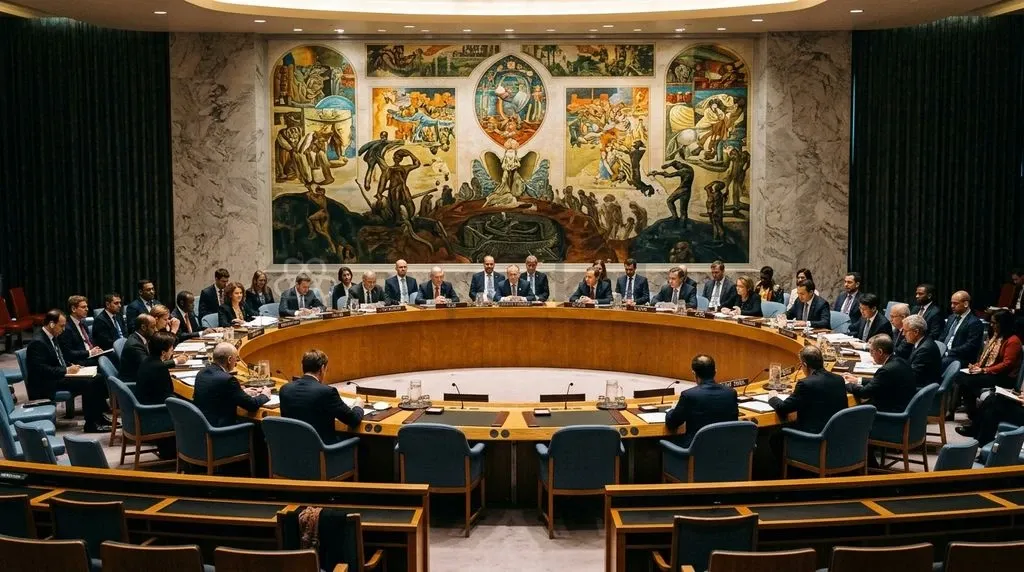
India’s early campaign for an elected United Nations Security Council seat during the 2028–29 cycle reflects proactive diplomacy. Yet, recurring two-year tenures cannot bypass the institutional veto barriers preventing permanent membership under the UN Charter.
New Delhi declared its bid in December 2022 and launched its campaign in July 2026 under the theme 'SHANTI' (Securing Holistic Advancement through Norms, Trust and Integrity), according to the Ministry of External Affairs. As of July 2026, the election set for June 2027 in the UN General Assembly faces a contest following a competing bid from Tajikistan for the single Asia-Pacific Group vacancy.
Non-permanent membership offers high-profile opportunities to lead counter-terrorism bodies and shape maritime norms. Even so, it functions as an operational holding pattern rather than a direct path to permanent representation.
Why in the News: India's Early Campaign for the 2028–29 Term
The Ministry of External Affairs launched India’s campaign in July 2026 for an elected seat on the UN Security Council for the 2028–29 term. As of July 2026, New Delhi is mobilising diplomatic outreach under the thematic acronym 'SHANTI' (Securing Holistic Advancement through Norms, Trust and Integrity) to secure broad international support.
Key details of the contested race include:
- Early declaration: India announced its initial candidacy in December 2022 to build diplomatic momentum.
- Contested ballot: Tajikistan announced a competing bid for the single 2028–29 Asia-Pacific Group non-permanent seat, according to United Nations General Assembly candidatures records.
- Election timeline: The secret-ballot election will take place during the 81st UN General Assembly session in June 2027.
Securing early diplomatic commitments helps states navigate contested ballots. It also allows capitals to consolidate reciprocal voting pacts across the multilateral system.
Discuss with Superkalam
Can you recall which country has declared a competing bid against India for the 2028–29 Asia-Pacific seat in the UN Security Council?
Ask NowHow the Non-Permanent Race Works: Rules, Quotas, and Vote-Trading
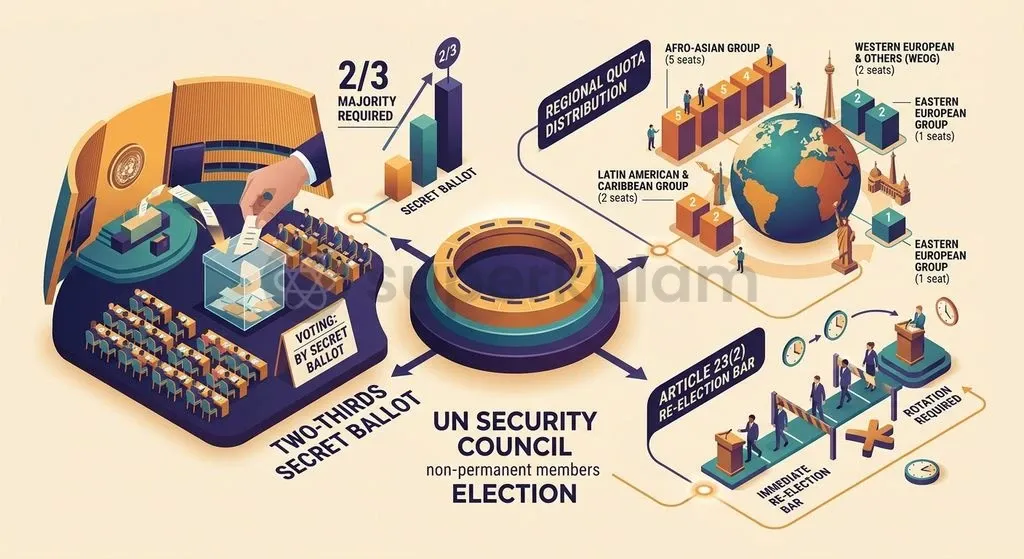
Article 23 of the United Nations Charter structures the Security Council around five permanent members and ten elected non-permanent members serving non-consecutive two-year terms. UN General Assembly Resolution 1991 A (XVIII) amended the Charter in 1963 to expand the Council from 11 to 15 members, formalising equitable geographical distribution across regional voting blocs:
- African and Asian States: 5 seats
- Latin American States: 2 seats
- Western European and Other States (WEOG): 2 seats
- Eastern European States: 1 seat
The election process adheres to rigid procedural standards under UN Charter Article 18(2) and Rule 83 of the UN General Assembly Rules of Procedure:
| Dimension | Constitutional & Procedural Provision | Practical Implication for Member States |
|---|---|---|
| Voting Majority | Two-thirds of UNGA members present and voting | Requires building broad coalitions beyond regional allies to reach ~129 votes. |
| Balloting Method | Secret ballot without formal nominations | Mandates extensive bilateral lobbying because voting commitments remain unverified. |
| Re-election Rule | Immediate re-election prohibited under Article 23(2) | Enforces mandatory exit after two years, interrupting diplomatic momentum. |
| Quota Allocation | Fixed regional groupings under UNGA Resolution 1991 A (XVIII) | Triggers direct regional rivalry within groups like the Asia-Pacific Group. |
Mutual endorsement agreements form the cornerstone of campaign strategy in UN elections. According to diplomatic reporting from the Ministry of External Affairs, declaring candidacies years in advance allows states to trade votes reciprocally across diverse UN bodies, lock in pledges early, and deter competing regional candidatures.
India's UNSC Record: Agenda-Setting from 1950 to 2021–22
India has completed eight separate non-permanent tenures on the UN Security Council since its inaugural 1950–51 term, establishing an active record of multilateral agenda-setting. These tenures span 1950–51, 1967–68, 1972–73, 1977–78, 1984–85, 1991–92, 2011–12, and 2021–22, according to the United Nations Security Council Members Database.
Key thematic milestones across recent tenures include:
- Maritime security norms: During its August 2021 presidency, India steered adoption of the Council's first-ever standalone Presidential Statement on Maritime Security (S/PRST/2021/15) during an open debate chaired by Prime Minister Narendra Modi, embedding navigation freedom into UNSC discussions.
- Counter-terrorism architecture: India chaired the Counter-Terrorism Committee (CTC) during its 2021–22 tenure, reinforcing global norms against terror financing and illicit technology misuse.
- The Delhi Declaration: Unanimously adopted in October 2022, this framework targeted terrorist exploitation of unmanned aerial systems, encrypted communication, and emerging financial technologies.
Discuss with Superkalam
Explain why mandatory rotation under UN Charter Article 23(2) limits the diplomatic momentum of elected UNSC members.
Ask NowThe Core Dilemma: Does a Non-Permanent Seat Advance Permanent Membership?
Elected membership in the UN Security Council offers valuable diplomatic visibility. However, periodic two-year tenures create structural limits that cannot bridge the gap to permanent membership.
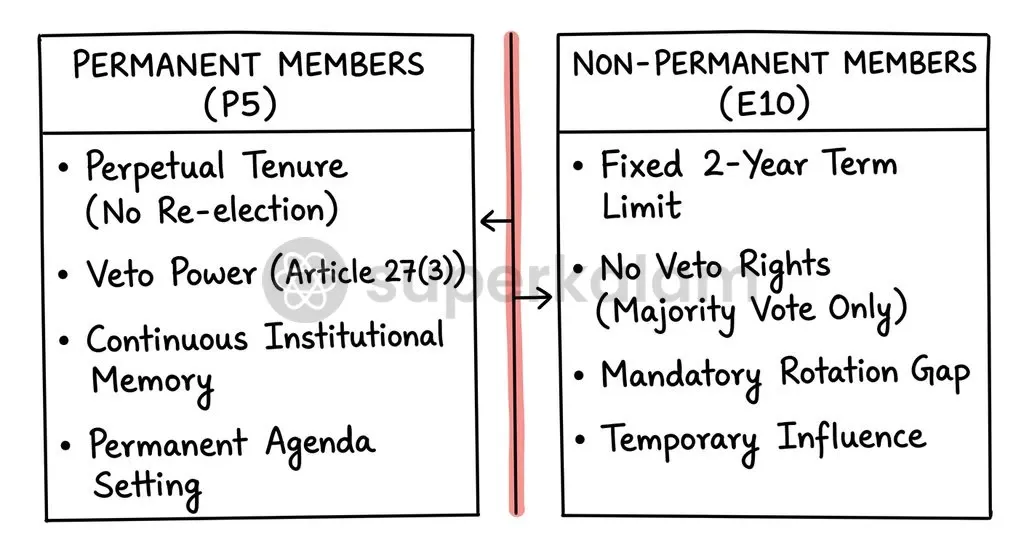
The fundamental constraint lies in UN Charter Article 27(3), which restricts veto authority exclusively to the five permanent members (P5). Non-permanent members lack substantive blocking power over coercive resolutions and sanctions, regardless of their election vote margin.
| Dimension | Non-Permanent (Elected) | Permanent (P5 Category) |
|---|---|---|
| Tenure Duration | 2-year sunset term | Perpetual presence |
| Veto Power | No veto power | Absolute veto authority |
| Institutional Continuity | Rotation disruption every two years | Continuous institutional control |
| Resource Allocation | Recurring campaign costs | Unchecked agenda-setting power |
Repeated elected tenures carry an institutional trade-off for rising powers. While an elected term proves a nation's ability to shoulder global security responsibilities, it simultaneously risks legitimising the two-tier structure of the 1945 settlement.
UN Charter Article 23(2) mandates an abrupt exit after 24 months. This compulsory rotation severs institutional memory and allows permanent members to outlast temporary diplomatic initiatives.
Coalition Math: Mobilising the Global South Against Institutional Inertia
The G4 coalition unites India, Brazil, Germany, and Japan in demanding structural expansion of permanent and non-permanent seats on the UN Security Council. The grouping proposes expanding total Council membership from 15 to 25–26 members, creating six new permanent seats (two for Africa, two for Asia-Pacific, one for Latin America, and one for Western Europe) and four to five non-permanent seats, according to the G4 Joint Statement delivered at the UNGA Intergovernmental Negotiations (IGN).
This reform vision faces stiff resistance from the Uniting for Consensus (UfC) coalition, commonly known as the Coffee Club. Led by Italy and joined by states like Pakistan, Mexico, Argentina, and South Korea, the UfC strictly rejects new permanent seats and advocates only for expanding non-permanent seats with longer or renewable mandates:
- G4 Model: Demands permanent seats with veto rights to correct historical imbalances and reflect contemporary multipolar realities.
- Uniting for Consensus Model: Opposes creating additional national centres of privilege, favouring elected seats to ensure democratic accountability.
- Intergovernmental Negotiations (IGN) Deadlock: Established under UNGA Decision 62/557 in 2008, the IGN has stalled for over 16 years without adopting a single text-based negotiating document, as highlighted by India’s Permanent Representative to the UN.
To bypass the stagnation of the IGN, India leverages plurilateral coalitions across the developing world. The 18th BRICS Summit New Delhi Declaration (2026) explicitly reaffirmed support for comprehensive UN reform, including greater representation for developing countries and expanded roles for India, Brazil, and South Africa.
Similarly, the IBSA Dialogue Forum and the Quad Leaders' Joint Statements consistently call for expanding both permanent and non-permanent categories. These plurilateral formations aim to redress the systemic under-representation of the Global South.
Discuss with Superkalam
How might India leverage its positions in plurilateral forums like BRICS and IBSA to build support in a secret-ballot UNGA election?
Ask NowThe Veto Wall: Why Middle-Power Diplomacy Hits a Structural Limit
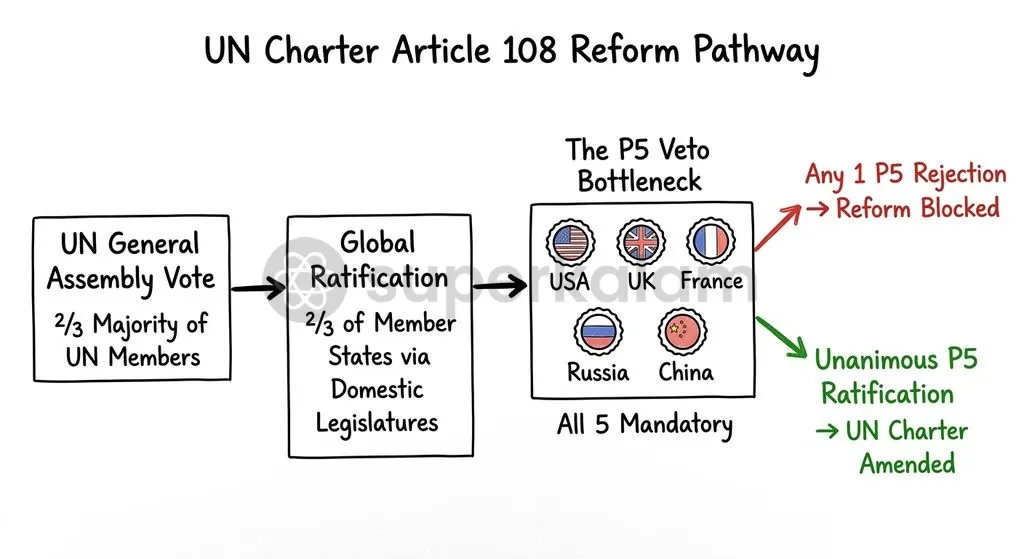
Article 108 of the United Nations Charter establishes a stringent legal barrier against Security Council reform by granting every permanent member absolute veto authority. Any amendment to the Charter requires meeting two cumulative thresholds:
- General Assembly Approval: An affirmative vote from two-thirds of UNGA members.
- Domestic Ratification: Formal constitutional ratification by two-thirds of UN member states, explicitly including all five permanent members.
This constitutional double-lock means that broad support across Africa, Asia, and Latin America cannot bypass an individual P5 veto. Strategic rivalry among permanent members ensures that geopolitical vetoes block institutional adaptation, freezing the UNSC's executive structure in its 1945 configuration.
Way Forward: Leveraging Elected Terms to Force Multilateral Reform
India can utilise its upcoming candidacy in the UN General Assembly to anchor plurilateral coalitions and enforce accountability across the multilateral architecture. A proactive campaign for the 2028–29 non-permanent seat should operate as a diplomatic lever rather than an end in itself.
- Mandating Text-Based Negotiations: New Delhi must collaborate with G4 partners and the African Union to transition the IGN process to a formal, bracketed negotiating text, ending open-ended procedural filibustering.
- Institutionalising Thematic Working Groups: India can establish permanent follow-up mechanisms on maritime safety and counter-terrorism, building upon Presidential Statement S/PRST/2021/15 and the 2022 Delhi Declaration.
- Mobilising Plurilateral Coalitions: High-level communiques across BRICS, IBSA, and the Quad should coordinate voting blocs in the UNGA to demand institutional reform under Article 108.
- Bridging Global South Priorities: India should champion the developmental and security concerns of small island developing states and least-developed nations, creating reciprocal voting coalitions that outlast the two-year election cycle.
Discuss with Superkalam
Compare the institutional leverage of holding an elected UNSC seat against the structural constraints of the P5 veto under Article 27(3).
Ask NowKey Takeaways
- Campaign Launch: India announced its candidacy for the 2028–29 UNSC term in December 2022 and launched its campaign under the theme 'SHANTI' in July 2026, facing a contested race against Tajikistan.
- Electoral Mechanics: Under UN Charter Article 18(2) and Article 23, non-permanent members are elected by a two-thirds secret ballot in the UN General Assembly for non-consecutive two-year terms.
- Proven Track Record: India has served eight terms, delivering significant institutional outcomes including the 2021 Maritime Security Presidential Statement and the 2022 Counter-Terrorism Delhi Declaration.
- Structural Dilemma: Elected seats provide diplomatic visibility but lack Article 27(3) veto power, leaving P5 dominance intact while requiring continuous campaign resources.
- Institutional Impasse: The G4 reform model faces resistance from the Uniting for Consensus (Coffee Club), leaving the IGN process without a text-based negotiating document for over 16 years.
- The Amendment Barrier: Meaningful reform requires clearing the Article 108 threshold, which gives each P5 member an absolute veto over any structural Charter amendment.
Mains Question
"Periodic two-year elected tenures in the UN Security Council function as an operational holding pattern rather than a direct path to permanent representation." In light of UN Charter provisions and the Intergovernmental Negotiations (IGN) process, critically examine this statement. (15 Marks)
Evaluate NowMains Question
The G4 and the Uniting for Consensus (UfC) coalitions present contrasting visions for United Nations Security Council reform. Elucidate their core structural differences and explain the constitutional hurdles posed by Article 108 of the UN Charter. (10 Marks)
Evaluate NowPractice MCQs
QUESTION 1
With reference to the election of non-permanent members to the United Nations Security Council (UNSC), consider the following statements:
- Non-permanent members are elected by a two-thirds majority of the General Assembly members present and voting.
- Under Article 23(2) of the UN Charter, a retiring non-permanent member is eligible for immediate re-election.
- UN General Assembly Resolution 1991 A (XVIII) allocated five non-permanent seats to African and Asian States.
Which of the statements given above are correct?
QUESTION 2
Consider the following statements regarding the procedure for amending the United Nations Charter under Article 108:
- An amendment requires adoption by a two-thirds vote of the members of the UN General Assembly.
- Ratification of the amendment requires domestic legislative approval by two-thirds of UN member states, including all permanent members of the Security Council.
- A permanent member's negative vote during domestic ratification can be overridden by a three-fourths majority in the UN General Assembly.
Which of the statements given above is/are correct?
QUESTION 3
Regarding the proposals for UN Security Council reform, consider the following statements:
- The G4 coalition advocates expanding Council membership to 25–26 members, including six new permanent seats.
- The Uniting for Consensus (UfC) coalition strictly opposes the creation of new permanent seats and favors expanding only non-permanent seats.
- The Intergovernmental Negotiations (IGN) framework was established under UNGA Decision 62/557 in 2008.
Which of the statements given above are correct?
QUESTION 4
Consider the following statements regarding India's past tenures and initiatives at the UN Security Council:
- India presided over the adoption of the Council's first standalone Presidential Statement on Maritime Security (S/PRST/2021/15) in August 2021.
- The Delhi Declaration, unanimously adopted under India's Counter-Terrorism Committee chairmanship in October 2022, focused on terrorist exploitation of unmanned aerial systems and emerging technologies.
Which of the statements given above is/are correct?
QUESTION 5
Under what campaign theme did the Ministry of External Affairs launch India's bid for the 2028–29 UN Security Council non-permanent seat?