National Security Act 1980: Detention Rules and SC Confession Ruling
The Supreme Court ruled that police confession alone cannot justify NSA detention. See the National Security Act, preventive detention and safeguards.
Sep, 2026
•10 min read

Overview
The Supreme Court of India ruled in Mulla Afroz v. Union of India that confessional statements made before police officers cannot legally form the basis of subjective satisfaction required to sustain preventive detention under the National Security Act, 1980. This ruling establishes that bypassing standard evidentiary thresholds strikes at the core of personal liberty protected under Article 21 of the Constitution. Executive authorities cannot invoke extraordinary preventive laws as a routine shortcut to circumvent standard bail proceedings or to substitute for diligent police investigation. Emphasising strict procedural accountability, the Court imposed exemplary costs of ₹10 lakh on the Government of Uttar Pradesh for administrative overreach. The decision reinforces that preventive detention is an exceptional power circumscribed by constitutional boundaries rather than an instrument of administrative convenience.
Discuss with Superkalam
What is the maximum duration an individual can be detained under Section 13 of the National Security Act, 1980?
Ask NowWhy in the News: The Supreme Court's Warning on Preventive Detention
The Supreme Court of India delivered a landmark ruling in Mulla Afroz v. Union of India & Ors. (2026 INSC 1067), quashing an executive detention order executed under the National Security Act, 1980. The Court held that relying solely on uncorroborated police confessions to detain a citizen violates fundamental constitutional safeguards. As of September 2026, the bench underscored that subjective satisfaction cannot be arbitrary and must rest on verifiable, probative material. To signal institutional disapproval of mechanical detention orders, the Court directed the state government to pay exemplary costs of ₹10 lakh to the petitioner.
How Preventive Detention Differs from Ordinary Criminal Law
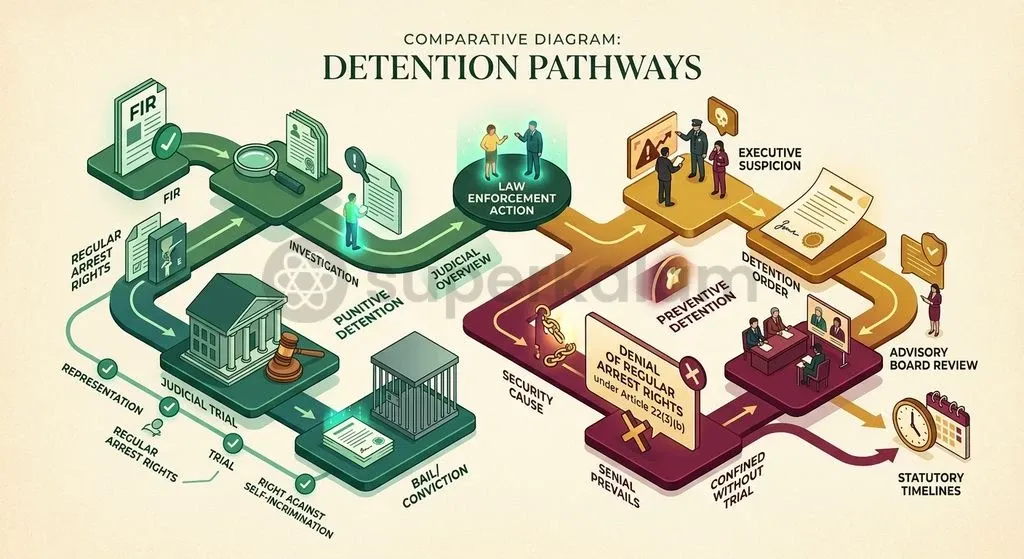
The Constitution of India recognises two distinct forms of personal restraint: punitive detention following judicial conviction and preventive detention aimed at forestalling future harm. Punitive detention arises only after an individual undergoes an open trial under penal statutes, with full access to defence counsel and cross-examination. Preventive detention, by contrast, operates on reasonable executive suspicion rather than proved guilt.
| Parameter | Punitive Detention | Preventive Detention |
|---|---|---|
| Objective | Punishes a past offence established in court | Prevents an anticipated act prejudicial to state security |
| Constitutional Basis | Governed under ordinary criminal procedures | Governed under Article 22(3) to 22(7) |
| Evidentiary Standard | Proof beyond reasonable doubt | Subjective executive satisfaction |
| Judicial Safeguards | Full trial, legal representation, regular appeal | Advisory Board review; judicial review limited to procedure |
| Article 22 Protections | Retains Article 22(1) and Article 22(2) rights | Explicitly excludes Article 22(1) and 22(2) via Article 22(3)(b) |
Under Article 22(3)(b) of the Constitution, standard protections guaranteed during ordinary arrests do not apply to preventive detainees. A person detained under preventive legislation is stripped of the fundamental right to consult legal counsel and the mandatory right to be produced before a magistrate within 24 hours. Because the detainee faces incarceration without formal charges or trial, courts demand strict compliance with statutory and constitutional procedures.
Discuss with Superkalam
How does the evidentiary standard for establishing subjective satisfaction in preventive detention differ from the standard of proof in a regular criminal trial?
Ask NowThe National Security Act Framework: Grounds, Powers, and Advisory Boards
The National Security Act, 1980 serves as India's primary federal legislation governing administrative detention for state security and public order. Enacted by Parliament under Entry 9 of List I and Entry 3 of List III of the Seventh Schedule, the statute confers broad preventive powers on both Union and State executives.
According to Section 3 of the National Security Act, 1980, the Central Government or a State Government may issue a detention order against any person to prevent actions prejudicial to:
- The defence of India or relations with foreign powers;
- The security of India or the security of the State;
- The maintenance of public order;
- The maintenance of supplies and services essential to the community.
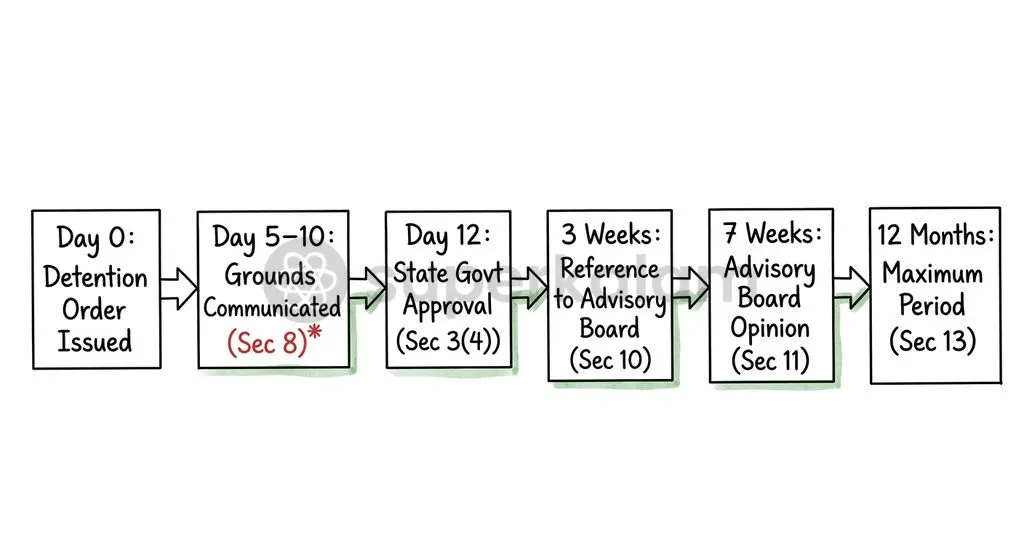
Detention orders issued by a District Magistrate or a Commissioner of Police are subject to strict administrative review timelines under the statute. Under Section 3(4), such an order remains valid for only 12 days unless approved by the State Government. Once approved, the State Government must report the detention and its supporting grounds to the Central Government within 7 days under Section 3(5).
The statute also establishes mandatory review bodies known as Advisory Boards. Under Sections 9 and 10 of the Act, every Advisory Board must consist of three individuals qualified to serve as High Court judges. The appropriate government must place the detention order, grounds, and any representation from the detenu before the Board within three weeks of detention. The Advisory Board is required under Section 11 to submit its report within seven weeks. If the Board finds no sufficient cause, Section 12 obligates the government to revoke the order immediately. Under Section 13, the maximum permissible period of detention is 12 months.
Why Police Confessions Cannot Form the Basis of an NSA Detention
Section 23 of the Bharatiya Sakshya Adhiniyam, 2023 (formerly Section 25 of the Indian Evidence Act, 1872) establishes that confessions made to police officers are inadmissible in court. This statutory barrier protects citizens from custodial coercion and fabricated statements during criminal proceedings.
In Mulla Afroz v. Union of India, the Supreme Court held that detaining authorities cannot bypass this evidentiary principle when forming subjective satisfaction under the National Security Act, 1980. When an administrative authority relies solely on an uncorroborated confession made in police custody, the detention order lacks probative evidentiary value.
The Court reaffirmed its earlier jurisprudence in Pebam Ningol Mikoi Devi v. State of Manipur (2010), holding that detention orders founded on extraneous or legally invalid material violate Article 21. Subjective satisfaction cannot be based on mere conjecture; it requires independent supporting material that demonstrates an actual, credible threat.
Discuss with Superkalam
If a District Magistrate orders the preventive detention of a theft suspect solely based on a confession made in police lockup, how should an Advisory Board evaluate the validity of that order?
Ask NowPublic Order vs. Law and Order: The Crucial Legal Distinction
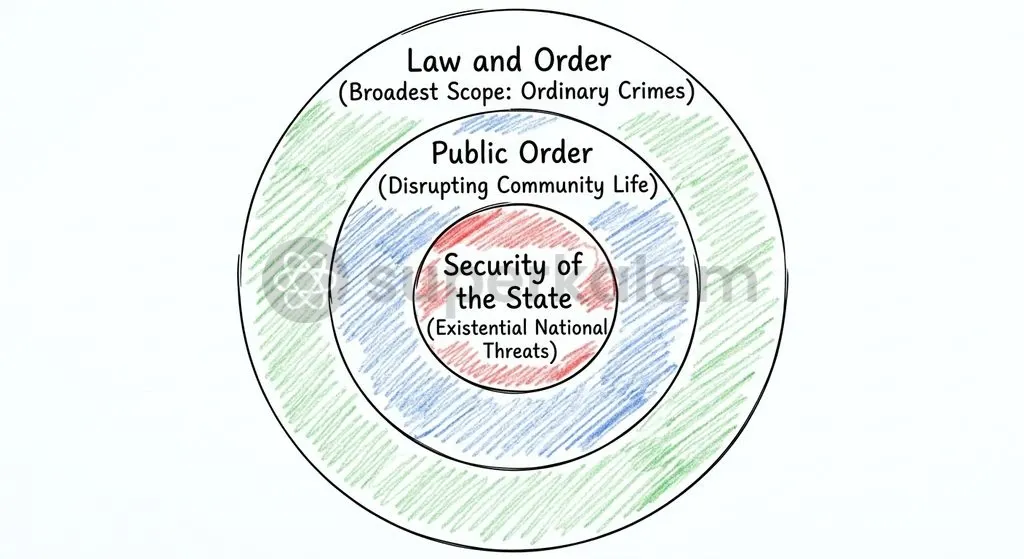
The Supreme Court of India formulated the foundational distinction between ordinary crime and public disorder in Ram Manohar Lohia v. State of Bihar (1966). The Court utilised the metaphor of three concentric circles to demarcate executive authority: the largest circle represents 'law and order', the intermediate circle denotes 'public order', and the core represents the 'security of the State'.
An ordinary crime affects only isolated individuals and falls strictly within the realm of law and order, manageable through the regular penal code. An act affects public order only when it disrupts the general tempo of community life, causing widespread panic or communal disruption.
In Mallada K. Sri Ram v. State of Telangana (2022) and Ameena Begum v. State of Telangana (2023), the Supreme Court reiterated that preventive detention cannot be invoked for routine penal infractions. The State must show that ordinary criminal laws are insufficient to neutralise an imminent, community-wide danger.
Systemic Misuse: When Preventive Laws Substitute for Real Investigation
The Supreme Court observed in Rekha v. State of Tamil Nadu (2011) that preventive detention cannot serve as an executive alternative to ordinary criminal prosecution. District administrations frequently invoke preventive laws mechanically when an accused is likely to secure regular bail in pending criminal trials.
This practice subverts the criminal justice system by enabling the police to bypass standard burdens of proof. Instead of conducting rigorous forensic investigations and securing judicial convictions, executive authorities use preventive statutes to impose punishment without trial. The Supreme Court has repeatedly struck down such orders, emphasising that the possibility of an accused obtaining bail must be contested through regular appellate processes rather than preventive detention.
The Ethical Balance: State Security vs. Individual Liberty Under Article 21
Preventive detention introduces a severe constitutional and ethical dilemma by sanctioning pre-crime incarceration within a democratic republic. In Banka Sneha Sheela v. State of Telangana (2021), the Supreme Court highlighted the danger of executive overreach when state agencies treat exceptional emergency provisions as everyday policing tools.
From an ethical governance perspective, preventive detention inverts the foundational maxim of criminal jurisprudence: the presumption of innocence. Incarcerating an individual based on unverified allegations or extracted confessions erodes institutional trust and degrades fundamental freedoms protected under Article 21. Maintaining national security requires robust institutional safeguards to ensure state power does not degenerate into arbitrary administrative coercion.
Discuss with Superkalam
Why does the Supreme Court insist on strict procedural compliance under Article 22 when judicial review of the executive's subjective satisfaction is inherently limited?
Ask NowWay Forward: Standardizing Advisory Boards and Limiting Executive Discretion
Strengthening procedural oversight and judicial accountability is essential to prevent executive overreach under preventive detention laws. Executive powers under statutes like the National Security Act, 1980 must remain strictly confined to genuine national emergencies and grave public disorders.
To align administrative practice with constitutional guarantees, institutional reforms must focus on several core areas:
- Independent Advisory Boards: Advisory Boards constituted under Section 9 of the NSA must operate with complete administrative independence, conducting rigorous factual scrutiny rather than acting as post-facto endorsement bodies.
- Strict Evidentiary Standards: Detaining magistrates must ensure that orders rest on independent, verifiable intelligence rather than uncorroborated police diaries or custodial statements barred under Section 23 of the Bharatiya Sakshya Adhiniyam, 2023.
- Exemplary Administrative Penalties: Imposing financial costs on detaining authorities for illegal detention—as demonstrated in the ₹10 lakh penalty against Uttar Pradesh—serves as a vital deterrent against frivolous orders.
- Mandatory Judicial Audits: High Courts should institutionalise periodic audits of preventive detention orders to identify patterns of statutory misuse in routine law and order matters.
Key Takeaways
- In Mulla Afroz v. Union of India (2026 INSC 1067), the Supreme Court held that uncorroborated police confessions cannot form the legal basis for subjective satisfaction under the National Security Act, 1980.
- Statements made to police officers are inadmissible under Section 23 of the Bharatiya Sakshya Adhiniyam, 2023, and cannot supply the probative material required for preventive detention.
- Under Article 22(3)(b) of the Constitution, preventive detainees are denied the fundamental rights of legal representation and 24-hour magisterial production provided under Articles 22(1) and 22(2).
- The Supreme Court in Ram Manohar Lohia demarcated routine law and order from community-wide public order, barring preventive detention for ordinary penal offences.
- The National Security Act, 1980 caps detention at 12 months (Section 13) and mandates Advisory Board review within seven weeks of detention (Section 11).
Mains Question
The Supreme Court in Ram Manohar Lohia v. State of Bihar demarcated the spheres of 'law and order', 'public order', and 'security of the State' through the metaphor of concentric circles. Examine how the conflation of these categories by detaining authorities leads to executive overreach and undermines Article 21. (15 Marks)
Evaluate NowMains Question
'Preventive detention is an exceptional executive power circumscribed by strict constitutional boundaries rather than an instrument of administrative convenience.' Elucidate the procedural safeguards under Article 22 and the National Security Act, 1980 that check executive discretion. (10 Marks)
Evaluate NowPractice MCQs
QUESTION 1
With reference to the National Security Act (NSA), 1980, consider the following statements:
- A detention order issued by a District Magistrate remains valid indefinitely unless explicitly set aside by the High Court.
- The State Government is required to report the approved detention order along with grounds to the Central Government within seven days.
- The maximum permissible period of detention under the Act is twelve months.
Which of the statements given above are correct?
QUESTION 2
Regarding the constitutional safeguards under Article 22 of the Constitution of India, consider the following statements:
- The right to consult legal counsel and the right to be produced before a magistrate within 24 hours are excluded for preventive detainees under Article 22(3)(b).
- An individual can be detained under preventive detention beyond three months only if an Advisory Board confirms sufficient cause before the expiration of that period.
- The detaining authority is constitutionally barred from withholding any fact or ground of detention from the detenu under any circumstance.
Which of the statements given above is/are correct?
QUESTION 3
Consider the following statements regarding the legal distinction between 'Law and Order' and 'Public Order':
- In Ram Manohar Lohia v. State of Bihar, the Supreme Court used the metaphor of three concentric circles where 'Law and Order' represents the outermost circle and 'Security of the State' forms the core.
- Routine penal infractions that affect isolated individuals fall within 'Public Order' and justify preventive detention.
- An act qualifies as disrupting 'Public Order' only when it disturbs the general tempo of community life.
Which of the statements given above are correct?
QUESTION 4
Under the National Security Act, 1980, what is the statutory composition and timeline prescribed for the Advisory Board?
QUESTION 5
In Mulla Afroz v. Union of India (2026), what did the Supreme Court hold regarding the formation of 'subjective satisfaction' for preventive detention?