National Media Council: Regulating India's Media Without Executive Control
As India plans a unified media watchdog, the challenge lies in tackling misinformation without subordinating press freedom to executive control.
Oct, 2026
•12 min read
Context
The proposed National Media Council seeks to replace India's fragmented media oversight architecture. It aims to unify print, television broadcasting, and digital news under a single statutory watchdog.
This unified statutory body aims to bridge regulatory silos and enforce uniform journalistic standards. Yet scholars warn that without strict institutional safeguards, it risks enabling executive censorship across previously decentralised speech platforms. As of September 2024, Indian media governance remains divided between the Press Council of India for print, voluntary associations for television news, and executive-led ministerial oversight for digital portals.
The Parliamentary Standing Committee on Communications and Information Technology has repeatedly urged the Union Government to establish an overarching statutory council. The panel argues this is necessary to tackle media ethics and digital misinformation. The core institutional challenge lies in penalising malpractice without subordinating press freedom to administrative discretion.
Why India Is Talking About a Single Media Watchdog
Parliamentary reviews highlight an unaddressed regulatory mismatch: digital news convergence has outpaced India's siloed administrative oversight.
- December 2021 recommendation: In its 27th Report titled 'Ethical Standards in Media Coverage' presented in December 2021, the Committee recommended a unified statutory body to address escalating concerns over fake news and media ethics, as noted by the Parliamentary Standing Committee on Communications and Information Technology in its 27th Report.
- Inadequacy of self-regulation: The Ministry of Information and Broadcasting initially maintained that separate self-regulatory frameworks were sufficient. However, in its February 2023 Action Taken Report, the parliamentary panel reiterated that voluntary compliance had proven inadequate to enforce cross-platform accountability, as highlighted by the Parliamentary Standing Committee on Communications and Information Technology in its Action Taken Report (17th Lok Sabha).
- Structural tension: While information dissemination has converged digitally, administrative oversight remains siloed. Unifying media governance under a single statutory body addresses digital convergence.
- Risk of administrative overreach: Without structural firewalls against executive interference, statutory unification threatens to replace voluntary self-regulation with centralised administrative control. State-led media oversight risks eroding institutional independence if adjudicatory powers become concentrated in executive hands.
Discuss with Superkalam
Identify the specific sections of the Press Council Act, 1978 that restrict the PCI's jurisdiction strictly to print and limit its penal authority to admonition and censure.
Ask NowThe Broken Puzzle: How India Regulates Media Across Print, TV, and Web
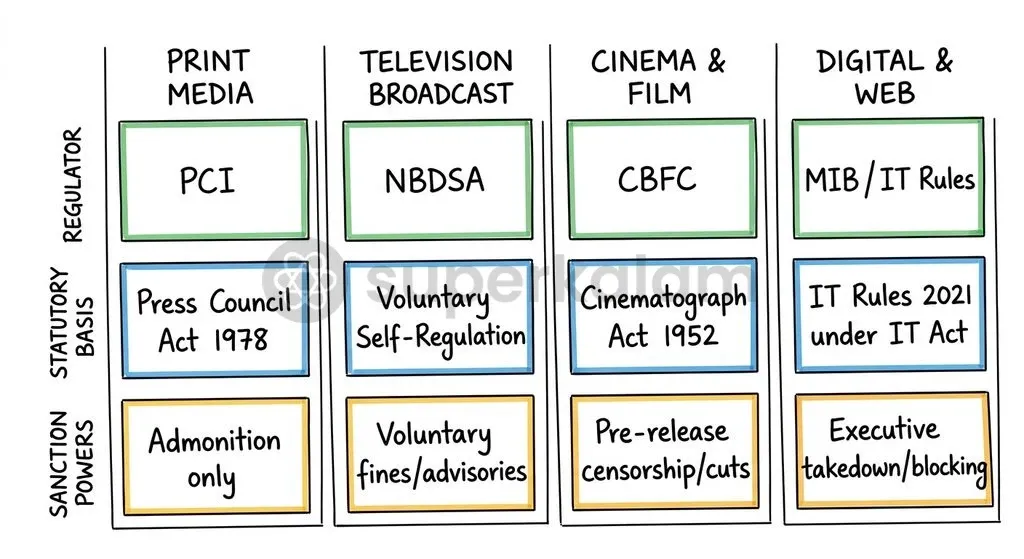
India regulates its information ecosystem through a fragmented framework. Oversight is split between statutory bodies, voluntary industry panels, and direct executive rules administered by different Union ministries.
Print journalism falls under the jurisdiction of the Press Council of India (PCI). The Press Council of India exercises jurisdiction strictly over print newspapers and news agencies under Section 13 of the Press Council Act, 1978, leaving television broadcasting and digital media entities entirely outside its statutory remit, per Section 13 of the Press Council Act, 1978.
Disciplinary powers under the statute remain narrow. The disciplinary powers of the Press Council of India are restricted under Section 14 of the Press Council Act, 1978 to warning, admonishing, censuring, or disapproving journalistic conduct, devoid of any authority to levy monetary fines or cancel publication licences.
Broadcast television operates in a separate, non-statutory tier. The News Broadcasting & Digital Standards Authority (NBDSA) operates as a private voluntary self-regulatory body established by the News Broadcasters & Digital Association without statutory backing. Its authority and fine-imposing sanctions are binding only upon voluntary members, per the Regulations of the News Broadcasting & Digital Standards Authority (NBDSA). Broadcasters dissatisfied with an adverse ruling can simply withdraw their membership to escape regulatory compliance.
Cinematographic content undergoes statutory pre-censorship. The Central Board of Film Certification (CBFC) is a statutory pre-censorship body under the Cinematograph Act, 1952, empowered to demand modifications, cuts, or outright refusal of public exhibition certification, pursuant to Sections 3, 4, and 5B of the Cinematograph Act, 1952. Digital platforms, meanwhile, are governed by executive-notified subordinate legislation under the Information Technology Act, 2000.
| Media Segment | Primary Regulatory Body / Framework | Legal Status | Enforcement and Penal Powers |
|---|---|---|---|
| Print Media | Press Council of India (PCI) | Statutory body under the Press Council Act, 1978 | Limited to warning, admonishing, or censuring; cannot levy fines or cancel licences. |
| Broadcast News | News Broadcasting & Digital Standards Authority (NBDSA) | Private voluntary body (News Broadcasters & Digital Association) | Fines and advisories apply strictly to voluntary corporate members. |
| Cinema | Central Board of Film Certification (CBFC) | Statutory body under the Cinematograph Act, 1952 | Prior restraint powers to mandate cuts or refuse exhibition certificates. |
| Digital News & OTT | Part III of the Information Technology Rules, 2021 | Subordinate executive rules under the IT Act, 2000 | Three-tier oversight culminating in an inter-departmental committee of executive secretaries. |
Discuss with Superkalam
Explain how the operational mechanism of the News Broadcasting & Digital Standards Authority (NBDSA) differs from that of a statutory regulatory body.
Ask NowThe Proposal: What Would an Integrated National Media Council Actually Do?
The proposed National Media Council would replace piecemeal oversight bodies by establishing a unified statutory regulator with adjudicatory authority across print, television, and internet news. The conceptual roots of statutory media oversight trace back to the First Press Commission of India, constituted in 1952.
The First Press Commission recommended the creation of an all-India Press Council to protect press freedom and encourage voluntary professional ethics rather than establish a coercive executive directorate, according to the Report of the First Press Commission.
Under the current framework, Section 5 of the Press Council Act, 1978 outlines an institutional structure where the Press Council of India comprises a Chairperson and 28 members. The Chairperson of the Council is nominated by a statutory committee consisting of the Chairman of the Rajya Sabha, the Speaker of the Lok Sabha, and an elected member of the Council, as stipulated in Section 5 of the Press Council Act, 1978.
An integrated National Media Council would consolidate these disparate systems into a unified mechanism:
- Cross-Platform Standards: Establishing a single, binding journalistic code of conduct applicable equally to print editors, television anchors, and digital publishers.
- Statutory Adjudication: Resolving public complaints regarding defamation, misinformation, and privacy violations through quasi-judicial orders rather than voluntary advisories.
- Escalated Sanctions: Introducing proportionate penal remedies, bridging the gap between the Press Council of India's non-coercive censure and executive-driven website blocks.
- Professional Accreditations: Streamlining the recognition and legal protection of journalists across traditional newsrooms and independent digital channels.
Free Speech and the Courts: Constitutional Red Lines Under Article 19
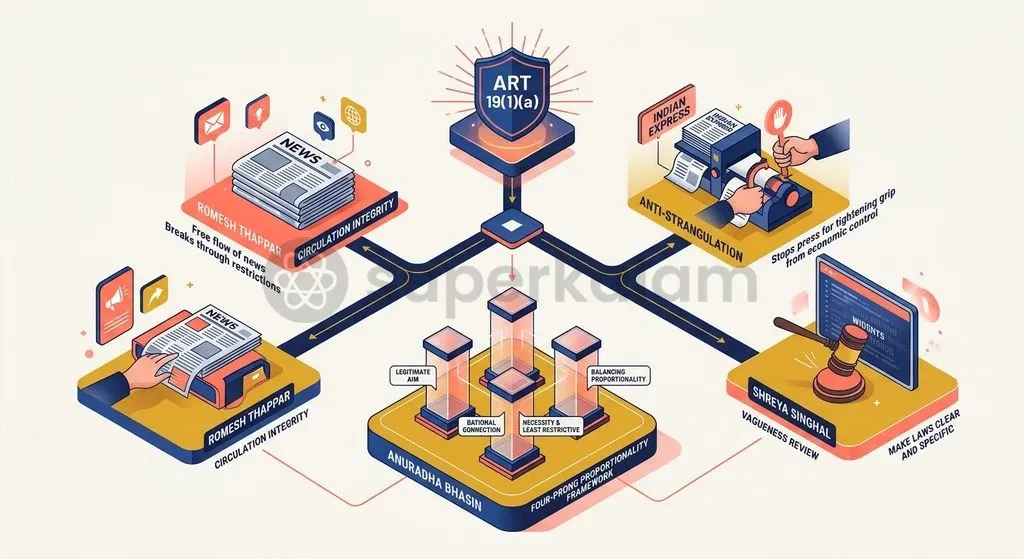
The Supreme Court of India has consistently held that freedom of the press is an intrinsic component of the fundamental right guaranteed under Article 19(1)(a) of the Constitution. Article 19(1)(a) protects freedom of speech and expression, subject only to the exhaustive reasonable restrictions enumerated in Article 19(2), such as state sovereignty, public order, and decency. State measures regulating the press must respect these judicial boundaries:
- Prohibition of Pre-Censorship: In Romesh Thappar v. State of Madras (1950), the Supreme Court ruled that freedom of speech and expression includes the freedom of circulation, invalidating executive orders that impose pre-censorship or prohibit the entry of publications, as established in Romesh Thappar v. State of Madras.
- Protection Against Indirect Economic Strangulation: In Sakal Papers (P) Ltd. v. Union of India (1962), the Supreme Court held that the state cannot indirectly restrict the circulation of newspapers by regulating their price and page volume, establishing that speech cannot be abridged under the guise of commercial regulation.
- The Public Watchdog Principle: In Indian Express Newspapers (Bombay) Pvt. Ltd. v. Union of India (1985), the Supreme Court declared the press to be a public watchdog and essential democratic institution, holding that the state cannot use regulatory or fiscal levies to indirectly undermine press autonomy.
- Voiding Vague Speech Standards: In Shreya Singhal v. Union of India (2015), the Supreme Court struck down Section 66A of the Information Technology Act for overbreadth and vagueness, establishing that statutory standards regulating speech must not create an unconstitutional chilling effect, as ruled in Shreya Singhal v. Union of India.
- Constitutional Scrutiny of Internet Expression: In Anuradha Bhasin v. Union of India (2020), the Supreme Court held that freedom of speech, expression, and trade over the internet is constitutionally protected under Article 19(1)(a) and Article 19(1)(g), requiring any government restriction to satisfy the four-prong proportionality test.
Discuss with Superkalam
If a government introduces statutory price-per-page caps on digital or print news subscriptions, how would the precedent in Sakal Papers (1962) apply to its constitutional validity?
Ask NowThe Executive Capture Dilemma: IT Rules, Broadcasting Bills, and State Control
Recent regulatory initiatives by the Ministry of Information and Broadcasting reveal how state-led media oversight mechanisms frequently encounter constitutional challenges over executive overreach. When subordinate legislation vests adjudication in executive officials, regulatory friction quickly follows.
- Stay on the IT Rules, 2021: The High Court of Judicature at Madras in TM Krishna v. Union of India (2021) and the High Court of Bombay in Agij Promotion v. Union of India (2021) stayed Sub-rules 9(1) and 9(3) of Part III of the IT Rules, 2021. The courts held that subjecting digital publishers to executive oversight violated Article 19(1)(a), per orders in TM Krishna v. Union of India and Agij Promotion v. Union of India.
- Striking Down the Fact-Check Unit (2024): On September 26, 2024, the Bombay High Court in Kunal Kamra v. Union of India struck down Rule 3(1)(b)(v) of the Information Technology Intermediary Guidelines and Digital Media Ethics Code Amendment Rules, 2023, which had authorised a Central Government Fact-Check Unit to identify online government-related speech as fake, false, or misleading. The High Court held that allowing an executive unit to act as the sole arbiter of truth infringed upon expressive freedom.
- Retraction of the Broadcasting Services Bill: The draft Broadcasting Services (Regulation) Bill, 2024 proposed mandating internal Content Evaluation Committees (CECs) and a government-constituted Broadcast Advisory Council for all broadcasters, including OTT streaming platforms and digital news content creators. The ministry later retracted the proposal for wider consultations in August 2024, as recorded by the Ministry of Information and Broadcasting.
Legal scholars and parliamentary records observe that establishing a converged statutory media council whose members are appointed unilaterally by the executive creates an inherent risk of institutional capture. This design risks turning the regulator into an instrument for suppressing oppositional speech (as reported per Law Commission of India and Standing Committee Parliamentary Records).
How Other Democracies Balance Press Freedom with Media Accountability
The United Kingdom separates broadcast licensing from print press regulation to prevent the state from exercising statutory control over editorial publications.
Following systemic phone-hacking revelations, the 2012 Leveson Inquiry in the United Kingdom recommended an independent self-regulatory body underpinned by a statutory 'recognition' mechanism. The goal was to ensure complete editorial independence from both commercial proprietors and state politicians. Rather than creating a government-run press regulator, the British constitutional framework adopted an arm's-length co-regulatory design.
Under the UK Royal Charter on Self-Regulation of the Press (2013), oversight operates along two distinct institutional tracks:
- Print Press Recognition: The Press Recognition Panel (PRP) operates as an independent body to evaluate voluntary press self-regulators against 29 recognition criteria of independence.
- Statutory Broadcast Licensing: Television and radio broadcasting remain under the independent statutory remit of Ofcom.
This bifurcated system prevents political ministers from interfering with print press ethics while maintaining a statutory broadcast regime. Co-regulation models balance democratic accountability with journalistic autonomy by combining statutory recognition with industry-led oversight.
By requiring self-regulatory bodies to meet objective statutory criteria verified by an independent panel, democracies avoid both the toothless inertia of voluntary bodies and the authoritarian risks of executive licensing.
Discuss with Superkalam
Compare the risks of executive capture under subordinate legislation (such as the IT Rules) with the potential harms of unchecked voluntary industry self-regulation.
Ask NowA Blueprint for Genuine Independence: What an Autonomous Council Needs
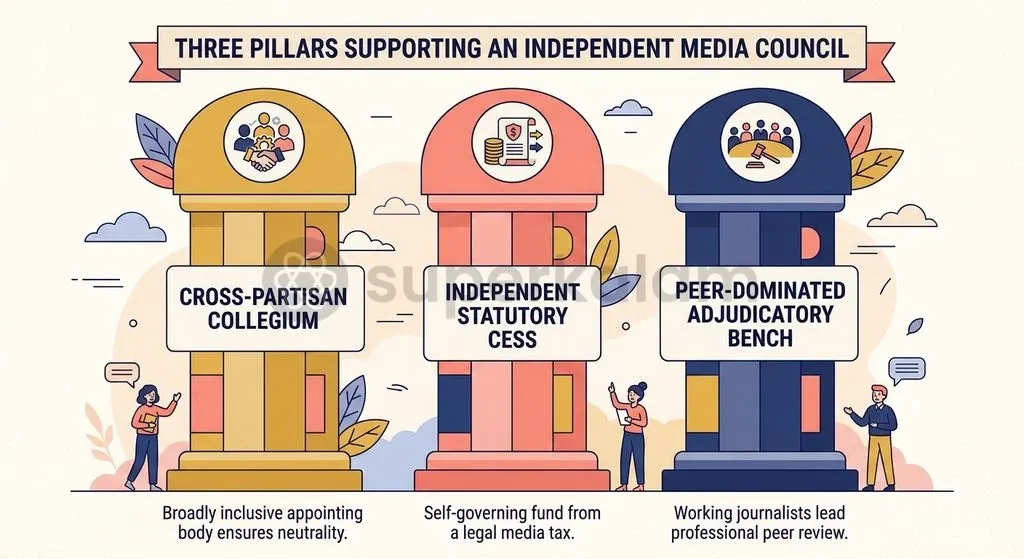
The Law Commission of India and constitutional scholars emphasise that a statutory media council must incorporate institutional firewalls to shield its adjudicatory processes from executive influence. To prevent a converged media council from degenerating into an instrument of administrative control, three structural safeguards are essential:
- Cross-Partisan Collegium Appointments: Leadership appointments must not remain under unilateral executive discretion. As proposed in comparative regulatory studies within the Law Commission of India's Report No. 255 on Electoral Reforms, appointments to sensitive regulatory bodies should be conducted by a broad collegium comprising the Chief Justice of India, the Leader of the Opposition, and the Presiding Officers of Parliament.
- Dedicated Statutory Funding: Financial reliance on discretionary ministerial budgeting compromises institutional autonomy. Deliberations in the Parliamentary Standing Committee on Information Technology's 27th Report records suggest that funding must derive from a guaranteed statutory cess or independent endowment corpus rather than annual budgetary allocations from the Ministry of Information and Broadcasting (as reported per Parliamentary Standing Committee on Information Technology Records).
- Peer-Dominated Adjudication Benches: Quasi-judicial dispute resolution must remain insulated from administrative civil servants. Internal deliberations on media council provisions indicate that adjudicatory benches should be composed predominantly of practising working journalists and retired judges rather than executive bureaucrats to safeguard natural justice (as reported per Press Council of India Deliberations).
Grounding media governance in institutional autonomy balances ethical regulation with constitutional liberty. By safeguarding institutional design, India can ensure that media accountability serves the democratic public interest rather than the transient convenience of the state executive.
Key Takeaways
- Under Section 13 and Section 14 of the Press Council Act, 1978, the Press Council of India exercises jurisdiction strictly over print media and possesses no statutory authority to levy monetary fines or cancel publication licences.
- The Parliamentary Standing Committee on Communications and Information Technology, in its 27th Report (2021) and February 2023 Action Taken Report, recommended establishing a unified statutory Media Council across print, television, and digital platforms.
- The Supreme Court has circumscribed state regulation of speech under Article 19(1)(a) and 19(2) through landmark rulings, including Romesh Thappar (banning pre-censorship), Indian Express (press as democratic watchdog), Shreya Singhal (invalidating vague speech rules), and Anuradha Bhasin (applying the proportionality test to internet expression).
- Executive attempts to oversee digital news have met judicial resistance: the Madras and Bombay High Courts stayed Sub-rules 9(1) and 9(3) of Part III of the IT Rules, 2021, and the Bombay High Court struck down the Central Government Fact-Check Unit in Kunal Kamra v. Union of India (2024).
- To evade executive capture, an autonomous National Media Council requires structural firewalls: cross-partisan collegium appointments, dedicated statutory cess financing, and peer-dominated adjudicatory benches.
Mains Question
"Voluntary compliance has proven inadequate to enforce cross-platform accountability, yet statutory unification threatens to replace voluntary self-regulation with centralised administrative control." In light of the Parliamentary Standing Committee's recommendations, critically examine the proposal to establish an integrated National Media Council. (15 Marks)
Evaluate NowMains Question
The Supreme Court in Sakal Papers (1962) and Indian Express Newspapers (1985) established that the state cannot indirectly abridge press autonomy through administrative or fiscal mechanisms. Elucidate how judicial precedents delineate constitutional red lines for media regulation under Article 19 of the Constitution. (10 Marks)
Evaluate NowPractice MCQs
QUESTION 1
With reference to the Press Council of India (PCI) under the Press Council Act, 1978, consider the following statements:
- Its statutory jurisdiction extends to print newspapers, news agencies, and television broadcasting.
- Under Section 14 of the Act, it is empowered to warn, admonish, or censure journalistic conduct, but lacks the power to levy monetary fines.
- The Chairperson of the Council is nominated by a committee comprising the Chairman of the Rajya Sabha, the Speaker of the Lok Sabha, and an elected member of the Council.
Which of the statements given above are correct?
QUESTION 2
Consider the following statements regarding media regulation bodies in India:
- The News Broadcasting & Digital Standards Authority (NBDSA) is a statutory authority established under the Information Technology Act, 2000.
- Sanctions and fines imposed by the NBDSA are legally binding only upon its voluntary members.
- The Central Board of Film Certification (CBFC) possesses statutory prior restraint powers under the Cinematograph Act, 1952.
Which of the statements given above is/are correct?
QUESTION 3
With reference to landmark Supreme Court judgements concerning press freedom and Article 19 of the Constitution of India, consider the following pairs:
- Romesh Thappar v. State of Madras (1950) — Held that freedom of speech and expression includes freedom of circulation and invalidated pre-censorship.
- Sakal Papers (P) Ltd. v. Union of India (1962) — Ruled that the state cannot indirectly restrict circulation by regulating price and page volume.
- Anuradha Bhasin v. Union of India (2020) — Formulated the doctrine that freedom of speech over the internet must satisfy the four-prong proportionality test.
Which of the pairs given above are correctly matched?
QUESTION 4
Which one of the following reports initially recommended the establishment of an all-India Press Council to protect press freedom and foster voluntary professional ethics rather than creating a coercive executive directorate?
QUESTION 5
Consider the following statements regarding the regulatory framework for digital media and cinema in India:
- Digital news portals and Over-The-Top (OTT) platforms are regulated via executive-notified subordinate rules under the Information Technology Act, 2000.
- The oversight mechanism under Part III of the Information Technology Rules, 2021 culminates in an inter-departmental committee of executive secretaries.
- The Central Board of Film Certification derives its statutory certification mandate from the Press Council Act, 1978.
Which of the statements given above is/are correct?