National Green Hydrogen Mission: Why SIGHT Needs Demand Mandates
Without statutory off-take mandates under the Energy Conservation Act, heavy industries will not absorb the steep green cost premium over grey hydrogen.
Nov, 2026
•10 min read
Overview
India's National Green Hydrogen Mission cannot achieve commercial viability through supply-side incentives alone. It requires statutory off-take mandates compelling domestic industrial consumers to absorb the persistent green cost premium. The Union Cabinet approved the mission with a financial outlay of ₹19,744 crore to establish 5 Million Metric Tonnes of annual production capacity by 2030, supported by the Strategic Interventions for Green Hydrogen Transition programme.
Capital subsidies kickstart initial capacity. Yet industrial sectors like refining and fertilisers remain reluctant to switch from cheaper fossil fuels voluntarily. Sustained decarbonisation requires bridging this economic divide through statutory consumption quotas alongside production support.
Why in the News: Tracking India's Clean Fuel Ambitions
The Ministry of New and Renewable Energy is operationalising the National Green Hydrogen Mission to transform India into an export hub for clean hydrogen. As of March 2024, the Solar Energy Corporation of India completed initial allocations under the Strategic Interventions for Green Hydrogen Transition programme. The Union Cabinet approved the mission on January 4, 2023, committing an initial outlay of ₹19,744 crore.
Through this policy framework, policymakers seek to achieve three key structural outcomes by 2030:
- Establishing at least 5 Million Metric Tonnes of annual green hydrogen production capacity.
- Adding approximately 125 GW of associated renewable capacity to power electrolysis nationwide.
- Mitigating nearly 50 MMT of annual emissions while substituting over ₹1 lakh crore of cumulative fossil fuel imports.
Discuss with Superkalam
What is the maximum permissible well-to-gate emission limit for green hydrogen under India's national standard?
Ask NowThe Hydrogen Colour Spectrum: What Makes Hydrogen Truly Green?
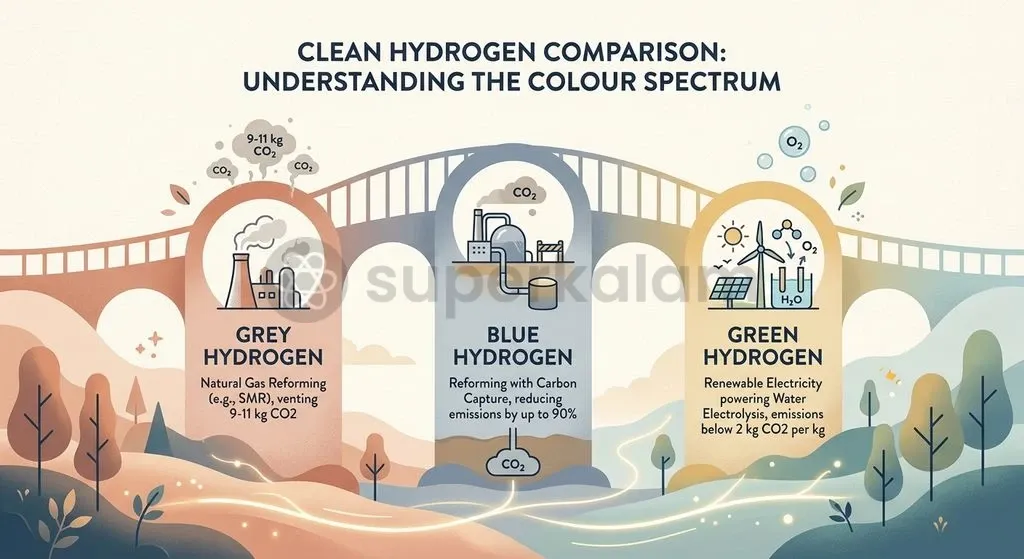
Hydrogen gas is colourless. Energy analysts classify it using colour metaphors that reflect the environmental footprint of its underlying production pathway. Conventional industrial hydrogen consists predominantly of fossil-derived variants that release substantial volumes of greenhouse gases.
Grey hydrogen represents the standard baseline across Indian refineries and fertiliser plants. Manufacturers produce grey hydrogen via unabated steam methane reforming of natural gas, a chemical pathway emitting 9 to 11 kg CO2 per kilogram of hydrogen.
Blue hydrogen uses the identical steam reforming process but captures carbon emissions before atmospheric release. Incorporating carbon capture and storage technologies abates between 60% to 90% of emissions, providing a transitional step toward cleaner production.
Green hydrogen eliminates fossil feedstocks entirely by splitting demineralised water into hydrogen and oxygen via electrolysis powered by zero-emission renewable electricity. Brown or black hydrogen, by contrast, relies on coal gasification, yielding the most carbon-intensive fuel profile across the entire spectrum.
| Hydrogen Variant | Primary Feedstock | Core Conversion Technology | Carbon Intensity (kg CO2 / kg H2) |
|---|---|---|---|
| Grey | Natural gas | Steam Methane Reforming | 9 to 11 |
| Blue | Natural gas | Reforming with Carbon Capture | Substantially abated (60% to 90% captured) |
| Green | Water | Renewable-powered Water Electrolysis | ≤ 2 (Indian Standard) |
| Black / Brown | Bituminous coal or Lignite | Coal Gasification | High unabated lifecycle footprint |
Defining the Standard: India's Well-to-Gate Emission Thresholds
The Ministry of New and Renewable Energy notified the formal Green Hydrogen Standard for India to establish clear environmental benchmarks for trade. This regulatory threshold determines which production processes qualify for financial subsidies under the national mission.
Under this notification, green hydrogen must have well-to-gate emissions not exceeding 2 kg CO2 equivalent per kilogram of hydrogen taken as an average over the preceding 12-month period. The standard covers water treatment, electrolysis, gas purification, drying, and compression.
Institutional governance divides regulatory responsibilities across key energy bodies:
- The Ministry of New and Renewable Energy oversees national policy targets and formulates operational guidelines.
- The Bureau of Energy Efficiency is the nodal authority responsible for accrediting monitoring, verification, and certification agencies.
- Accredited independent agencies conduct periodic audits of production facilities to ensure continuous compliance with the 2 kg CO2 equivalent ceiling.
To accelerate plant construction, the Ministry of Environment, Forest and Climate Change exempted standalone green hydrogen and green ammonia plants powered by renewable energy from obtaining prior Environmental Clearance under the EIA Notification 2006.
Discuss with Superkalam
How does the environmental footprint of grey hydrogen differ from that of blue hydrogen in terms of emissions abated?
Ask NowThe SIGHT Mechanism: Electrolyser Manufacturing and Production Subsidies
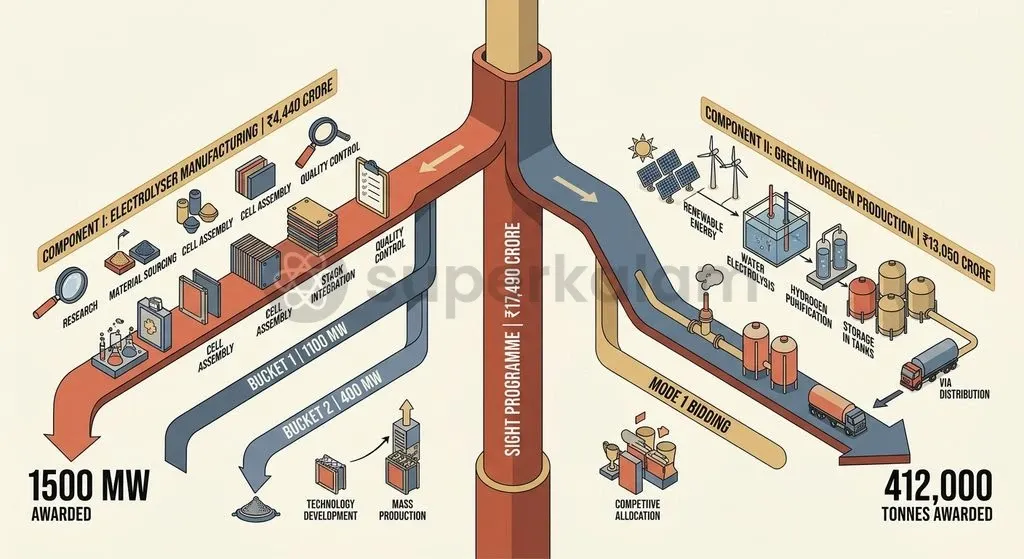
The Strategic Interventions for Green Hydrogen Transition programme is the primary financial engine of the national mission. The Union Cabinet allocated a total financial envelope of ₹17,490 crore to SIGHT, dividing resources into two complementary intervention legs:
- Component I (₹4,440 crore): Incentivises domestic electrolyser manufacturing between financial year 2025–26 and financial year 2029–30. Under Tranche-I bidding concluded by the Solar Energy Corporation of India, authorities awarded 1,500 MW of manufacturing capacity, allocating 1,200 MW to general stack technologies and 300 MW to indigenously developed stacks.
- Component II (₹13,050 crore): Subsidises green hydrogen production directly over the same five-year window. The scheme awards financial assistance over a three-year operational horizon per recipient to cushion initial operating deficits. In Tranche-I, the Solar Energy Corporation of India awarded 412,000 tonnes per annum of production incentives to ten commercial developers under technology-agnostic competitive bidding.
The Missing Demand Link: Why Supply Incentives Need Off-Take Mandates
The Energy Conservation Act, 2001 provides the statutory architecture required to enforce domestic green fuel consumption across energy-intensive industries. Parliament strengthened this mechanism when the Energy Conservation (Amendment) Act, 2022 inserted Section 14(x) into the principal statute.
Section 14(x) creates the legal foundation for Green Hydrogen Consumption Obligations, mirroring the Renewable Purchase Obligations that expanded India's solar sector. The statutory clause empowers the Central Government to specify a minimum consumption share of non-fossil sources as energy or industrial feedstock for designated consumers.
Yet two core bottlenecks stall off-take:
- Regulatory forbearance on mandates: The Central Government has withheld notifying binding consumption obligations, choosing instead to rely on voluntary industrial transition backed by supply-side incentives. This administrative delay leaves project developers exposed to significant market risks, as prospective buyers refuse long-term purchase contracts.
- The persistent green premium: According to NITI Aayog, green hydrogen costs $3.5 to $5 per kg to produce, whereas unabated fossil grey hydrogen costs approximately $1.5 to $2.2 per kg. Without statutory quotas, profit-oriented entities in refining, chemicals, and fertilisers will not voluntarily absorb fuel costing more than double their current baseline.
Discuss with Superkalam
If you were advising a fertiliser manufacturing unit, how would the current green cost premium impact your operational decision to switch from grey to green hydrogen without mandates?
Ask NowPolicy Comparison: India's SIGHT Subsidies vs EU Contracts for Difference
Industrialised economies employ contrasting financial architectures to bridge the cost differential between fossil fuels and clean hydrogen energy carriers. While India focuses fiscal outlays on initial capital expenditure and short-term production support, the European Union structures its policy around long-term operational risk management.
The European Commission operates the European Hydrogen Bank, which provides operational risk hedging through ten-year fixed-premium support contracts awarded via competitive auctions. This ten-year certainty allows European project developers to secure low-cost debt financing from institutional commercial lenders.
European governments also deploy Carbon Contracts for Difference through mechanisms like the European Union Innovation Fund. Under a Carbon Contract for Difference, the state guarantees a fixed strike price for low-carbon products, reimbursing industrial operators for the difference between clean production costs and the prevailing carbon price under the European Union Emissions Trading System. When emissions allowance prices rise, industrial consumers automatically see their operational cost gap diminish.
| Feature / Dimension | India: SIGHT Programme | European Union: Contracts for Difference |
|---|---|---|
| Primary Policy Focus | Production-side CAPEX and short-term OPEX support | Long-term operational risk mitigation and off-take bridging |
| Duration of Operational Support | 3-year tapering production subsidy | 10-year fixed premium or strike-price guarantee |
| Demand-Side Integration | Voluntary adoption without statutory off-take mandates | Integrated with carbon pricing via the EU Emissions Trading System |
| Financing Certainty | Short subsidy window leaves residual long-term market risk | Extended revenue horizon simplifies bankable project debt |
Discuss with Superkalam
Why does a 3-year production subsidy under SIGHT provide less financial certainty for commercial debt financing than the EU's 10-year fixed-premium contracts?
Ask NowStructural Bottlenecks: Renewable Tariffs, Water Footprint, and Storage Deficits
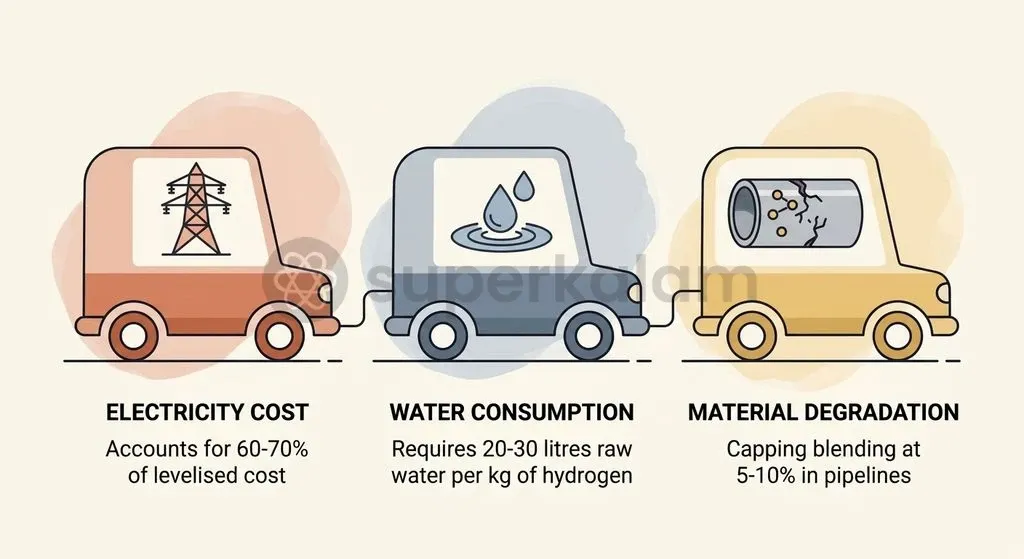
The levelised cost of green hydrogen depends heavily on the cost of round-the-clock clean electricity and reliable access to industrial water resources. According to the International Renewable Energy Agency, electricity input tariffs account for 60% to 70% of total levelised production costs.
To ease electricity procurement costs, the Ministry of Power introduced targeted regulatory reforms:
- Granting a 100% waiver of Inter-State Transmission System charges for 25 years for projects commissioned on or before December 31, 2030.
- Lowering open access transaction limits from 1 MW to 100 kW under the Green Energy Open Access Rules, 2022, allowing smaller consumers to source clean power.
Resource requirements present a separate geographic challenge. Water electrolysis demands a stoichiometric baseline of 8.93 to 9 litres of demineralised pure water for every kilogram of hydrogen generated. When accounting for reverse osmosis purification blowdown and cooling systems, commercial plants consume 20 to 30 litres of raw freshwater per kilogram of fuel. Siting massive facilities in arid industrial regions like Gujarat or Rajasthan risks aggravating local water security stresses.
Midstream transmission infrastructure faces severe material constraints. The phenomenon of hydrogen embrittlement—where atomic hydrogen diffuses into carbon steel lattices and induces cracking—restricts hydrogen blending in standard natural gas pipelines to 5% to 10% by volume without specialised upgrades. To evaluate technical tolerances, the Petroleum and Natural Gas Regulatory Board approved a pilot framework permitting up to 5% blending into Piped Natural Gas, targeting eventual expansion toward 20%.
The Way Forward: Derisking Adoption in Hard-to-Abate Sectors
The Ministry of New and Renewable Energy must transition from exclusive supply-side subsidisation toward an integrated policy framework that creates predictable, legally mandated industrial off-take. Without statutory demand, early production capacity risks becoming stranded before reaching commercial scale.
Key policy interventions to derisk and accelerate adoption include:
- Enforcing phased consumption mandates: Operationalise Section 14(x) of the Energy Conservation Act, 2001 by introducing phased Green Hydrogen Consumption Obligations for petroleum refineries and urea fertiliser manufacturing plants. Refineries already consume massive quantities of captive grey hydrogen for desulphurisation, making them the most practical initial anchor customers. Requiring a modest starting obligation of 5% to 10% would generate bankable domestic demand without compromising industrial margins.
- Adopting hybrid risk-hedging mechanisms: Evolve financial schemes beyond capital grants. Integrating domestic carbon credit markets with Carbon Contracts for Difference would compensate industrial early adopters for the green premium while penalising unabated fossil alternatives.
- Mandating circular water and infrastructure upgrades: Combine demand-side measures with water recycling mandates and pipeline upgrades to ensure India's green hydrogen ambitions translate into enduring industrial decarbonisation.
Discuss with Superkalam
Weigh the merits of immediate mandatory off-take quotas against voluntary industry transition for energy-intensive sectors like refining.
Ask NowKey Takeaways
- The Union Cabinet approved the National Green Hydrogen Mission in January 2023 with an outlay of ₹19,744 crore, targeting 5 MMT of annual production capacity and 125 GW of associated renewable energy by 2030.
- India's national standard strictly defines green hydrogen by a well-to-gate carbon intensity threshold not exceeding 2 kg CO2 equivalent per kg H2, verified under Bureau of Energy Efficiency accreditation.
- The SIGHT programme allocates ₹17,490 crore split across electrolyser manufacturing (Component I: ₹4,440 crore) and green hydrogen production incentives (Component II: ₹13,050 crore).
- Green hydrogen faces a severe green premium of $3.5 to $5 per kg compared to $1.5 to $2.2 per kg for grey hydrogen, making voluntary commercial adoption unviable in price-sensitive sectors.
- Section 14(x) of the Energy Conservation Act, 2001 (inserted via the 2022 Amendment) empowers the government to establish binding Green Hydrogen Consumption Obligations, but authorities have withheld notifying them.
- Infrastructure challenges include high industrial freshwater consumption (20–30 litres raw water per kg H2) and hydrogen embrittlement limits (5% to 10% pipeline blending ceiling).
Mains Question
"Supply-side incentives like the SIGHT programme can create production capacity, but commercial viability remains elusive without tackling the persistent green cost premium." In this context, evaluate the necessity of notifying Green Hydrogen Consumption Obligations under Section 14(x) of the Energy Conservation Act. (10 Marks)
Evaluate NowMains Question
Contrasting India's capital-subsidy-focused SIGHT mechanism with the European Union's long-term operational risk instruments, critically analyse the policy instruments required to de-risk green hydrogen adoption in domestic hard-to-abate sectors. (15 Marks)
Evaluate NowPractice MCQs
QUESTION 1
Regarding the National Green Hydrogen Mission and India's standard for green hydrogen, consider the following statements:
- The formal standard stipulates that well-to-gate emissions must not exceed 2 kg CO2 equivalent per kilogram of hydrogen as a 12-month average.
- The Bureau of Energy Efficiency is designated as the nodal authority for accrediting monitoring, verification, and certification agencies.
- Standalone green hydrogen and green ammonia plants powered by renewable energy require mandatory prior Environmental Clearance under the EIA Notification 2006. Which of the statements given above are correct?
QUESTION 2
Consider the following statements regarding the Strategic Interventions for Green Hydrogen Transition (SIGHT) programme:
- Component I provides financial support aimed at incentivising domestic electrolyser manufacturing.
- Component II provides production incentives for green hydrogen awarded over a three-year operational horizon per recipient.
- The total financial allocation committed to the SIGHT programme is ₹19,744 crore. Which of the statements given above is/are correct?
QUESTION 3
With reference to the statutory architecture for energy regulation in India, consider the following statements:
- The Energy Conservation (Amendment) Act, 2022 inserted Section 14(x) into the Energy Conservation Act, 2001.
- Section 14(x) empowers the Central Government to specify minimum consumption quotas of non-fossil sources for designated industrial consumers. Which of the statements given above is/are correct?
QUESTION 4
Consider the following pairs of hydrogen production pathways and their characteristics:
- Grey Hydrogen: Steam Methane Reforming without carbon capture
- Blue Hydrogen: Reforming coupled with Carbon Capture and Storage capturing 60% to 90% of emissions
- Brown or Black Hydrogen: Coal gasification with unabated lifecycle footprint Which of the pairs given above is/are correctly matched?
QUESTION 5
Under the European Union's policy framework for hydrogen, how does the European Hydrogen Bank primarily structure operational risk support for clean hydrogen developers?