Nasha Mukt Bharat Abhiyaan and India's Drug-Free 2029 Target
While security forces scale up interdictions against synthetic cartels, bridging India's rehabilitation deficit remains the true test for the 2029 target.
Oct, 2026
•12 min read
Context
India has set a national deadline of 31 December 2029 to dismantle narcotics trafficking networks and eliminate the illicit drug trade. Yet achieving a drug-free society remains an elusive ideal without closing deep demand-side treatment deficits.
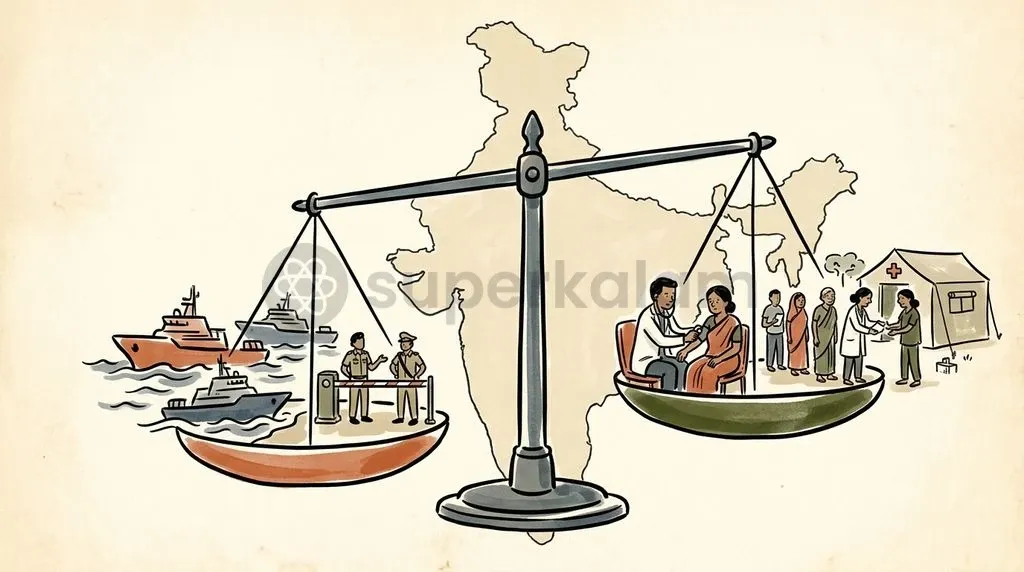
Interdiction metrics show rapid growth across maritime zones and domestic clandestine laboratories. Even so, the domestic reality features over seven crore people suffering from substance use disorders. Real national progress requires moving beyond supply interdiction to address deficits in medical infrastructure, harm reduction, and rehabilitation.
Why the 2029 Drug-Free Target Is in the News
Union Home Minister Amit Shah formally set a national deadline of 31 December 2029 to dismantle narcotics trafficking networks and eliminate the illicit drug trade from India. As of September 2026, the central government has directed all security agencies to shift from episodic seizures toward total structural disruption of transnational syndicates.
This policy push is anchored conceptually in Article 47 of the Constitution of India. Article 47 directs the State to bring about the prohibition of the consumption, except for medicinal purposes, of intoxicating drinks and of drugs injurious to health. As a non-justiciable directive under Part IV, Article 47 guides governance priorities rather than conferring enforceable individual rights.
Several tactical triggers prompted this aggressive enforcement pivot:
- Domestic synthetic expansion: Rapid growth of clandestine chemical manufacturing hubs inside industrial belts.
- Digital procurement: Organised trade moving onto encrypted darknet platforms.
- Maritime incursions: Deep-sea trafficking corridors threading across the Arabian Sea.
What Is the 2029 Goal and How Does the Government Plan to Reach It?
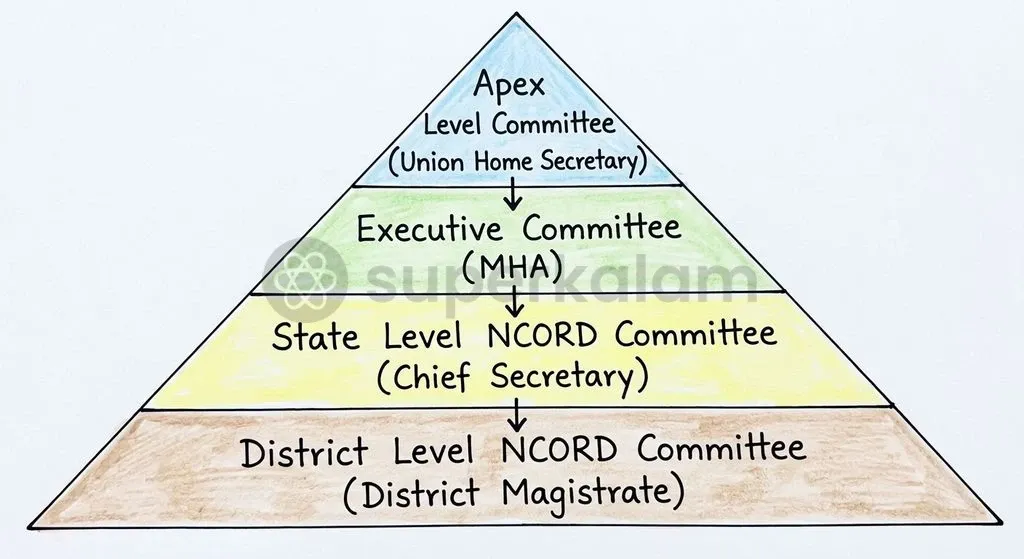
The Ministry of Home Affairs structured anti-narcotics enforcement around a multi-tier institutional framework designed to bridge coordination gaps across central and state jurisdictions. The strategic architecture rests upon the revamped Narco-Coordination Centre (NCORD), established as a four-tier institutional mechanism to ensure vertical command.
This four-tier NCORD architecture operationalises policy across all levels of public administration:
- Apex Committee: Chaired by the Union Home Secretary to oversee national policy and multi-agency coordination.
- Executive Committee: Supervised by senior home ministry and enforcement officials to monitor operational execution.
- State NCORD Committees: Led by respective State Chief Secretaries to align regional police and administrative resources.
- District NCORD Committees: Headed by District Magistrates to drive ground-level enforcement and demand-reduction tracking.
To translate administrative decisions into enforcement action, every State and Union Territory has instituted a dedicated Anti-Narcotics Task Force (ANTF) headed by an officer of ADGP or IGP rank. These units serve as executive secretariats for State NCORD committees.
According to a press release from the Ministry of Home Affairs, the central government has directed law enforcement to categorise all Indian districts into three functional clusters: entry or manufacturing districts, transit corridor districts, and consumption districts. This targeted mapping directs interdiction assets straight to critical nodes rather than scattering resources uniformly.
Discuss with Superkalam
Which constitutional directive in Part IV guides the State's policy priorities regarding the prohibition of intoxicating drugs?
Ask NowBenchmarking Progress: Where Does India Stand Against the 2029 Clock?
Evaluating the 2029 timeline requires balancing law enforcement seizure metrics against underlying public health realities. Narcotics Control Bureau records demonstrate substantial operational activity, with synthetic drug seizures expanding to 11.8 million kilograms between 2014 and 2026, compared to 2.6 million kilograms seized between 2004 and 2014.
Interdiction volumes capture only a fraction of the illicit market. A comprehensive national survey by the Ministry of Social Justice and Empowerment revealed that approximately 2.26 crore Indians consume opioids, representing a 2.1% prevalence rate that is three times the global average.
The same survey recorded 3.1 crore cannabis users. Heroin consumption has overtaken raw opium use, with national prevalence reaching 1.14% for heroin compared to 0.52% for raw opium.
| Dimension | Administrative Seizure Metrics | Epidemiological Public Health Reality |
|---|---|---|
| Opioid Burden | Seizures tracking transit corridors | 2.26 crore consumers (2.1% prevalence) |
| Injecting Vulnerability | Targeted interdiction of peddlers | Approximately 8.5 lakh active PWIDs |
| Synthetic Enforcement | 11.8 million kg seized (2014–2026) | Rapid spread of cheap chemical substitutes |
| Addiction Burden | Rising arrests under the NDPS Act | Over 7 crore people with substance disorders |
The epidemiological data demonstrates that seizures alone cannot dismantle drug market dynamics. High profit margins across illicit supply chains allow organised cartels to absorb consignment losses as standard operating costs. When enforcement focuses purely on supply, untreated domestic dependency sustains resilient street demand.
The Shifting Drug Landscape: Beyond Golden Crescent and Triangle
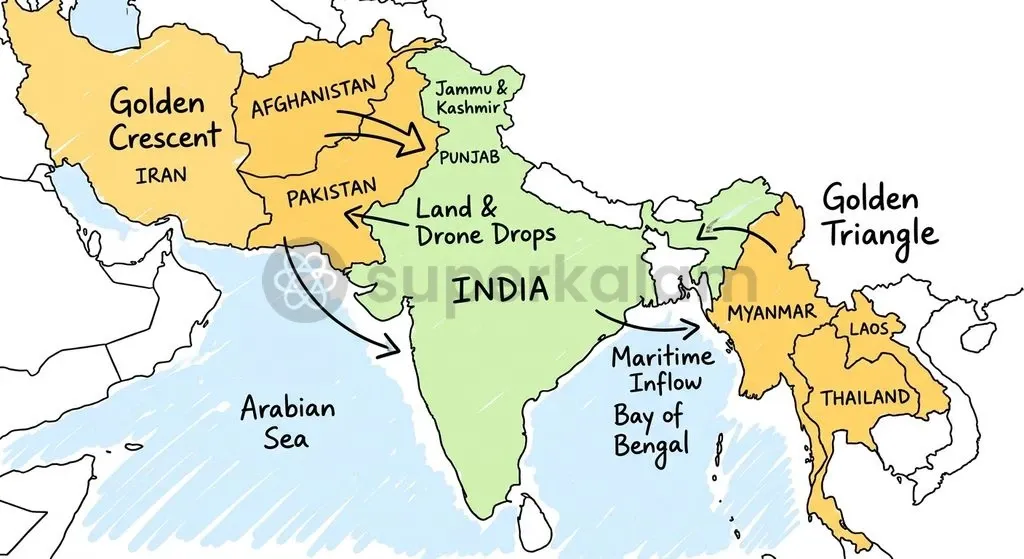
India sits geographically sandwiched between the Golden Crescent (Afghanistan, Iran, and Pakistan) to the west and the Golden Triangle (Myanmar, Laos, and Thailand) to the east. This position historically turned the subcontinent into a high-volume transit corridor for plant-based narcotics like raw opium, hashish, and refined heroin.
Transit vulnerabilities have expanded into diversified domestic consumption. Cross-border trafficking along India's western frontier increasingly uses aerial technology to bypass physical border fencing. According to the NCB Vision Document on Narcotics Control, drone-based narcotics delivery cases surged to 305 detected incidents in 2025, up from just 3 recorded in 2021.
Border guarding forces have been empowered under the Narcotic Drugs and Psychotropic Substances (NDPS) Act, 1985 to execute search, seizure, and arrests. These include:
- Border Security Force (BSF) and Assam Rifles along land frontiers
- Sashastra Seema Bal (SSB) along open borders
- Railway Protection Force (RPF) across national transit corridors
This multi-agency delegation strengthens physical border interdiction. However, traffickers counter these controls by shifting operations into domestic synthetic manufacturing and coastal maritime routes.
The Rise of Domestic Synthetic Labs and Pharmaceutical Diversion
The domestic narcotics landscape has evolved from agricultural poppy cultivation to chemical synthesis inside industrial clusters. Synthetic drugs such as mephedrone and methamphetamine present severe enforcement challenges. Their production relies on dual-use commercial chemicals rather than open crop fields visible to satellite imaging.
The NCB Vision Document on Narcotics Control reported that clandestine synthetic laboratories busted inside India tripled in 2025 compared to 2024, with 30 clandestine labs detected. These facilities frequently operate inside disused chemical factories, small-scale industrial estates, or remote farmhouses, using commercial chemical processing hardware.
Precursor diversion feeds this synthetic expansion through several distinct operational channels:
- Legitimate industrial diversion: Siphoning of dual-use processing agents from unmonitored chemical clusters.
- Pharmaceutical leakage: Illicit diversion of cold medication precursors like ephedrine and pseudoephedrine into methamphetamine kitchens.
- High-yield processing: Conversion of minor chemical consignments into massive, high-purity synthetic drug batches.
Discuss with Superkalam
How does the functional clustering of districts into manufacturing, transit, and consumption nodes improve law enforcement resource allocation?
Ask NowSupply Choke Points: Darknet, Maritime Smuggling, and Precursor Controls
Transnational syndicates bypass terrestrial border checkpoints by moving high-volume consignments across maritime shipping routes. In response, the Narcotics Control Bureau launched Operation Samudragupt in January 2022 to target maritime trafficking of heroin and methamphetamine originating from the Makran coast of Baluchistan and Afghanistan across the Indian Ocean.
Under Operation Samudragupt, the NCB and the Indian Navy intercepted approximately 2,500 kilograms of high-purity methamphetamine valued at 15,000 crore rupees in the Arabian Sea off the Kochi coast. This operation revealed that deep-sea mother vessels offload consignments onto untracked fishing trawlers to penetrate India's peninsular coastline.
At the retail distribution level, physical street corners are being replaced by digital transactions. Traffickers operate across darknet marketplaces using encrypted communications, drop-shipping logistics, and cryptocurrency payments. To counter these digital networks, the central government instituted several targeted mechanisms:
- Task Force on Darknet and Crypto-Currency: Set up under the Multi-Agency Centre (MAC) to monitor encrypted marketplaces and digital financial flows.
- NIDAAN Portal: The National Integrated Database on Arrested Narco-Offenders, managed by the MHA, centralises offender profiles, biometrics, and criminal networks for law enforcement agencies.
- MANAS Platform: The Madak-Padarth Nishedh Asoochna Kendra (toll-free helpline 1933) offers a bilingual interface for anonymous citizen tips and counselling support.
According to a report by The Hindu on 22 September 2026, the Ministry of Home Affairs announced a dedicated campaign to deport foreign nationals convicted or charge-sheeted for drug trafficking and place them on permanent re-entry blacklists.
Discuss with Superkalam
If you were a District Magistrate heading a District NCORD Committee, how would you balance NDPS enforcement actions with public health rehabilitation?
Ask NowDemand-Side Gaps: Criminalisation Under NDPS vs Harm Reduction and Rehabilitation
The statutory foundation of India's narcotics policy is the Narcotic Drugs and Psychotropic Substances (NDPS) Act, 1985. While the Act provides severe punitive tools against major traffickers, its enforcement mechanisms frequently conflict with public health approaches to addiction treatment.
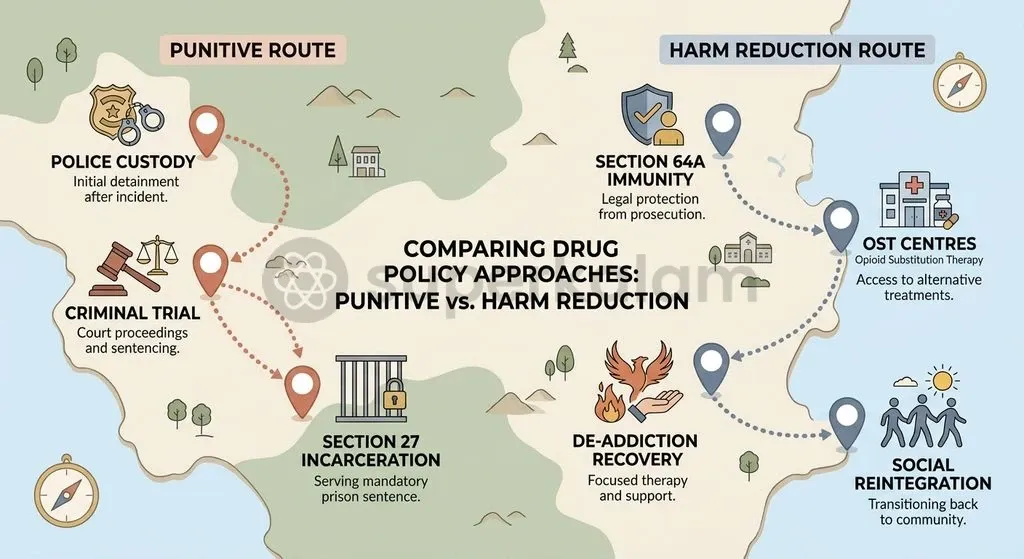
Section 27 of the NDPS Act criminalises personal drug consumption, prescribing imprisonment of up to one year or six months depending on the substance. This provision exposes people with substance use disorders to arrest, criminal records, and institutional stigma, which often drives dependent individuals away from voluntary healthcare.
The statute contains progressive diversion mechanisms, but these provisions remain underutilised:
- Section 64A of the NDPS Act: Grants statutory immunity from prosecution under Section 27 to any addict charged with small-quantity possession or consumption who voluntarily undergoes medical treatment at a recognised facility.
- Section 39 of the NDPS Act: Empowers courts to release convicted small-quantity consumers or addicts on probation or bond to undergo treatment at an approved de-addiction facility instead of serving prison time.
- Section 37 of the NDPS Act: Imposes strict twin bail conditions for commercial quantity offences, barring bail unless the court finds reasonable grounds that the accused is not guilty and unlikely to commit offences while released.
Medical and public health frameworks treat substance use disorders as chronic neurobiological conditions rather than deliberate criminal misconduct. Incarcerating dependent individuals exacerbates social marginalisation and strains prisons without lowering street-level consumption.
| Punitive Paradigm (Section 27) | Public Health Approach |
|---|---|
| Arrest and incarceration | Medical decriminalisation |
| Criminal records and social stigma | Opioid substitution therapy (OST) |
| Hidden, high-risk consumption | Clean needle exchanges |
| High relapse rates post-release | Community-based reintegration |
Harm-reduction programmes run by the National AIDS Control Organisation (NACO) under Phase V of the National AIDS Control Programme operate 393 Opioid Substitution Therapy (OST) centres. These facilities provide buprenorphine therapy to 44,553 People Who Inject Drugs (PWIDs).
With national surveys documenting approximately 8.5 lakh PWIDs across India, harm-reduction infrastructure covers less than 6% of the target vulnerable population. Bridging this coverage deficit is essential to prevent transmission of blood-borne infections like HIV and Hepatitis C while stabilising dependent individuals.
Can a Country Ever Be 100% Drug-Free? Lessons from Global Zero-Tolerance Models
Comparative international experience demonstrates that an absolute zero-tolerance enforcement model rarely achieves a permanent drug-free society. Heavy criminalisation frequently shifts supply chains into more potent, synthetic, and adulterated chemical variants that are easier to conceal and transport.
| Country Model | Enforcement Strategy | Measurable Public Health Outcome |
|---|---|---|
| Sweden | Strict zero-tolerance policing with compulsory rehabilitation | Reduced general prevalence, but above-average EU overdose mortality due to delayed emergency reporting |
| Portugal | Decriminalised personal possession (2001); non-punitive dissuasion commissions | Steep drop in drug-related HIV infections, reduced street crime, and marked increases in voluntary treatment uptake |
India's policy challenge lies in reconciling its constitutional vision with international experience. A zero-tolerance framework directed at organised trafficking cartels must be paired with public-health protections for dependent users.
What India Must Change to Make 2029 Meaningful
Transforming the 2029 deadline into meaningful reform requires addressing structural bottlenecks in medical infrastructure and community aftercare. The Ministry of Social Justice and Empowerment expanded the Nasha Mukt Bharat Abhiyaan (NMBA) from an initial 272 vulnerable districts at its August 2020 launch to all districts across India on 15 August 2023. Administrative expansion, however, must be matched by clinical capacity.
India faces a severe mental healthcare deficit. The country possesses approximately 0.75 psychiatrists per 100,000 population, falling far short of the World Health Organization benchmark of 3 psychiatrists per 100,000. The National Mental Health Survey documented that the treatment gap for substance and alcohol use disorders reaches 86%.
The physical rehabilitation ecosystem remains constrained across three key areas:
- Hospital Treatment Capacity: Under the National Action Plan for Drug Demand Reduction (NAPDDR), the central government sanctioned 125 hospital-based Addiction Treatment Facilities (ATFs) in district hospitals. Most district hospitals lack dedicated de-addiction wards.
- Standardisation of Residential Care: The central government funds voluntary organisations running 350 to 400 Integrated Rehabilitation Centres for Addicts (IRCAs) providing 15-to-30 day residential care. These centres face uneven staffing, limited clinical oversight, and variable treatment protocols.
- Community Aftercare Support: Clinical studies indicate that 12-month post-rehabilitation relapse rates range between 50% and 70% among chronic opioid and synthetic substance users due to insufficient aftercare and vocational reintegration.
To make the 2029 milestone meaningful, India must invoke statutory diversion under Section 64A of the NDPS Act by default for personal consumption charges. Expanding hospital-based Addiction Treatment Facilities across all 700+ districts and integrating de-addiction into primary healthcare under Ayushman Bharat will treat substance dependency as a public health priority rather than solely an internal security crisis.
Discuss with Superkalam
Why do high profit margins in transnational narcotics trafficking make supply-side interdictions insufficient to curb illicit street availability?
Ask NowKey Takeaways
- The Union Home Minister established 31 December 2029 as the national deadline to dismantle narcotics trafficking networks and eliminate the illicit drug trade.
- Enforcement relies on a four-tier NCORD architecture (Apex, Executive, State, and District levels), supported by dedicated State Anti-Narcotics Task Forces (ANTFs).
- Seizures of synthetic drugs rose to 11.8 million kilograms (2014–2026), yet national surveys document over 7 crore individuals with substance use disorders.
- Trafficking has diversified into maritime smuggling routes (intercepted under Operation Samudragupt), drone deliveries across western borders, and domestic clandestine synthetic laboratories.
- A profound treatment gap exists: the substance use disorder treatment gap stands at 86%, with only 0.75 psychiatrists per 100,000 population.
- Statutory mechanisms under Section 64A and Section 39 of the NDPS Act provide diversion pathways toward medical treatment, but punitive enforcement under Section 27 continues to dominate.
Mains Question
'Despite record seizures under the NDPS Act and multi-tier coordination through NCORD, supply-side interdiction alone fails to dismantle illicit drug markets without closing demand-side treatment deficits.' Critically analyse. (15 Marks)
Evaluate NowMains Question
Examine how the operational landscape of narcotics trafficking in India has shifted beyond traditional overland routes of the Golden Crescent and Golden Triangle. (10 Marks)
Evaluate NowPractice MCQs
QUESTION 1
Consider the following statements regarding the institutional framework for narcotics control in India:
- The Narco-Coordination Centre (NCORD) Apex Committee is chaired by the Union Home Minister.
- State NCORD Committees are headed by the respective State Chief Secretaries.
- Dedicated Anti-Narcotics Task Forces (ANTF) in States and Union Territories are headed by officers of ADGP or IGP rank. Which of the statements given above are correct?
QUESTION 2
Consider the following statements regarding narcotics interdiction and legal frameworks in India:
- Border guarding forces like the BSF, Assam Rifles, and SSB have been delegated powers of search, seizure, and arrest under the NDPS Act, 1985.
- The Railway Protection Force (RPF) is not empowered to execute seizures or arrests under the NDPS Act.
- Operation Samudragupt was launched by the Narcotics Control Bureau to target maritime narcotics trafficking across the Indian Ocean. Which of the statements given above is/are correct?
QUESTION 3
With reference to the constitutional and strategic dimensions of drug policy in India, consider the following statements:
- The policy push for drug elimination is anchored in Article 47 under the Directive Principles of State Policy.
- Article 47 confers an enforceable fundamental right on citizens to demand total prohibition of intoxicating substances.
- Under central policy guidelines, districts are categorised into entry or manufacturing districts, transit corridor districts, and consumption districts. Which of the statements given above is/are correct?
QUESTION 4
According to the national survey on the 'Magnitude of Substance Use in India' highlighted in official data, which of the following statements is correct regarding substance consumption patterns?
QUESTION 5
Consider the following pairs of technological and operational mechanisms with their stated roles:
- Task Force on Darknet and Crypto-Currency — Monitored under the Multi-Agency Centre (MAC) to track encrypted digital transactions.
- NIDAAN Portal — Centralised database managed by MHA for offender profiles and biometric records.
- Operation Samudragupt — Interdiction mechanism specifically targeting drone deliveries across the western land border. How many of the above pairs are correctly matched?