Mule Account Meaning: How Cyber Fraud Money Moves, Bihar Cyber Prahar 5.0
What a mule account is, how stolen money moves through them, and what Bihar Police's Cyber Prahar 5.0 flagging of 1,09,475 accounts shows. UPSC notes.
Nov, 2026
•8 min read

Overview
A money mule account is a legitimate bank account owned by an individual or entity. Third parties utilise these accounts to receive, layer, and launder illegally acquired funds originating from digital arrest, investment fraud, and cybercrime operations. According to the DD News Official Release on Mule Accounts and AI Deployment, these accounts form the primary operational infrastructure converting digital theft into untraceable liquid assets.
Transnational cyber syndicates exploit socio-economic vulnerabilities across India. They rent credentials from students, gig workers, and rural account holders for nominal commissions. Addressing this threat requires moving beyond retrospective police debit freezes toward real-time automated surveillance across the banking grid.
Why Mule Accounts Are in the News
As of November 2026, state and central law enforcement agencies have intensified nationwide crackdowns against rapidly expanding cyber-fraud infrastructure. The Bihar Police flagged 1,09,475 suspected mule accounts across all 38 districts, with ₹72.53 crore involved (The Hindu reports it as the amount deposited in these accounts; India Today calls it the disputed fraud amount) during the 'Cyber Prahar 5.0' campaign, as reported by The Hindu Report on Bihar Police Cyber Unit Operation.
Patna district registered the highest number with 14,644 flagged accounts, followed by Gaya with 6,172. The Hindu lists Muzaffarpur (4,244) next, while India Today lists East Champaran (4,414) ahead of Muzaffarpur, so the third place differs between reports. Inspector General (Cyber Crime and Security Unit) Ranjit Kumar Mishra announced the findings on 13 November 2026, with action to follow under Cyber Prahar 5.0 (earlier campaigns were Cyber Prahar 4.0 and 4.1). Another 7,728 accounts appeared in two or more complaints on the National Cyber Crime Reporting Portal, and a further cyber police station is planned in Patna. In September-October 2026, Bihar registered 47,659 cybercrime complaints against 5,69,160 nationally. These enforcement sweeps demonstrate how syndicated digital arrests and deceptive investment scams depend entirely on domestic banking conduits to siphon stolen wealth out of regulatory reach.
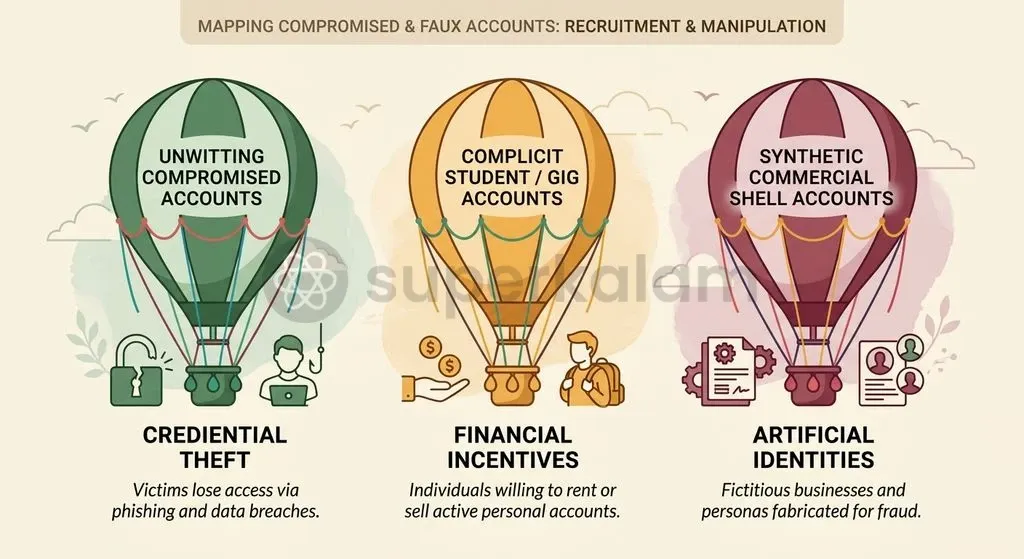
What Is a Mule Account and Who Gets Targeted?
A money mule account is an intermediary financial conduit. Illicit funds flow through it to obscure the trail between victims and cybercrime syndicates. Accounts can reach a syndicate in different ways: by being compromised through phishing or credential theft, or by the holder renting or selling credentials, debit cards and linked SIM cards for a commission.
Cyber fraud syndicates systematically solicit bank credentials, ATM cards, and registered mobile numbers from vulnerable populations by offering quick monetary commissions. Many young job seekers and informal workers view renting out an idle savings account as harmless passive income.
Discuss with Superkalam
Recall the four sequential stages through which stolen funds move across mule account networks as identified by the I4C.
Ask NowStep-by-Step: How Stolen Funds Move Through Mule Networks
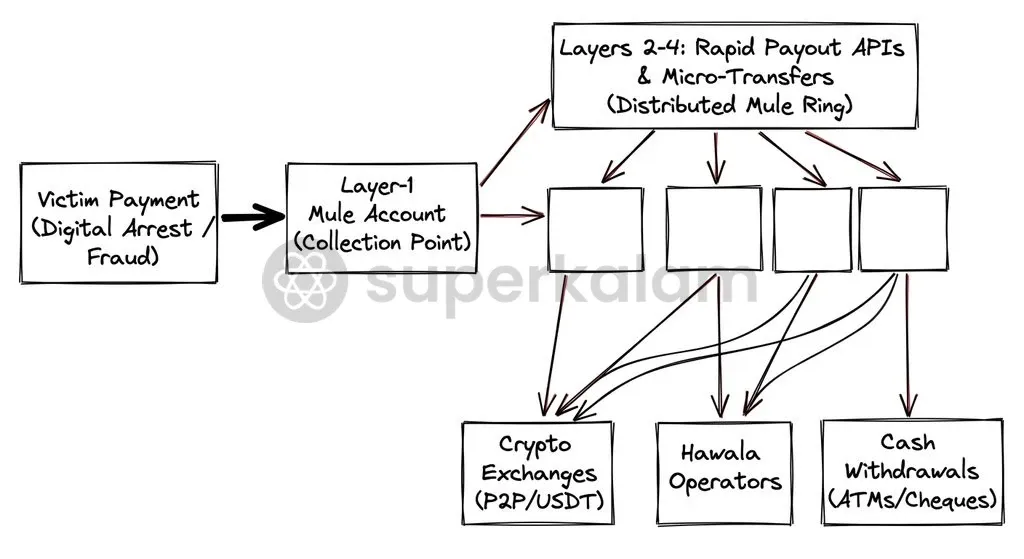
Transnational cyber laundering follows the classic three-stage framework of placement, layering, and integration, executed at machine speed across multi-tiered banking channels. The Indian Cyber Crime Coordination Centre (I4C) identified that modern digital cartels operate a structured pipeline to clean illicit gains.
- Illicit Acquisition (The Cyber Predation Phase): Victims are defrauded through staged "digital arrests", intimidation calls by impersonators of law enforcement, or manipulated online investment schemes.
- Placement (Layer 1 Mule Accounts): Fraudsters direct the victim to deposit funds straight into primary "Layer 1" mule accounts, injecting dirty cash directly into formal banking channels.
- Automated Rapid Layering (Layers 2 to 4): Syndicates execute rapid micro-transfers across second, third, and fourth-tier mule accounts quickly, fragmenting the audit trail.
- Integration (Off-Ramping into Liquid Assets): Layered capital is consolidated and converted into foreign exchange, peer-to-peer (P2P) cryptocurrency assets, or offshore hawala channels to sever domestic links.
The speed of this dispersion makes timely intervention difficult, because funds move on before victims report.
Discuss with Superkalam
Explain why static point-of-onboarding KYC frameworks fail to detect transactions executed through compromised or rented mule accounts.
Ask NowThe Nexus: Cyber Fraud, Illegal Betting, and Cross-Border Syndicates
Transnational criminal networks deploy specialised payment gateways to route illicit capital through domestic bank accounts:
- Insider Role: Under Operation Octopus 2.0, Hyderabad Police arrested 52 people in April 2026, including 32 bank officials, in a multi-state crackdown on mule accounts.
Why Traditional Banking Checks Fail to Catch Mule Activity
Conventional fraud detection systems in commercial banks rely on static threshold alerts that fail against distributed micro-transfers:
- Sub-Threshold Transaction Splitting: When illicit funds enter a Layer-1 mule account, automated scripts split the capital into small amounts below reporting triggers, routing them through Unified Payments Interface (UPI) switches across dozens of distinct institutions.
- Static Point-of-Onboarding Verification: Traditional Know Your Customer (KYC) frameworks inspect an account holder's identity strictly at onboarding. When a legitimate customer voluntarily surrenders their verified account to a syndicate, subsequent digital transactions pass routine cryptographic checks.
- Absence of Behavioural Telemetry: Bank monitoring platforms struggle to distinguish between a student spending pocket money and a mule handler moving layered cyber loot unless transaction velocity and device telemetry are analysed in tandem.
Discuss with Superkalam
Analyse the trade-off between treating socio-economically vulnerable account holders as victims of exploitation versus treating them as co-accused under the doctrine of wilful blindness.
Ask NowIndia's Institutional Response: Role of I4C, RBI, and FIU-IND
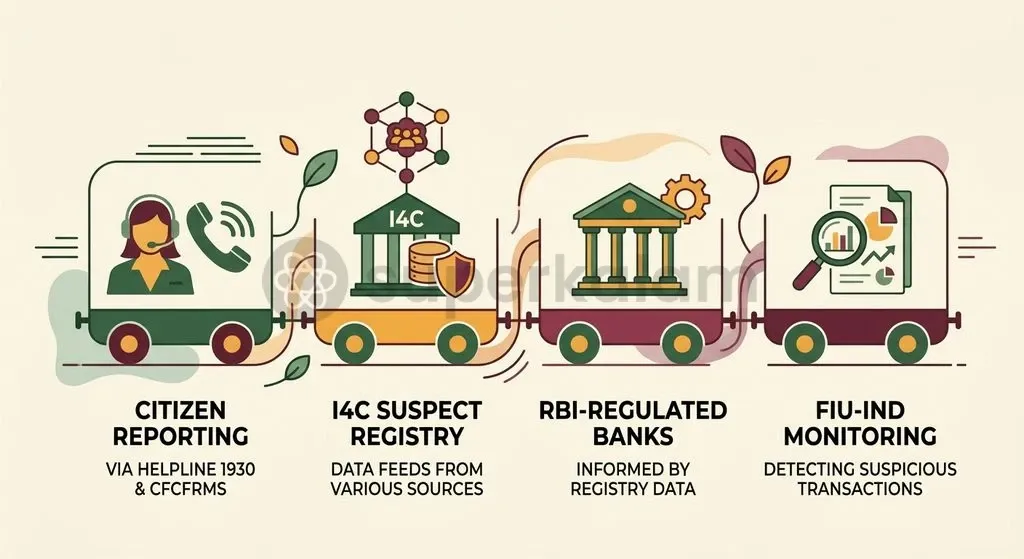
Coordinated enforcement unites central law enforcement, monetary regulators, and financial intelligence units against illicit banking conduits:
- Indian Cyber Crime Coordination Centre (I4C): It is the central nodal agency under the Ministry of Home Affairs fighting organised cybercrime across India. Through its Citizen Financial Cyber Fraud Reporting and Management System (CFCFRMS) linked to the national helpline 1930, the platform saved over ₹11,158 crore across more than 32.80 lakh complaints up to June 30, 2026, as confirmed in Lok Sabha Unstarred Question No. 3751 by the Ministry of Home Affairs.
- Reserve Bank of India (RBI): Establishes institutional safeguards and monitoring protocols across commercial lenders.
- Financial Intelligence Unit – India (FIU-IND): Enforces statutory transaction disclosures across all reporting entities. Reporting entities must file Suspicious Transaction Reports with FIU-IND under the Prevention of Money Laundering (Maintenance of Records) Rules, 2005. Concurrently, central authorities blocked over 3,718 malicious applications under Sections 69A and 79(3)(b) of the Information Technology Act, 2000 to sever recruitment channels.
Legal Safeguards: PMLA, IT Act, and the Liability of Account Holders
Account holders who surrender banking credentials to cyber syndicates face severe criminal liability across multiple statutory frameworks. Under Section 318(4) of the Bharatiya Nyaya Sanhita, 2023, providing a bank account to fraudsters constitutes cheating and dishonestly inducing delivery of property, attracting imprisonment for up to seven years.
Key statutory provisions governing mule accounts include:
- Bharatiya Nyaya Sanhita, 2023 (Section 318(4)): Penalises cheating and dishonestly inducing delivery of property with up to seven years of imprisonment.
- Information Technology Act, 2000 (Section 66C): Punishes fraudulent identity theft through stolen credentials.
- Information Technology Act, 2000 (Section 66D): Penalises cheating by personation using a computer resource.
- Prevention of Money Laundering Act, 2002 (Sections 3 & 4): Defines laundering of criminal proceeds, mandating rigorous imprisonment up to seven years.
Furthermore, the Ministry of Finance Gazette Notification S.O. 1072(E) brought Virtual Digital Asset service providers under PMLA obligations in March 2023, closing off-ramp avenues used to convert mule balances into cryptocurrencies.
The Ethical Dimension: Financial Ignorance vs Criminal Complicity
The recruitment of vulnerable individuals into mule syndicates presents an ethical tension between socio-economic exploitation and legal responsibility. Marginalised individuals, impoverished gig workers, and financially stressed students frequently yield to deceptive online offers, believing they are merely earning processing fees.
The legal doctrine of wilful blindness establishes that deliberately ignoring suspicious circumstances does not absolve a citizen of criminal liability. Allowing one's identity to be weaponised facilitates crimes that wipe out life savings and cause severe psychological trauma to victims.
The Union Home Ministry runs public awareness campaigns on cyber fraud.
Discuss with Superkalam
Propose an automated regulatory and technological framework that Indian commercial banks could adopt to execute real-time inter-bank freezes on layered UPI transactions.
Ask NowWay Forward: Building Real-Time Freezes and Stronger KYC Defence
Stemming the flow of cybercrime money requires an automated, technology-first defence framework across India's financial sector. Retrospective freezes executed hours after a crime cannot match automated laundering pipelines.
- Deploy Algorithmic Fraud Detection: On May 12, 2026, I4C signed an MoU with the Reserve Bank Innovation Hub (RBIH) to integrate suspect registry data directly into MuleHunter.ai, an artificial intelligence model used to detect and intercept mule accounts before fund withdrawals.
- Strengthen State-Level Coordination: State campaigns such as Bihar's Cyber Prahar series work alongside national tools like the National Cyber Crime Reporting Portal and the 1930 helpline.
- Implement Automated Inter-Bank Freeze Protocols: Commercial banks must interface their internal core banking solutions directly with the I4C Suspect Registry to execute simultaneous multi-tier debit freezes.
- Conduct Targeted Financial Literacy Programmes: Educational institutions, village panchayats, and labour welfare boards must educate vulnerable demographics on the penal consequences of sharing bank credentials.
Key Takeaways
- A money mule account is a legitimate banking facility exploited by cybercrime syndicates to layer and integrate stolen proceeds from digital arrests, investment scams, and phishing frauds.
- Syndicates target economically vulnerable groups, including university students, gig economy workers, and rural account holders, using small commission payouts to acquire active account credentials.
- Money moves quickly across multiple layering tiers, making recovery difficult.
- The Citizen Financial Cyber Fraud Reporting and Management System (CFCFRMS) under I4C has saved over ₹11,158 crore across 32.80 lakh complaints up to June 30, 2026.
- Individuals renting out accounts face rigorous imprisonment up to seven years under Section 318(4) of the Bharatiya Nyaya Sanhita, 2023 and Sections 3 and 4 of the Prevention of Money Laundering Act, 2002.
- Future safeguards depend on AI integration through tools like MuleHunter.ai, automated inter-bank debit hold protocols, and strict verification of enterprise documentation.
Mains Question
"Static point-of-onboarding verification frameworks in commercial banking have proven inadequate against syndicated cyber fraud reliant on mule accounts." Examine the operational vulnerabilities of the current banking architecture and evaluate the institutional safeguards introduced by I4C and RBI. (15 Marks)
Evaluate NowMains Question
"The voluntary renting of bank credentials by vulnerable individuals highlights a sharp conflict between socio-economic exploitation and the legal doctrine of wilful blindness." Comment. (10 Marks)
Evaluate NowPractice MCQs
QUESTION 1
With reference to the legal frameworks governing cyber fraud and mule accounts in India, consider the following statements:
- Cheating and dishonestly inducing delivery of property by providing a bank account to fraudsters is penalised under Section 318(4) of the Bharatiya Nyaya Sanhita, 2023.
- Sections 66C and 66D of the Information Technology Act, 2000 penalise identity theft and cheating by personation using a computer resource, respectively.
- Virtual Digital Asset service providers were brought under the statutory reporting framework of the Prevention of Money Laundering Act, 2002 via a Ministry of Finance notification. Which of the statements given above are correct?
QUESTION 2
Consider the following statements regarding the institutional response to cyber financial fraud in India:
- The Indian Cyber Crime Coordination Centre (I4C) operates as a nodal agency under the Ministry of Home Affairs.
- Under the Prevention of Money Laundering (Maintenance of Records) Rules, 2005, reporting entities are mandated to file Suspicious Transaction Reports directly with the Reserve Bank Innovation Hub.
- MuleHunter.ai is an artificial intelligence model integrated with suspect registry data to detect and intercept mule accounts prior to withdrawal. Which of the statements given above is/are correct?
QUESTION 3
Regarding the mechanics of cyber laundering networks described in India, consider the following statements:
- Placement involves directing victims to deposit funds straight into primary 'Layer 1' mule accounts.
- Automated rapid layering fragments the audit trail through micro-transfers distributed across multiple tiers of mule accounts.
- Traditional banking KYC checks effectively flag mule transactions because point-of-onboarding checks re-verify account holders during high-velocity UPI transfers. Which of the statements given above is/are correct?
QUESTION 4
The Citizen Financial Cyber Fraud Reporting and Management System (CFCFRMS), linked to the national helpline 1930, functions under the aegis of which of the following bodies?
QUESTION 5
Consider the following statements regarding the enforcement actions against cybercrime networks in Bihar:
- The Bihar Police's 'Cyber Prahar 5.0' campaign flagged over one lakh suspected mule accounts across all 38 districts of the state.
- In September-October 2026, Bihar accounted for more than half of the total cybercrime complaints registered nationally. Which of the statements given above is/are correct?